Drone Detection Radar Systems Market (2026-2036)
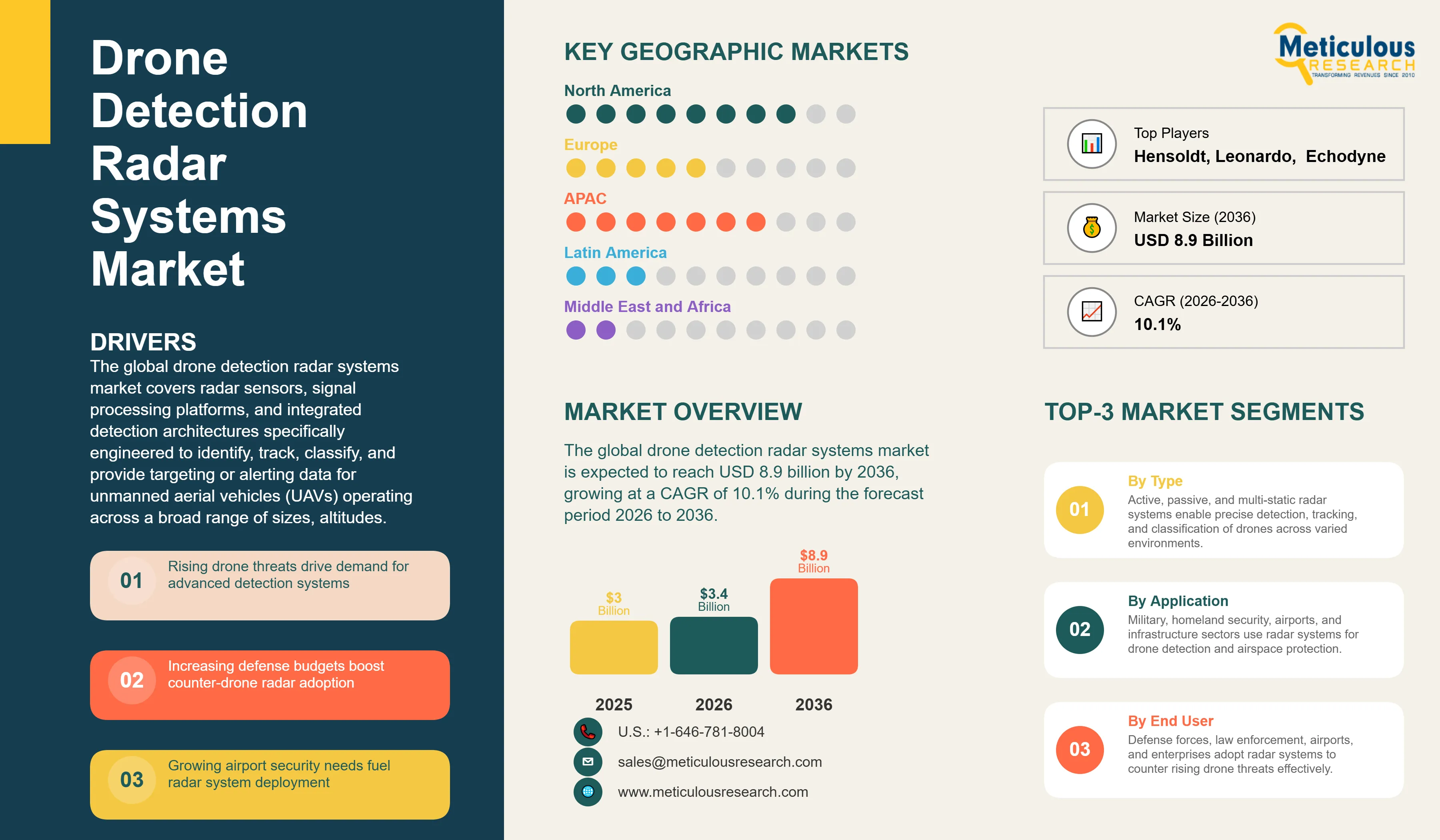
The global drone detection radar systems market was valued at USD 3.0 billion in 2025. This market is expected to reach USD 8.9 billion by 2036 from an estimated USD 3.4 billion in 2026, growing at a CAGR of 10.1% during the forecast period 2026 to 2036.
- Published
- Apr 2026
- Pages
- 265
- Format
- PDF + Excel
- Report ID
- MR-1908
- Base year
- 2025
- 2025 · BASELINE
- $3.00B
- 2036
- $8.90B
- CAGR 2026–2036
- 10.1%
2025 baseline · 2026–2036 forecast at 10.1% CAGR · hover a bar for the value
Key highlights
The global drone detection radar systems market is projected to reach USD 8.9 billion by 2036.
The market is expected to grow at a CAGR of 10.1% during the forecast period 2026 to 2036.
The global drone detection radar systems market was valued at USD 3.0 billion in 2025 and is estimated to reach USD 3.4 billion in 2026.
North America is expected to dominate the global drone detection radar systems market with the largest market share in 2026, driven by the United States Department of Defense's substantial and sustained investment in counter-unmanned aerial systems (C-UAS) programs across all service branches, the Federal Aviation Administration's expanding UTM (UAS Traffic Management) infrastructure requirements that are driving procurement of airspace surveillance radar at major airports and dense urban corridors, the strong concentration of leading defense electronics and radar system developers including Raytheon Technologies, Northrop Grumman, L3Harris Technologies, and Lockheed Martin within the United States that generate significant domestic procurement activity, and the heightened homeland security threat environment following multiple documented drone incursion incidents at sensitive government, military, and energy infrastructure sites.
Asia-Pacific is projected to witness the fastest growth during the forecast period, driven by China's aggressive military modernization and border security programs incorporating advanced counter-drone radar systems along disputed frontier regions, India's large-scale defense modernization investment under its 'Make in India' defense initiative that is accelerating domestic procurement of counter-drone detection systems for its northern and western border regions, the elevated drone security threat environment across the Korean Peninsula driving South Korean defense investment in layered drone detection capabilities, and the rapid expansion of commercial drone traffic across aviation-dense Asia-Pacific economies including Japan, Singapore, and Australia that is generating strong civil airspace monitoring demand.
By radar type, the active radar systems segment is expected to hold the largest share of the global drone detection radar systems market in 2026.
By frequency band, the X-Band segment is expected to hold the largest share in 2026.
By detection range, the medium range (5 to 20 km) segment is expected to hold the largest share in 2026.
By platform, the fixed/stationary systems segment is expected to hold the largest share in 2026.
By application, the military and defense segment is expected to hold the largest share in 2026.
By end user, the defense forces segment is expected to hold the largest share in 2026.
By integration type, the multi-sensor integrated systems segment is expected to hold the largest share in 2026, while command and control integrated systems are projected to register the fastest CAGR during the forecast period.
Report summary
| Particulars | Details |
|---|---|
| Market Size by 2036 | USD 8.9 Billion |
| Market Size in 2026 | USD 3.4 Billion |
| Market Size in 2025 | USD 3.0 Billion |
| Revenue Growth Rate (2026 to 2036) | CAGR of 10.1% |
| Format | PDF, Excel & Cloud Portal · 265 pages |
| Dominating Radar Type | Active Radar Systems |
| Fastest Growing Radar Type | Multi-Static Radar Systems |
| Dominating Frequency Band | X-Band |
| Fastest Growing Frequency Band | Ku/Ka-Band |
| Dominating Detection Range | Medium Range (5 to 20 km) |
| Fastest Growing Detection Range | Long Range (above 20 km) |
| Dominating Platform | Fixed/Stationary Systems |
| Fastest Growing Platform | Mobile/Vehicle-Mounted Systems |
| Dominating Application | Military and Defense |
| Fastest Growing Application | Critical Infrastructure Protection |
| Dominating End User | Defense Forces |
| Fastest Growing End User | Airport Authorities |
| Dominating Integration Type | Multi-Sensor Integrated Systems |
| Fastest Growing Integration Type | Command and Control Integrated Systems |
| Dominating Geography | North America |
| Fastest Growing Geography | Asia-Pacific |
| Base Year | 2025 |
| Forecast Period | 2026 to 2036 |
Report overview
Segments covered: radar type, frequency band, application, end user, integration type.
The global drone detection radar systems market covers radar sensors, signal processing platforms, and integrated detection architectures specifically engineered to identify, track, classify, and provide targeting or alerting data for unmanned aerial vehicles (UAVs) operating across a broad range of sizes, altitudes, and operational profiles. The market spans active radar technologies including active electronically scanned array (AESA), pulse-Doppler, and frequency-modulated continuous-wave (FMCW) radar systems; passive radar architectures exploiting ambient radio frequency emissions; and multi-static radar configurations deploying spatially separated transmitters and receivers to achieve detection geometries optimized for small, low-radar-cross-section (RCS) drone targets. These systems serve defense forces, law enforcement agencies, airport authorities, commercial enterprises, and government agencies across applications spanning military and defense operations, homeland security, critical infrastructure protection, aviation security, public event security, and industrial facility protection.
The growth of the global drone detection radar systems market is primarily driven by the rapidly escalating threat environment created by the proliferation of commercially available drone technology capable of delivering surveillance, electronic warfare, explosive payload, and cyberattack capabilities to non-state actors, criminal organizations, and adversarial military forces at unprecedented accessibility and low cost. The armed drone threat has transitioned from an asymmetric capability available only to well-resourced state military forces into a mainstream tactical tool employed by a broad spectrum of conflict actors, as demonstrated by the extensive and innovative use of commercial quadcopter drones modified for grenade and munitions delivery in the Ukraine conflict, the complex swarm drone attacks on Saudi Aramco's Abqaiq and Khurais oil processing facilities, and the documented use of drones for surveillance and smuggling at correctional facilities, military installations, and international borders globally. This threat environment is generating urgent and sustained procurement investment by defense establishments, homeland security agencies, and critical infrastructure operators in radar detection systems capable of providing the earliest possible detection and cueing of drone threats to enable protective countermeasure response.
Two transformative opportunities are defining the market's long-term trajectory. The integration of artificial intelligence signal processing algorithms into drone detection radar systems is enabling a new generation of detection capability that can distinguish drone radar signatures from bird and other airspace clutter with dramatically improved discrimination accuracy, classify detected drones by type and payload probability based on micro-Doppler blade rotation signatures and flight behavior analysis, and manage simultaneous multi-target tracking scenarios across complex urban and cluttered airspace environments that challenge conventional radar signal processing. Simultaneously, the expansion of civil airspace integration of commercial drone operations under UTM frameworks being developed by aviation regulators globally is creating a large new procurement market for drone detection radar at airports, heliports, urban air mobility corridors, and dense commercial drone delivery operating zones where airspace surveillance is required to ensure safe and compliant drone traffic management.
Report infographic
Market dynamics
7 factors across 3 forcesRising Threat of Unauthorized and Malicious Drones
The rapidly escalating global threat posed by unauthorized and maliciously operated drone platforms constitutes the most urgent and immediate structural driver of the drone detection radar systems market, as drone incidents across military, governmental, and civilian contexts have grown in frequency, sophistication, and consequence at a pace that has overtaken the protective deployment of drone detection systems at the majority of vulnerable sites globally. Documented drone incidents demonstrate the breadth and severity of the threat landscape: the January 2024 Tower 22 base attack in Jordan that killed three U.S. service members utilized one-way attack drones that evaded existing base protection systems; Houthi forces have deployed sophisticated drone and anti-ship missile combinations that have disrupted global shipping through the Red Sea; and criminal organizations in multiple countries are systematically using drones to conduct aerial surveillance of law enforcement operations, deliver contraband into correctional facilities, and coordinate organized criminal activities with real-time aerial intelligence unavailable by any other means. This documented threat environment is creating urgent procurement imperatives for drone detection capabilities across the defense, homeland security, and critical infrastructure sectors that are driving accelerated investment in radar-based detection as the foundational sensor technology for drone awareness.
Increasing Defense and Homeland Security Spending
The sustained global expansion of defense budgets and homeland security spending in response to the evolving drone threat is generating large and growing procurement programs for counter-unmanned aerial systems (C-UAS) capabilities in which drone detection radar systems constitute the essential detection layer. NATO member states' commitment to defense spending targets of 2% of gross domestic product or above, combined with the urgent C-UAS capability requirements demonstrated by conflicts in Ukraine and the Middle East, are generating synchronized and substantial drone detection procurement programs across multiple Allied nations simultaneously. The United States Department of Defense's Joint Counter-Small Unmanned Aircraft Systems Office (JCO) has identified counter-drone capability as one of the highest operational priority gaps requiring urgent investment, and its multi-billion-dollar C-UAS program portfolio includes detection radar systems deployed across Army, Navy, Air Force, and Marine Corps installations and forward operating bases globally. The U.S. Department of Homeland Security's parallel counter-drone investment programs targeting the protection of the aviation system, federal facilities, and national special security events from drone threats represent a substantial second domestic procurement channel for drone detection radar systems separate from military procurement.
Table of contents
15 chapters · 166 sections · 265 pages · click to expandSegmental analysis
| Segment | Largest share (2026) | Fastest growth (2026–2036) |
|---|---|---|
| By Radar Type | Active Radar Systems | Multi-static radar systems |
| By Frequency Band | X-Band | Ku/Ka-Band |
| By Detection Range | Medium Range (5 to 20 km) | Long range (above 20 km) |
| By Platform | Fixed/Stationary Systems | Mobile/vehicle-mounted systems |
| By Application | Military and Defense | Critical infrastructure protection |
| By End User | Defense Forces | Airport authorities |
| By Integration Type | Multi-Sensor Integrated Systems | Command and control integrated systems |
By Radar Type
- Active Radar Systems to Dominate
- The active radar systems segment is expected to account for the largest share of the global drone detection radar systems market.
- Active radar systems dominate the market because they provide the all-weather, day-night, long-range detection performance and reliable standalone operation capability that defense and security customers require as the foundational detection sensor in their counter-drone architectures.
- AESA radar systems offer the highest performance in terms of simultaneous multi-target tracking, beam agility, and electronic protection against jamming.
- Pulse-Doppler radar systems provide excellent velocity discrimination that enables moving drone detection against stationary ground clutter, while FMCW radar systems offer cost-effective short to medium range detection in compact form factors suitable for portable and vehicle-mounted applications.
- The well-established procurement track records, extensive field deployment experience, and broad supplier ecosystem of active radar technologies support their continued dominant position across defense, homeland security, and airport procurement programs.
- However, the multi-static radar systems segment is projected to register the highest CAGR during the forecast period.
- Multi-static radar configurations deploy spatially separated transmitter and receiver nodes to illuminate drone targets from multiple geometric angles simultaneously, overcoming the radar cross-section nulls that cause monostatic radars to temporarily lose tracking continuity on targets maneuvering to present minimal RCS aspect.
- This geometric diversity advantage is particularly valuable for detecting small drone targets and drone swarms executing evasive maneuvers, and the growing sophistication of adversarial drone operators in exploiting monostatic radar limitations is driving interest in multi-static architectures among defense procurement agencies evaluating next-generation counter-drone detection capabilities.
By Frequency Band
- X-Band to Hold the Largest Share
- The X-Band segment is expected to account for the largest share of the global drone detection radar systems market.
- X-Band radar (8 to 12 GHz) represents the optimal frequency band for drone detection applications, offering the combination of sufficient wavelength for atmospheric transmission under most weather conditions, antenna aperture sizes compatible with man-portable and vehicle-mounted system form factors, and range resolution capable of resolving the micro-Doppler signatures of drone rotor and propeller blade rotation that are the primary radar signature discriminator for drone identification and classification.
- The wide deployment of X-Band marine and weather radar technology has established a mature supplier ecosystem for X-Band components and antenna systems that enables cost-effective drone detection radar development relative to higher-frequency bands.
- Leading drone detection radar suppliers including Blighter Surveillance Systems, Hensoldt, and SRC have developed their primary drone detection radar product lines in the X-Band, and the large installed base of X-Band drone detection systems in military and security deployments globally establishes this frequency band's market leadership.
- However, the Ku/Ka-Band segment is projected to register the highest CAGR during the forecast period.
- The higher frequencies of Ku-Band (12 to 18 GHz) and Ka-Band (26.5 to 40 GHz) radar provide superior micro-Doppler resolution for rotor blade signature analysis, enabling more detailed drone classification and even identification of specific drone models based on characteristic blade rotation patterns.
- The finer range resolution achievable at millimeter-wave Ka-Band frequencies enables imaging-quality target characterization at short ranges that is valuable for high-confidence drone identification in urban and facility protection scenarios.
- Miniaturized solid-state Ku and Ka-Band radar modules enabled by advanced semiconductor manufacturing are making these higher-frequency radar approaches increasingly cost-competitive for drone detection applications, driving growing adoption particularly in short-range portable and automated point-defense applications.
By Detection Range
- Medium Range (5 to 20 km) to Hold the Largest Share
- The medium range (5 to 20 km) segment is expected to account for the largest share of the global drone detection radar systems market.
- Medium-range drone detection radar systems represent the optimal capability tier for the largest proportion of current deployment scenarios, providing detection range adequate for airbase and military installation perimeter protection, airport airspace surveillance, critical infrastructure facility protection, and urban security monitoring while remaining within cost and form factor parameters compatible with broad procurement and deployment.
- A detection range of 5 to 20 kilometers provides approximately 2 to 8 minutes of warning time against drones approaching at 15 to 20 meters per second cruise speed, which is sufficient for trained security teams to implement defensive protocols and activate countermeasure systems in the majority of threat scenarios.
- The market-leading drone detection radar systems from suppliers including Blighter, Echodyne, and Thales in this detection range category have accumulated extensive field deployment references that support their continued procurement dominance.
- However, the long range (above 20 km) segment is projected to register the highest CAGR during the forecast period.
- Growing awareness of the range capabilities of military-grade and high-endurance commercial drones capable of flying missions at altitudes and ranges beyond the coverage of conventional medium-range detection systems is driving defense procurement agencies to specify long-range drone detection capabilities for the protection of high-value fixed installations, air defense command and control nodes, and strategic infrastructure that adversaries would prioritize for drone reconnaissance and attack.
- Extended detection range also provides the additional response time required for kinetic and non-kinetic defeat systems including laser weapons, directed energy, and interceptor drone systems to engage drone threats before they reach protected airspace or delivery range of their payload.
By Platform
- Fixed/Stationary Systems to Hold the Largest Share
- The fixed/stationary systems segment is expected to account for the largest share of the global drone detection radar systems market.
- Fixed drone detection radar installations at military bases, airports, nuclear power plants, government facilities, and critical infrastructure sites represent the largest by-value deployment category, as permanent fixed-site installations can accommodate the larger antenna apertures, higher power outputs, and infrastructure-connected processing systems that deliver the highest detection performance and most comprehensive coverage geometry for protecting fixed high-value assets.
- The permanence of fixed installations supports the integration of drone detection radar into broader security system architectures including perimeter intrusion detection, access control, video surveillance, and command and control center operations in ways that mobile and portable systems cannot replicate.
- Airport drone detection radar installations mandated by aviation regulators across Europe, North America, and Asia-Pacific represent a large and growing fixed-site procurement category that is driving sustained fixed system market revenue.
- However, the mobile/vehicle-mounted systems segment is projected to register the highest CAGR during the forecast period.
- The operational requirement to provide organic counter-drone awareness to mobile military ground forces, convoy protection units, and rapidly redeploying security elements is generating strong and growing demand for vehicle-integrated drone detection radar that can operate while in transit and be rapidly deployed at new operating positions without infrastructure requirements.
- The Ukraine conflict has demonstrated with particular clarity the vulnerability of military ground forces to commercially available drone surveillance and one-way attack capabilities, and this demonstrated operational reality is driving urgent procurement of vehicle-integrated drone detection radar systems by NATO members and other defense establishments seeking to equip their maneuver forces with protective counter-drone awareness across the full range of operational scenarios.
By Application
- Military and Defense to Hold the Largest Share
- The military and defense segment is expected to account for the largest share of the global drone detection radar systems market.
- Military and defense procurement constitutes the dominant application segment, driven by the urgent operational priority that drone detection has achieved across all major military establishments following the demonstrated effectiveness of drone systems in contemporary conflicts.
- The scale of military procurement programs for drone detection radar substantially exceeds civil and commercial procurement by both unit count and system value, as military-specification systems deployed in operational conflict environments command premium pricing reflecting their advanced electronic protection, environmental ruggedization, and integration requirements.
- The United States military's comprehensive C-UAS program portfolio spanning all service branches, NATO allies' coordinated drone detection capability development programs, and the major defense modernization investments of countries including India, South Korea, Japan, and Australia collectively constitute a procurement base that established the military segment's dominant market position.
- However, the critical infrastructure protection segment is projected to register the highest CAGR during the forecast period.
- The documented vulnerability of power generation facilities, oil and gas processing infrastructure, water treatment systems, telecommunications towers, and data centers to drone-borne surveillance, physical disruption, and cyberattack through proximity-enabled wireless access is driving rapidly growing investment in drone detection radar by critical infrastructure operators, government infrastructure protection agencies, and energy sector security organizations.
- The 2019 Abqaiq attack on Saudi Aramco's oil processing infrastructure, which temporarily disrupted approximately 5% of global oil supply, demonstrated the catastrophic economic impact of successful drone attacks on critical infrastructure and accelerated protective investment globally.
By End User
- Defense Forces to Hold the Largest Share
- The defense forces segment is expected to account for the largest share of the global drone detection radar systems market.
- Military and defense forces globally represent the largest procurement channel for drone detection radar systems by aggregate spending, as national defense establishments are investing in multi-system, multi-site drone detection radar deployments at military installations, forward operating bases, and operational theaters of a scale and value that exceeds any other end-user segment.
- Defense procurement programs for drone detection radar are characterized by long contract durations, large per-contract values including system procurement, installation, training, and multi-year maintenance and upgrade provisions, and stringent technical performance and security requirements that support premium pricing for systems meeting military specifications.
- The JCO's procurement of Raytheon Technologies' KuRFS radar systems, Northrop Grumman's Forward Area Air Defense Command and Control integration contracts, and European NATO member states' national C-UAS procurement programs represent the scale and value of defense procurement driving segment leadership.
- However, the airport authorities segment is projected to register the highest CAGR during the forecast period.
- Regulatory requirements for drone detection systems at airports are being progressively implemented across major aviation markets, with the UK Civil Aviation Authority, European Union Aviation Safety Agency, and Federal Aviation Administration developing drone detection standards and requirements that will create mandatory procurement obligations for airport operators globally.
- The documented history of drone incursions causing flight suspensions at major international airports, including the December 2018 Gatwick Airport closure that disrupted over 1,000 flights and affected approximately 140,000 passengers, has created both the regulatory impetus for mandatory drone detection requirements and the airport operator motivation to invest proactively in detection systems that avoid the severe operational and reputational costs of unmanaged drone incursion events.
By Integration Type
- Multi-Sensor Integrated Systems to Hold the Largest Share
- The multi-sensor integrated systems segment is expected to account for the largest share of the global drone detection radar systems market.
- Multi-sensor integrated systems that combine radar with RF, EO/IR, and acoustic sensor data in a fused detection and tracking architecture are the preferred procurement choice for the majority of sophisticated defense, security, and infrastructure protection customers, reflecting the widely recognized principle that no single sensor technology achieves the combination of detection range, all-weather operation, target classification accuracy, and false alarm performance required for reliable operational deployment.
- The market leadership of multi-sensor systems reflects the maturation of the drone detection market beyond its early phase where standalone radar was the primary available solution into a more sophisticated procurement environment where buyers specify integrated multi-sensor performance requirements and evaluate competing systems on the basis of their fusion architecture capability, data management platform, and operational software interface.
- However, the command and control integrated systems segment is projected to register the highest CAGR during the forecast period.
- The integration of drone detection sensor data into broader command and control (C2) architectures that manage the complete counter-drone response cycle from detection through classification, threat assessment, engagement decision support, and countermeasure activation represents the most sophisticated and highest-value integration tier in the drone detection market.
- Defense procurement programs are increasingly specifying C2-integrated drone detection as a requirement, recognizing that detection data that cannot be rapidly and reliably communicated to decision-makers and defeat system operators provides incomplete operational value.
- The development of open architecture C2 integration standards for counter-drone systems by the U.S. DoD's JCO and NATO's C-UAS working groups is enabling more efficient C2 integration of detection systems from multiple suppliers and driving the adoption of C2-integrated architectures across both military and civil security applications.
Geographic analysis
North America
Largest shareIn 2026, North America is expected to account for the largest share of the global drone detection radar systems market. North America's dominant market position reflects the United States' position as both the world's largest defense spender and the most advanced developer and deployer of counter-drone detection technologies. The U.S. Department of Defense's C-UAS priority investment programs, administered through the Joint Counter-Small Unmanned Aircraft Systems Office, encompass radar detection system procurement for hundreds of military installations across the continental United States and overseas deployments in Europe, the Pacific, and the Middle East. The U.S. homeland security procurement ecosystem for drone detection spans airport security, border protection, federal facility protection, and national special security events, adding substantial civil procurement volume to the dominant military program base. Canada's defense investment in drone detection capability under the NORAD modernization program, which is allocating over USD 4.9 billion to Arctic surveillance and detection infrastructure upgrades that include drone detection radar capability, represents a significant regional procurement addition to U.S. market leadership.
Asia-Pacific
Fastest growthHowever, the Asia-Pacific drone detection radar systems market is expected to grow at the fastest CAGR during the forecast period. Asia-Pacific's rapid growth reflects the convergence of multiple demand drivers operating simultaneously across the region's largest defense markets. India's defense modernization investment, supported by the government's push for indigenous defense manufacturing under the 'Make in India' program and the substantial procurement budget of the Indian Army and Air Force for counter-drone capabilities along the Line of Actual Control with China and the Line of Control with Pakistan, is generating large and sustained procurement demand for drone detection radar systems. China's investment in counter-drone detection for its military and border security forces, while opaque in procurement detail, represents a major demand element within the Asia-Pacific market. South Korea's urgent operational requirement for counter-drone detection along the Demilitarized Zone, driven by documented North Korean balloon and drone incursions into South Korean airspace, is funding accelerated procurement of advanced detection systems. Japan's Self Defense Forces' investment in drone detection capability under the country's historic defense spending increase toward 2% of GDP is establishing a new and substantial procurement program in the region's third-largest defense market.
Europe
Europe represents the third-largest regional drone detection radar market and is experiencing rapid growth driven by the operational urgency demonstrated by the Russia-Ukraine conflict and its implications for NATO member state counter-drone capability requirements. The extensively documented operational effectiveness of drone systems in the Ukraine conflict, including both Russian and Ukrainian use of commercial and military drones for reconnaissance, fire correction, and precision attack missions, has created an urgent capability gap awareness among NATO members that is driving accelerated counter-drone procurement investment. Germany's Bundeswehr, the UK's Ministry of Defence, France's Armee de Terre, and Poland's rapidly expanding defense forces are all executing or planning drone detection radar procurement programs that collectively represent multi-billion-euro regional market demand. European defense industry participants including Hensoldt, Thales, Saab, and Leonardo are competing actively for this domestic procurement while also pursuing export opportunities across NATO partner and global security market customers.
Competitive landscape
- Raytheon Technologies
- Thales
- Saab
- Northrop Grumman
Frequently asked questions
The global drone detection radar systems market is expected to reach USD 8.9 billion by 2036 from an estimated USD 3.4 billion in 2026, at a CAGR of 10.1% during the forecast period 2026 to 2036.
Cite this report
Meticulous Research. (2026). Drone Detection Radar Systems Market - Global Opportunity Analysis and Industry Forecast (2026-2036) (Report No. MR-1908). Meticulous Market Research Pvt. Ltd. https://www.meticulousresearch.com/product/drone-detection-radar-systems-market-6591