Resources
About Us
Digital Food Safety Market by Solution Type (Food Safety Management Software), Technology (IoT, AI & ML), Deployment Mode, End User, and Geography - Global Forecast to 2036
Report ID: MRFB - 1041850 Pages: 320 Mar-2026 Formats*: PDF Category: Food and Beverages Delivery: 24 to 72 Hours Download Free Sample Report
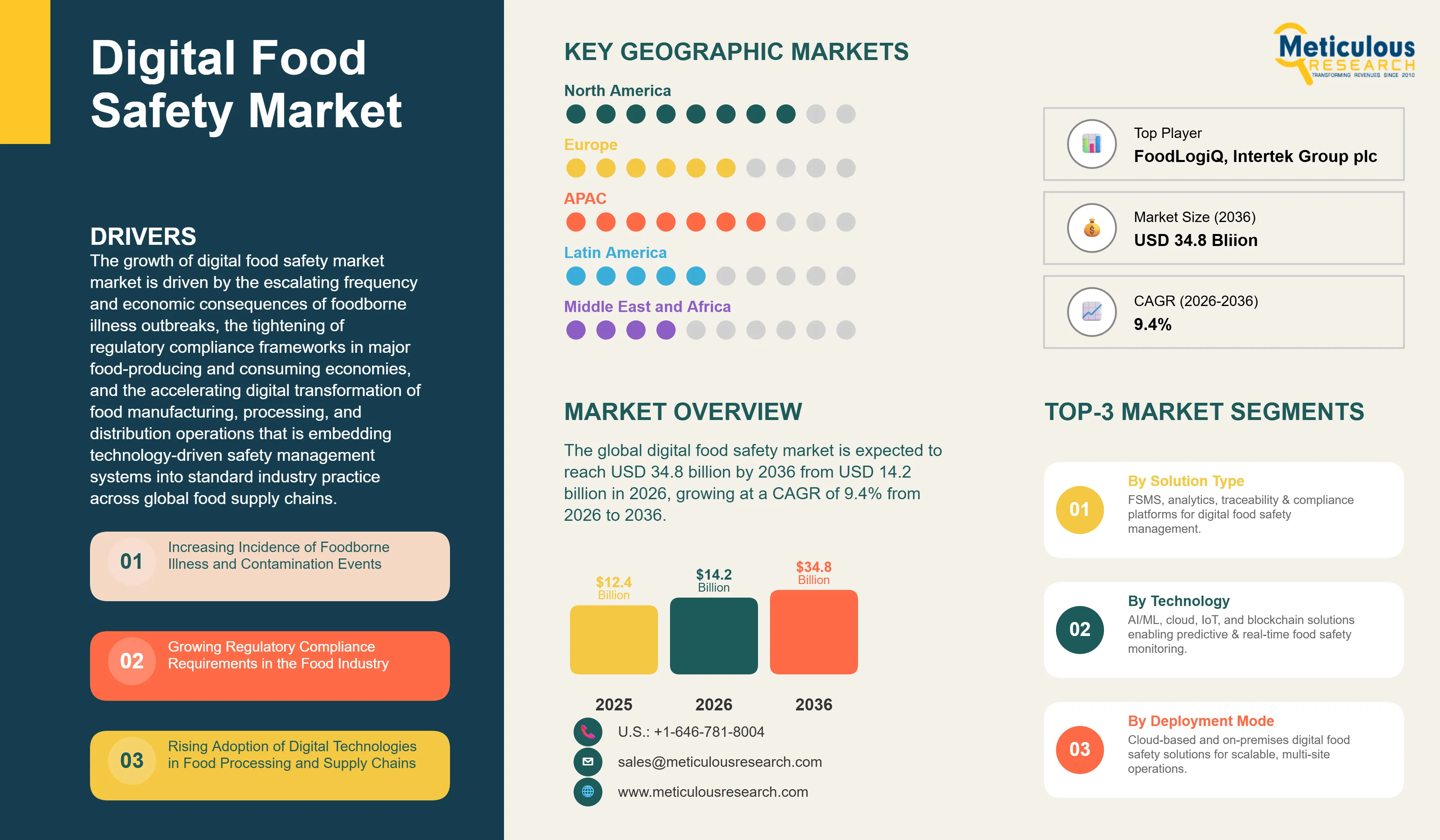
The global digital food safety market was valued at USD 12.4 billion in 2025. This market is expected to reach USD 34.8 billion by 2036 from USD 14.2 billion in 2026, growing at a CAGR of 9.4% from 2026 to 2036.
The growth of this market is driven by the escalating frequency and economic consequences of foodborne illness outbreaks, the tightening of regulatory compliance frameworks in major food-producing and consuming economies, and the accelerating digital transformation of food manufacturing, processing, and distribution operations that is embedding technology-driven safety management systems into standard industry practice across global food supply chains. Digital food safety encompasses the comprehensive ecosystem of software platforms, sensor-based monitoring systems, traceability technologies, compliance management tools, and analytics solutions that enable food industry participants — from primary producers and ingredient suppliers through processors, manufacturers, distributors, retailers, and foodservice operators — to systematically monitor, document, analyze, and improve food safety performance across complex multi-tier supply chains using connected digital technologies rather than paper-based manual processes.
The transition from paper-based to digital food safety management represents a fundamental operational transformation across the global food industry that is simultaneously driven by regulatory mandate, commercial necessity, and the demonstrated operational and financial benefits of digital food safety approaches relative to conventional manual systems. The FDA's Food Safety Modernization Act and its implementing rules including the Food Traceability Rule, which mandates electronic traceability records for a defined list of high-risk foods from 2026 onward, represent the most consequential regulatory driver of digital adoption in the U.S. market. The EU's Farm-to-Fork strategy and its associated food law revisions establishing mandatory digital traceability requirements across the European food supply chain create equivalent compliance-driven demand for digital food safety platforms in European markets. These regulatory frameworks collectively mandate digital food safety capabilities for food industry participants whose scale and market access requirements make compliance non-negotiable, creating a large and committed demand base for digital food safety solutions that is expanding through successive implementation deadline waves.
Beyond regulatory compliance, the business case for digital food safety is grounded in the documented economic consequences of food safety failures — product recalls, illness outbreak investigations, brand reputational damage, and legal liability — that dwarf the implementation costs of digital safety management systems for most large food industry operators. The average cost of a major food recall in the United States exceeds USD 10 million in direct costs, with total business impact including brand damage and lost sales often reaching multiples of this figure, creating compelling financial justification for the investment in traceability, monitoring, and predictive risk management capabilities that can prevent, detect, and contain food safety incidents before they escalate to recall scale.
 Click here to: Get Free Sample Pages of this Report
The digital food safety market encompasses a broad and rapidly evolving technology ecosystem that addresses the full lifecycle of food safety management from farm-to-fork, spanning the capture, analysis, documentation, and communication of food safety information across the entire food supply chain through connected digital platforms that replace the paper-based manual processes that historically characterized food safety compliance in most food industry segments. The category's commercial scope includes both standalone specialist food safety software platforms developed by dedicated food safety technology companies and food safety functionality embedded within broader enterprise resource planning, quality management, and supply chain management platforms offered by large enterprise software vendors.
The architecture of comprehensive digital food safety systems addresses three distinct functional layers that correspond to the three primary failure modes of food safety management in complex food supply chains. The prevention layer encompasses HACCP management software, risk assessment and hazard analysis tools, supplier compliance management platforms, and food safety training management systems that help food businesses systematically identify, evaluate, and control food safety hazards before they occur in production operations. The detection layer encompasses real-time monitoring systems — including IoT sensor networks for temperature, humidity, and environmental parameter monitoring; automated lab integration platforms that capture microbiological and chemical test results digitally; and computer vision-based inspection systems that detect visible contamination and quality defects in production lines — that identify potential food safety problems in time to prevent affected product from reaching consumers. The response and traceability layer encompasses supply chain traceability platforms, product recall and incident management systems, blockchain-based provenance verification tools, and regulatory reporting systems that enable rapid and accurate identification and removal of affected products when food safety issues do occur, and that provide the documentation infrastructure required for regulatory investigation cooperation and audit evidence.
The competitive landscape of the digital food safety market spans three distinct competitive tiers that serve different segments of the food industry with different solution architectures and commercial models. Specialist food safety software companies including SafetyChain Software, FoodLogiQ, iFoodDS, Safefood 360°, TraceGains, and ReposiTrak offer purpose-built food safety management platforms designed specifically for the workflows, regulatory requirements, and operational contexts of food industry users, providing deep functional specialization and food industry-specific user experience that general-purpose enterprise software cannot match. Large testing, inspection, and certification companies including SGS SA, Bureau Veritas, Intertek Group, and DNV are extending their traditional physical food testing and certification services into digital food safety platform offerings, leveraging their established food industry relationships and regulatory expertise to provide integrated digital-physical food safety service packages. Enterprise technology platform providers including IBM, Honeywell, and SAP offer food safety capabilities integrated within broader supply chain management and industrial IoT platform architectures, targeting large enterprise food industry customers with existing relationships and complex multi-system integration requirements.
The regulatory environment is the single most powerful market shaping force in digital food safety, with successive waves of regulatory mandates in the United States, European Union, United Kingdom, China, and other major food markets establishing progressively more stringent requirements for electronic traceability records, digital HACCP documentation, and real-time monitoring data retention that create non-discretionary compliance-driven demand for digital food safety solutions. The FDA's Food Traceability Rule, which requires large food businesses handling Key Data Elements for food commodities on the Food Traceability List to maintain electronic records and provide them to FDA within 24 hours of a request, represents the most operationally transformative U.S. food safety regulation in a generation, mandating digital traceability capabilities across produce, seafood, fresh cheese, and other high-risk food categories for the estimated 50,000 U.S. food businesses subject to its requirements.
AI-Powered Predictive Food Safety Analytics
The most technically transformative trend in the digital food safety market is the rapid maturation and commercial adoption of artificial intelligence and machine learning applications that move food safety management from reactive incident response and retrospective compliance documentation toward proactive prediction and prevention of food safety risks before they manifest as contamination events, regulatory violations, or product recalls. Conventional digital food safety systems, even sophisticated HACCP management software and IoT monitoring platforms, operate primarily as data capture, documentation, and alert-threshold systems that record what has happened and notify operators when measured parameters exceed defined limits — essentially digitizing and automating the same detection-and-response logic that manual food safety systems implement, without fundamentally changing the reactive nature of the approach.
AI-powered predictive food safety platforms, by contrast, apply machine learning models trained on historical food safety incident data, environmental monitoring records, supplier performance histories, and production process parameters to generate forward-looking risk assessments that identify elevated food safety risk conditions before they produce detectable contamination events. Predictive models that identify production conditions — combinations of temperature deviation magnitude, personnel hygiene compliance rates, equipment cleaning cycle intervals, and incoming ingredient test results — statistically associated with elevated contamination risk enable proactive intervention at precisely the points in the production process where risk is concentrated, rather than applying uniform monitoring intensity across all production activities. Companies including IBM with its Food Trust platform, Intelex Technologies, and specialist AI food safety analytics vendors are developing predictive food safety intelligence capabilities that are demonstrating measurable reduction in food safety incident rates in early pilot deployments with large food manufacturer customers.
Blockchain-Based Food Traceability Solutions
Blockchain technology's application to food supply chain traceability has moved from proof-of-concept demonstrations to commercially deployed implementations over the past several years, with IBM Food Trust's commercial launch and adoption by Walmart, Carrefour, Nestlé, Dole, and other major food industry participants representing the most prominent large-scale deployment of blockchain traceability in the food industry. The fundamental value proposition of blockchain for food traceability — an immutable, shared, decentralized ledger that records every supply chain custody event for a food product in a form that all authorized supply chain participants can access and verify — addresses the critical weakness of conventional centralized traceability systems: the inability of a single actor's records to provide trusted end-to-end supply chain visibility when the supply chain spans dozens of independent organizations whose records cannot be independently verified.
The practical adoption of blockchain food traceability at commercial scale has been more challenging than early promotional claims suggested, requiring extensive multi-party technology integration work, data standardization across supply chain partners with heterogeneous enterprise systems, and careful governance design for the shared blockchain network. Despite these implementation challenges, blockchain traceability has demonstrated compelling performance in documented use cases: Walmart's leafy greens traceability program implemented with IBM Food Trust demonstrated the ability to trace the origin of a specific package of sliced mango from store shelf to farm in 2.2 seconds, compared with more than six days using conventional supply chain investigation methods — a traceability speed improvement that could be decisive in containing a rapidly spreading foodborne illness outbreak. The FDA's FSMA Food Traceability Rule's electronic record requirements, while not mandating blockchain specifically, are compatible with and in many cases most efficiently satisfied through blockchain-based traceability implementations that simultaneously provide the required Key Data Element records and the supply chain transparency capabilities that food safety incident response demands.
|
Parameter |
Details |
|
Market Size by 2036 |
USD 34.8 Billion |
|
Market Size in 2026 |
USD 14.2 Billion |
|
Market Size in 2025 |
USD 12.4 Billion |
|
Market Growth Rate (2026–2036) |
CAGR of 9.4% |
|
Dominating Region |
North America |
|
Fastest Growing Region |
Asia-Pacific |
|
Base Year |
2025 |
|
Forecast Period |
2026 to 2036 |
|
Segments Covered |
Solution Type, Technology, Deployment Mode, End User, and Region |
|
Regions Covered |
North America, Europe, Asia-Pacific, Latin America, and Middle East & Africa |
Increasing Incidence of Foodborne Illness and Contamination Events
The primary driver of the digital food safety market is the persistent and economically consequential burden of foodborne illness globally, combined with the growing recognition across the food industry, regulatory agencies, and the investment community that the prevention of food safety incidents through digital monitoring, traceability, and predictive risk management technology represents a commercially sound and ethically essential alternative to the reactive recall and remediation model that has characterized the industry's historical approach to food safety incidents. The World Health Organization estimates that approximately 600 million people — nearly 1 in 10 people globally — fall ill after eating contaminated food each year, resulting in 420,000 deaths annually and disproportionate impacts on children under five years of age and populations in low- and middle-income countries with less developed food safety oversight infrastructure.
In developed economies with more advanced food safety surveillance, the economic impact of foodborne illness is thoroughly documented and staggering in scale. The U.S. Centers for Disease Control and Prevention estimates that foodborne illnesses cost the U.S. economy approximately USD 15.6 billion annually in direct medical costs, lost productivity, and quality-adjusted life years, with individual outbreak investigations and associated recalls often generating direct industry costs of tens to hundreds of millions of dollars when brand damage, market withdrawal expenses, and legal liability are included. High-profile outbreaks including successive Salmonella outbreaks in peanut butter, Listeria contamination in cantaloupe and deli meats, and recurring E. coli O157:H7 events in leafy greens have each generated nine-figure economic impacts and sustained public and regulatory attention to food safety investment requirements that directly drive digital food safety technology procurement decisions. The COVID-19 pandemic's disruption of food safety audit programs and the associated increase in food safety incidents during 2020 to 2022 further reinforced executive-level awareness of food safety risk management as a business continuity and reputational protection priority.
Adoption of IoT Sensors for Real-Time Monitoring
The declining cost and improving reliability of IoT sensor hardware — driven by the same semiconductor component cost reduction and miniaturization trends that have powered consumer electronics — is making comprehensive IoT-based food safety monitoring deployable across a progressively broader range of food industry facility types and scales that previously could not economically justify the investment. Temperature sensors, humidity monitors, water activity sensors, and CO2 concentration monitors suitable for food safety monitoring applications have declined dramatically in unit cost over the past decade, with wireless Bluetooth and WiFi-enabled temperature loggers now available at price points of USD 20 to 50 per unit that enable dense monitoring coverage of cold storage facilities, production lines, and distribution vehicles at total deployment costs accessible to mid-sized food businesses. The convergence of affordable sensor hardware with cloud-based IoT data management platforms that aggregate, visualize, and alert on sensor data without requiring on-premise server infrastructure has created a complete IoT monitoring solution architecture available at price points that align with the budget realities of the broad food industry customer base, including foodservice operators and regional food distributors that represent a large underserved market for IoT food safety monitoring technology.
How Does Food Safety Management Software (FSMS) Lead the Market?
In 2026, the food safety management software (FSMS) segment is expected to hold the largest share of the digital food safety market. FSMS platforms encompassing HACCP management systems, risk assessment and hazard analysis tools, CAPA management, and compliance documentation and record management capabilities represent the foundational digital food safety infrastructure that food manufacturers, processors, and foodservice operators prioritize first in digital food safety transformation programs. The regulatory compliance value of digital HACCP management — replacing paper-based HACCP plans with searchable, auditable, and easily updatable digital systems that provide comprehensive compliance documentation for FDA, EU, and third-party certification audits — creates immediate and clearly quantifiable business benefit that justifies FSMS investment across the broadest range of food industry customer types. Vendors including SafetyChain Software, Safefood 360°, Intelex Technologies, and the food safety modules of enterprise quality management platform providers have built substantial installed bases of FSMS deployments across food manufacturing and processing customers globally.
However, the data analytics and predictive risk management platforms segment is expected to witness the fastest growth during the forecast period, driven by the accumulation of large historical datasets in digital food safety management systems that are now providing the training data required for machine learning model development, the commercial availability of AI food safety analytics capabilities from platform vendors, and the compelling return on investment of preventing food safety incidents through predictive intervention rather than responding to them through recall and remediation. The rapid improvement in AI model performance for food safety applications — including computer vision contamination detection, microbiological growth prediction modeling, and supplier risk scoring — is creating commercially deployable predictive food safety solutions that food manufacturers of sufficient operational scale are beginning to procure
How Does Cloud Computing Lead the Technology Segment?
In 2026, the cloud computing segment is expected to hold the largest share of the digital food safety market, reflecting the industry-wide migration toward cloud-delivered software as a service models that has made cloud deployment the default architecture for new digital food safety platform implementations across all solution categories and end user segments. Cloud-based food safety platforms provide the multi-site accessibility, supply chain partner connectivity, mobile device compatibility, and continuous product update delivery that modern food safety management operational requirements demand, at total cost of ownership models that are substantially more favorable for most food business sizes and types than equivalent on-premise deployments. The cloud technology segment's dominance is reinforced by the growing concentration of new market entrant digital food safety vendors on native cloud platform architectures that do not offer on-premise deployment options, progressively shifting the competitive dynamics of the market toward cloud-first solutions.
However, the artificial intelligence and machine learning technology segment is expected to witness the fastest growth during the forecast period, driven by the accelerating commercial deployment of AI applications across all digital food safety functional categories — from computer vision quality inspection and IoT anomaly detection to predictive supply chain risk scoring and natural language processing for food safety documentation — that are moving beyond research and pilot stages into production commercial deployments at leading food industry operators. The rapid improvement in foundation model capabilities accessible through cloud AI platform APIs is enabling digital food safety software vendors to integrate sophisticated AI capabilities into their platforms without building large internal AI research teams, democratizing AI food safety functionality development and accelerating the pace of commercially available AI feature delivery across the market.
How Do Cloud-Based Solutions Lead the Market?
In 2026, the cloud-based solutions segment is expected to hold the largest share of the digital food safety market by deployment mode and is expected to maintain the fastest growth trajectory through the forecast period. The comprehensive advantages of cloud deployment for food safety management — including lower upfront investment requirements, automatic software updates that deliver regulatory compliance feature updates without customer IT involvement, multi-site and supply chain partner accessibility without VPN or remote access infrastructure, mobile device compatibility for plant-floor food safety documentation, and API-based integration with connected sensor hardware and enterprise systems — make cloud the strongly preferred deployment architecture across new digital food safety implementations. The migration of existing on-premise food safety software customers to cloud platforms is adding to organic growth from new platform adoptions, as vendors including Intelex Technologies and TraceGains have developed cloud migration programs that enable legacy on-premise customers to transition to cloud delivery while preserving historical food safety records and system configurations.
How Do Food and Beverage Manufacturers Lead the End User Market?
In 2026, the food and beverage manufacturers segment is expected to hold the largest share of the digital food safety market by end user. Large food and beverage manufacturers — encompassing branded packaged food companies, dairy processors, meat and poultry processors, beverage producers, and ingredient manufacturers — represent the highest-value digital food safety technology customers, procuring comprehensive enterprise platforms that span HACCP management, supplier compliance, traceability, environmental monitoring, and analytics in integrated deployments that can represent multi-million dollar annual software investments for global enterprise operators. The combination of direct regulatory compliance obligations under FSMA and EU food law, the scale of production operations requiring systematic digital safety management, the significant brand equity and market capitalization exposed to food safety reputation risk, and the operational sophistication to implement and extract value from complex digital food safety systems makes this customer segment both the largest current revenue contributor and the reference customer base for digital food safety platform vendor product development.
However, the food logistics and distribution companies segment is expected to witness the fastest growth during the forecast period, driven by the FSMA Food Traceability Rule's specific requirements for electronic Key Data Element records at distribution and logistics points in the food supply chain, and the rapid adoption of IoT-enabled cold chain monitoring solutions by temperature-controlled logistics operators responding to regulatory requirements, shipper contractual demands, and insurance underwriting requirements for documented cold chain compliance. Third-party logistics providers, cold storage warehouse operators, and refrigerated transport companies are investing in IoT monitoring and traceability platform capabilities to meet supply chain customer requirements and to position digital food safety compliance capability as a competitive differentiator in logistics service procurement.
How is North America Maintaining Market Leadership?
In 2026, North America is expected to hold the largest share of the global digital food safety market. The United States is the primary driver, supported by the most comprehensive regulatory framework for digital food safety compliance globally — the FSMA Food Traceability Rule, the Preventive Controls rules, and the Produce Safety Rule collectively mandate digital food safety management capabilities across virtually all categories of U.S. food business — and the large, sophisticated, and well-resourced food and beverage manufacturing sector that has the procurement capability to invest in enterprise digital food safety platforms. The concentration of leading digital food safety platform vendors in the United States, including SafetyChain Software, FoodLogiQ, iFoodDS, TraceGains, and ReposiTrak alongside major technology companies IBM and Honeywell with significant food safety platform businesses, creates a competitive and innovative technology vendor ecosystem that drives rapid product development and market penetration.
The U.S. retail grocery sector's progressive adoption of digital food safety and traceability requirements for produce and seafood suppliers — exemplified by Walmart's IBM Food Trust blockchain traceability mandate and Costco's supplier food safety management system requirements — is creating supply chain ripple effects that compel the broad supplier ecosystems of major U.S. food retailers to adopt digital food safety platforms as a commercial prerequisite for retail supply access. This retailer-driven supply chain adoption dynamic is one of the most powerful market development mechanisms in the U.S. digital food safety market, extending digital adoption requirements to thousands of food suppliers that might not have invested in digital food safety platforms based on direct regulatory compliance obligations alone. Canada's closely aligned food regulatory framework with U.S. FSMA equivalents under the Safe Food for Canadians Act and the shared North American food supply chain infrastructure create a highly integrated North American digital food safety market that Canadian food businesses participate in through the same platform vendors and standards frameworks as their U.S. counterparts.
Which Factors Drive Asia-Pacific's Rapid Growth?
Asia-Pacific is expected to witness the highest growth rate in the digital food safety market during the forecast period, driven by the combination of strengthening food safety regulatory enforcement in China, India, and Southeast Asia, the rapid modernization of food manufacturing and processing operations across the region's large and growing food industry, and the growing export market compliance requirements that compel Asian food producers supplying U.S., EU, and Japanese markets to adopt digital food safety management systems that meet the standards of their destination markets.
China represents the largest growth market within Asia-Pacific, driven by the National Food Safety Law's strengthened enforcement infrastructure, the State Administration for Market Regulation's digital traceability system requirements for key food categories, and the large-scale modernization of China's food manufacturing sector that is embedding digital quality and safety management systems in new food processing facilities. China's national food traceability system development programs, which aim to establish traceable digital records for infant formula, dairy, meat, and aquaculture products across domestic supply chains, represent a government-mandated market development initiative that is creating substantial procurement demand for digital food safety and traceability platforms among Chinese food manufacturers and processors. India's rapidly growing food processing sector, which is expanding to serve both domestic consumption growth and food export market development, is adopting digital food safety management systems to demonstrate compliance with FSSAI regulations domestically and with import market food safety requirements for exports to the EU, United States, and Middle East. Japan's highly sophisticated food safety management infrastructure, built on decades of rigorous food safety culture in food manufacturing, represents a mature market for advanced digital food safety capabilities including AI-based quality inspection and predictive monitoring that premium-segment Japanese food manufacturers are increasingly adopting. Singapore's role as a regional food hub and its advanced regulatory infrastructure under SFA make it a disproportionately important digital food safety adoption market and a regional reference point for food safety technology standards in Southeast Asia.
Some of the key companies operating in the global digital food safety market are SafetyChain Software Inc., FoodLogiQ, IBM Corporation, SGS SA, Bureau Veritas, Intertek Group plc, DNV, ComplianceMate, Parsable, iFoodDS, Safefood 360°, Intelex Technologies, TraceGains, ReposiTrak, and Honeywell International Inc.
The global digital food safety market is expected to grow from USD 14.2 billion in 2026 to USD 34.8 billion by 2036.
The global digital food safety market is projected to grow at a CAGR of 9.4% from 2026 to 2036.
The food safety management software (FSMS) segment is expected to dominate the overall market in 2026, reflecting FSMS platforms' role as the foundational digital food safety investment across the food industry driven by direct HACCP documentation and regulatory compliance value. The data analytics and predictive risk management platforms segment is expected to witness the fastest CAGR, driven by the commercial maturation of AI food safety applications, the accumulation of historical operational datasets enabling machine learning model training, and the compelling financial return on investment of predictive incident prevention relative to reactive recall and remediation responses.
The cloud computing segment is expected to dominate the overall market in 2026, reflecting cloud delivery's established position as the standard architecture for digital food safety platform deployment across all solution categories and end user segments. The artificial intelligence and machine learning segment is expected to witness the fastest CAGR, driven by the rapid commercial deployment of AI applications across computer vision quality inspection, predictive contamination risk modeling, supplier risk analytics, and food safety documentation automation that are moving from pilot programs into production commercial deployments at leading food manufacturers and processors.
The cloud-based solutions segment is expected to dominate the overall market in 2026 and is expected to also witness the fastest CAGR, driven by the continued migration of on-premise food safety software customers to cloud platforms, the growing adoption of cloud-native food safety solutions by mid-market food businesses, and the supply chain connectivity and mobile accessibility benefits of cloud deployment that make it the strongly preferred architecture for new digital food safety implementations across all end user segments.
The food and beverage manufacturers segment is expected to dominate the overall market in 2026, reflecting its position as the largest procurer of enterprise digital food safety platforms across all solution categories. The food logistics and distribution companies segment is expected to witness the fastest CAGR, driven by FSMA Food Traceability Rule digital recordkeeping mandates at logistics points in the food supply chain and the rapid adoption of IoT-enabled cold chain monitoring by temperature-controlled logistics operators responding to regulatory and commercial supply chain requirements.
North America is expected to lead the global market in 2026, supported by the FDA FSMA's comprehensive digital food safety mandates, the large and sophisticated U.S. food and beverage manufacturing sector, and the concentration of leading digital food safety platform vendors. Asia-Pacific is expected to witness the fastest CAGR, driven by China's strengthened food safety law enforcement and national traceability programs, India's rapidly expanding food processing sector meeting export market compliance requirements, and the growing food safety regulatory frameworks across Japan, South Korea, Singapore, and Southeast Asia.
The major players are SafetyChain Software Inc., FoodLogiQ, IBM Corporation, SGS SA, Bureau Veritas, Intertek Group plc, DNV, ComplianceMate, Parsable, iFoodDS, Safefood 360°, Intelex Technologies, TraceGains, ReposiTrak, and Honeywell International Inc.
























Published Date: Jan-2025
Published Date: Sep-2020
Published Date: Jun-2023
Published Date: Nov-2024
Published Date: Dec-2024
Please enter your corporate email id here to view sample report.
Subscribe to get the latest industry updates


