Resources
About Us
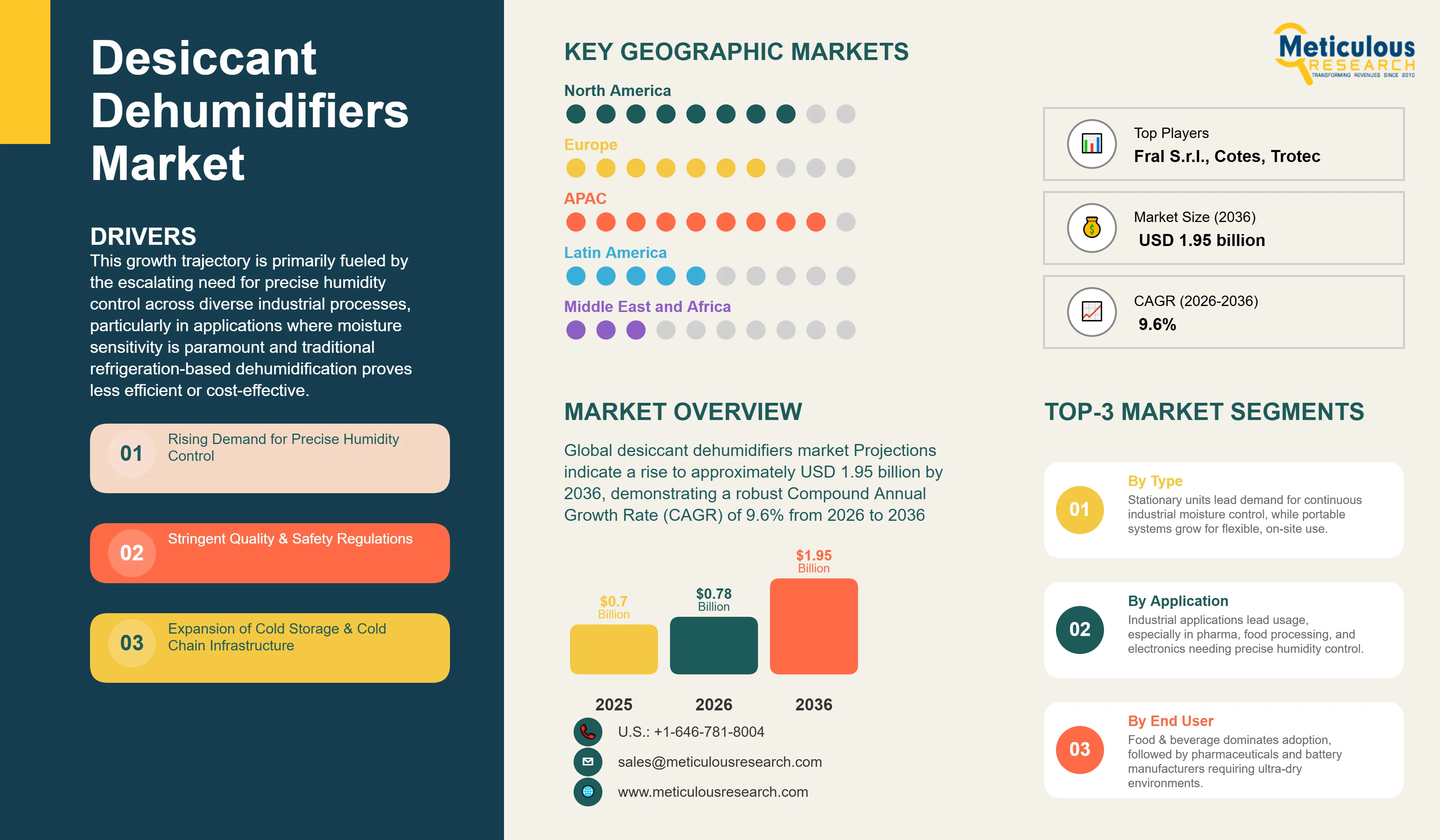
The global desiccant dehumidifiers market, valued at an estimated USD 0.70 billion in 2025, is poised for substantial expansion. Projections indicate a rise to approximately USD 1.95 billion by 2036, demonstrating a robust Compound Annual Growth Rate (CAGR) of 9.6% from 2026 to 2036. This growth trajectory is primarily fueled by the escalating need for precise humidity control across diverse industrial processes, particularly in applications where moisture sensitivity is paramount and traditional refrigeration-based dehumidification proves less efficient or cost-effective. Key drivers include stringent quality and safety regulations within the pharmaceutical and food processing sectors, the rapid expansion of cold storage infrastructure, and the critical imperative for corrosion prevention in power generation and automotive industries. Furthermore, continuous advancements in desiccant materials, innovative energy recovery systems, and the seamless integration of smart control technologies are collectively enhancing the efficacy and market appeal of desiccant dehumidifiers worldwide.
Click here to: Get Free Sample Pages of this Report
Desiccant dehumidifiers represent a sophisticated class of air treatment systems engineered to meticulously extract moisture from the ambient air through an adsorption process. This mechanism leverages specialized desiccant materials, commonly silica gel, lithium chloride, or activated alumina. Distinct from their refrigeration-based counterparts, which condense moisture by cooling air, desiccant dehumidifiers excel in environments characterized by low temperatures and humidity, or where exceptionally dry air conditions are a prerequisite. These systems are indispensable for meticulously regulating humidity levels within sensitive industrial operations, thereby mitigating corrosion, inhibiting microbial proliferation, and preserving the intrinsic integrity of products. The market landscape for these devices is diverse, encompassing robust stationary units tailored for extensive industrial applications and agile portable units designed for flexible, localized dehumidification requirements.
The market is currently experiencing a dynamic phase of continuous innovation, primarily propelled by an industry-wide pursuit of superior energy efficiency, enhanced precision in control, and unwavering operational reliability. Contemporary desiccant dehumidifiers frequently incorporate advanced desiccant materials boasting augmented adsorption capacities, sophisticated energy recovery systems engineered to curtail regeneration costs, and highly intelligent control mechanisms. These cutting-edge systems are equipped with real-time humidity sensors, programmable logic controllers (PLCs), and seamless IoT connectivity, facilitating remote management and proactive predictive maintenance. Manufacturers are strategically channeling their research and development efforts towards crafting solutions that not only minimize energy consumption and reduce maintenance overheads but also feature modular designs for effortless integration into existing HVAC infrastructures or as standalone operational units. This emphasis on customization ensures that a broad spectrum of industrial and commercial demands can be met, ranging from the exacting standards of pharmaceutical cleanrooms to the protective requirements of power plant lay-up procedures.
The global industrial ecosystem is increasingly characterized by an imperative for stringent environmental control, driven by the need to adhere to rigorous quality benchmarks, optimize production workflows, and prolong the operational lifespan of sensitive equipment. Industries spanning pharmaceuticals, food processing, advanced electronics manufacturing, and power generation necessitate exceptionally low humidity levels to avert product degradation, mitigate electrostatic discharge issues, and prevent corrosive damage. The escalating awareness regarding the detrimental ramifications of uncontrolled humidity—encompassing product spoilage, equipment malfunctions, and potential safety hazards—is significantly accelerating the adoption of advanced desiccant dehumidification solutions. This burgeoning recognition of desiccant dehumidifiers as a foundational component of modern industrial infrastructure is firmly establishing their indispensable role in contemporary industrial operations.
Growing Emphasis on Energy Efficiency and Hybrid Dehumidification Systems
The desiccant dehumidifiers market is currently undergoing a transformative shift, marked by a pronounced emphasis on energy-efficient solutions and the strategic development of hybrid dehumidification systems. This evolution is a direct response to escalating energy costs, increasingly stringent environmental regulations, and a pervasive drive towards corporate sustainability. Industrial entities are actively seeking dehumidification technologies that not only minimize energy consumption but also reduce their ecological footprint, all while maintaining uncompromising standards of precise humidity control. This trend is catalyzing significant innovations in desiccant wheel design, refining regeneration processes, and fostering the integration of advanced heat recovery systems, which collectively lead to a substantial reduction in the energy required for desiccant regeneration. Furthermore, the emergence of hybrid systems, which ingeniously combine desiccant dehumidification with either refrigeration or evaporative cooling technologies, offers an optimized performance envelope across a broader spectrum of temperature and humidity conditions. These innovative hybrid solutions deliver enhanced efficiency and operational flexibility, empowering industries to achieve desired humidity levels with markedly lower energy consumption, thereby positioning them as a pivotal differentiator in the competitive market landscape.
Integration of Smart Control Systems and Advanced Desiccant Materials
Another defining trend shaping the desiccant dehumidifiers market is the pervasive integration of smart control systems, coupled with continuous advancements in desiccant materials. This dual focus aims to deliver unparalleled precision, facilitate seamless remote management, and elevate overall system performance. Manufacturers are proactively embedding sophisticated sensors, advanced algorithmic intelligence, and robust IoT connectivity into their dehumidification systems. This technological synergy enables real-time data acquisition pertaining to humidity levels, temperature, energy consumption, and the performance metrics of the desiccant wheel. The collected data is subsequently subjected to rigorous analysis via cloud-based platforms and artificial intelligence, yielding actionable insights into system efficiency, predicting impending maintenance requirements, and autonomously adjusting operational parameters to sustain optimal humidity conditions. Concurrently, intensive research and development endeavors are concentrated on engineering novel desiccant materials that boast superior adsorption capacities, accelerated regeneration rates, and enhanced long-term durability. Examples include next-generation silica gels, advanced molecular sieves, and innovative polymer-based desiccants. These synergistic innovations are culminating in the creation of more compact, inherently efficient, and exceptionally reliable desiccant dehumidifiers, adept at addressing the increasingly rigorous demands of diverse industrial applications.
|
Parameter |
Details |
|
Market Size by 2036 |
USD 1.95 Billion |
|
Market Size in 2026 |
USD 0.78 Billion |
|
Market Size in 2025 |
USD 0.70 Billion |
|
Market Growth Rate (2026–2036) |
CAGR of 9.6% |
|
Dominating Region |
Asia-Pacific |
|
Fastest Growing Region |
North America |
|
Base Year |
2025 |
|
Forecast Period |
2026 to 2036 |
|
Segments Covered |
Type, Technology, Application, End-use Vertical, and Region |
|
Regions Covered |
North America, Europe, Asia-Pacific, Latin America, and Middle East & Africa |
Drivers: Increasing Demand for Precise Humidity Control in Moisture-Sensitive Industries
A primary driver for the desiccant dehumidifiers market is the escalating need for precise and ultra-low humidity control in a wide array of moisture-sensitive industries. Sectors such as pharmaceuticals, food processing, lithium-ion battery manufacturing, and electronics require extremely dry environments to prevent product degradation, ensure quality, and optimize production processes. For instance, in pharmaceutical manufacturing, precise humidity control is crucial to prevent moisture absorption by hygroscopic materials, which can affect drug stability and efficacy. In food processing, it inhibits microbial growth and maintains the texture and freshness of products. Conventional refrigeration-based dehumidifiers often struggle to achieve the very low dew points required by these industries, making desiccant dehumidifiers the preferred solution. The continuous expansion and stringent regulatory requirements in these high-value industries are significantly fueling the demand for advanced desiccant dehumidification systems.
Opportunity: Growing Adoption in Cold Storage and Ice Prevention Applications
The growing adoption of desiccant dehumidifiers in cold storage facilities, freezers, and for ice prevention applications presents a significant growth opportunity for the market. In cold storage environments, high humidity can lead to frost and ice buildup on coils, floors, and products, resulting in reduced refrigeration efficiency, increased energy consumption, product damage, and safety hazards. Desiccant dehumidifiers effectively remove moisture from the air before it enters the cold space, preventing ice formation and maintaining optimal conditions. This application is particularly critical in food processing, logistics, and pharmaceutical industries where maintaining precise temperature and humidity is paramount for product preservation and operational efficiency. The increasing global demand for frozen and refrigerated goods, coupled with the need for energy savings and reduced maintenance in cold chain logistics, is driving the adoption of desiccant dehumidifiers in these specialized applications.
Why Do Stationary Desiccant Dehumidifiers Lead the Market?
The Stationary Desiccant Dehumidifiers segment accounts for the largest share of the overall desiccant dehumidifiers market in 2026. This dominance is primarily driven by their widespread use in large-scale industrial and commercial facilities that require continuous, robust, and high-capacity moisture removal. Industries such as pharmaceutical manufacturing, food processing plants, chemical processing facilities, and power generation plants often have dedicated areas or entire facilities where maintaining extremely low humidity levels is critical for product quality, process efficiency, and equipment protection. Stationary units are designed for permanent installation, integrated into the HVAC system or as standalone units, offering superior performance, energy efficiency, and precise control for demanding applications. Their ability to handle large air volumes and achieve very low dew points makes them an indispensable component in maintaining safe and compliant industrial environments.
The Portable Desiccant Dehumidifiers segment is expected to witness the fastest growth during the forecast period. This growth is fueled by the increasing demand for flexible and mobile dehumidification solutions that can be easily deployed for temporary projects, emergency drying, or localized humidity control in various settings. Industries requiring versatility, such as construction (for concrete drying, water damage restoration), rental services, and small-scale manufacturing, benefit significantly from portable units. Their ease of use, compact design, and ability to provide effective moisture removal in challenging conditions make them ideal for applications where fixed systems are impractical or insufficient. The growing emphasis on adaptable operational layouts and rapid response capabilities further drives the adoption of portable desiccant dehumidifiers.
How Does the Rotary Desiccant Dehumidifiers Segment Maintain Its Lead?
The Rotary Desiccant Dehumidifiers segment holds the largest market share in 2026. This dominance is attributed to their continuous operation, high efficiency, and suitability for a broad range of industrial humidity control applications, particularly those requiring very low dew points. Rotary desiccant dehumidifiers utilize a slowly rotating wheel impregnated with a desiccant material (like silica gel or lithium chloride). As the wheel rotates, one section adsorbs moisture from the process air, while another section is simultaneously regenerated by a heated air stream, allowing for continuous and uninterrupted dehumidification. This technology is highly reliable, offers precise control over humidity levels, and can handle large air volumes, making it the preferred choice for critical applications in pharmaceuticals, food processing, electronics manufacturing, and cold storage facilities. Continuous advancements in desiccant materials and energy recovery systems further reinforce their leading position.
The Solid Desiccant Dehumidifiers segment, encompassing rotary desiccant dehumidifiers, is expected to continue its strong growth. The Liquid Desiccant Dehumidifiers segment is also gaining traction, particularly in applications where simultaneous cooling and dehumidification are required, or where the desiccant can be regenerated using low-grade waste heat. Liquid desiccants (e.g., lithium chloride solution) offer advantages in energy efficiency and the ability to handle higher moisture loads, making them attractive for large commercial buildings and industrial processes with available waste heat sources.
Why Does the Industrial Segment Lead the Market?
The Industrial segment commands the largest share of the global desiccant dehumidifiers market in 2026. This leadership stems from the extensive and critical need for precise humidity control across numerous industrial processes to ensure product quality, prevent material degradation, and optimize operational efficiency. Industries such as pharmaceuticals, food processing, chemical manufacturing, electronics, and power generation rely heavily on desiccant dehumidifiers to achieve and maintain very low humidity levels. These applications often involve moisture-sensitive materials, equipment prone to corrosion, or processes where even slight variations in humidity can lead to significant product defects or safety issues. Stringent regulatory requirements, coupled with the high costs associated with product spoilage or equipment damage, compel industrial players to invest in robust desiccant dehumidification solutions. The continuous growth in global manufacturing and industrial output ensures a sustained demand for these critical systems.
The Commercial segment is poised for significant growth, driven by the increasing demand for improved indoor air quality, comfort, and energy efficiency in commercial buildings, supermarkets, ice rinks, and data centers. Desiccant dehumidifiers help prevent mold growth, reduce cooling loads, and protect sensitive equipment. The Residential segment, while smaller, is also experiencing growth, particularly in regions with high humidity or for specialized applications like basements and crawl spaces, where homeowners seek effective solutions for moisture control and mold prevention.
Why Does the Food & Beverage Segment Lead the Market?
The Food & Beverage vertical commands the largest share of the global desiccant dehumidifiers market in 2026. This leadership is primarily due to the critical role of precise humidity control in preventing spoilage, maintaining product quality, and extending the shelf life of a wide range of food and beverage products. In processes such as confectionery manufacturing, snack food production, and dry ingredient storage, controlling moisture content is essential to prevent caking, clumping, microbial growth, and changes in texture or flavor. Desiccant dehumidifiers are indispensable in these environments, ensuring that products remain fresh, safe, and compliant with stringent food safety regulations. The global demand for processed and packaged foods, coupled with the need to minimize waste and optimize production yields, ensures a continuous and growing demand for desiccant dehumidification solutions in this vital sector.
The Pharmaceuticals vertical is poised for significant growth, driven by the stringent regulatory requirements for environmental control in drug manufacturing, storage, and packaging. Precise humidity is crucial for preventing moisture absorption by hygroscopic active pharmaceutical ingredients (APIs), which can affect drug stability, potency, and shelf life. The Chemical and Electronics verticals also represent crucial applications, where desiccant dehumidifiers prevent corrosion, static electricity, and moisture-induced defects in sensitive materials and components. The Power Generation and Automotive sectors utilize desiccant dehumidifiers for turbine lay-up protection, corrosion prevention, and maintaining optimal conditions in paint booths and battery manufacturing facilities. The Construction sector uses portable desiccant dehumidifiers for rapid drying of buildings after water damage or during specific construction phases.
How is Asia-Pacific Maintaining Dominance in the Global Desiccant Dehumidifiers Market?
Asia-Pacific holds the largest share of the global desiccant dehumidifiers market in 2026. This dominance is primarily attributable to the region’s rapid industrialization, expanding manufacturing sectors, and increasing investments in moisture-sensitive industries such as food processing, pharmaceuticals, and electronics across countries like China, India, Japan, and South Korea. The region’s diverse climatic conditions, including high humidity in many areas, further drive the demand for effective dehumidification solutions. Rapid urbanization, coupled with significant investments in infrastructure development and cold chain logistics, fuels market growth. The presence of numerous local and international manufacturers, offering a wide range of products tailored to regional needs, also contributes to Asia-Pacific’s leading position. Government initiatives promoting quality control and energy efficiency in industrial processes are additionally boosting market expansion.
Which Factors Support North America and Europe Market Growth?
North America represents a substantial and steadily growing share of the global desiccant dehumidifiers market, driven by stringent quality control standards, a strong focus on energy efficiency, and the expansion of high-tech industries such as data centers, pharmaceuticals, and automotive. The United States and Canada are key markets, driven by continuous investments in advanced manufacturing and the need for precise environmental control in critical applications. The region benefits from a well-established ecosystem of technology providers and industrial firms collaborating to develop and deploy innovative and energy-efficient dehumidification solutions. The emphasis on upgrading aging infrastructure and adopting smart factory initiatives also fuels market expansion, particularly in applications requiring very low dew points.
Europe is experiencing significant growth in the desiccant dehumidifiers market, primarily driven by stringent regulatory requirements for product quality and safety in industries like pharmaceuticals, food processing, and chemical manufacturing. Countries such as Germany, the United Kingdom, and France have mature industrial bases that demand high-performance humidity control solutions. The region’s strong focus on energy efficiency and sustainability also promotes the adoption of desiccant dehumidifiers, especially those with advanced heat recovery systems. Furthermore, the increasing demand for controlled environments in museums, archives, and historical buildings to preserve sensitive artifacts contributes to market growth. Innovations in desiccant materials and system integration, tailored to European market demands, are further accelerating adoption.
Latin America is an emerging market for desiccant dehumidifiers, with countries like Brazil, Mexico, and Argentina showing increasing interest in adopting advanced moisture control solutions. The region’s growing industrialization, particularly in sectors like food processing, pharmaceuticals, and automotive, is driving initial investments in dehumidification systems. While market penetration is currently lower compared to developed regions, the potential for growth is significant as economic conditions improve and awareness of the benefits of precise humidity control increases. Government support for industrial modernization and quality improvement initiatives are expected to fuel further adoption.
The Middle East & Africa region is also experiencing nascent growth in the desiccant dehumidifiers market, primarily driven by large-scale industrial projects and investments in sectors such as pharmaceuticals, food processing, and power generation in the GCC countries (e.g., Saudi Arabia, UAE) and South Africa. These projects, often characterized by ambitious timelines and a demand for cutting-edge technologies, are creating opportunities for the deployment of modern desiccant dehumidification systems. The region’s focus on diversifying economies, investing in industrial infrastructure, and attracting foreign manufacturing investments is expected to fuel further adoption of desiccant dehumidifiers in various industrial sectors, particularly where high ambient humidity is a challenge.
Companies such as Munters Group AB, Bry-Air (Asia) Pvt. Ltd., Trotec GmbH, Seibu Giken DST AB, and Condair Group AG lead the global desiccant dehumidifiers market with comprehensive, integrated platforms that combine dehumidification units, advanced desiccant technologies, and energy recovery systems. Meanwhile, players including Ebac Industrial Products Ltd., Fral S.r.l., DehuTech AB, and Cotes A/S focus on specific architectural niches—such as industrial-grade portable solutions, specialized applications for lithium-ion battery manufacturing, and energy-efficient regeneration systems—targeting enterprises with particular performance preferences or existing facility requirements. Emerging and expanding providers such as Dry-Air, Inc., Quest Climate (Therma-Stor LLC), and DST Seibu Giken are strengthening their market positions through innovations in compact designs, sustainable desiccant materials, and purpose-built offerings for various industrial and commercial applications.
The global desiccant dehumidifiers market is expected to grow from USD 0.78 billion in 2026 to USD 1.95 billion by 2036.
The global desiccant dehumidifiers market is projected to grow at a CAGR of 9.6% from 2026 to 2036.
The stationary desiccant dehumidifiers segment is expected to dominate the market in 2026 due to their widespread use in large-scale industrial facilities. The portable desiccant dehumidifiers segment is projected to accelerate its growth due to increasing demand for flexible and mobile solutions.
Energy efficiency and smart control systems are transforming the desiccant dehumidifiers market by enabling real-time monitoring, remote management, and predictive maintenance, leading to optimized energy usage, reduced operational costs, and enhanced precision in humidity management. Hybrid systems also offer improved performance across diverse conditions.
Asia-Pacific holds the largest share of the global desiccant dehumidifiers market in 2026. This dominance is driven by rapid industrialization, expanding manufacturing sectors, and increasing investments in moisture-sensitive industries.
The leading companies include Munters Group AB, Bry-Air (Asia) Pvt. Ltd., Trotec GmbH, Seibu Giken DST AB, and Condair Group AG.
1. Introduction
1.1 Market Definition
1.2 Market Scope
1.3 Research Methodology
1.4 Assumptions & Limitations
2. Executive Summary
3. Market Overview
3.1 Introduction
3.2 Market Dynamics
3.2.1 Drivers
3.2.2 Restraints
3.2.3 Opportunities
3.2.4 Challenges
3.3 Impact of Precise Humidity Control on Product Quality and Operational Efficiency
3.4 Technological Advancements in Desiccant Materials and Energy Recovery Systems
3.5 Porter’s Five Forces Analysis
4. Global Desiccant Dehumidifiers Market, by Type
4.1 Introduction
4.2 Stationary Desiccant Dehumidifiers
4.3 Portable Desiccant Dehumidifiers
5. Global Desiccant Dehumidifiers Market, by Technology
5.1 Introduction
5.2 Rotary Desiccant Dehumidifiers
5.3 Solid Desiccant Dehumidifiers (e.g., Fixed Bed, Cassette)
5.4 Liquid Desiccant Dehumidifiers
5.5 Other Technologies
6. Global Desiccant Dehumidifiers Market, by Application
6.1 Introduction
6.2 Industrial
6.3 Commercial
6.4 Residential
7. Global Desiccant Dehumidifiers Market, by End-use Vertical
7.1 Introduction
7.2 Food & Beverage
7.3 Pharmaceuticals
7.4 Chemical
7.5 Electronics
7.6 Power Generation
7.7 Automotive
7.8 Construction
7.9 Other End-use Verticals (e.g., Cold Storage, Museums & Archives, Data Centers)
8. Global Desiccant Dehumidifiers Market, by Region
8.1 Introduction
8.2 North America
8.2.1 U.S.
8.2.2 Canada
8.2.3 Mexico
8.3 Europe
8.3.1 Germany
8.3.2 France
8.3.3 U.K.
8.3.4 Italy
8.3.5 Spain
8.3.6 Nordic Countries
8.3.7 Rest of Europe
8.4 Asia-Pacific
8.4.1 China
8.4.2 India
8.4.3 Japan
8.4.4 South Korea
8.4.5 Southeast Asia
8.4.6 Australia
8.4.7 Rest of Asia-Pacific
8.5 Latin America
8.5.1 Brazil
8.5.2 Mexico
8.5.3 Argentina
8.5.4 Rest of Latin America
8.6 Middle East & Africa
8.6.1 Saudi Arabia
8.6.2 UAE
8.6.3 South Africa
8.6.4 Rest of Middle East & Africa
9. Competitive Landscape
9.1 Overview
9.2 Key Growth Strategies
9.3 Competitive Benchmarking
9.4 Competitive Dashboard
9.4.1 Industry Leaders
9.4.2 Market Differentiators
9.4.3 Vanguards
9.4.4 Emerging Companies
9.5 Market Ranking / Positioning Analysis of Key Players, 2025
10. Company Profiles
(Business Overview, Financial Overview, Product Portfolio, Strategic Developments, SWOT Analysis)
10.1 Munters Group AB
10.2 Bry-Air (Asia) Pvt. Ltd.
10.3 Trotec GmbH
10.4 Seibu Giken DST AB
10.5 Condair Group AG
10.6 Ebac Industrial Products Ltd.
10.7 Fral S.r.l.
10.8 DehuTech AB
10.9 Cotes A/S
10.10 Dry-Air, Inc.
10.11 Quest Climate (Therma-Stor LLC)
10.12 DST Seibu Giken
11. Appendix
11.1 Questionnaire
11.2 Related Reports
























Published Date: Feb-2026
Published Date: Nov-2019
Subscribe to get the latest industry updates