Resources
About Us

Industrial Humidifiers Market by Type (Isothermal Humidifiers, Adiabatic Humidifiers, Mounting Type (Duct-Mounted, Stand-Alone), Application (Printing & Packaging, Textile, Data Centers, Food Processing & Cold Storage), and Region - Global Forecast to 2036
Report ID: MRSE - 1041810 Pages: 265 Feb-2026 Formats*: PDF Category: Semiconductor and Electronics Delivery: 24 to 72 Hours Download Free Sample Report
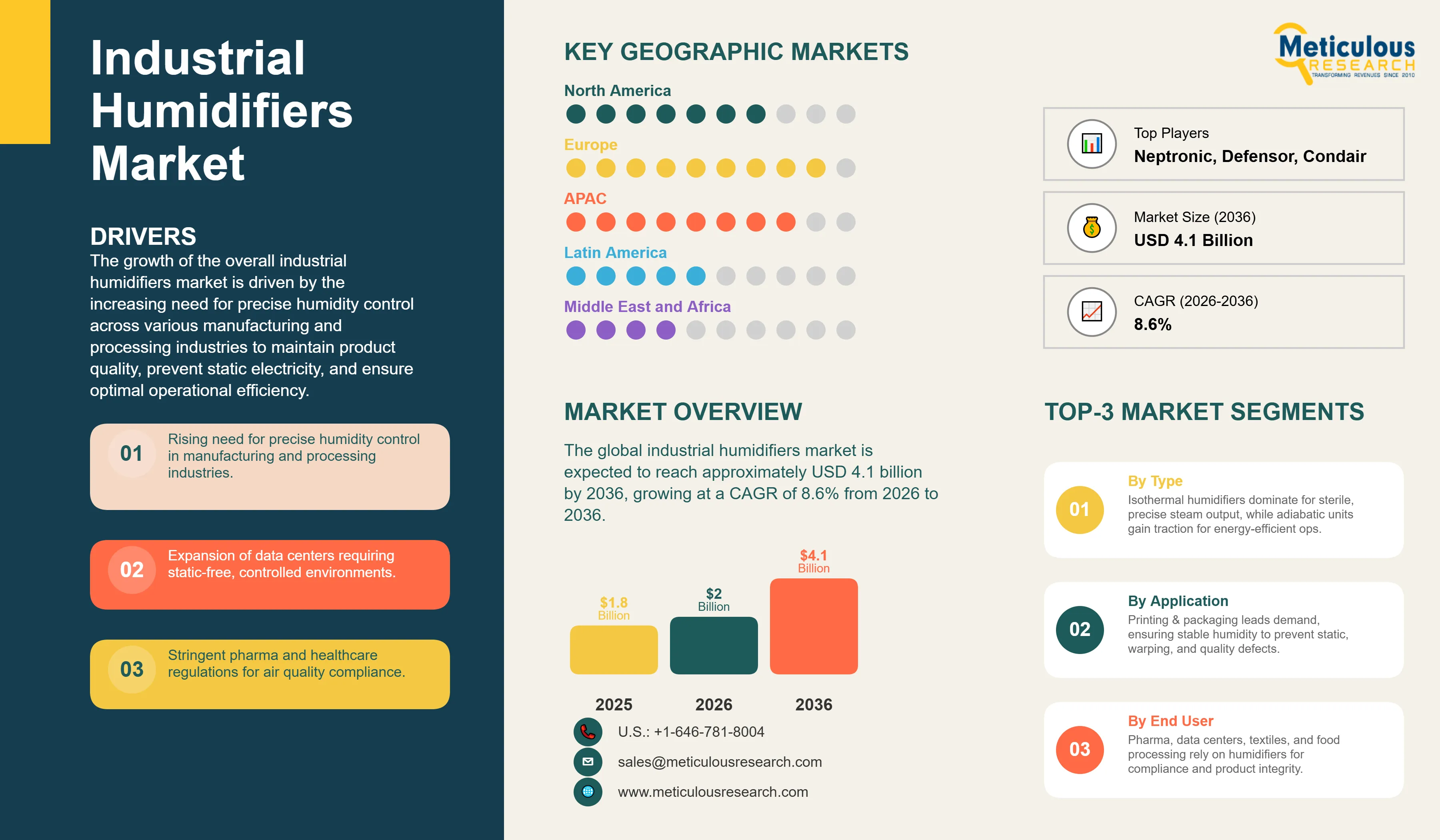
The global industrial humidifiers market was valued at USD 1.8 billion in 2025. The market is expected to reach approximately USD 4.1 billion by 2036 from USD 2.0 billion in 2026, growing at a CAGR of 8.6% from 2026 to 2036. The growth of the overall industrial humidifiers market is driven by the increasing need for precise humidity control across various manufacturing and processing industries to maintain product quality, prevent static electricity, and ensure optimal operational efficiency. Factors such as the expansion of data centers, stringent regulations in pharmaceutical and healthcare sectors, and the growing demand for controlled environments in printing, textile, and food processing industries are significantly contributing to market expansion. Furthermore, advancements in energy-efficient technologies and the integration of smart control systems are enhancing the appeal and adoption of industrial humidifiers globally.
Click here to: Get Free Sample Pages of this Report
Industrial humidifiers are specialized devices designed to introduce and maintain specific levels of moisture in the air within industrial and commercial environments. Unlike residential humidifiers, industrial units are built for continuous operation, high capacity, and precise control, catering to the demanding requirements of various manufacturing processes, storage facilities, and sensitive environments. These systems are crucial for preventing issues such as static electricity discharge, material shrinkage or expansion, product damage, and ensuring optimal conditions for human comfort and health. The market encompasses a broad range of technologies, including isothermal humidifiers (which heat water to produce steam) and adiabatic humidifiers (which introduce fine water droplets into the air without heating).
The market is characterized by continuous innovation, driven by the need for greater energy efficiency, precise control, and enhanced hygiene. Modern industrial humidifiers often integrate advanced control systems, including sensors for real-time humidity monitoring, programmable logic controllers (PLCs), and IoT connectivity for remote management and predictive maintenance. Manufacturers are focusing on developing solutions that minimize water and energy consumption, reduce maintenance requirements, and prevent the growth of bacteria and mold. The modular design and customization options offered by manufacturers provide flexibility to address the unique challenges of diverse industrial environments, from cleanrooms and data centers to textile mills and printing presses.
The global industrial landscape is increasingly reliant on controlled environments to ensure product quality, operational efficiency, and worker well-being. Industries such as pharmaceuticals, electronics, data centers, and automotive manufacturing require strict humidity control to prevent defects, protect sensitive equipment, and comply with regulatory standards. The rising awareness of the adverse effects of improper humidity levels—ranging from material degradation and static discharge to respiratory issues for workers—is accelerating the adoption of sophisticated industrial humidification solutions. This growing recognition of humidity control as a critical component of industrial infrastructure is solidifying the market’s position as an indispensable element of modern industrial operations.
Growing Demand for Energy-Efficient and Sustainable Humidification Solutions
The industrial humidifiers market is witnessing a significant trend towards the adoption of energy-efficient and sustainable humidification solutions, driven by rising energy costs, increasing environmental regulations, and corporate sustainability initiatives. Industries are actively seeking humidifiers that minimize their energy consumption and reduce their environmental footprint without compromising on precise humidity control. This trend is leading to innovations in adiabatic humidification technologies, such as high-pressure cold water atomizers and ultrasonic humidifiers, which consume significantly less energy compared to traditional steam humidifiers. Furthermore, manufacturers are focusing on developing systems with optimized water management, including advanced filtration and recirculation systems, to reduce water waste. The emphasis on using eco-friendly materials and designing for easier maintenance and longer product lifecycles also contributes to the sustainability aspect. This drive for energy-efficient and eco-friendly solutions is not only a regulatory imperative but also a strategic business decision, offering long-term operational cost savings and enhancing a company’s environmental credentials.
Integration of Smart Control Systems and IoT for Enhanced Precision and Management
Another prominent trend in the industrial humidifiers market is the increasing integration of smart control systems and IoT (Internet of Things) for enhanced precision, remote management, and predictive maintenance. Manufacturers are embedding sensors, advanced algorithms, and connectivity modules into their humidification systems, enabling real-time data collection on humidity levels, water quality, energy consumption, and system performance. This data is then analyzed using cloud-based platforms and AI to provide insights into system efficiency, predict maintenance needs, and automatically adjust parameters to maintain optimal humidity conditions. For instance, smart humidifiers can dynamically respond to changes in ambient conditions or production schedules, ensuring consistent humidity levels while minimizing energy use. This shift towards intelligent and automated systems not only improves the accuracy of humidity control and product quality but also significantly reduces operational costs and downtime, making smart industrial humidifiers a key differentiator in the market.
|
Parameter |
Details |
|
Market Size by 2036 |
USD 4.1 Billion |
|
Market Size in 2026 |
USD 2.0 Billion |
|
Market Size in 2025 |
USD 1.8 Billion |
|
Market Growth Rate (2026–2036) |
CAGR of 8.6% |
|
Dominating Region |
Europe |
|
Fastest Growing Region |
Asia-Pacific |
|
Base Year |
2025 |
|
Forecast Period |
2026 to 2036 |
|
Segments Covered |
Type, Mounting Type, Application, and Region |
|
Regions Covered |
North America, Europe, Asia-Pacific, Latin America, and Middle East & Africa |
Drivers: Increasing Need for Precise Humidity Control in Manufacturing and Processing
A primary driver for the industrial humidifiers market is the escalating need for precise humidity control across a wide array of manufacturing and processing industries. In sectors such as printing, textiles, pharmaceuticals, and electronics, maintaining specific humidity levels is critical for product quality, operational efficiency, and preventing material degradation. For instance, in printing, incorrect humidity can lead to paper warping, static electricity, and ink drying issues, while in textile manufacturing, it can affect fiber strength and elasticity. In pharmaceutical production, precise humidity control is essential for the stability of active ingredients and preventing microbial growth. The increasing automation and sophistication of industrial processes demand even tighter environmental controls, making industrial humidifiers indispensable for ensuring consistent product quality, reducing waste, and optimizing production yields.
Opportunity: Technological Advancements in Energy Efficiency and Smart Control
The continuous technological advancements in energy efficiency and the integration of smart control systems present a significant growth opportunity for the industrial humidifiers market. Innovations in adiabatic humidification technologies, such as high-pressure atomizers and ultrasonic humidifiers, offer significantly lower energy consumption compared to traditional steam-based systems. Furthermore, the incorporation of IoT sensors, advanced algorithms, and cloud-based platforms enables real-time monitoring, remote control, and predictive maintenance. These smart features allow for optimized energy usage, reduced operational costs, and enhanced precision in humidity management. Manufacturers are leveraging these advancements to offer more sophisticated, sustainable, and user-friendly solutions, expanding the market’s appeal to a broader range of industrial applications and contributing to the adoption of humidifiers in smart factory initiatives.
Why Do Isothermal Humidifiers Lead the Market?
The Isothermal Humidifiers segment accounts for the largest share of the overall industrial humidifiers market in 2026. This dominance is primarily driven by the widespread use of steam humidifiers, which fall under this category, for precise, hygienic, and reliable humidity control in various industrial applications. Isothermal humidifiers, particularly resistive and electrode steam humidifiers, produce sterile steam by heating water, making them ideal for sensitive environments like healthcare facilities, cleanrooms, and pharmaceutical manufacturing where air purity is paramount. Their ability to deliver consistent and controllable humidity levels, coupled with their proven reliability and ease of integration into existing HVAC systems, makes them a preferred choice for industries requiring high-performance humidification solutions. The continuous demand for sterile and precise humidity management in critical industrial processes ensures the sustained leadership of isothermal humidifiers.
The Adiabatic Humidifiers segment is expected to witness the fastest growth during the forecast period. This growth is fueled by their superior energy efficiency, lower operational costs, and increasing adoption in large industrial and commercial spaces. Adiabatic humidifiers, including ultrasonic, atomizing, evaporative, and high-pressure cold water humidifiers, introduce moisture into the air through the evaporation of fine water droplets, consuming significantly less energy than steam-based systems. The rising focus on energy conservation, coupled with the need for sustainable solutions, is driving their rapid adoption in data centers, textile mills, printing facilities, and large warehouses. Advancements in atomization technology and water treatment systems are further enhancing their efficiency and hygiene, making them an increasingly attractive option for a wide range of industrial applications.
How Does the Duct-Mounted Segment Maintain Its Lead?
The Duct-Mounted humidifiers segment holds the largest market share in 2026. This dominance is attributed to their seamless integration into existing or new HVAC (Heating, Ventilation, and Air Conditioning) systems, providing centralized and efficient humidity management across large industrial and commercial facilities. Duct-mounted units distribute humidified air evenly throughout a building via the ventilation ductwork, ensuring consistent humidity levels in multiple zones from a single source. This method is highly efficient for large-scale applications, reducing the need for multiple stand-alone units and simplifying maintenance. Their ability to provide discreet and comprehensive humidity control, without occupying floor space, makes them the preferred choice for data centers, hospitals, museums, and large manufacturing plants where precise environmental conditions are critical.
The Stand-Alone humidifiers segment is expected to witness significant growth, particularly in applications requiring localized humidity control or where integration with existing HVAC systems is not feasible. These units offer flexibility and ease of installation, making them suitable for smaller workshops, laboratories, or specific areas within a larger facility that have unique humidity requirements. The increasing demand for adaptable and modular solutions, coupled with advancements in portable and high-capacity stand-alone units, is driving their adoption in diverse industrial settings.
Why Does the Printing & Packaging Segment Lead the Market?
The Printing & Packaging segment commands the largest share of the global industrial humidifiers market in 2026. This leadership is primarily due to the critical need for stable and precise humidity control in printing and packaging processes to ensure product quality, prevent material defects, and optimize operational efficiency. In printing, incorrect humidity levels can lead to paper warping, static electricity buildup (which attracts dust and causes misfeeds), ink drying issues, and poor print registration. In packaging, it affects the integrity of materials like cardboard and films, impacting their strength and flexibility. Industrial humidifiers prevent these issues, ensuring consistent material properties, reducing waste, and maintaining high-quality output. The continuous growth of the global printing and packaging industry, driven by e-commerce and consumer goods demand, ensures a sustained need for effective humidification solutions.
The Healthcare & Pharmaceuticals segment is poised for significant growth, driven by stringent regulatory requirements for environmental control in hospitals, laboratories, and pharmaceutical manufacturing facilities. Precise humidity is crucial for preventing microbial growth, ensuring the stability of sensitive drugs, and maintaining sterile conditions. The Data Centers segment is also experiencing rapid growth, as humidifiers are essential for preventing static electricity that can damage sensitive electronic equipment and for maintaining optimal operating temperatures. The Textile and Wood Processing industries also rely heavily on humidification to maintain material properties, prevent shrinkage, and improve processing efficiency.
How is Europe Maintaining Dominance in the Global Industrial Humidifiers Market?
Europe holds the largest share of the global industrial humidifiers market in 2026. This dominance is primarily attributable to the region’s highly developed and diversified industrial base, stringent quality control standards, and a strong emphasis on maintaining optimal environmental conditions in manufacturing and processing. Countries such as Germany, the United Kingdom, and France have well-established industries like printing, textiles, automotive, and pharmaceuticals, all of which require precise humidity control. The presence of leading global manufacturers of humidification systems, coupled with continuous innovation in energy-efficient and hygienic technologies, further solidifies Europe’s leading position. The region’s focus on industrial automation and smart factory initiatives also contributes to sustained demand for advanced humidification solutions.
Which Factors Support Asia-Pacific and North America Market Growth?
Asia-Pacific is the fastest-growing regional market for industrial humidifiers during the forecast period, driven by rapid industrialization, increasing investments in manufacturing infrastructure, and the expansion of data centers across the region. Countries like China, India, Japan, and South Korea are experiencing massive growth in industries such as electronics, textiles, and pharmaceuticals, all of which require precise humidity control. The region’s growing awareness regarding product quality, operational efficiency, and worker comfort, coupled with the adoption of international industrial standards, is accelerating the deployment of advanced humidification systems. The sheer scale of manufacturing output and the continuous establishment of new production facilities ensure a robust growth trajectory for this market.
North America represents a substantial and steadily growing share of the global industrial humidifiers market, shaped by a technologically advanced industrial sector, a strong focus on indoor air quality, and the increasing demand for controlled environments in data centers and healthcare facilities. The United States and Canada are key markets, driven by continuous investments in high-tech manufacturing, pharmaceuticals, and food processing industries, all of which benefit significantly from optimized humidity levels. The region benefits from a well-established ecosystem of HVAC professionals and technology providers collaborating to develop and deploy innovative and energy-efficient humidification solutions. The emphasis on upgrading aging infrastructure and adopting smart building technologies also fuels market expansion.
Latin America is an emerging market for industrial humidifiers, with countries like Brazil, Mexico, and Argentina showing increasing interest in adopting advanced environmental control solutions. The region’s growing industrialization, particularly in sectors like food processing, textiles, and automotive, is driving initial investments in humidification systems. While adoption is currently lower compared to developed regions, the potential for growth is significant as economic conditions improve and awareness of the benefits of precise humidity control increases. Government support for industrial modernization and quality improvement initiatives are expected to fuel further adoption.
The Middle East & Africa region is also experiencing nascent growth in the industrial humidifiers market, primarily driven by large-scale industrial projects and investments in sectors such as pharmaceuticals, food processing, and data centers in the GCC countries (e.g., Saudi Arabia, UAE) and South Africa. These projects, often characterized by ambitious timelines and a demand for cutting-edge technologies, are creating opportunities for the deployment of modern humidification systems. The region’s focus on diversifying economies, investing in industrial infrastructure, and attracting foreign manufacturing investments is expected to fuel further adoption of industrial humidifiers in various sectors.
Companies such as Condair Group AG, Armstrong International, Inc., Carel Industries S.p.A., Danfoss A/S, and DriSteem (a brand of Nortec Humidity) lead the global industrial humidifiers market with comprehensive, integrated platforms that combine humidification units, advanced control systems, and water treatment solutions. Meanwhile, players including STULZ GmbH, Neptronic, Inc., Humidity Control Systems, Inc., and Walter Meier AG focus on specific architectural niches—such as adiabatic humidification, precise control for data centers, and specialized solutions for cleanrooms—targeting enterprises with particular performance preferences or existing facility requirements. Emerging and expanding providers such as Hygromatik GmbH, Vapac Humidity Control, and Defensor AG are strengthening their market positions through innovations in energy efficiency, compact designs, and purpose-built offerings for various industrial applications.
The global industrial humidifiers market is expected to grow from USD 2.0 billion in 2026 to USD 4.1 billion by 2036.
The global industrial humidifiers market is projected to grow at a CAGR of 8.6% from 2026 to 2036.
The isothermal humidifiers segment is expected to dominate the market in 2026 due to the widespread use of steam humidifiers for precise and hygienic control. The adiabatic humidifiers segment is projected to accelerate its growth due to their superior energy efficiency and lower operational costs.
Smart control systems and IoT are transforming the industrial humidifiers market by enabling real-time monitoring, remote management, and predictive maintenance, leading to enhanced precision, optimized energy usage, and reduced operational costs.
Europe holds the largest share of the global industrial humidifiers market in 2026. This dominance is driven by a strong manufacturing base, stringent quality control standards, and high adoption of advanced humidity control solutions.
The leading companies include Condair Group AG, Armstrong International, Inc., Carel Industries S.p.A., Danfoss A/S, and DriSteem.


















Published Date: Feb-2026
Published Date: Nov-2024
Published Date: Jan-2023
Published Date: Apr-2022
Please enter your corporate email id here to view sample report.
Subscribe to get the latest industry updates


