Resources
About Us
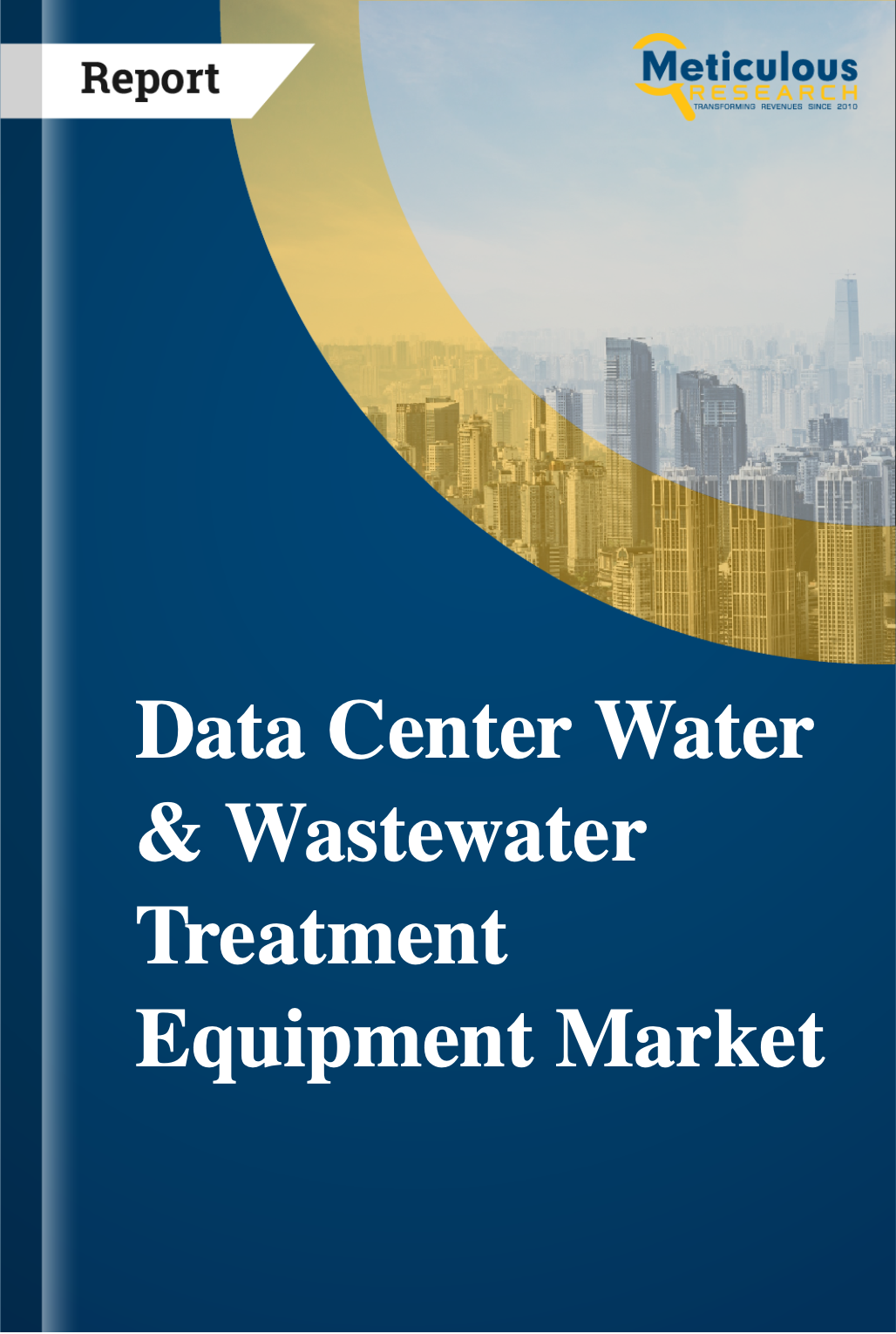
Data Center Water & Wastewater Treatment Equipment Market Size, Share & Trends Analysis by Equipment Type, Application, Data Center Type, End User, and Geography - Global Opportunity Analysis and Industry Forecast (2026–2036)
Report ID: MRSE - 1042108 Pages: 211 Aug-2026 Formats*: PDF Category: Semiconductor and Electronics Delivery: 24 to 72 Hours Download Free Sample Report
The global data center water & wastewater treatment equipment market was valued at USD 2.8 billion in 2025. This market is expected to reach USD 10.1 billion by 2036 from an estimated USD 3.20 billion in 2026, growing at a CAGR of 12.1% during the forecast period 2026–2036.
Market growth is being driven by rapid investments in AI and hyperscale data centers, increasing deployment of liquid cooling technologies, and growing emphasis on water conservation. As data centers become larger and more power-intensive, operators are investing in advanced water treatment solutions to improve cooling efficiency, extend equipment life, reduce freshwater consumption, and comply with increasingly stringent environmental regulations.
The rapid expansion of artificial intelligence, cloud computing, and digital services is reshaping the global data center industry. While power availability has traditionally been the primary focus, water management is emerging as an equally important operational priority. Modern AI servers generate significantly higher heat loads than conventional IT equipment, increasing the need for advanced cooling systems that depend on reliable, high-quality water.
According to the International Energy Agency (IEA), global electricity demand from data centers is expected to increase significantly by the end of this decade, with AI applications accounting for a major share of incremental demand. As rack densities continue to rise, data center operators are increasingly adopting liquid cooling technologies that require treated water with controlled chemistry to prevent scaling, corrosion, and biological fouling. This is driving demand for reverse osmosis (RO), ultrafiltration (UF), chemical dosing, UV disinfection, and intelligent water monitoring systems.
Water availability has also become a critical consideration when selecting new data center locations. According to the UN World Water Development Report, global water demand is expected to increase by 20–30% by 2050, while many regions already experience seasonal water stress. In response, governments are tightening regulations on water withdrawal and wastewater discharge, encouraging greater use of recycled water and advanced treatment technologies.
At the same time, leading hyperscale operators—including Microsoft, Google, Amazon Web Services (AWS), and Meta—have announced long-term sustainability programs focused on improving water efficiency and increasing the use of reclaimed water. These initiatives are accelerating investment in advanced water treatment equipment and creating new growth opportunities for technology providers serving the global data center industry.
Rapid Expansion of AI and Hyperscale Data Centers
The global rollout of AI infrastructure is significantly increasing demand for new hyperscale data centers. These facilities require reliable cooling systems to support high-density computing environments, making water treatment an essential part of overall infrastructure planning. As more hyperscale campuses are developed worldwide, investment in filtration, water purification, and wastewater treatment equipment continues to rise.
According to the International Energy Agency (IEA), electricity demand from data centers is expected to grow rapidly through 2030, driven primarily by AI workloads. This expansion is encouraging operators to build larger, more efficient facilities that incorporate advanced water management systems to improve operational reliability and sustainability.
Growing Adoption of Liquid Cooling Technologies
As AI processors become more powerful, conventional air cooling is becoming less effective for managing heat. This is accelerating the adoption of direct-to-chip liquid cooling and immersion cooling, both of which require high-quality treated water for efficient operation.
To support these cooling systems, data center operators are investing in membrane filtration, reverse osmosis, UV disinfection, and smart water monitoring technologies. These solutions help maintain water quality, reduce maintenance requirements, and improve the overall efficiency of cooling infrastructure.
High Initial Investment Costs
Advanced water treatment systems involve significant upfront investment. In addition to treatment equipment, operators must invest in automation systems, piping networks, storage tanks, instrumentation, and ongoing maintenance. While these technologies reduce long-term operating costs and improve water efficiency, the initial capital requirement remains a key challenge, particularly for enterprise data centers and smaller operators.
Integration with Existing Infrastructure
Many existing data centers were designed around conventional cooling systems and have limited capacity to accommodate modern water treatment technologies. Upgrading these facilities often requires changes to piping layouts, cooling equipment, control systems, and wastewater infrastructure.
The additional engineering work, implementation time, and operational disruption associated with retrofit projects can delay investment decisions, especially where uninterrupted data center operations are critical.
Increasing Adoption of Water Recycling and Zero Liquid Discharge (ZLD) Systems
Water scarcity is becoming an important consideration for both governments and data center operators. As large facilities consume substantial volumes of water for cooling, companies are increasingly investing in water recycling and reuse systems to reduce freshwater dependency and meet sustainability targets. Technologies such as Zero Liquid Discharge (ZLD), wastewater recycling, and condensate recovery are gaining traction, particularly in water-stressed regions.
Major hyperscale operators are also expanding the use of reclaimed and non-potable water for cooling applications. These initiatives are expected to create significant opportunities for suppliers of advanced filtration, membrane treatment, and wastewater recovery equipment over the coming decade.
Digital Water Management Creates New Revenue Opportunities
Digitalization is transforming water management across modern data centers. Operators are increasingly deploying IoT sensors, AI-enabled analytics, and automated monitoring platforms to track water quality, detect leakages, optimize chemical dosing, and improve overall system performance.
These intelligent water management solutions help reduce operating costs, improve asset reliability, and support sustainability reporting. As more facilities adopt digital infrastructure management, demand for integrated water treatment and monitoring solutions is expected to grow significantly.
Maintaining Water Quality in High-Density Cooling Systems
As data centers transition to liquid cooling, maintaining consistent water quality becomes increasingly important. Even minor variations in water chemistry can lead to corrosion, scaling, biological fouling, and reduced cooling efficiency, affecting the performance of high-value computing equipment.
Operators therefore require continuous monitoring and precise treatment processes, increasing the need for specialized expertise and advanced control systems.
Regional Variations in Water Availability and Regulations
Water availability and environmental regulations vary significantly across countries and regions. While some locations encourage wastewater reuse through supportive policies, others impose strict discharge limits or face limited access to recycled water infrastructure.
These regional differences make it challenging for equipment suppliers and operators to implement standardized water treatment solutions across global data center portfolios.
Liquid Cooling is Reshaping Water Treatment Requirements
The rapid deployment of AI servers is accelerating the adoption of direct-to-chip and immersion cooling technologies. Compared with conventional air cooling, these systems improve thermal efficiency but require highly treated water and continuous water quality management.
This trend is increasing demand for membrane filtration, reverse osmosis, UV disinfection, and automated water monitoring solutions specifically designed for next-generation cooling infrastructure.
Sustainability is Becoming a Core Design Criterion
Water efficiency is evolving from a compliance requirement to a strategic investment priority. New data centers are increasingly being designed with water recycling systems, low-water cooling technologies, and real-time monitoring platforms to reduce environmental impact and operating costs.
As environmental, social, and governance (ESG) commitments become more important, investment in sustainable water infrastructure is expected to remain a long-term market trend.
Market Analysis by Equipment Type
Based on equipment type, the global Data Center Water & Wastewater Treatment Equipment Market is segmented into Membrane Treatment Equipment, Filtration Equipment, Chemical Dosing Systems, UV Disinfection Systems, Water Softening Systems, Deionization Systems, Smart Monitoring & Control Systems, and Others.
In 2026, the membrane treatment equipment segment is expected to account for the largest share of the global data center water & wastewater treatment equipment market. The large share of this segment is mainly attributed to its extensive use in producing high-purity water for cooling applications and water recycling systems. Reverse osmosis (RO), ultrafiltration (UF), and nanofiltration (NF) technologies play a critical role in removing dissolved solids, microorganisms, and contaminants, thereby improving cooling efficiency, minimizing equipment fouling, and extending the life of cooling infrastructure.
However, the smart monitoring & control systems segment is projected to register the fastest growth during the forecast period. The rapid growth of this segment is driven by the increasing adoption of IoT-enabled sensors, AI-based analytics, automated water quality monitoring, and predictive maintenance solutions. These technologies enable operators to optimize water consumption, reduce operating costs, improve system reliability, and support sustainability initiatives.
Market Analysis by Water Treatment Stage
Based on water treatment stage, the global market is segmented into Raw Water Treatment, Water Purification & Conditioning, Cooling Water Treatment, Wastewater Treatment, and Water Recycling & Reuse.
In 2026, the Water Purification & Conditioning segment is expected to account for the largest share of the global market. The dominance of this segment is primarily due to its critical role in supplying high-quality water for cooling systems. Effective purification minimizes corrosion, scaling, and biological fouling, ensuring efficient heat transfer, improving equipment reliability, and reducing maintenance costs.
However, the Water Recycling & Reuse segment is projected to witness the fastest growth during the forecast period. The rapid growth of this segment is driven by increasing investments in water conservation, greater use of reclaimed water, growing adoption of Zero Liquid Discharge (ZLD) systems, and stricter environmental regulations aimed at reducing freshwater consumption.
Market Analysis by Cooling Technology
Based on cooling technology, the global market is segmented into Air Cooling, Evaporative Cooling, Direct-to-Chip Liquid Cooling, Immersion Cooling, and Hybrid Cooling Systems.
In 2026, the Evaporative Cooling segment is expected to account for the largest share of the global market. The large share of this segment is mainly attributed to its widespread deployment across hyperscale and colocation data centers due to its ability to provide efficient cooling while maintaining relatively lower operating costs. The technology is particularly suitable for facilities located in regions with favorable climatic conditions.
However, the Direct-to-Chip Liquid Cooling segment is projected to register the highest CAGR during the forecast period. The rapid growth of this segment is driven by increasing deployment of AI servers and high-performance computing (HPC) systems, rising rack power densities, and growing demand for energy-efficient cooling technologies capable of supporting next-generation computing infrastructure.
Market Analysis by Application
Based on application, the global market is segmented into Cooling Water Treatment, Boiler Feed Water Treatment, Wastewater Treatment, Water Recycling & Reuse, and Other Applications.
In 2026, the Cooling Water Treatment segment is expected to account for the largest share of the global market. The large share of this segment is mainly attributed to the continuous requirement for high-quality cooling water to maintain optimal operating temperatures, improve energy efficiency, and protect cooling equipment from scaling, corrosion, and microbial contamination.
However, the Water Recycling & Reuse segment is projected to witness the fastest growth during the forecast period. The fast growth of this segment is driven by increasing corporate sustainability initiatives, rising adoption of circular water management practices, growing use of reclaimed water, and regulatory efforts to improve water efficiency across large-scale data center facilities.
Market Analysis by Data Center Type
Based on data center type, the global market is segmented into Hyperscale Data Centers, Colocation Data Centers, Enterprise Data Centers, Edge Data Centers, and Government & Institutional Data Centers.
In 2026, the Hyperscale Data Centers segment is expected to account for the largest share of the global market. The large share of this segment is mainly attributed to continuous investments by leading cloud service providers, increasing deployment of AI infrastructure, and the growing need for large-scale computing capacity. These facilities require advanced water treatment systems to support high-capacity cooling operations and sustainability objectives.
However, the Edge Data Centers segment is projected to register the fastest growth during the forecast period. The rapid growth of this segment is driven by increasing adoption of edge computing, expansion of 5G networks, growing demand for low-latency digital services, and rising deployment of AI applications closer to end users.
Market Analysis by End User
Based on end user, the global market is segmented into Cloud Service Providers, Colocation Service Providers, Enterprise Data Centers, Telecommunications Companies, Government Organizations, and Other End Users.
In 2026, the Cloud Service Providers segment is expected to account for the largest share of the global market. The large share of this segment is mainly attributed to continued expansion of hyperscale cloud infrastructure by major technology companies, increasing AI investments, and growing demand for reliable and sustainable cooling infrastructure. These operators continue to invest heavily in advanced water treatment technologies to improve operational efficiency and meet environmental commitments.
However, the Telecommunications Companies segment is projected to register the fastest growth during the forecast period. The rapid growth of this segment is driven by expanding edge computing infrastructure, deployment of 5G networks, increasing investments in distributed data centers, and rising demand for low-latency digital services. Growing digital transformation initiatives are also encouraging telecom operators to upgrade their water management and cooling infrastructure.
The global Data Center Water & Wastewater Treatment Equipment Market is segmented into North America, Europe, Asia-Pacific, Latin America, and the Middle East & Africa.
In 2026, North America is expected to account for the largest share of the global market. The region's leading position is primarily driven by the presence of a large installed base of hyperscale data centers, continuous investments in AI infrastructure, and early adoption of advanced cooling technologies. Major cloud service providers, including Amazon Web Services (AWS), Microsoft, Google, and Meta, continue to expand their data center capacity across the U.S. and Canada. In addition, stringent environmental regulations and growing emphasis on water conservation are encouraging investments in advanced water treatment and water reuse systems.
However, Asia-Pacific is projected to register the highest CAGR during the forecast period. The rapid growth of this region is attributed to increasing investments in cloud infrastructure, rapid digital transformation, expansion of AI-ready data centers, and favorable government initiatives supporting digital economies. Countries such as China, India, Singapore, Malaysia, Indonesia, Japan, South Korea, and Australia are witnessing substantial investments in hyperscale and colocation facilities, creating strong demand for advanced water and wastewater treatment equipment.
The global Data Center Water & Wastewater Treatment Equipment Market is moderately consolidated, with the presence of global water technology providers, specialized treatment equipment manufacturers, and engineering solution providers. Competition is primarily based on product performance, treatment efficiency, automation capabilities, lifecycle costs, after-sales support, and the ability to deliver customized solutions for hyperscale and AI data centers.
Market participants are increasingly focusing on technological innovation, digital water management, strategic partnerships with data center developers, capacity expansion, and sustainability-driven product development. Companies are also integrating AI, IoT, and cloud-based monitoring platforms into their water treatment solutions to improve operational efficiency, enable predictive maintenance, and optimize water consumption.
Increasing investments in water recycling technologies, Zero Liquid Discharge (ZLD) systems, and energy-efficient treatment equipment are expected to remain key competitive strategies over the forecast period.
The report provides a comprehensive competitive assessment of the leading companies operating in the global Data Center Water & Wastewater Treatment Equipment Market. The key players profiled in the report include Veolia Water Technologies, Xylem Inc., Ecolab Inc. (Nalco Water), SUEZ Water Technologies & Solutions, Evoqua Water Technologies LLC (a Xylem company), Kurita Water Industries Ltd., Pentair plc, DuPont Water Solutions, Toray Industries, Inc., Grundfos Holding A/S, Aquatech International LLC, Lenntech B.V., Ovivo Inc., Pall Corporation, Watts Water Technologies, Inc., Pure Aqua, Inc., Wigen Water Technologies, GEA Group AG, Thermax Limited, and Hitachi Aqua-Tech Engineering Pte. Ltd.
The global Data Center Water & Wastewater Treatment Equipment Market is estimated to be valued at USD 3.2 billion in 2026.
The market is projected to reach USD 10.1 billion by 2036, driven by increasing investments in AI-ready data centers and sustainable water infrastructure.
The market is expected to grow at a CAGR of 12.1% during the forecast period (2026–2036).
Growing investments in hyperscale and AI data centers, rising adoption of liquid cooling technologies, and increasing focus on water sustainability are driving market growth.
High capital investment requirements and the complexity of integrating advanced treatment systems into existing facilities remain the primary market challenges.
AI-enabled water management, water recycling technologies, Zero Liquid Discharge (ZLD), and smart monitoring systems are emerging as key market trends.
Membrane Treatment Equipment is expected to account for the largest share of the market in 2026.
Smart Monitoring & Control Systems are expected to register the highest CAGR during the forecast period.
Water Purification & Conditioning is expected to remain the largest water treatment stage due to its essential role in maintaining cooling water quality.
Direct-to-Chip Liquid Cooling is expected to witness the fastest adoption as AI server densities continue to increase.
Water Recycling & Reuse is projected to be the fastest-growing application segment over the forecast period.
Hyperscale Data Centers are expected to remain the largest revenue-generating segment throughout the forecast period.
Cloud Service Providers are expected to account for the largest market share, while AI-focused infrastructure operators are projected to generate the fastest growth.
North America is expected to dominate the global market due to its concentration of hyperscale data centers and AI infrastructure investments.
Asia-Pacific is projected to register the highest CAGR owing to rapid cloud infrastructure expansion and digital transformation initiatives.
Leading market participants include Veolia Water Technologies, Xylem Inc., Ecolab Inc., SUEZ Water Technologies & Solutions, Kurita Water Industries, Pentair plc, DuPont Water Solutions, Toray Industries, and several other global water technology providers.
Key companies are focusing on product innovation, AI-enabled water management, strategic partnerships, acquisitions, capacity expansion, and sustainable treatment technologies to strengthen their competitive position.







Please enter your corporate email id here to view sample report.
Subscribe to get the latest industry updates


