
Cooling Tower Market (2025-2035)
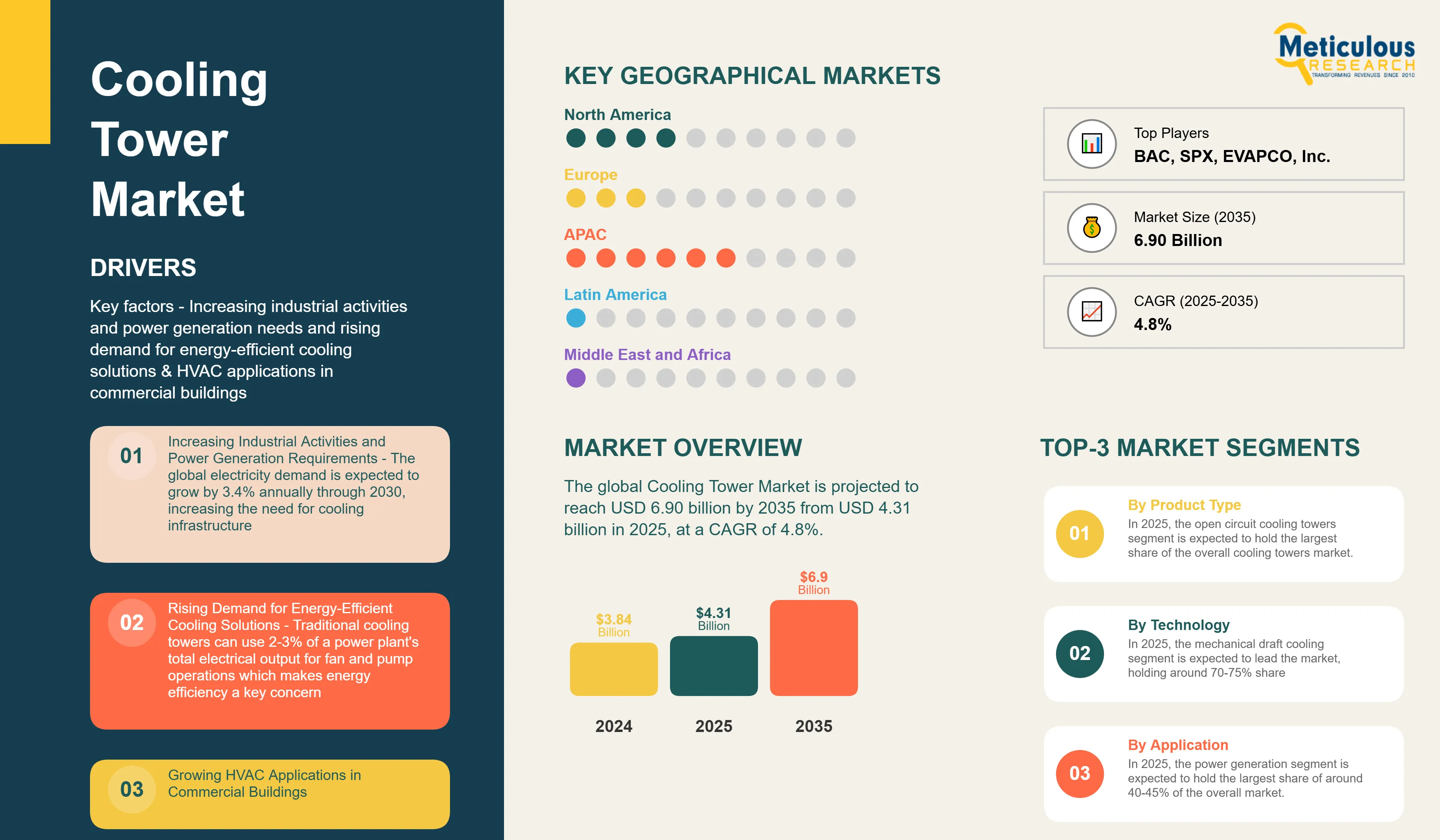
The global Cooling Tower Market is projected to reach USD 6.90 billion by 2035 from USD 4.31 billion in 2025, at a CAGR of 4.8% during the forecast period. The market was valued at USD 3.84 billion in 2024. Market Overview Key factors driving the growth of the cooling towers market include increasing
- Published
- Jul 2025
- Pages
- 178
- Format
- PDF + Excel
- Report ID
- MR-1534
- Base year
- 2024
- 2024 · BASELINE
- $3.84B
- 2035
- $6.90B
- CAGR 2025–2035
- 4.8%
2024 baseline · 2025–2035 forecast at 4.8% CAGR · hover a bar for the value
Key highlights
The global Cooling Tower Market is projected to reach USD 6.90 billion by 2035 from USD 4.31 billion in 2025, at a CAGR of 4.8% during the forecast period.
The market was valued at USD 3.84 billion in 2024.
In 2025, the Asia-Pacific region is expected to hold the largest share of around 45-50% of the global cooling towers market.
Report summary
| Particulars | Details |
|---|---|
| Number of Pages | 178 |
| Forecast Period | 2025–2035 |
| Base Year | 2024 |
| CAGR (Value) | 4.8% |
| Format | PDF, Excel & Cloud Portal · 178 pages |
| Market Size 2024 | USD 3.84 billion |
| Market Size 2025 | USD 4.31 billion |
| Market Size 2035 | USD 6.90 billion |
| Segments Covered | By Product Type, Technology, Flow Type, Material, Application |
| Countries Covered | North America (U.S., Canada), Europe (Germany, France, U.K., Italy, Spain, Netherlands, Rest of Europe), Asia-Pacific (China, Japan, India, South Korea, Australia, Rest of Asia-Pacific), Latin America (Brazil, Mexico, Rest of Latin America), and the Middle East & Africa (Saudi Arabia, UAE, Rest of Middle East & Africa) |
Report overview
Segments covered: product type, technology, flow type, application, product. Regions: North America, Europe, Asia-Pacific, Latin America, Middle East & Africa.
Key factors driving the growth of the cooling towers market include increasing industrial activities and power generation needs, rising demand for energy-efficient cooling solutions & HVAC applications in commercial buildings, and strict environmental regulations that support sustainable cooling technologies. However, high initial investment and installation costs, water scarcity and treatment issues, and maintenance and operational complexities requiring special skills are challenging the growth of this market to a certain extent.
There are also untapped opportunities in emerging markets with rapid industrialization. The integration of smart technologies and the Internet of Things for predictive maintenance, development of hybrid and modular cooling systems, and growing renewable energy sector offer significant growth potential for market players. Notable trends in this market include the use of eco-friendly and sustainable materials, modular and pre-fabricated cooling tower systems, advanced water treatment technologies, and digitalization with predictive maintenance capabilities.
Report infographic
Market dynamics
3 factors across 1 forceIncreasing Industrial Activities and Power Generation Requirements
According to the IEA (International Energy Agency), global electricity demand is expected to grow by 3.4% annually through 2030, increasing the need for cooling infrastructure. Power plants make up about 40-45% of the global cooling tower market; they need effective heat rejection systems to keep operating temperatures in check and ensure reliable electricity production. As global industrialization expands—especially in emerging economies—sectors like manufacturing, chemical processing, steel, petrochemicals, and food & beverage are consuming more energy and producing more heat. These processes require efficient thermal management, making cooling towers essential to maintain operational safety and productivity.
According to the International Energy Agency, electricity demand is growing at ~3.4% annually through 2026, especially in regions like China, India, and Southeast Asia. The rise in air conditioning demand alone will add ~1,200 TWh to global electricity requirements by 2035—far exceeding growth from data centers, and largely centered in emerging economies. Power plants—both thermal and nuclear—rely on cooling towers to condense turbines and manage heat. As electricity generation expands to meet rising demand, so too does demand for cooling infrastructure. Each megawatt of installed power generation capacity usually requires cooling systems that can reject 2-3 times the electrical output as waste heat. This creates a strong need for cooling tower installations.
Industrial processes in petrochemical, steel, chemical, and manufacturing sectors produce large amounts of process heat that must be removed efficiently to maintain ideal production conditions. The growth of these industries, especially in emerging economies, is increasing the need for specialized cooling tower solutions tailored to specific industrial applications.
Rising Demand for Energy-Efficient Cooling Solutions
The increasing focus on energy efficiency and cutting operational costs is boosting demand for better cooling tower technologies. Traditional cooling towers can use 2-3% of a power plant's total electrical output for fan and pump operations. This makes energy efficiency a key concern for plant operators.
Modern cooling tower designs that include variable frequency drives (VFDs), high-efficiency fans, and improved heat transfer materials can lower energy use by 20-30% compared to older systems. Using smart controls and IoT sensors allows for real-time adjustments of cooling tower performance based on weather conditions and load needs.
The rising emphasis on sustainability and reducing carbon footprints is leading to the use of dry and hybrid cooling technologies. These methods lower water use while still providing efficient heat rejection. They are especially useful in areas with limited water supplies and for projects that aim to lessen their environmental impact.
Growing HVAC Applications in Commercial Buildings
The growth of commercial construction and the rising need for advanced HVAC systems in office buildings, shopping centers, hospitals, and data centers are creating significant opportunities for cooling tower manufacturers. Commercial HVAC systems need dependable heat rejection to keep indoor spaces comfortable and protect sensitive equipment.
Data centers are one of the fastest-growing parts of the cooling tower market. They need constant cooling to avoid equipment overheating and to ensure reliable operations. The rapid increase in data processing, cloud computing, and digital infrastructure is fueling the demand for specialized cooling tower solutions meant for critical applications.
The push for green building certifications and energy-efficient design is encouraging the use of high-performance cooling tower systems. These systems help reduce energy use and lessen environmental impact while still delivering optimal performance.
Table of contents
13 chapters · 154 sections · 178 pages · click to expandGeographic analysis
Asia-Pacific
Largest shareIn 2025, the Asia-Pacific region is expected to hold the largest share of around 45-50% of the global cooling towers market. This is due to the region's fast industrial growth, large power generation expansion, growing manufacturing sector, and increasing infrastructure development. The Asia-Pacific cooling towers market is also projected to grow at the highest CAGR during the forecast period from 2025 to 2035. Rising industrial activities, expansion in power generation capacity, rapid urbanization leading to commercial construction, and awareness of energy-efficient cooling technologies are some of the factors driving the growth of this regional segment. China and India are driving regional growth, while developed markets such as Japan and South Korea concentrate on incorporating advanced technologies and high-efficiency solutions.
Competitive landscape
The cooling towers market includes a mix of established industrial equipment manufacturers, specialized cooling tower firms, and engineering companies that compete on technological innovation, energy efficiency, reliability, and service capabilities. Leading players in the global cooling towers market are Baltimore Aircoil Company (BAC), SPX Cooling Technologies (SPX Corporation), EVAPCO, Inc., Delta Cooling Towers, Inc., Johnson Controls International plc, Babcock & Wilcox Enterprises, Inc., Krones AG, John Cockerill (Belgium), Kelvion Holding GmbH, ENEXIO Water Technologies GmbH, Paharpur Cooling Towers Ltd., Thermax Limited, Seagull Cooling Tower Co., Ltd., Ebara Corporation, Hamon Corporation, MITA Cooling Technologies Srl, Tower Tech, Inc., Brentwood Industries, Inc., Cooling Tower Systems, Inc., and Longhua Group, among others.
These companies focus on strategies like developing energy-efficient and sustainable cooling technologies, investing in digitalization and IoT integration, expanding hybrid and dry cooling solutions, forming partnerships with power generation and industrial firms, and growing in high-growth emerging markets to strengthen their position and reach more customers.
- SPX Corporation
- EVAPCO, Inc.
- Delta Cooling Towers, Inc.
- Johnson Controls International plc
- Wilcox Enterprises, Inc.
- Krones AG
- Kelvion Holding GmbH
- ENEXIO Water Technologies GmbH
- Paharpur Cooling Towers Ltd.
- Thermax Limited
- Seagull Cooling Tower Co., Ltd.
- Ebara Corporation
- Hamon Corporation
- Technologies Srl, Tower Tech, Inc.
- Brentwood Industries, Inc.
- Cooling Tower Systems, Inc.
Frequently asked questions
The cooling towers market is projected to reach USD 6.90 billion by 2035 from USD 4.31 billion in 2025, at a CAGR of 4.8% during the forecast period.
Cite this report
Meticulous Research. (2025). Cooling Tower Market - Global Opportunity Analysis and Industry Forecast (2025–2035) (Report No. MR-1534). Meticulous Market Research Pvt. Ltd. https://www.meticulousresearch.com/product/cooling-tower-market-6217