Resources
About Us
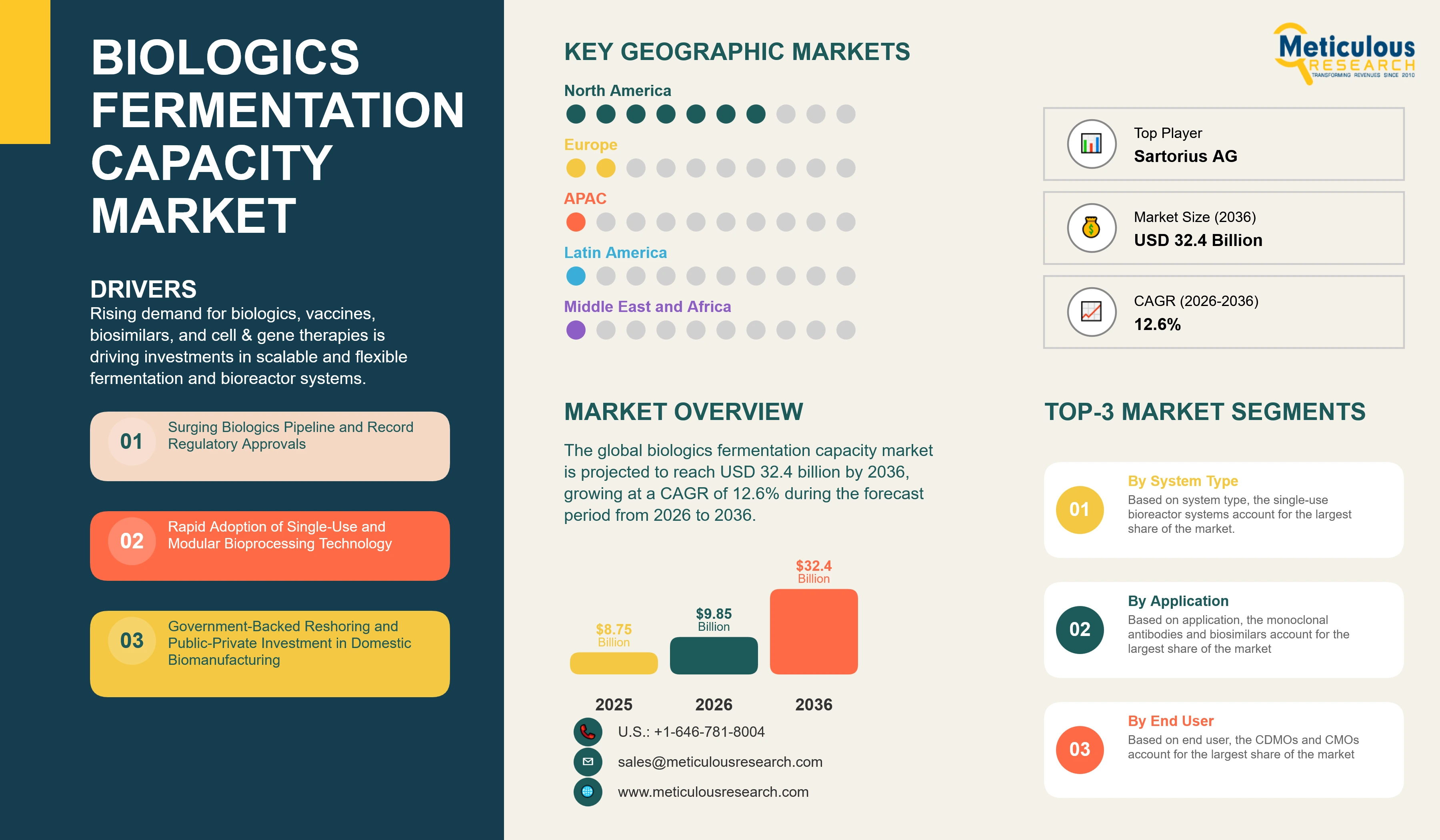
The global biologics fermentation capacity market is projected to reach USD 32.4 billion by 2036 from an estimated USD 9.85 billion in 2026, at a CAGR of 12.6% during the forecast period from 2026 to 2036. Single-use bioreactor systems account for the largest share of installed capacity additions through most of the forecast period, reflecting their lower capital intensity and faster commissioning timelines, while hybrid facility designs that combine single-use flexibility with stainless-steel scale represent the fastest-growing system category as large-scale commercial manufacturers balance speed-to-capacity with the economics of high-volume production.
Click here to: Get Free Sample Pages
Fermentation capacity refers to the installed base of bioreactor and fermenter systems, together with the associated upstream processing equipment, used to cultivate mammalian cells, bacteria, yeast, and other production organisms for manufacturing biologic drugs. The category covers classical stainless-steel, reusable bioreactor vessels engineered for large, dedicated commercial production; single-use or disposable bioreactor systems built around pre-sterilized polymer bags that eliminate cleaning and sterilization cycles between batches; and hybrid facility designs that combine both formats within the same manufacturing footprint. Fermentation capacity is installed to produce monoclonal antibodies and biosimilars, vaccines, recombinant proteins and enzymes, and a fast-growing set of cell and gene therapy products, using either mammalian cell culture platforms such as CHO and HEK293 cell lines or microbial fermentation platforms based on bacteria and yeast.
The category has moved well beyond the era when stainless-steel vessels were the default choice for any biologics facility. Sartorius, Cytiva, Thermo Fisher Scientific, and Merck KGaA now offer single-use bioreactor platforms spanning bench-scale development systems through multi-thousand-liter commercial production vessels, while specialist manufacturers such as ABEC, PBS Biotech, and Distek focus on custom, large-format single-use systems and vertical-wheel or advanced therapy-specific designs. At the same time, contract development and manufacturing organizations including FUJIFILM Diosynth Biotechnologies and WuXi Biologics continue to invest in very large stainless-steel and microbial fermenter capacity for high-volume commercial programmes, reflecting the reality that no single system type serves every stage of the biologics manufacturing lifecycle.
Demand for fermentation capacity is increasingly shaped by the sheer scale of the biologics pipeline rather than by any single therapeutic class. Regulatory approval volumes for monoclonal antibodies, biosimilars, and cell and gene therapies continue to climb, placing sustained pressure on both in-house biopharmaceutical manufacturers and outsourced CDMO networks to add fermentation capacity quickly and predictably. Government policy is reinforcing this pressure in several major markets, such as, the United States has directed public-private investment through NIIMBL into manufacturing technology and workforce readiness, the European Union has proposed the Critical Medicines Act and European Biotech Act to fast-track EU-based manufacturing capacity, and India has structured a dedicated incentive scheme for fermentation-based bulk drug production. These factors are expected to support strong, sustained growth in the biologics fermentation capacity market through 2036.
Surging Biologics Pipeline and Record Regulatory Approvals
The volume of biologics reaching regulatory approval has risen steadily over the past several years. The FDA's Center for Biologics Evaluation and Research approved 24 new Biologics License Applications in 2024, compared with 22 in 2023 and just 12 and 13 in 2021 and 2022, and monoclonal antibody approvals reached a record 13 molecules in 2024, the highest since 2015. Each newly approved biologic requires dedicated or shared fermentation capacity for both clinical supply and commercial launch, and this sustained approval volume is a direct structural driver of new bioreactor and fermenter installations across CDMOs and in-house manufacturers alike.
Rapid Adoption of Single-Use and Modular Bioprocessing Technology
Single-use bioreactor systems allow manufacturers to add fermentation capacity in months rather than the years typically required for stainless-steel facility construction, and equipment manufacturers have responded with an accelerating pace of platform launches. Thermo Fisher Scientific's February 2026 introduction of its 5-liter DynaDrive system, Cytiva's March 2025 expansion of the Xcellerex platform to 500-liter and 2,000-liter formats, and ABEC's 2025 launch of an advanced therapy-focused single-use bioreactor collectively illustrate how modular, disposable technology is becoming the default route for both new capacity and rapid capacity conversion.
Government-Backed Reshoring and Public-Private Investment in Domestic Biomanufacturing
Governments across major markets are treating biologics manufacturing capacity as a matter of supply security. In the United States, NIIMBL has channelled more than USD 111 million into biopharmaceutical manufacturing technology and workforce projects since 2017 under a cooperative agreement with NIST. In the European Union, the European Commission's Critical Medicines Act and the subsequently proposed European Biotech Act are designed to fast-track permitting and provide financial support for strategic EU manufacturing capacity projects. In India, the Department of Pharmaceuticals' Production Linked Incentive Scheme for Bulk Drugs specifically targets fermentation-based products, requiring 90% minimum domestic value addition for products manufactured through fermentation routes.
High Capital Intensity and Long Gestation Periods for Capacity Buildout
Fermentation-based manufacturing depends on the growth of living cells, which is inherently slower and less predictable than chemical synthesis, and this constraint extends directly to how quickly new capacity can be brought online and utilized. India's own Production Linked Incentive Scheme for Bulk Drugs illustrates the effect at a policy level: as of March 2026, disbursement under the fermentation-heavy bulk drugs component stood at only ₹87.70 crore against ₹6,659 crore disbursed under the broader pharmaceuticals PLI scheme, a gap that Indian government reporting attributes in part to the prolonged production cycles, high utility costs, and specialized infrastructure requirements inherent to fermentation-based manufacturing. These same dynamics apply globally, limiting how quickly greenfield and brownfield fermentation capacity investments translate into usable output.
Expansion of Fermentation Capacity for Cell and Gene Therapy and Next-Generation Modalities
Cell and gene therapy manufacturing requires fermentation and cell culture platforms distinct from those optimized for monoclonal antibodies, and equipment manufacturers are responding with dedicated designs such as ABEC's Advanced Therapy Bioreactor, engineered to mimic conditions relevant to cell therapy production. As viral vector and cell therapy pipelines mature toward commercial scale, demand for purpose-built, smaller-footprint fermentation systems represents a substantial incremental opportunity distinct from traditional large-scale mAb capacity.
Localization of Biomanufacturing Capacity in Emerging Markets
National programmes in China, South Korea, and India are actively encouraging domestic fermentation capacity build-out. WuXi Biologics' construction of a commercial microbial manufacturing site in Chengdu, featuring a 15,000-liter fermenter across a 95,000-square-meter facility, and India's PLI-backed push into fermentation-based antibiotic production illustrate how emerging-market capacity is shifting from purely cost-driven outsourcing toward strategically located, policy-supported manufacturing hubs.
Shortage of Skilled Bioprocessing Workforce and Engineering Talent
Bringing new fermentation capacity online requires specialized personnel across process development, automation, and quality operations, and this talent pool has not kept pace with capacity expansion. Indian government reporting on the Bulk Drugs PLI Scheme specifically cites limited availability of skilled labour for advanced fermentation and bioprocessing technologies as an implementation constraint, a challenge mirrored in mature markets where NIIMBL has directed a dedicated share of its project funding toward biopharmaceutical manufacturing workforce development. Newly commissioned bioreactor capacity that cannot be adequately staffed and validated remains underutilized, tempering the pace at which nominal capacity additions translate into commercial output.
Shift Toward Hybrid Facility Designs Combining Single-Use Flexibility with Stainless-Steel Scale
Large commercial manufacturers are increasingly designing facilities that pair single-use systems for early-phase flexibility with stainless-steel or large-format single-use vessels for late-stage, high-volume production. FUJIFILM Diosynth Biotechnologies' phased expansion of its Hillerød, Denmark site toward twelve 20,000-liter mammalian cell bioreactors, alongside its integrated fill-finish capability, and AGC Biologics' installation of large-format single-use systems at its Yokohama facility both reflect this blended approach to scaling capacity without committing entirely to one system type.
Rise of Continuous Bioprocessing and Process Intensification
Perfusion and continuous manufacturing techniques allow manufacturers to extract more output from a given fermentation footprint, reducing the need for proportionally larger vessels as pipelines grow. NIIMBL's Process Intensification Program has advanced a dedicated testbed facility for continuous manufacturing under its public-private partnership structure, reflecting how process intensification is being treated as a strategic capacity lever alongside physical bioreactor expansion.
By System Type: Single-Use Bioreactor Systems Lead the Market in 2026, While Hybrid Systems Grow Fastest
Based on system type, the market is segmented into single-use (disposable) bioreactor systems, stainless steel (reusable) bioreactor systems, and hybrid systems. In 2026, single-use bioreactor systems account for the largest share of new capacity additions, supported by lower upfront capital requirements and faster facility commissioning timelines from manufacturers such as Sartorius, Cytiva, and Thermo Fisher Scientific. Hybrid systems, which pair single-use flexibility with stainless-steel scale within the same facility, are projected to grow fastest as large commercial manufacturers such as FUJIFILM Diosynth Biotechnologies pursue blended capacity strategies.
By Scale of Operation: Commercial/Large Scale Leads in 2026, Bench & Pilot Scale Grows Fastest
Based on scale of operation, the market is segmented into bench and pilot scale, clinical scale, and commercial or large scale. Commercial and large-scale systems account for the largest share in 2026, reflecting the multi-thousand-liter bioreactor investments underway at CDMOs and large biopharmaceutical manufacturers. Bench and pilot scale systems are projected to grow fastest, driven by the expanding population of early-stage biotechnology companies and equipment launches such as Thermo Fisher Scientific's 5-liter DynaDrive system aimed at small-scale, GMP-ready bioprocessing.
By Mode of Operation: Fed-Batch Leads in 2026, Perfusion/Continuous Grows Fastest
Based on mode of operation, the market is segmented into batch, fed-batch, and perfusion or continuous processing. Fed-batch operation accounts for the largest share in 2026, reflecting its established role as the standard mode for monoclonal antibody manufacturing. Perfusion and continuous processing are projected to grow fastest, supported by process intensification initiatives, including NIIMBL's continuous manufacturing testbed programme, that aim to increase output per unit of installed fermentation capacity.
By Cell/Organism Type: Mammalian Cell Culture Leads in 2026, Microbial Fermentation Grows Fastest
Based on cell or organism type, the market is segmented into mammalian cell culture, microbial fermentation, and other platforms. Mammalian cell culture accounts for the largest share in 2026, reflecting its central role in producing monoclonal antibodies and other glycosylation-dependent biologics. Microbial fermentation is projected to grow fastest, supported by its cost advantages for recombinant proteins, biosimilars, and fermentation-based bulk drugs, an area specifically targeted by India's Bulk Drugs PLI Scheme.
By Application: Monoclonal Antibodies & Biosimilars Lead in 2026, Cell & Gene Therapy Grows Fastest
Based on application, the market is segmented into monoclonal antibodies and biosimilars, vaccines, cell and gene therapy, and recombinant proteins and enzymes. In 2026, monoclonal antibodies and biosimilars account for the largest share of the market, consistent with the record 13 monoclonal antibody approvals recorded by the FDA in 2024. Cell and gene therapy is projected to grow fastest, supported by dedicated fermentation and bioreactor platforms such as ABEC's Advanced Therapy Bioreactor entering commercial use.
By End User: CDMOs/CMOs Dominate the Market in 2026
Based on end user, the market is segmented into CDMOs and CMOs, biopharmaceutical and biotechnology companies, and academic and research institutes. In 2026, CDMOs and CMOs account for the largest share of the market driven by large-scale capacity investments such as FUJIFILM Diosynth Biotechnologies' Hillerød expansion and WuXi Biologics' Chengdu microbial manufacturing site. Biopharmaceutical and biotechnology companies building owned, in-house fermentation capacity are projected to register meaningful growth, supported by reshoring-oriented policy programmes including NIIMBL, the European Biotech Act, and India's Bulk Drugs PLI Scheme.
Based on geography, the global biologics fermentation capacity market is segmented into North America, Europe, Asia-Pacific, Latin America, and the Middle East & Africa. North America holds a leading share in 2026, supported by the FDA's sustained pace of biologics approvals, a dense network of CDMOs and in-house biopharmaceutical manufacturers, and public-private capacity investment channelled through NIIMBL under its cooperative agreement with the National Institute of Standards and Technology.
Europe represents a major and increasingly policy-supported centre for fermentation capacity investment, anchored by large single-site expansions such as FUJIFILM Diosynth Biotechnologies' Hillerød, Denmark facility. The European Commission's Critical Medicines Act, proposed in March 2025, and the subsequently proposed European Biotech Act of December 2025 are both designed to fast-track permitting and provide targeted financial support for EU-based biomanufacturing capacity, reinforcing the region's strategic push toward manufacturing self-sufficiency.
Asia-Pacific is expected to register the fastest CAGR during the forecast period, driven by large-scale capacity build-out in China, exemplified by WuXi Biologics' Chengdu microbial manufacturing site, continued expansion by South Korea's contract manufacturing base, and India's Department of Pharmaceuticals-administered Production Linked Incentive Scheme for Bulk Drugs, which specifically incentivizes fermentation-based production. Latin America and the Middle East & Africa remain earlier-stage markets, with growth concentrated in national health security and import-substitution initiatives for essential biologics and fermentation-based drugs.
Major companies in the global biologics fermentation capacity market have pursued platform innovation, capacity expansion, targeted acquisitions, and geographic diversification to strengthen their positions. Established bioprocess equipment manufacturers with global service networks compete alongside specialist single-use and modular system providers addressing next-generation modalities.
Some of the prominent players operating in the global biologics fermentation capacity market include Sartorius AG (Germany), Danaher Corporation/Cytiva (U.S.), Thermo Fisher Scientific Inc. (U.S.), Merck KGaA (Germany), Eppendorf SE (Germany), ABEC, Inc. (U.S.), Getinge AB (Sweden), Tofflon Science and Technology Co., Ltd. (China), GEA Group Aktiengesellschaft (Germany), Pierre Guérin (France), ZETA GmbH (Austria), Bioengineering AG (Switzerland), INFORS HT (Switzerland), PBS Biotech, Inc. (U.S.), bbi-biotech GmbH (Germany), Solaris Biotech Solutions S.r.l. (Italy).
Biologics Fermentation Capacity Market: Latest Developments from Key Industry Players
|
Particulars |
Details |
|
Forecast Period |
2026–2036 |
|
Base Year |
2025 |
|
Estimated Year |
2026 |
|
CAGR (Value) |
12.6% |
|
Market Size (Value) in 2026 |
USD 9.85 Billion |
|
Market Size (Value) in 2036 |
USD 32.4 Billion |
|
Segments Covered |
By System Type: Single-Use Bioreactor Systems; Stainless Steel/Reusable Bioreactor Systems; Hybrid Systems. By Scale of Operation: Bench & Pilot Scale; Clinical Scale; Commercial/Large Scale. By Mode of Operation: Batch; Fed-Batch; Perfusion/Continuous. By Cell/Organism Type: Mammalian Cell Culture; Microbial Fermentation; Others. By Application: Monoclonal Antibodies & Biosimilars; Vaccines; Cell & Gene Therapy; Recombinant Proteins & Enzymes. By End User: CDMOs/CMOs; Biopharmaceutical & Biotechnology Companies; Academic & Research Institutes |
|
Countries Covered |
North America (U.S., Canada), Europe (Germany, U.K., France, Denmark, Switzerland, Italy, Rest of Europe), Asia-Pacific (China, South Korea, India, Japan, Australia & New Zealand, Rest of Asia-Pacific), Latin America (Brazil, Argentina, Mexico, Rest of Latin America), and the Middle East & Africa (Saudi Arabia, UAE, South Africa, Rest of Middle East & Africa) |
|
Key Companies |
Sartorius AG (Germany), Danaher Corporation/Cytiva (U.S.), Thermo Fisher Scientific Inc. (U.S.), Merck KGaA (Germany), Eppendorf SE (Germany), ABEC, Inc. (U.S.), Getinge AB (Sweden), Tofflon Science and Technology Co., Ltd. (China), GEA Group Aktiengesellschaft (Germany), Pierre Guérin (France), ZETA GmbH (Austria), Bioengineering AG (Switzerland), INFORS HT (Switzerland), PBS Biotech, Inc. (U.S.), bbi-biotech GmbH (Germany), Solaris Biotech Solutions S.r.l. (Italy). |
|
Primary Reference Sources |
U.S. Food and Drug Administration, Center for Biologics Evaluation and Research (biologics approval data); National Institute for Innovation in Manufacturing Biopharmaceuticals, operating under cooperative agreement with the National Institute of Standards and Technology, U.S. Department of Commerce (manufacturing project investment data); European Commission (Critical Medicines Act and European Biotech Act proposals); Press Information Bureau and Department of Pharmaceuticals, Government of India (Production Linked Incentive Scheme data); company press releases, product documentation, and investor disclosures from Sartorius, Thermo Fisher Scientific, Cytiva/Danaher, Merck KGaA, ABEC, PBS Biotech, Getinge, FUJIFILM Diosynth Biotechnologies, and WuXi Biologics; and specialist trade press including BioProcess International and Fierce Pharma |
The global biologics fermentation capacity market size is estimated at USD 9.85 billion in 2026.
The market is projected to grow from USD 9.85 billion in 2026 to USD 32.4 billion by 2036, at a CAGR of 12.6%.
The biologics fermentation capacity market is projected to reach USD 32.4 billion by 2036, at a compound annual growth rate of 12.6% from 2026 to 2036.
Key companies include Sartorius AG (Germany), Danaher Corporation/Cytiva (U.S.), Thermo Fisher Scientific Inc. (U.S.), Merck KGaA (Germany), Eppendorf SE (Germany), ABEC, Inc. (U.S.), Getinge AB (Sweden), Tofflon Science and Technology Co., Ltd. (China), GEA Group Aktiengesellschaft (Germany), Pierre Guérin (France), ZETA GmbH (Austria), Bioengineering AG (Switzerland), INFORS HT (Switzerland), PBS Biotech, Inc. (U.S.), bbi-biotech GmbH (Germany), Solaris Biotech Solutions S.r.l. (Italy), among others.
The shift toward hybrid facility designs that combine single-use flexibility with stainless-steel scale, the rise of continuous bioprocessing and process intensification, and continued government-backed investment in domestic biomanufacturing capacity across the United States, European Union, and India are prominent trends in the market.
By system type, single-use bioreactor systems hold the largest share in 2026 while hybrid systems grow fastest; by scale of operation, commercial/large scale leads while bench & pilot scale grows fastest; by mode of operation, fed-batch leads while perfusion/continuous grows fastest; by cell/organism type, mammalian cell culture leads while microbial fermentation grows fastest; by application, monoclonal antibodies & biosimilars lead while cell & gene therapy grows fastest; by end user, CDMOs/CMOs lead; and by geography, North America and Europe together command the largest share in 2026.
North America and Europe hold the largest combined share in 2026, supported by dense CDMO and biopharmaceutical manufacturing networks and supportive regulatory and funding frameworks. Asia-Pacific is expected to register the fastest growth rate, driven by large-scale capacity build-out in China and South Korea and India's fermentation-focused bulk drug incentive programme.
Key drivers include the surging biologics pipeline and record regulatory approval volumes, rapid adoption of single-use and modular bioprocessing technology, and government-backed reshoring and public-private investment in domestic biomanufacturing capacity across the United States, European Union, and India.
1 Introduction
1.1. Market Definition
1.2. Currency & Limitations
2 Research Methodology
2.1. Research Approach
2.2. Data Collection & Validation
2.2.1. Secondary Research
2.2.2. Primary Research
2.3. Market Assessment
2.3.1. Market Size Estimation
2.3.2. Bottom-Up Approach
2.3.3. Top-Down Approach
2.3.4. Growth Forecast
2.4. Assumptions for the Study
3 Executive Summary
4 Market Insights
4.1. Overview
4.2. Factors Affecting Market Growth
4.2.1. Drivers
4.2.1.1. Surging Biologics Pipeline and Record Regulatory Approvals
4.2.1.2. Rapid Adoption of Single-Use and Modular Bioprocessing Technology
4.2.1.3. Government-Backed Reshoring and Public-Private Investment in Domestic Biomanufacturing
4.2.2. Restraints
4.2.2.1. High Capital Intensity and Long Gestation Periods for Capacity Buildout
4.2.3. Opportunities
4.2.3.1. Expansion of Fermentation Capacity for Cell and Gene Therapy and Next-Generation Modalities
4.2.3.2. Localization of Biomanufacturing Capacity in Emerging Markets
4.2.4. Challenges
4.2.4.1. Shortage of Skilled Bioprocessing Workforce and Engineering Talent Expected to Remain a Major Challenge
4.3. Key Trends
4.3.1. Shift Toward Hybrid Facility Designs Combining Single-Use Flexibility with Stainless-Steel Scale
4.3.2. Rise of Continuous Bioprocessing and Process Intensification
4.4. Vendor Selection Criteria/Factors Influencing Purchase Decisions
4.5. Use Cases
4.6. Porter's Five Forces Analysis
4.6.1. Bargaining Power of Buyers: Moderate
4.6.2. Bargaining Power of Suppliers: Moderate to High
4.6.3. Threat of Substitutes: Low to Moderate
4.6.4. Threat of New Entrants: Moderate
4.6.5. Degree of Competition: High
4.7. Value Chain Analysis
4.8. Pricing Analysis (Single-Use vs. Stainless-Steel Capital and Operating Cost Comparison)
4.9. Technology Analysis (Traditional Stirred-Tank vs. Single-Use, Vertical-Wheel, and Advanced Therapy Bioreactor Platforms)
4.10. Facility Design and Commissioning Timeline Analysis
4.11. Regulatory Landscape (U.S. FDA/CBER, EU Critical Medicines Act & European Biotech Act, India Fertilizer & Pharmaceutical PLI Frameworks, Other National Biomanufacturing Programmes)
4.12. Government Subsidy and Incentive Landscape
4.13. Pestel Analysis
5 Biologics Fermentation Capacity Market Assessment—By System Type
5.1. Overview
5.2. Single-Use (Disposable) Bioreactor Systems
5.3. Stainless Steel (Reusable) Bioreactor Systems
5.4. Hybrid Systems
6 Biologics Fermentation Capacity Market Assessment—By Scale of Operation
6.1. Overview
6.2. Bench & Pilot Scale
6.3. Clinical Scale
6.4. Commercial/Large Scale
7 Biologics Fermentation Capacity Market Assessment—By Mode of Operation
7.1. Overview
7.2. Batch
7.3. Fed-Batch
7.4. Perfusion/Continuous
8 Biologics Fermentation Capacity Market Assessment—By Cell/Organism Type
8.1. Overview
8.2. Mammalian Cell Culture
8.3. Microbial Fermentation
8.4. Others (Insect Cell, Yeast & Alternative Platforms)
9 Biologics Fermentation Capacity Market Assessment—By Application
9.1. Overview
9.2. Monoclonal Antibodies & Biosimilars
9.3. Vaccines
9.4. Cell & Gene Therapy
9.5. Recombinant Proteins & Enzymes
10 Biologics Fermentation Capacity Market Assessment—By End User
10.1. Overview
10.2. CDMOs/CMOs
10.3. Biopharmaceutical & Biotechnology Companies
10.4. Academic & Research Institutes
11 Biologics Fermentation Capacity Market Assessment, By Geography
11.1. Overview
11.2. North America
11.2.1. United States
11.2.2. Canada
11.3. Europe
11.3.1. Germany
11.3.2. United Kingdom
11.3.3. France
11.3.4. Denmark
11.3.5. Switzerland
11.3.6. Italy
11.3.7. Rest of Europe
11.4. Asia Pacific
11.4.1. China
11.4.2. South Korea
11.4.3. India
11.4.4. Japan
11.4.5. Australia & New Zealand
11.4.6. Rest of Asia Pacific
11.5. Latin America
11.5.1. Brazil
11.5.2. Argentina
11.5.3. Mexico
11.5.4. Rest of Latin America
11.6. Middle East & Africa
11.6.1. Saudi Arabia
11.6.2. United Arab Emirates
11.6.3. South Africa
11.6.4. Rest of Middle East & Africa
12 Competitive Landscape
12.1. Introduction
12.2. Key Growth Strategies
12.3. Competitive Benchmarking (System Type Coverage, Scale Range, Facility Footprint, Registered Geographies)
12.4. Competitive Dashboard
12.4.1. Industry Leaders
12.4.2. Market Differentiators
12.4.3. Vanguards
12.4.4. Emerging Companies
12.5. Market Share/Position Analysis
13 Company Profiles
13.1. Sartorius AG (Germany)
13.2. Danaher Corporation/Cytiva (U.S.)
13.3. Thermo Fisher Scientific Inc. (U.S.)
13.4. Merck KGaA (Germany)
13.5. Eppendorf SE (Germany)
13.6. ABEC, Inc. (U.S.)
13.7. Getinge AB (Sweden)
13.8. Tofflon Science and Technology Co., Ltd. (China)
13.9. GEA Group Aktiengesellschaft (Germany)
13.10. Pierre Guérin (France)
13.11. ZETA GmbH (Austria)
13.12. Bioengineering AG (Switzerland)
13.13. INFORS HT (Switzerland)
13.14. PBS Biotech, Inc. (U.S.)
13.15. bbi-biotech GmbH (Germany)
13.16. Solaris Biotech Solutions S.r.l. (Italy)
14 Appendix
14.1. Available Customization
14.2. Related Reports
























Published Date: Aug-2026
Published Date: Jun-2026
Published Date: Oct-2013
Subscribe to get the latest industry updates