Battery Recycling Equipment Market
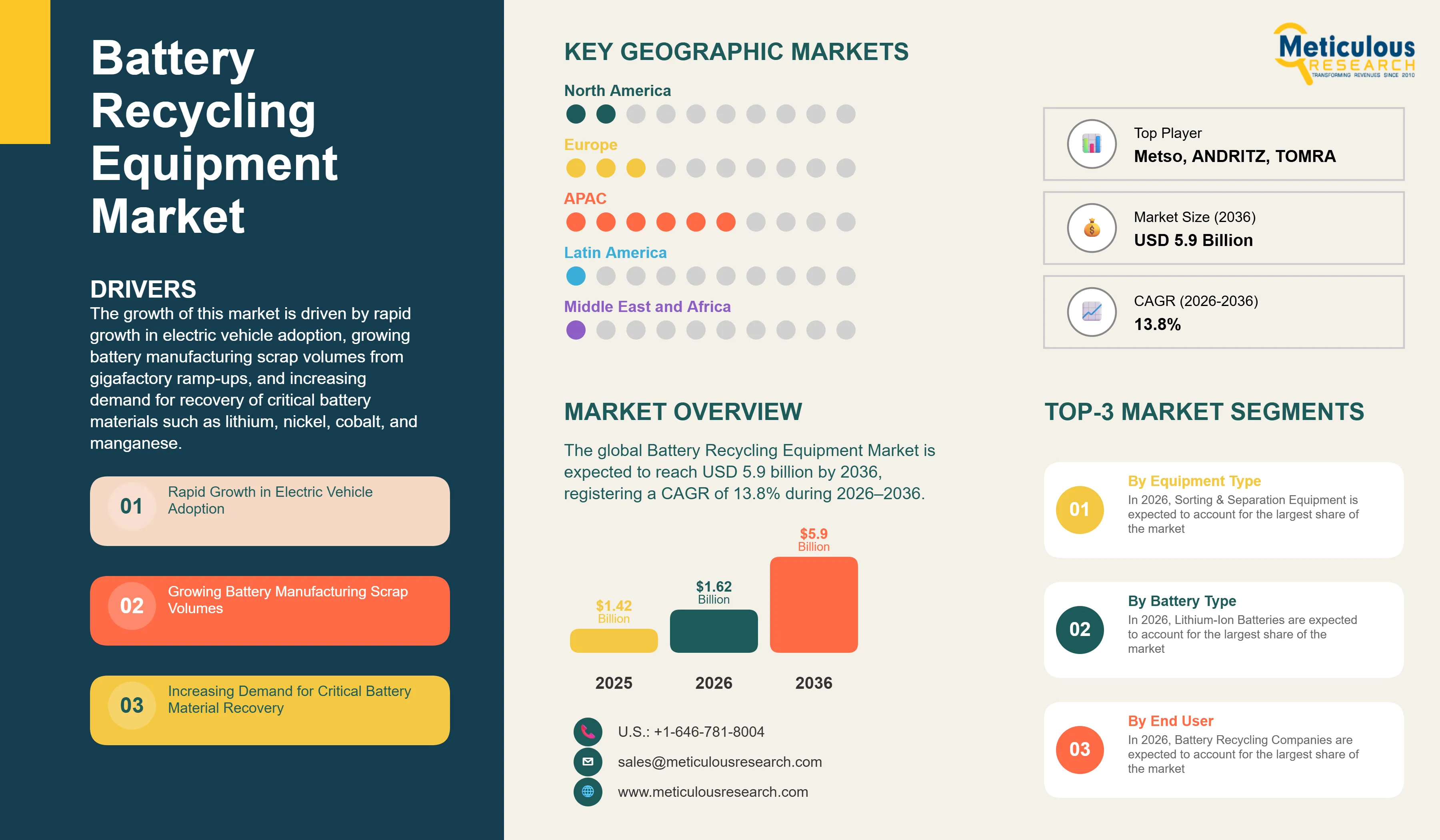
The global Battery Recycling Equipment Market was valued at USD 1.42 billion in 2025 and is projected to reach USD 1.62 billion in 2026. The market is expected to reach USD 5.9 billion by 2036, registering a CAGR of 13.8% during the forecast period (2026-2036).
- Published
- Aug 2026
- Pages
- 310
- Format
- PDF + Excel
- Report ID
- MR-2135
- Base year
- 2025
- 2025 · BASELINE
- $1.42B
- 2036
- $5.90B
- CAGR 2026–2036
- 13.8%
2025 baseline · 2026–2036 forecast at 13.8% CAGR · hover a bar for the value
Key highlights
The global Battery Recycling Equipment Market is projected to reach USD 5.9 billion by 2036, driven by rapid growth in electric vehicle adoption and the rising volume of end-of-life lithium-ion batteries entering the recycling stream.
Asia-Pacific is expected to account for the largest market share in 2026, while North America is projected to register the fastest growth during the forecast period.
By equipment type, Sorting & Separation Equipment is expected to account for the largest market share, whereas Direct Recycling Equipment is projected to witness the fastest growth through 2036.
By recycling process, Hydrometallurgical Recycling is expected to dominate the market, while Direct Recycling is projected to register the highest CAGR during the forecast period.
Manufacturing scrap rates in gigafactories can run as high as 15-30% during production ramp-up, according to Fraunhofer FFB, generating substantial near-term feedstock volumes for battery recycling equipment even ahead of large-scale end-of-life EV battery returns.
Government-backed investment, including the U.S. DOE's over USD 200 million commitment to the ReCell Center and the USD 3 billion allocated under the Bipartisan Infrastructure Law for battery manufacturing and recycling projects, is expected to create significant long-term growth opportunities.
Report summary
| Particulars | Details |
|---|---|
| Forecast Period | 2026-2036 |
| Base Year | 2025 |
| Estimated Year | 2026 |
| CAGR (Value) | 13.8% |
| Format | PDF, Excel & Cloud Portal · 310 pages |
| Market Size (Value) in 2026 | USD 1.62 Billion |
| Market Size (Value) in 2036 | USD 5.9 Billion |
| Segments Covered | By Equipment Type: Battery Collection, Handling & Discharge Equipment, Battery Dismantling Equipment, Battery Crushing & Shredding Equipment, Sorting & Separation Equipment, Black Mass Processing Equipment, Hydrometallurgical Processing Equipment, Pyrometallurgical Processing Equipment, Direct Recycling Equipment, Material Recovery & Refining Equipment, Environmental & Safety Equipment, Automation, Robotics & Process Control Equipment. · By Recycling Process: Mechanical Recycling, Hydrometallurgical Recycling, Pyrometallurgical Recycling, Direct Recycling, Hybrid Recycling. By Battery Type: Lithium-Ion Batteries (NMC, NCA, LFP, LCO, LMO), Lead-Acid Batteries, Nickel-Based Batteries, Emerging Battery Chemistries. · By Battery Form Factor: Cylindrical Cells, Prismatic Cells, Pouch Cells, Battery Modules, Battery Packs. By Feedstock: End-of-Life Batteries, Manufacturing Scrap. By Recovered Material: Lithium, Nickel, Cobalt, Manganese, Copper, Aluminum, Graphite. · By Capacity: Small-Scale, Medium-Scale, Large-Scale, Gigafactory-Scale Systems. · By End User: Battery Recycling Companies, Battery Manufacturers, Automotive OEMs, Battery Material Producers, Electronics Manufacturers, Energy Storage System Manufacturers, Waste Management Companies. |
| Countries Covered | North America: U.S., Canada. · Europe: Germany, France, U.K., Italy, Spain, Norway, Sweden, Rest of Europe. · Asia-Pacific: China, Japan, South Korea, India, Australia, Indonesia, Rest of Asia-Pacific. · Latin America: Brazil, Mexico, Argentina, Chile, Rest of Latin America. · Middle East & Africa: UAE, Saudi Arabia, South Africa, Israel, Rest of Middle East & Africa. |
| Key Companies | Metso Corporation, ANDRITZ AG, FLSmidth & Co. A/S, Hosokawa Micron Group, Bühler AG, Eldan Recycling A/S, TOMRA Systems ASA, Komptech GmbH, Duesenfeld GmbH, BHS-Sonthofen GmbH, STOKES, Wendt Corporation, REDWAVE, SWECO, and Goudsmit Magnetics. |
Report overview
Segments covered: equipment type, recycling process, battery form factor, capacity, end user, battery type, feedstock.
The Battery Recycling Equipment Market comprises the machinery and systems used to collect, discharge, dismantle, shred, sort, and process spent batteries and battery manufacturing scrap to recover critical materials such as lithium, nickel, cobalt, manganese, copper, and aluminum. Equipment spans battery collection and discharge systems, automated dismantling and robotic disassembly systems, crushers and shredders, magnetic and eddy current separators, black mass processing equipment, and hydrometallurgical, pyrometallurgical, and direct recycling process equipment, deployed by battery recycling companies, battery manufacturers, automotive OEMs, and material recovery companies.
Demand for recycling equipment is being shaped by two converging feedstock streams: battery manufacturing scrap and end-of-life batteries. On the manufacturing side, scrap rates in gigafactories are commonly reported in the range of 15% to 30% during the first few years of production ramp-up, and can remain around 10% even after five years of operation, according to a joint white paper by Fraunhofer FFB and RWTH Aachen University. With global battery demand projected to reach 2,500 to 3,500 GWh by 2030 per the same analysis, even modest scrap rates translate into substantial and immediate volumes of recyclable material, making manufacturing scrap the dominant near-term feedstock ahead of large-scale end-of-life EV battery returns.
On the policy side, government investment is reinforcing infrastructure build-out for recycling equipment. In the United States, the Department of Energy's ReCell Center has invested more than USD 200 million in battery recycling research focused on direct recycling processes capable of recovering cathode materials at up to 50% lower cost than conventional pyrometallurgical routes, while the Bipartisan Infrastructure Law has allocated USD 3 billion toward battery manufacturing and recycling projects.
Report infographic
Market dynamics
8 factors across 4 forcesRapid Growth in Electric Vehicle Adoption
The accelerating global adoption of electric vehicles is a primary driver of demand for battery recycling equipment, as it expands both the installed base of lithium-ion batteries that will eventually require end-of-life processing and the scale of battery cell manufacturing, which itself generates significant recyclable scrap. According to the IEA's Global EV Outlook 2026, global electric car sales exceeded 20 million units in 2025, increasing by approximately 20% from 2024 and accounting for around 25% of all new car sales worldwide. China remained the dominant market, with more than 13 million electric cars sold in 2025, representing nearly 60% of global electric car sales, while Europe recorded more than 4 million sales after a 30% increase. This rapid expansion is creating a substantially larger future feedstock base for battery recycling. As EV battery packs reach end-of-life over the coming decade, recyclers are investing in automated disassembly, shredding, separation, and material recovery equipment sized for growing battery volumes.
Growing Battery Manufacturing Scrap Volumes
The rapid buildout of battery gigafactories is generating substantial manufacturing scrap volumes that require dedicated recycling equipment. According to the International Energy Agency (IEA), global battery cell manufacturing capacity exceeded 3 TWh in 2024, while battery demand from the energy sector reached approximately 1 TWh for the first time, indicating a rapidly expanding manufacturing base and growing potential for production scrap. The IEA also projects global battery manufacturing capacity to remain significantly above announced battery demand through 2030, creating increasing opportunities for recycling and recovery of manufacturing scrap. Scrap rates during gigafactory ramp-up can be substantially higher than during mature production, particularly because of yield losses during process qualification and equipment ramp-up. Fraunhofer Research Institution for Battery Cell Production (FFB) research indicates that production scrap can reach double-digit percentages during battery manufacturing ramp-up, with improvements in yield required as factories move toward stable mass production. This creates an immediate feedstock stream for equipment such as electrode scrap separation, shredding, and black mass processing systems well ahead of large-scale end-of-life EV battery volumes.
Table of contents
16 chapters · 262 sections · 310 pages · click to expandSegmental analysis
| Segment | Largest share (2026) | Fastest growth (2026–2036) |
|---|---|---|
| By Equipment Type | Sorting & Separation Equipment | Direct Recycling Equipment |
| By Recycling Process | Hydrometallurgical Recycling | Direct Recycling |
| By Battery Type | Lithium-Ion Batteries | — |
| By Feedstock | Manufacturing Scrap | End-of-Life Batteries |
| By End User | Battery Recycling Companies | Battery Manufacturers |
By Equipment Type
- Sorting & Separation Equipment is expected to account for the largest market share, supported by its critical role in isolating recoverable materials and battery chemistries across mixed feedstock streams using magnetic, eddy current, and sensor-based sorting technologies.
- However, Direct Recycling Equipment is projected to register the fastest growth during the forecast period, driven by rising investment in cathode regeneration and relithiation systems that offer lower-cost material recovery.
By Recycling Process
- Hydrometallurgical Recycling is expected to account for the largest market share, owing to its established ability to achieve high recovery rates of lithium, nickel, and cobalt at battery-grade purity.
- However, Direct Recycling is projected to register the highest CAGR during the forecast period, supported by government-backed research demonstrating significant cost advantages over conventional recycling routes.
By Battery Type
- Lithium-Ion Batteries are expected to account for the largest market share, driven by their dominant use in electric vehicles, consumer electronics, and energy storage systems.
- However, Emerging Battery Chemistries, including sodium-ion and solid-state batteries, are projected to register the highest CAGR during the forecast period, as recyclers begin building dedicated processing capacity ahead of anticipated future feedstock volumes.
By Feedstock
- Manufacturing Scrap is expected to account for the largest market share, reflecting the substantial scrap volumes generated during gigafactory ramp-up, which can range from 15% to 30% of material inputs.
- However, End-of-Life Batteries are projected to register the highest CAGR during the forecast period, as the first large wave of electric vehicle batteries deployed over the past decade begins reaching end-of-life.
By End User
- Battery Recycling Companies are expected to account for the largest market share, reflecting their role as dedicated equipment operators processing feedstock from multiple upstream sources.
- However, Battery Manufacturers are projected to register the highest CAGR during the forecast period, as gigafactory operators increasingly integrate in-house or co-located recycling equipment to process manufacturing scrap and support closed-loop material strategies.
Geographic analysis
Asia-Pacific
Largest shareIn 2026, Asia-Pacific is expected to account for the largest share of the global Battery Recycling Equipment Market, supported by the region's dominant position in global battery cell manufacturing capacity, led by China, along with growing recycling infrastructure investment in Japan, South Korea, and India to process both manufacturing scrap and the rapidly expanding installed base of lithium-ion batteries. According to the International Energy Agency (IEA), China accounted for around 80% of global battery cell manufacturing capacity in 2025, while global battery manufacturing capacity exceeded 3 TWh. China also accounted for more than half of global battery demand in 2025, creating a substantial future feedstock base for recycling equipment. The region's expanding EV market and large manufacturing base are expected to sustain demand for shredding, sorting, black mass processing, hydrometallurgical, and direct recycling equipment.
North America
Fastest growthHowever, North America is projected to register the highest CAGR during the forecast period, driven by substantial government-backed investment in domestic battery manufacturing and recycling infrastructure. Under the U.S. Bipartisan Infrastructure Law, the U.S. Department of Energy has made more than US$3 billion available for battery manufacturing, recycling, and materials processing projects, while the DOE has also awarded more than US$70 million to support battery recycling research and development through programs including the ReCell Center. The U.S. Department of Energy's Battery Manufacturing and Recycling Grants have supported projects across the country to establish domestic capacity for battery materials recovery and recycling. These investments, combined with rapidly increasing EV adoption and the localization of battery supply chains, are accelerating the buildout of domestic recycling capacity and creating strong demand for advanced battery recycling equipment across the United States and Canada.
Competitive landscape
The global Battery Recycling Equipment Market is moderately fragmented, with competition among established industrial processing equipment manufacturers, specialized battery recycling technology providers, and material handling and sorting equipment suppliers. Companies compete primarily on material recovery rates, processing throughput, equipment safety features for handling hazardous battery feedstock, and the ability to support multiple recycling process routes within a single facility.
Leading market participants are investing in automated robotic disassembly systems, AI-based sorting technologies, and direct recycling process equipment to support rising material recovery expectations and closed-loop supply chain strategies. Strategic partnerships with battery manufacturers and automotive OEMs, capacity expansion at existing recycling facilities, and continued R&D investment in hydrometallurgical and direct recycling process equipment remain key strategies adopted by major vendors.
The report provides a comprehensive competitive assessment of the leading companies operating in the global Battery Recycling Equipment Market. The key players profiled in the report include Metso Corporation, ANDRITZ AG, FLSmidth & Co. A/S, Hosokawa Micron Group, Bühler AG, Eldan Recycling A/S, TOMRA Systems ASA, Komptech GmbH, Duesenfeld GmbH, BHS-Sonthofen GmbH, STOKES, Wendt Corporation, REDWAVE, SWECO, and Goudsmit Magnetics.
- Metso Corporation
- ANDRITZ AG
- FLSmidth & Co. A/S
- Hosokawa Micron Group
- Bühler AG
- Eldan Recycling A/S
- TOMRA Systems ASA
- Komptech GmbH
- Duesenfeld GmbH
- BHS-Sonthofen GmbH
- STOKES
- Wendt Corporation
- REDWAVE
- SWECO
- Goudsmit Magnetics
Frequently asked questions
The global Battery Recycling Equipment Market is estimated at USD 1.62 billion in 2026.
Cite this report
Meticulous Research. (2026). Battery Recycling Equipment Market - Global Opportunity Analysis and Industry Forecast to 2036 (Report No. MR-2135). Meticulous Market Research Pvt. Ltd. https://www.meticulousresearch.com/product/battery-recycling-equipment-market-6818