Recycling Equipment Market (2026-2036)
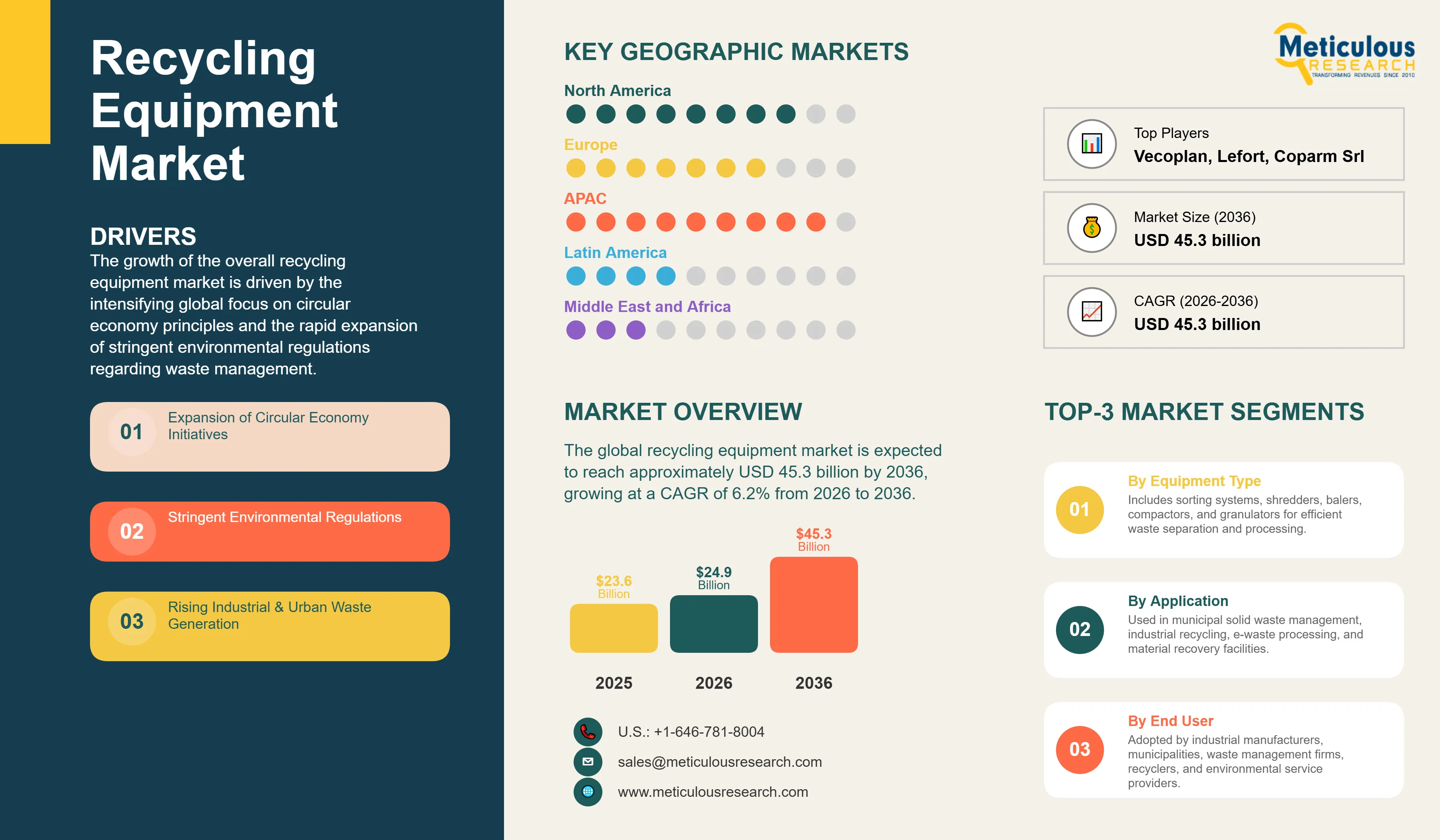
The global recycling equipment market was valued at USD 23.6 billion in 2025. The market is expected to reach approximately USD 45.3 billion by 2036 from USD 24.9 billion in 2026, growing at a CAGR of 6.2% from 2026 to 2036.
- Published
- Feb 2026
- Pages
- 290
- Format
- PDF + Excel
- Report ID
- MR-1755
- Base year
- 2025
- 2025 · BASELINE
- $23.60B
- 2036
- $45.30B
- CAGR 2026–2036
- 6.2%
2025 baseline · 2026–2036 forecast at 6.2% CAGR · hover a bar for the value
Key highlights
In terms of revenue, the global recycling equipment market is projected to reach USD 45.3 billion by 2036.
The market is expected to grow at a CAGR of 6.2% from 2026 to 2036.
Asia-Pacific dominates the global recycling equipment market with the largest market share in 2026, driven by massive investments in waste management infrastructure and the rapid adoption of advanced sorting solutions in China, India, and Southeast Asia.
North America is expected to witness steady growth during the forecast period, supported by advanced environmental engineering innovators and the presence of leading technology firms in the U.S. and Canada.
By equipment type, the sorting systems segment holds the largest market share in 2026, particularly in supporting high-purity material recovery projects, rapid urbanization requirements, and superior efficiency in municipal solid waste networks.
By processed material, the metal segment holds the largest market share in 2026, due to the high economic value of scrap metal and the increasing demand for secondary raw materials in the manufacturing sector.
By end-use, the industrial segment holds the largest share of the overall market in 2026.
Report summary
| Particulars | Details |
|---|---|
| Market Size by 2036 | USD 45.3 Billion |
| Market Size in 2026 | USD 24.9 Billion |
| Market Size in 2025 | USD 23.6 Billion |
| Market Growth Rate (2026-2036) | CAGR of 6.2% |
| Format | PDF, Excel & Cloud Portal · 290 pages |
| Dominating Region | Asia-Pacific |
| Fastest Growing Region | Asia-Pacific |
| Base Year | 2025 |
| Forecast Period | 2026 to 2036 |
| Segments Covered | Equipment Type, Processed Material, End-use, and Region |
| Regions Covered | North America, Europe, Asia-Pacific, Latin America, and Middle East & Africa |
Report overview
Segments covered: equipment type, processed material, end-use.
The growth of the overall recycling equipment market is driven by the intensifying global focus on circular economy principles and the rapid expansion of stringent environmental regulations regarding waste management. As waste management providers seek to integrate more functionality into material recovery and processing systems, recycling equipment has become essential for maintaining high-performance resource recovery and operational efficiency. The rapid expansion of smart sorting initiatives and the increasing need for high-reliability processing in industrial and municipal complexes continue to fuel significant growth of this market across all major geographic regions.
Recycling equipment are critical environmental systems that leverage advanced separation and processing technologies to provide optimized resource recovery and improved waste stability through a connected structural infrastructure. These systems include integrated sensor-based sorters, high-torque shredders, and automated balers designed to automate material detection and enhance system integrity across the waste lifecycle. The market is defined by high-efficiency technologies such as AI-driven optical sorting and IoT-enabled predictive maintenance, which significantly enhance recovery precision and resource utilization in high-pressure processing environments. These systems are indispensable for facility administrators seeking to optimize their internal operations and meet aggressive sustainability and safety targets.
The market includes a diverse range of solutions, ranging from simple vertical balers for commercial applications to complex multi-sensor sorting lines and AI-driven robotic separation platforms. These systems are increasingly integrated with advanced components such as deep learning algorithms and cloud-based monitoring to provide services such as real-time purity analysis and remote diagnostics of processing networks. The ability to provide stable, high-precision recovery while minimizing contamination has made recycling equipment technology the choice for institutions where material accuracy and operational reliability are paramount.
The global environmental sector is pushing hard to modernize facility capabilities, aiming to meet net-zero carbon targets and consumer-centric sustainability goals. This drive has increased the adoption of high-performance recovery solutions, with advanced digital sorters helping to stabilize internal material flows for ultra-high-efficiency recovery operations. At the same time, the rapid growth in the green manufacturing and circular economy markets is increasing the need for high-reliability, secure processing solutions.
Report infographic
Market dynamics
4 factors across 3 forcesCircular Economy Initiatives and Stringent Waste Regulations
A key driver of the recycling equipment market is the rapid movement of the global environmental industry toward sustainable, circular economy models. Global demand for seamless resource recovery, real-time material monitoring, and data-driven waste management has created significant incentives for the adoption of recycling equipment infrastructure. The trend toward “zero-waste” and the integration of recovery systems into unified digital platforms drive waste managers toward scalable solutions that recycling equipment can uniquely provide. It is estimated that as urban adoption of recycled materials rises and resource tools become more decentralized through 2036, the need for robust, connected infrastructure increases significantly; therefore, high-performance digital sorters and modular shredders, with their ability to ensure high-density material processing, are considered a crucial enabler of modern resource delivery strategies.
Table of contents
10 chapters · 96 sections · 290 pages · click to expandSegmental analysis
| Segment | Largest share (2026) | Fastest growth (2026–2036) |
|---|---|---|
| By Equipment Type | Sorting Systems | — |
| By Processed Material | Metal | Plastic |
| By End-use | Industrial | — |
By Equipment Type
- The sorting systems segment accounts for a significant portion of the overall recycling equipment market in 2026.
- This is mainly attributed to the versatile use of this technology in supporting high-purity material recovery projects, rapid urbanization requirements, and complex municipal designs within modern urban environments.
- These systems offer the most comprehensive way to ensure quality control across diverse material applications.
- The municipal and industrial sectors alone consume a large share of sorting systems, with major projects in Asia-Pacific and North America demonstrating the technology’s capability to handle high-density structural requirements.
- However, the shredders segment is expected to grow at a rapid CAGR during the forecast period, driven by the growing need for robust implementation, e-waste integration, and technical support in complex industrial digital transformations.
By Processed Material
- The metal segment holds the largest share of the overall market in 2026.
- This is primarily due to the massive volume of industrial scrap and the rigorous purity standards required for modern manufacturing management.
- Current large-scale resource systems are increasingly specifying high-density digital platforms to ensure compliance with global quality standards and consumer expectations for reliable material environments.
- The plastic segment is expected to witness the fastest growth during the forecast period.
- The shift toward high-purity polymer recovery and the complexity of multi-functional packaging materials are pushing the requirement for advanced smart systems that can handle varied material profiles and high-resolution operational data while ensuring absolute reliability for safety-critical environmental decisions.
By End-use
- The industrial segment commands the largest share of the global recycling equipment market in 2026.
- This dominance stems from its superior ability to support large-scale manufacturing plants, mining operations, and construction sites, making it the end-use of choice for high-performance recycling equipment.
- Large-scale operations in public infrastructure, urban redevelopment, and mixed-use projects drive demand, with advanced systems from providers like Metso and TOMRA enabling reliable performance in complex industrial environments.
- However, the municipal segment is poised for steady growth through 2036, fueled by expanding applications in smart waste collection and urban recovery centers.
- Municipalities face mounting pressure to optimize costs for high-volume, less demanding applications, where recycling equipment provides a cost-effective alternative for basic material connectivity.
Geographic analysis
Asia-Pacific
Largest shareAsia-Pacific holds the largest share of the global recycling equipment market in 2026. The largest share of this region is primarily attributed to the massive investments in waste management infrastructure and the presence of the world’s leading manufacturing hubs, particularly in China and India. China alone accounts for a significant portion of global recycling equipment investment, with its position as a leading adopter of circular economy technology and green manufacturing driving sustained growth. The presence of leading manufacturers like Satake and a well-developed environmental supply chain provides a robust market for both standard and high-density smart solutions.
North America
North America and Europe together account for a substantial share of the global recycling equipment market. The growth of these markets is mainly driven by the need for technological modernization in the environmental and industrial sectors. The demand for advanced smart systems in North America is mainly due to its large-scale resource redevelopment projects and the presence of innovators like SSI Shredding Systems and Eriez.
Europe
In Europe, the leadership in environmental engineering and the push for sustainable resource innovation are driving the adoption of high-reliability smart solutions. Countries like Germany, Norway, and the UK are at the forefront, with significant focus on integrating smart digital solutions into resource workflows and advanced environmental systems to ensure the highest levels of performance and reliability.
Competitive landscape
- TOMRA Systems ASA
- Metso Corporation
- Steinert GmbH
- BHS-Sonthofen GmbH
Frequently asked questions
The global recycling equipment market is expected to grow from USD 24.9 billion in 2026 to USD 45.3 billion by 2036.
Cite this report
Meticulous Research. (2026). Recycling Equipment Market - Global Opportunity Analysis and Industry Forecast (2026-2036) (Report No. MR-1755). Meticulous Market Research Pvt. Ltd. https://www.meticulousresearch.com/product/recycling-equipment-market-6438