
Asia-Pacific Electric Car Market (2021-2028)
The Asia-Pacific Electric Car Market is expected to reach a value of $761.97 billion by 2028, at a CAGR of 34.6 % during the forecast period 2021-2028. By volume, this market is expected to grow at a CAGR of 40.4% from 2021 to reach 53.8 million units by 2028.
- Published
- Jan 2022
- Pages
- 105
- Format
- PDF + Excel
- Report ID
- MR-524
- Base year
- 2020
- 2028 · FORECAST
- $762.0B
- 2028
- $762.0B
- CAGR 2021–2028
- 34.6%
2020 baseline · 2021–2028 forecast at 34.6% CAGR · hover a bar for the value
Key highlights
The fuel cell electric vehicles segment is projected to grow at a significant pace during the forecast period
The 100kW to 250 kW segment is projected to grow at a significant pace during the forecast period
The commercial use segment is projected to grow at a significant pace during the forecast period
India to be the fastest-growing market by value and by volume, Singapore to be the fastest-growing market
Report summary
| Particulars | Details |
|---|---|
| Base Year | 2020 |
| Estimated Year | 2021 |
| Forecast Period | 2021–2028 |
| Market Size (2028) | USD 761.97 billion |
| CAGR (2021–2028) | 34.6% |
| Format | PDF, Excel & Cloud Portal · 105 pages |
| Segments Covered | By Propulsion Type: Hybrid Vehicles Pure Hybrid Vehicles, Plug-in Hybrid Vehicles · By Power Output: Less Than 100 kW, 100 kW to 250 kW · By End-Use: Private Use, Commercial Use · By End Use: Private, Commercial |
| Countries Covered | Asia-Pacific (Japan, South Korea, India, Singapore, Thailand, Philippines, Malaysia, Australia, New Zealand, Taiwan, Rest of Asia-Pacific) |
| Key Companies | Honda Motor Co., Ltd., Toyota Motor Corporation, Tata Motors Limited, Mahindra Ltd., NIO Inc., XPeng Inc., Geely Automobile Holdings Limited, Nissan Motor Co., Ltd., Mitsubishi Motor Corporation |
Report overview
Segments covered: propulsion type, power output, end-use, end use. Regions: Asia-Pacific.
Supportive government policies and regulations, increasing investments by leading automotive OEMs, and decreasing battery prices are the key factors driving the growth of the Asia-Pacific electric cars market. Increasing adoption of electric mobility in emerging economies and increasing EV and battery manufacturing capabilities in Southeast Asia provides significant growth opportunities for market players in the coming years.
The Asia-Pacific electric cars market was moderately affected due to the quick recovery of automotive manufacturing industries in China. The developing countries witnessed a sharp decline in their economy due to low consumer demands and increased prices for essential commodities. The adoption of electric cars has also decreased significantly. The high cost of electric cars also remained a restraining factor for the growth of the electric cars market in these countries. However, stringent government regulations in phasing out ICE vehicles till 2030 are expected to support the market's growth during the forecast period.
In Thailand, the government has introduced an EV roadmap to produce about 250,000 electric cars and establish itself as an Asian EV hub by 2025. Moreover, the tax incentives provided by the government on purchasing electric cars are poised to increase the adoption rate in a couple of years, thus supporting the market growth during the forecast period.
The supply chain diversification trend is the major driver for the Southeast Asian automotive industry. In this region, Thailand is one of the largest automotive manufacturers due to its well-established automotive manufacturing know-how, policy package, and strategic location that makes a perfect diversification option for the automotive industry, including the strategic EV manufacturing sector. In 2020, the Southeast Asian automotive industry was badly hit by coronavirus pandemic, it aimed to seize the opportunity of the rising EV manufacturing sector, but investments by foreign investors have strengthened the EV market of this region. As of 2020, the Board of Investment of Thailand (BOI) has approved 24 projects by the automotive industry to produce several types of electric vehicles in the country with a capacity of over 500,000 units annually. Further, in 2020, according to the Thai government, the BOI aimed to encourage EV production that will account for 30% of the total Thai automotive production by 2030. Thus, increasing government initiatives are expected to overcome this challenge in the coming years.
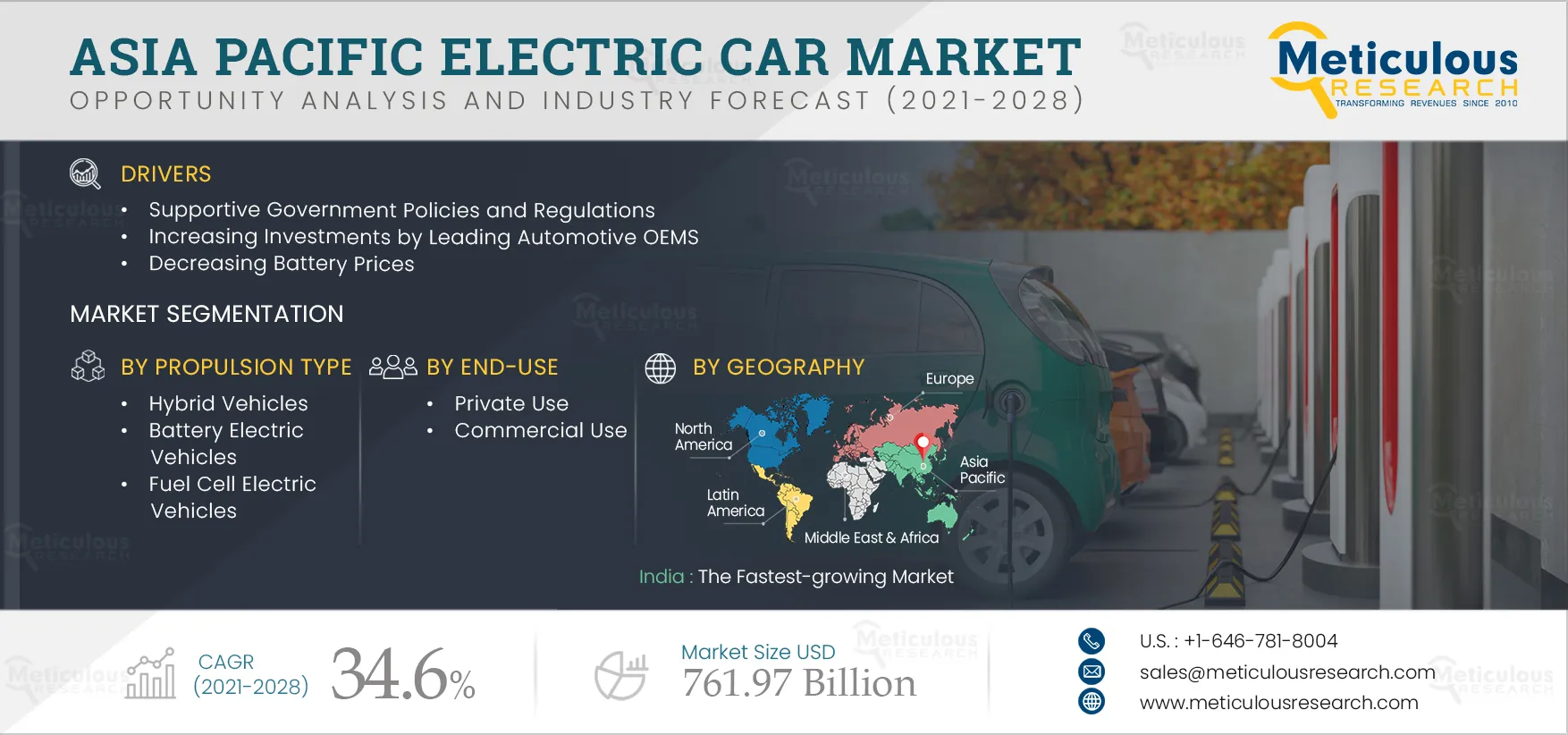
Table of contents
12 chapters · 166 sections · 105 pages · click to expandSegmental analysis
| Segment | Largest share (2021) | Fastest growth (2021–2028) |
|---|---|---|
| By Propulsion Type | Hybrid vehicles | Fuel cell electric vehicles |
| By Power Output | Less than 100 kW | 100 kW |
| By End use | Private use | Commercial use |
By Propulsion Type
- The fuel cell electric vehicles segment is projected to grow at a significant pace during the forecast period
- The hybrid vehicles segment is estimated to account for the largest share of the Asia-Pacific electric cars market in 2021.
- However, the fuel cell electric vehicles segment is projected to grow at the highest CAGR during the forecast period.
- The rapid growth of this segment is mainly attributed to fast refueling, zero tailpipe emissions, smaller battery pack, various government initiatives for setting up hydrogen fuel cell charging stations, and increasing investments by leading automotive OEMs in the research and development of hydrogen fuel cell technology.
By Power Output
- The 100kW to 250 kW segment is projected to grow at a significant pace during the forecast period
- The less than 100 kW segment is estimated to account for the largest share of the Asia-Pacific electric cars market in 2021.
- However, the 100 kW to 250 kW segment is projected to grow at the highest CAGR during the forecast period.
- The rapid growth of this segment is mainly attributed to the increasing initiatives by leading automotive OEMs to introduce electric cars, increasing regulations and laws to reduce tailpipe emissions and rising adoption of electric cars in developed economies.
By End use
- The commercial use segment is projected to grow at a significant pace during the forecast period
- The private use segment is estimated to account for the largest share of the Asia-Pacific electric cars market in 2021.
- However, the commercial use segment is projected to grow at the highest CAGR during the forecast period.
- The rapid growth of this segment is mainly attributed to the increasing use of electric cars in shared mobility services and corporate taxi fleets, increasing regulations to reduce fleet emissions, and encouragement by global and state-level regulatory bodies to deploy policies promoting the adoption of electric cars for mobility services.
Geographic analysis
Asia-Pacific
Fastest growthHowever, India is estimated to account for the fastest growth during the forecast period. The factors attributed to the high growth of this country are growing investments by the leading automobile companies in the electric mobility ecosystem, the increasing number of start-ups operating in the electric mobility and associated technologies industry, and the growing need of government to reduce the pollution caused by combustion engine vehicles. India is considered one of the fastest-growing consumer markets in the world. The Indian government has also introduced fiscal incentives such as reduction of customs duty on import of EV components to 10-15%, reduction of GST on EV reduced to 5% from 12%, lowest RTO tax for EVs, and elimination of the requirement of a license to operate EV charging stations. Moreover, leading automotive OEMs are increasingly investing in the development of electric vehicle technology in India. For instance, Mahindra and Mahindra Ltd. has plans to invest USD 400 million (INFR 3,000 Crore) in developing an EV platform over the next three years. Such initiatives are expected to support the growth of the electric cars market in India during the forecast period. By Volume, Singapore is projected to grow at the highest CAGR during the forecast period. Major factors attributed to the high growth of this country are the investment by major automotive OEMs and various government initiatives to boost the demand for electric cars. Major automotive OEMs worldwide have started investing in Singapore for the manufacturing of electric cars. For instance, in 2020, Hyundai Motor Company invested USD 295 million to construct a research and development center in Singapore to house a small-scale electric vehicle production facility. The facility may produce up to 30,000 electric vehicles (EVs) annually by 2025. These developments are expected to support the growth of the electric cars market in Singapore during the forecast period. India to be the fastest-growing market by value and by volume, Singapore to be the fastest-growing market
Competitive landscape
- Honda Motor Co., Ltd.
- Toyota Motor Corporation
- Tata Motors Limited
- Mahindra Ltd.
- NIO Inc.
- XPeng Inc.
- Geely Automobile Holdings Limited
- Nissan Motor Co., Ltd.
- Mitsubishi Motor Corporation
Frequently asked questions
Cite this report
Meticulous Research. (2022). Asia-Pacific Electric Car Market - Opportunity Analysis and Industry Forecasts (2021-2028) (Report No. MR-524). Meticulous Market Research Pvt. Ltd. https://www.meticulousresearch.com/reports/asia-pacific-electric-car-market-5215