
Agricultural Sprayers Market (2026-2036)
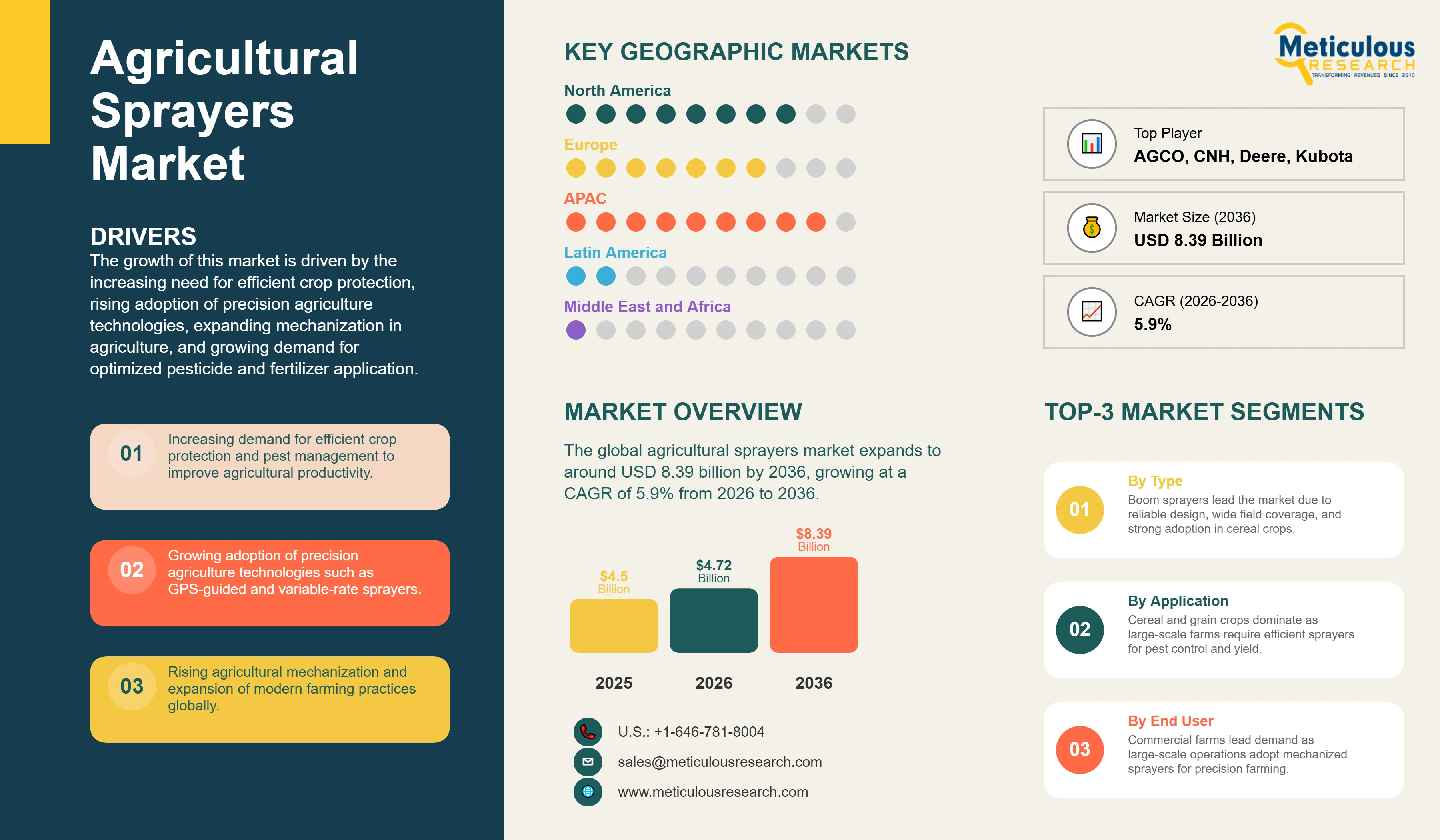
The global agricultural sprayers market size was valued at USD 4.50 billion in 2025 and is expected to increase to approximately USD 4.72 billion in 2026, then expand to around USD 8.39 billion by 2036, growing at a CAGR of 5.9% from 2026 to 2036.
- Published
- Mar 2026
- Pages
- 256
- Format
- PDF + Excel
- Report ID
- MR-1852
- Base year
- 2025
- 2025 · BASELINE
- $4.50B
- 2036
- $8.39B
- CAGR 2026–2036
- 5.9%
2025 baseline · 2026–2036 forecast at 5.9% CAGR · hover a bar for the value
Key highlights
In terms of revenue, the global agricultural sprayers market is valued at USD 4.72 billion in 2026 and is projected to reach USD 8.39 billion by 2036.
The market is expected to grow at a CAGR of 5.9% from 2026 to 2036.
Asia-Pacific dominates the global agricultural sprayers market with the largest market share of 53-58% in 2026.
North America is expected to witness steady growth during the forecast period, driven by agricultural modernization and precision farming standards.
By type, the boom sprayers segment holds the largest market share of 45-50% in 2026.
By type, the drone sprayers segment is expected to witness the fastest CAGR during the forecast period.
By application, the cereal and grain crops segment contributes the highest market share of 39-44% in 2026.
By application, the specialty crops segment is expected to witness the fastest CAGR during the forecast period.
Report summary
| Particulars | Details |
|---|---|
| Market Size by 2036 | USD 8.39 Billion |
| Market Size in 2026 | USD 4.72 Billion |
| Market Size in 2025 | USD 4.50 Billion |
| Market Growth Rate (CAGR) 2026 to 2036 | 5.9% |
| Format | PDF, Excel & Cloud Portal · 256 pages |
| Dominating Region | Asia-Pacific |
| Fastest Growing Region | Asia-Pacific |
| Base Year | 2025 |
| Forecast Period | 2026 to 2036 |
| Segments Covered | Type, Capacity, Power Source, Application, and Region |
| Regions Covered | North America, Europe, Asia-Pacific, Latin America, and Middle East & Africa |
Report overview
Segments covered: type, power source, capacity, application.
The growth of this market is driven by the increasing need for efficient crop protection, rising adoption of precision agriculture technologies, expanding mechanization in agriculture, and growing demand for optimized pesticide and fertilizer application. Agricultural sprayers play a crucial role in modern farming by enabling uniform distribution of pesticides, herbicides, fungicides, and liquid fertilizers, thereby improving crop yield and reducing chemical wastage.
Additionally, the integration of smart technologies such as GPS guidance, variable rate spraying, sensor-based spraying systems, and drone-based crop spraying solutions is accelerating the adoption of advanced sprayer systems. Government initiatives supporting agricultural mechanization and the growing adoption of precision farming practices are also contributing to market growth. However, high equipment costs and limited adoption among smallholder farmers in developing regions may restrain market growth to some extent.
The agricultural sprayers market includes equipment used for the application of pesticides, herbicides, fungicides, and fertilizers across agricultural fields. These systems help farmers improve crop protection, optimize chemical usage, and increase overall farming efficiency.
Agricultural sprayers are available in various configurations, including boom sprayers, knapsack sprayers, handheld sprayers, mist sprayers, and aerial or drone sprayers. These systems are widely used across field crops, horticulture crops, orchards, and plantation crops.
Increasing demand for high crop productivity, precision spraying technologies, and reduced chemical wastage is encouraging farmers to adopt modern sprayer equipment. Furthermore, technological innovations such as GPS-guided sprayers, automated nozzle control systems, and UAV-based spraying technologies are transforming crop protection practices worldwide.
Report infographic
Market dynamics
16 factors across 5 forcesIncreasing Demand for Crop Protection and Pest Management
A key factor driving the growth of the agricultural sprayers market is the increasing demand for crop protection and pest management globally. Agricultural systems require efficient chemical application for crop protection. Farming operations require advanced sprayer technology. The expansion of agricultural systems in emerging markets is creating substantial demand for sprayer equipment. The trend toward precision agriculture is driving investment in advanced sprayer solutions.
The need to improve crop health and comply with environmental standards is driving adoption of advanced sprayers. The trend toward continuous improvement and agricultural excellence is driving demand for reliable crop protection systems. The development of new agricultural facilities creates demand for advanced sprayer equipment. The expansion of agricultural systems in emerging markets is creating significant demand for sprayers. The trend toward nearshoring and farm expansion is driving demand for reliable crop protection solutions.
Growing Adoption of Precision Agriculture and Data-Driven Farming
The growing adoption of precision agriculture and data driven farming is a major driving the growth of the agricultural sprayers market. Precision farming operations are expanding globally creating demand for efficient chemical application. Data-driven farming facilities are expanding creating demand for advanced sprayer technology. The expansion of precision farming operations globally is creating substantial demand for sprayer equipment. The trend toward agricultural modernization is driving adoption of advanced sprayer systems.
The development of sprayer systems that enable farming efficiency is enabling farmers to improve performance. The growing focus on crop health optimization and resource efficiency is driving investment in advanced sprayer systems. The trend toward sustainable farming is driving demand for efficient sprayers. The expansion of precision farming operations globally is creating demand for sprayers that improve chemical application precision. The trend toward facility expansion is driving demand for reliable crop protection solutions.
Expansion of Agricultural and Farming Industries
The expansion of agricultural and farming industries globally is driving significant growth in the agricultural sprayers market. Agricultural operations are expanding and building new infrastructure requiring sprayer equipment. Farming operations are expanding globally creating demand for sprayers. The expansion of agricultural systems in emerging markets is creating substantial demand for sprayer equipment. The trend toward advanced automation is driving investment in advanced sprayer systems.
The development of new agricultural and farming facilities creates demand for advanced sprayers. The expansion of agricultural systems in emerging markets is creating significant demand for sprayers. The trend toward advanced crop protection technology is creating demand for sophisticated sprayer systems. The expansion of agricultural and farming systems globally is creating significant demand for sprayers. The trend toward nearshoring and facility expansion is driving demand for reliable crop protection solutions.
Table of contents
13 chapters · 123 sections · 256 pages · click to expandSegmental analysis
| Segment | Largest share (2026) | Fastest growth (2026–2036) |
|---|---|---|
| By Type | Boom sprayers | Drone Sprayers |
| By Application | Cereal and Grain Crops | Specialty Crops |
By Type
- The boom sprayers segment commands the largest share of approximately 47% of the overall agricultural sprayers market in 2026.
- Boom sprayers lead the market because they offer versatile chemical application, have proven and reliable designs, provide excellent performance for many applications, and have well-established service networks.
- These systems provide efficient chemical application at competitive cost.
- This proven technology makes boom sprayers ideal for cereal and grain crops, general crop protection, and diverse agricultural applications where versatile chemical application is critical.
- Boom sprayers work exceptionally well for conventional chemical application requiring efficient distribution.
- They are widely used in agriculture for crop protection.
- The farming sector uses boom sprayers for pesticide distribution.
- Agricultural operations rely on boom sprayers for reliable chemical application.
- Their proven design means they are reliable, require well-understood maintenance, and have extensive service networks across the industry.
- The availability of standardized designs allows for easy integration with different equipment types.
- Improvements in technology have enhanced boom sprayer performance through better spray designs that improve efficiency, improved materials that enhance durability, and advanced monitoring that improves performance.
- The development of boom sprayers with connectivity capabilities has improved their applicability to modern precision agriculture systems.
- These factors have contributed to widespread acceptance of boom sprayers across diverse chemical application applications.
- Drone Sprayers: The Fastest Growing Segment
- While boom sprayers command the largest market share, drone sprayers are expected to witness the fastest CAGR during the forecast period.
- Drone sprayers are gaining rapid adoption due to their aerial application capability, their superior performance in diverse applications, and their advanced customization capabilities compared to traditional sprayers.
- These systems provide precision chemical management and advanced customization.
- Drone sprayers are particularly valuable for applications requiring aerial application or advanced chemical management.
- The precision agriculture and data-driven farming industries rely heavily on drone sprayers for efficient chemical application.
- The trend toward precision farming is driving adoption of drone sprayer technology.
- Advances in drone sprayer design have improved reliability and reduced costs, making them increasingly attractive for broader applications.
- The ability to provide aerial chemical application makes drone sprayers increasingly valuable in diverse applications.
- The growing demand for precision agriculture is driving adoption of drone sprayer technology.
By Application
- The cereal and grain crops segment hold the largest share of approximately 41% of the agricultural sprayers market in 2026.
- This dominance reflects the critical importance of crop protection in cereal and grain crop production.
- Cereal and grain crop systems use sprayers extensively for crop protection and pest management.
- The cereal and grain crop industry requires sophisticated sprayers for safe and efficient operations.
- The expansion of cereal and grain crop systems globally is creating significant demand for sprayer equipment.
- The trend toward production optimization and crop health improvement is driving demand for advanced sprayers.
- The development of new cereal and grain crop facilities and the modernization of existing systems drive demand for advanced sprayer systems.
- The trend toward advanced crop protection is driving demand for high-performance sprayers.
- The expansion of cereal and grain crop systems in emerging markets is creating significant demand for sprayers.
- The trend toward operational excellence drives investment in advanced crop protection technology.
- Cereal and grain crop operations require reliable sprayers for safe and efficient operations.
- The need to maintain chemical application precision and optimize crop health drives investment in advanced sprayer systems.
- The trend toward operational efficiency drives investment in advanced crop protection technology.
- The expansion of cereal and grain crop systems in emerging markets is creating significant demand for sprayers.
- Specialty Crops Segment: The Fastest Growing Application
- While the cereal and grain crops segment dominates by volume, the specialty crops segment is expected to witness the fastest CAGR during the forecast period.
- The specialty crops segment's growth is driven by expanding specialty crop capacity, development of new facilities, and increasing demand for crop health optimization.
- Specialty crop facilities require sprayers for efficient crop protection and optimization.
- Specialty crop operations require specialized sprayers for advanced crop protection.
- The trend toward specialty crop expansion is creating demand for specialized sprayers for precision compliance.
- The development of new specialty crop facilities creates demand for advanced sprayers.
- The expansion of specialty crops globally is creating significant demand for sprayer systems.
- The growing demand for reliable and efficient crop protection drives demand for advanced sprayer systems.
- The trend toward precision compliance and advanced crop protection adoption requires advanced crop protection systems.
Geographic analysis
North America
The United States stand for a significant market for agricultural sprayers primarily driven by substantial agricultural infrastructure, efficiency production standards, and advanced system modernization. The U.S. agricultural systems are among the world's largest, with significant operations requiring sophisticated sprayer systems. The agricultural sector in the United States is well-developed with major crop protection requirements. Stringent regulatory requirements including efficiency standards and environmental regulations drive farmers to invest in advanced equipment that ensures compliance and efficiency. The U.S. market benefits from a well developed infrastructure including sprayer manufacturers, integrators, and technical expertise. The presence of major agricultural companies creates demand for high-performance equipment. The trend toward agricultural modernization and precision farming is driving adoption of advanced sprayer systems with monitoring capabilities. Investment in agricultural facility upgrades and modernization continues to support market growth. U.S. Agricultural Sprayers Market Size and Growth 2026 to 2036
Asia-Pacific
Largest shareAsia-Pacific is expected to hold the largest share the global agricultural sprayers market in 2026. This dominance comes from rapid agricultural expansion, significant farming development, and growing precision agriculture adoption across the region. China is the world's largest agricultural hub, creating enormous demand for sprayers. The expansion of agricultural operations in China to serve the growing domestic market drives significant equipment demand. India's agricultural sector is expanding rapidly, creating demand for sprayer equipment. Vietnam, Indonesia, Thailand, and other Southeast Asian countries are experiencing rapid agricultural growth driven by foreign direct investment and rising food demand. The growing agricultural operations across Asia-Pacific are creating substantial demand for sprayer equipment. Government initiatives promoting agricultural development and productivity are attracting investment and facility development. Infrastructure improvements including reliable water supply, transportation networks, and distribution systems are making these regions increasingly attractive for agricultural investments. The region benefits from lower infrastructure costs and growing agricultural capacity, which makes it attractive for farming investments. The presence of major multinational corporations establishing or expanding operations in the region is driving demand for modern sprayer equipment that meets global standards. The expansion of agricultural systems in Asia-Pacific is creating demand for advanced sprayers. The trend toward agricultural modernization is creating demand for intelligent sprayer systems with advanced capabilities.
Frequently asked questions
The global agricultural sprayers market is expected to grow from USD 4.72 billion in 2026 to USD 8.39 billion by 2036.
Cite this report
Meticulous Research. (2026). Agricultural Sprayers Market - Global Opportunity Analysis And Industry Forecast (2026-2036) (Report No. MR-1852). Meticulous Market Research Pvt. Ltd. https://www.meticulousresearch.com/product/agricultural-sprayers-market-6535