
Advanced Gripping Technology Market (2026-2036)
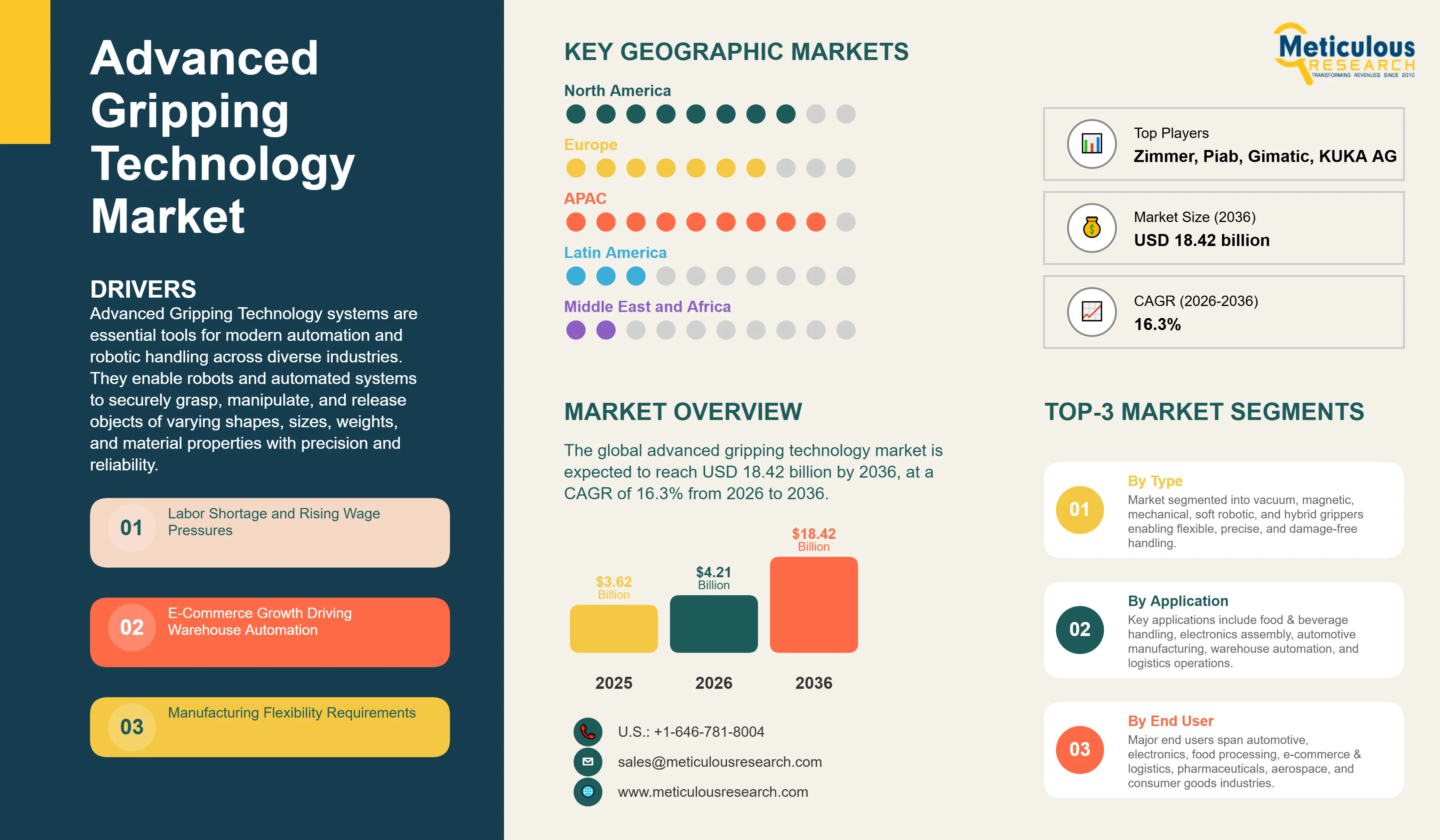
The global advanced gripping technology market is expected to reach USD 18.42 billion by 2036 from USD 4.21 billion in 2026, at a CAGR of 16.3% from 2026 to 2036.
- Published
- Jan 2026
- Pages
- 278
- Format
- PDF + Excel
- Report ID
- MR-1667
- Base year
- 2025
- 2026 · ESTIMATED
- $4.21B
- 2036
- $18.42B
- CAGR 2026–2036
- 16.3%
2025 baseline · 2026–2036 forecast at 16.3% CAGR · hover a bar for the value
Key highlights
In 2026, Asia-Pacific is estimated to account for the largest share of the global advanced gripping technology market, driven by massive manufacturing capacity requiring automation, aggressive industrial robotics deployment in China, Japan, and South Korea, and strong electronics and automotive production requiring precise handling.
North America is projected to register significant growth during the forecast period, fueled by warehouse automation expansion driven by e-commerce, reshoring of manufacturing driving domestic automation investment, and early adoption of soft robotics and AI-enhanced gripping systems.
Based on gripper mechanism, the vacuum gripping segment is estimated to hold the largest share of the market in 2026, driven by versatility across diverse materials and shapes, simple operation and maintenance requirements, and proven reliability in high-speed applications.
Based on material compatibility, the multi-material gripping segment is estimated to dominate the market in 2026, owing to increasing demand for flexible manufacturing systems handling diverse products and elimination of gripper changeover downtime.
Based on payload capacity, the medium payload (5-25 kg) segment is expected to account for substantial share, driven by widespread applicability across general manufacturing and assembly operations.
Based on application, the food and beverage handling segment is expected to witness significant growth during the forecast period, fueled by food safety regulations driving automation, gentle handling requirements for delicate products, and sanitary design standards for food contact applications.
The electronics assembly and handling segment is expected to grow at a significant CAGR during the forecast period, driven by miniaturization requiring precision micro-gripping, high-value components demanding damage-free handling, and rapid product changeovers requiring adaptable gripping solutions.
The U.S. advanced gripping technology market is projected to grow at a CAGR of around 15.5% during the forecast period 2026 to 2036, driven by Amazon and logistics sector automation, advanced manufacturing reshoring initiatives, and labor shortage pressures accelerating automation adoption.
China is expected to lead the Asia-Pacific advanced gripping technology market, driven by world's largest industrial robot installation base, government Made in China 2025 automation policies, and domestic gripper manufacturers offering competitive solutions.
In 2026, Germany is projected to account for the largest share of the European advanced gripping technology market, driven by Industry 4.0 leadership, premium automotive manufacturing requiring precision handling, and strong gripper technology innovation from companies like Schunk, Festo, and Zimmer.
Report summary
| Particulars | Details |
|---|---|
| Market Size Value in 2026 | USD 4.21 Billion |
| Revenue Forecast in 2036 | USD 18.42 Billion |
| Growth Rate | CAGR of 16.3% from 2026 to 2036 |
| Format | PDF, Excel & Cloud Portal · 278 pages |
| Base Year for Estimation | 2025 |
| Historical Data | 2021-2025 |
| Forecast Period | 2026-2036 |
| Quantitative Units | Revenue in USD Billion and CAGR from 2026 to 2036 |
| Report Coverage | Revenue forecast, company ranking, competitive landscape, growth factors, and trends |
| Segments Covered | Gripper Mechanism, Actuation Technology, Material Compatibility, Payload Capacity, Sensing Integration, Application, End-Use Industry, Region |
| Regional Scope | North America, Europe, Asia-Pacific, Latin America, Middle East & Africa |
| Countries Covered | U.S., Canada, Germany, U.K., France, Italy, Spain, Netherlands, China, Japan, South Korea, India, Singapore, Australia, Brazil, Mexico, Saudi Arabia, UAE |
| Key Companies Profiled | Schunk GmbH & Co. KG, Festo AG & Co. KG, SMC Corporation, Zimmer Group, OnRobot A/S, Robotiq Inc., Piab AB, Soft Robotics Inc., RightHand Robotics, Empire Robotics, Destaco (Dover Corporation), Applied Robotics Inc., PHD Inc., Gimatic S.r.l., Sichuan Dongju Intelligent Equipment Co. Ltd., Yaskawa Motoman, ABB Robotics, FANUC Corporation, KUKA AG, Universal Robots A/S |
Report overview
Segments covered: gripper mechanism, material compatibility, payload capacity, application, payload.
Advanced Gripping Technology systems are essential tools for modern automation and robotic handling across diverse industries. They enable robots and automated systems to securely grasp, manipulate, and release objects of varying shapes, sizes, weights, and material properties with precision and reliability. The goal is to maximize production efficiency through faster cycle times, reduce product damage through gentle handling, enable flexible manufacturing that handles diverse products, and improve workplace safety by automating hazardous material handling tasks.
These systems use sophisticated technologies such as vacuum suction with intelligent pressure control, electromagnetic gripping for ferrous materials, adaptive mechanisms that conform to object geometry, soft robotics utilizing compliant materials, force-torque sensing for delicate object handling, and AI-driven grasp planning algorithms. Vacuum grippers create negative pressure differential to hold objects through suction cups or surfaces, while magnetic systems use permanent or electromagnetic fields for metallic object manipulation. Adaptive grippers employ mechanical linkages or underactuated mechanisms that automatically adjust to object shape, and soft robotic grippers use pneumatic actuators with silicone or elastomeric materials that gently conform to fragile items.
The systems offer manufacturers the opportunity to dramatically increase throughput, reduce labor costs through automation, minimize product damage and waste, enable lights-out manufacturing operations, and quickly reconfigure production lines for different products. They also help address labor shortages through automation of repetitive tasks, support mass customization through flexible handling capabilities, improve consistency and quality through repeatable precise movements, and enable handling of objects unsuitable for human contact including hazardous materials, extreme temperatures, or sterile environments.
Advanced Gripping Technology systems are transforming manufacturing automation and enabling previously impossible robotic applications. In the past, industrial grippers were simple two-jaw pneumatic mechanisms limited to handling rigid, uniform objects in highly structured environments. These conventional grippers required precise part positioning, struggled with shape variation, and frequently damaged delicate items. This approach cannot meet modern manufacturing demands shaped by mass customization requiring flexible handling, e-commerce fulfillment demanding high-speed diverse product manipulation, and quality expectations requiring damage-free processing. Advanced gripping technology allows robotic systems to handle the complexity and variability that previously required human dexterity. Vacuum systems provide non-contact holding suitable for fragile items, adaptive grippers automatically conform to irregular shapes, and soft robotics enable gentle manipulation of deformable objects. Together, these technologies lay the groundwork for truly flexible automation, where single systems handle diverse products without manual reconfiguration or specialized tooling.
Several key trends are reshaping the advanced gripping technology market. These include the integration of artificial intelligence for grasp planning and object recognition, development of hybrid gripping systems combining multiple technologies, miniaturization enabling precision manipulation of tiny components, expansion of collaborative gripping systems safe for human interaction, and advancement of bio-inspired designs mimicking natural gripping mechanisms. The convergence of sensor technology providing tactile and force feedback, machine learning enabling adaptive grasp strategies, vision systems for object identification and localization, and cloud connectivity for fleet learning has accelerated capabilities. What started as specialized solutions for high-value applications is now becoming standard across manufacturing sectors.
Report infographic
Market dynamics
7 factors across 3 forcesLabor Shortage and Rising Wage Pressures
Manufacturing and logistics sectors worldwide face acute labor shortages that drive adoption of advanced gripping technology for automation. Demographic trends including aging populations in developed economies, declining workforce participation in manual labor, and younger workers avoiding repetitive manufacturing jobs create persistent recruitment challenges. Sectors particularly affected include food processing requiring sanitary handling, electronics assembly demanding precision manipulation, warehouse operations involving heavy lifting, and automotive manufacturing with ergonomically challenging tasks. Wage pressures compound the challenge as competition for available workers drives compensation costs upward. Manufacturing labor costs in developed economies frequently exceed productivity thresholds that justify manual operations. Advanced gripping technology addresses these pressures by automating tasks previously requiring human dexterity. Vacuum grippers handle diverse packaging in fulfillment centers, adaptive grippers manipulate irregular food products, and soft robotic systems gently process delicate electronics. Return on investment calculations increasingly favor automation as labor availability decreases and costs rise. The COVID-19 pandemic accelerated these trends by highlighting supply chain vulnerabilities from labor disruptions and demonstrating resilience benefits of automation. Companies that invested in advanced gripping technology maintained operations during workforce absences. This experience shifted automation from optional efficiency improvement to essential business continuity capability, driving sustained investment regardless of short-term economic conditions.
E-Commerce Growth Driving Warehouse Automation
Explosive e-commerce growth creates unprecedented demand for warehouse automation utilizing advanced gripping technology for order fulfillment. Online retail penetration continues expanding globally, with e-commerce representing increasing percentages of total retail sales. This shift fundamentally changes warehouse operations from bulk palletized handling to individual item picking. Traditional warehouse automation designed for pallet movements cannot economically handle millions of distinct SKUs in diverse packaging formats. Each-picking operations require gripping systems that adapt to different sizes, shapes, weights, and materials without manual reconfiguration. Advanced vacuum grippers with intelligent zone control handle everything from plastic bags to cardboard boxes, while adaptive grippers manipulate irregular products including apparel and sporting goods. Soft robotic systems gently handle fragile items without damage. The warehouse automation market specifically for piece-picking applications represents billions in investment, with companies like Amazon, Walmart, Alibaba, and JD.com deploying thousands of robotic systems. Same-day and next-day delivery promises require processing speed impossible with manual operations. Advanced gripping technology enables the cycle time performance necessary for competitive fulfillment. Integration with vision systems and AI planning software allows autonomous item identification and grasp strategy selection. This capability transforms warehouses from labor-intensive operations to highly automated facilities operating with minimal human intervention, directly addressing labor shortage challenges while meeting customer delivery expectations.
Table of contents
16 chapters · 214 sections · 278 pages · click to expandGeographic analysis
Asia-Pacific
Largest shareIn 2026, Asia-Pacific is expected to have the largest share of the global advanced gripping technology market. Regional leadership stems from massive manufacturing capacity concentrated in China, Japan, South Korea, and Southeast Asia, aggressive industrial robotics deployment with Asia-Pacific accounting for over 60% of global robot installations, strong electronics and automotive production requiring precision handling, and competitive domestic gripper manufacturers providing cost-effective solutions. Chinese automation initiatives under Made in China 2025 policies drive extensive factory automation investments. Electronics manufacturing giants including Foxconn, BYD, and Luxshare deploy thousands of robotic systems with advanced gripping for smartphone, computer, and consumer electronics assembly. Japanese manufacturers maintain leadership in robotics integration with companies like FANUC, Yaskawa, and Kawasaki Heavy Industries developing integrated gripper solutions. South Korean electronics and automotive sectors invest heavily in automation with Samsung, LG, and Hyundai Motor Group deploying advanced handling systems. Southeast Asian nations including Vietnam, Thailand, and Malaysia attract manufacturing relocations driving new automation installations. Regional implementations emphasize cost-effective solutions with domestic gripper suppliers offering competitive alternatives to Western brands while meeting performance requirements.
North America
North America is projected to show significant growth during the forecast period, driven by warehouse automation expansion from e-commerce growth. Companies like Amazon operate hundreds of fulfillment centers deploying robotic systems with advanced gripping for order picking. Logistics automation providers including Berkshire Grey, RightHand Robotics, and Kindred (later acquired) develop AI-powered gripping systems specifically for e-commerce applications. Manufacturing reshoring initiatives bring production back to the United States and Canada, driving domestic automation investment. Advanced manufacturing sectors including aerospace, medical devices, and semiconductor fabrication require precision gripping technology. Early adoption of collaborative robotics in North America creates demand for safe gripper designs. The region leads in soft robotics innovation with companies like Soft Robotics Inc. pioneering food-safe compliant grippers. Research institutions including MIT, Carnegie Mellon, and Stanford drive gripper technology advancement through robotics programs. Strong venture capital funding supports gripper technology startups developing innovative solutions.
Europe
Europe represents a substantial market, particularly in Germany where Industry 4.0 initiatives drive manufacturing digitalization and automation. German gripper manufacturers including Schunk, Festo, Zimmer, and Schmalz maintain global technology leadership through continuous innovation. Premium automotive manufacturing by Mercedes-Benz, BMW, Audi, and Volkswagen Group drives demand for precision handling systems. European food processing and packaging sectors invest in hygienic automation complying with stringent regulations. Collaborative robotics adoption increases across small and medium enterprises supported by European safety standards facilitating cobot deployment. Sustainability priorities drive development of energy-efficient vacuum systems and recyclable gripper materials. Eastern European manufacturing growth in Poland, Czech Republic, and Hungary creates additional automation demand.
Competitive landscape
- Schunk GmbH & Co. KG · Germany
- Festo AG & Co. KG · Germany
- SMC Corporation · Japan
- Zimmer Group · Germany
- OnRobot A/S · Denmark
- Robotiq Inc. · Canada
- Piab AB · Sweden
- Soft Robotics Inc. (U.S.)
- RightHand Robotics (U.S.)
- Empire Robotics (U.S.)
- Destaco (Dover Corporation) (U.S.)
- Applied Robotics Inc. (U.S.)
- PHD Inc. (U.S.)
- Gimatic S.r.l · Italy
- Sichuan Dongju Intelligent Equipment Co. Ltd. · China
- Yaskawa Motoman · Japan
- ABB Robotics · Switzerland
- FANUC Corporation · Japan
- KUKA AG · Germany
- Universal Robots A/S · Denmark
Frequently asked questions
The advanced gripping technology market is expected to grow from USD 4.21 billion in 2026 to USD 18.42 billion by 2036.
Cite this report
Meticulous Research. (2026). Advanced Gripping Technology Market - Global Opportunity Analysis and Industry Forecast (2026-2036) (Report No. MR-1667). Meticulous Market Research Pvt. Ltd. https://www.meticulousresearch.com/product/advanced-gripping-technology-market-6350