Advanced Battery Materials Market (2026-2036)
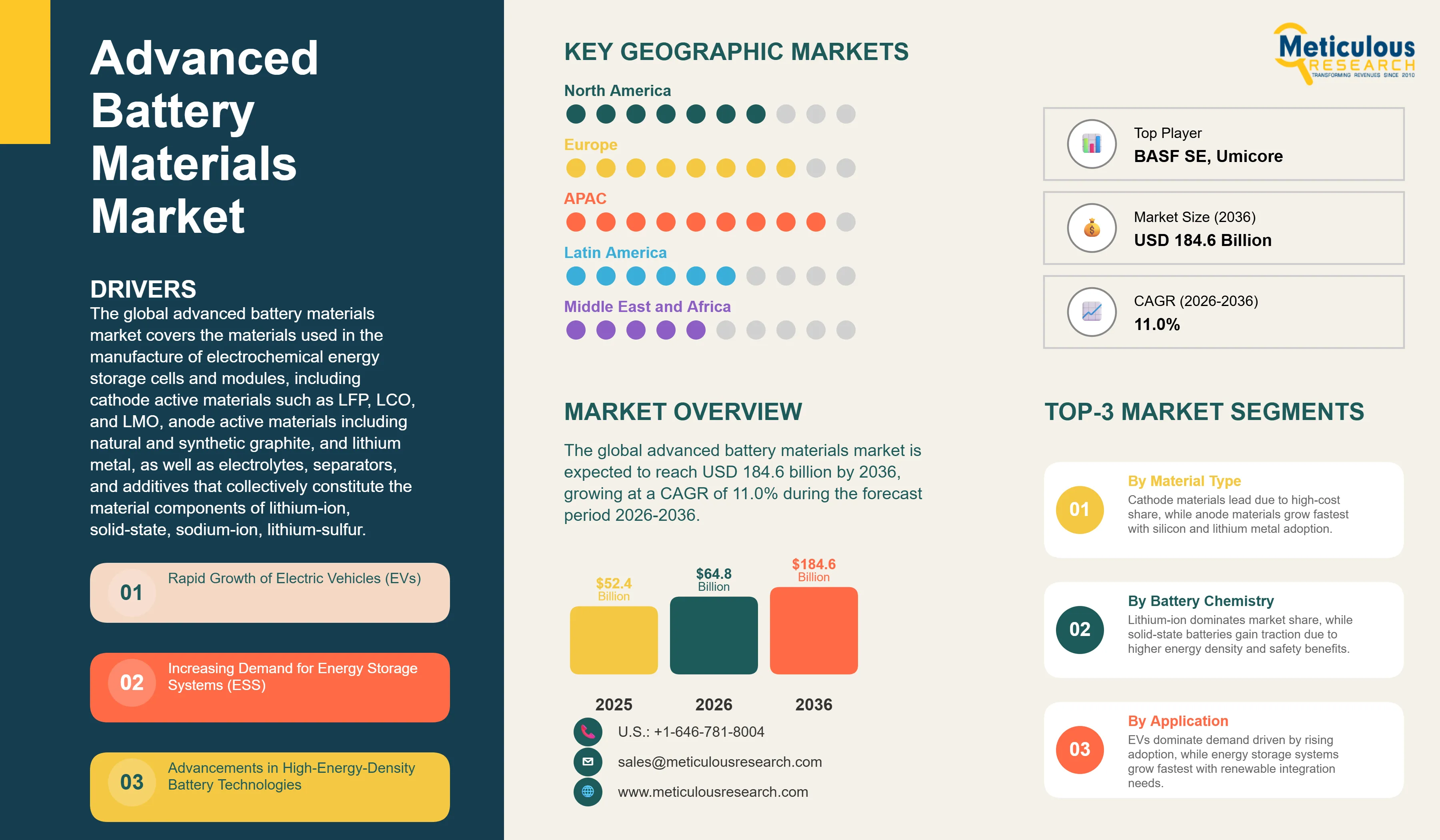
The global advanced battery materials market was valued at USD 52.4 billion in 2025. This market is expected to reach USD 184.6 billion by 2036 from an estimated USD 64.8 billion in 2026, growing at a CAGR of 11.0% during the forecast period 2026-2036.
- Published
- Apr 2026
- Pages
- 292
- Format
- PDF + Excel
- Report ID
- MR-1886
- Base year
- 2025
- 2025 · BASELINE
- $52.40B
- 2036
- $184.6B
- CAGR 2026–2036
- 11.0%
2025 baseline · 2026–2036 forecast at 11.0% CAGR · hover a bar for the value
Key highlights
The global advanced battery materials market is projected to reach USD 184.6 billion by 2036.
The market is expected to grow at a CAGR of 11.0% during the forecast period 2026-2036.
The global advanced battery materials market was valued at USD 52.4 billion in 2025 and is estimated to reach USD 64.8 billion in 2026.
Asia-Pacific is expected to dominate the global advanced battery materials market with the largest market share in 2026, driven by China's dominant position across the full battery material supply chain encompassing cathode and anode material production, lithium and cobalt refining, separator manufacturing, and electrolyte synthesis, the strong vertically integrated battery manufacturing ecosystems of South Korea anchored by LG Chem, POSCO Future M, Samsung SDI, and SK On, and Japan's leadership in high-performance battery material innovation across separator, electrolyte, and advanced cathode material categories.
Europe is projected to witness the fastest growth during the forecast period, driven by the EU's Critical Raw Materials Act and Battery Regulation establishing mandatory requirements for battery material traceability, recycled content, and carbon footprint disclosure, the aggressive European gigafactory investment programs from Northvolt, ACC, AESC, and global battery manufacturers localizing production within the EU, and the strong EV demand growth across Germany, France, the U.K., Sweden, and Norway creating large domestic battery material consumption centers.
By material type, the cathode materials segment is expected to hold the largest share of the global advanced battery materials market in 2026.
By battery chemistry, the lithium-ion batteries segment is expected to hold the largest share in 2026.
By application, the electric vehicles segment is expected to hold the largest share in 2026.
By end user, the battery manufacturers segment is expected to hold the largest share in 2026.
Report summary
| Particulars | Details |
|---|---|
| Market Size by 2036 | USD 184.6 Billion |
| Market Size in 2026 | USD 64.8 Billion |
| Market Size in 2025 | USD 52.4 Billion |
| Revenue Growth Rate (2026-2036) | CAGR of 11.0% |
| Format | PDF, Excel & Cloud Portal · 292 pages |
| Dominating Material Type | Cathode Materials |
| Fastest Growing Material Type | Anode Materials |
| Dominating Battery Chemistry | Lithium-Ion Batteries |
| Fastest Growing Battery Chemistry | Solid-State Batteries |
| Dominating Application | Electric Vehicles (EVs) |
| Fastest Growing Application | Energy Storage Systems (ESS) |
| Dominating End User | Battery Manufacturers |
| Fastest Growing End User | Energy Companies |
| Dominating Geography | Asia-Pacific |
| Fastest Growing Geography | Europe |
| Base Year | 2025 |
| Forecast Period | 2026 to 2036 |
Report overview
Segments covered: material type, battery chemistry, application, end user.
The global advanced battery materials market covers the materials used in the manufacture of electrochemical energy storage cells and modules, including cathode active materials such as LFP, NMC, NCA, LCO, and LMO, anode active materials including natural and synthetic graphite, silicon-based composites, and lithium metal, as well as electrolytes, separators, current collectors, binders, and additives that collectively constitute the material components of lithium-ion, solid-state, sodium-ion, lithium-sulfur, and other advanced electrochemical cell technologies serving EV, energy storage, consumer electronics, and industrial applications.
The growth of the global advanced battery materials market is primarily driven by the rapid global expansion of electric vehicle adoption, which is generating unprecedented demand for battery cell production and the cathode and anode materials that constitute the majority of cell material cost. Global EV sales exceeded 17 million units in 2024 and are projected to reach 40 to 50 million units annually by the mid-2030s, translating directly into battery material demand growth that is driving gigafactory capacity expansion across Asia, Europe, and North America and sustained investment in battery material supply chain development. In addition, the accelerating deployment of grid-scale and distributed energy storage to support renewable energy integration is creating a second major and rapidly growing demand pillar for advanced battery materials that is progressively diversifying the market beyond its EV application concentration.
Two significant opportunities are shaping the market's long-term trajectory. The commercial development of solid-state battery technology represents the most transformative near-term material opportunity, creating demand for solid-state electrolyte materials including sulfide, oxide, and polymer compositions and advancing the adoption of lithium metal anodes that could not be used safely in liquid electrolyte cell formats. The localization of battery material supply chains in Europe and North America, accelerated by the U.S. Inflation Reduction Act's domestic content requirements and the EU Battery Regulation's sustainability mandates, is creating large greenfield market opportunities for battery material producers establishing production capacity in these regions to serve the expanding local gigafactory base.
Report infographic
Market dynamics
7 factors across 3 forcesRapid Growth of Electric Vehicles (EVs)
The rapid global expansion of electric vehicle adoption is the primary structural demand driver of the advanced battery materials market, as EV battery packs require between 50 and 100 kilograms of battery materials per vehicle depending on battery capacity, directly translating EV sales growth into battery material volume demand at extraordinary scale. Global EV sales have grown from under 1 million units in 2017 to over 17 million units in 2024, and industry forecasts project continued strong growth toward 40 to 50 million annual EV sales by 2030 to 2035, driven by government combustion engine phase-out mandates in the EU and U.K., the Inflation Reduction Act EV tax credit structure in the United States, and the rapid improvement in EV price competitiveness relative to combustion vehicle equivalents driven by battery cost reduction. This EV demand trajectory directly translates into the multi-hundred-billion-dollar advanced battery material procurement programs that battery manufacturers and automotive OEMs are executing through gigafactory supply agreements spanning cathode active materials, anode materials, electrolytes, and separators.
Increasing Demand for Energy Storage Systems (ESS)
The accelerating global deployment of grid-scale and distributed battery energy storage to support renewable energy integration represents the second major and rapidly growing demand pillar for advanced battery materials. The International Energy Agency projects that installed global battery storage capacity needs to grow from approximately 85 GWh in 2024 to over 1,500 GWh by 2030 to support the renewable energy transition under a net-zero pathway, implying an extraordinary expansion of battery material demand from the energy storage sector over the forecast period. Grid-scale lithium-ion battery storage is being deployed at gigawatt-hour scale in the United States, China, Australia, and Europe as utilities, grid operators, and independent power producers invest in battery storage to provide grid frequency regulation, peak capacity, and renewable firming services. The residential storage market is growing rapidly in tandem with solar panel installation, with home battery systems from Tesla, Sonnen, BYD, and others creating an additional and broadly distributed demand channel for LFP and NMC battery materials.
Table of contents
12 chapters · 181 sections · 292 pages · click to expandSegmental analysis
| Segment | Largest share (2026) | Fastest growth (2026–2036) |
|---|---|---|
| By Material Type | Cathode Materials | Anode materials |
| By Battery Chemistry | Lithium-Ion Batteries | Solid-state batteries |
| By Application | Electric Vehicles | Energy storage systems |
| By End User | Battery Manufacturers | Energy companies |
By Material Type
- Cathode Materials to Dominate
- The cathode materials segment is expected to account for the largest share of the global advanced battery materials market.
- The large share of this segment is attributed to cathode active materials representing 30 to 40% of total lithium-ion cell material cost, the broadest commercial product development activity across LFP, NMC 811, NMC 9-series, NCA, and next-generation cobalt-free cathode formulations, and the very high dollar-per-kilogram value of advanced cathode materials including high-nickel NMC and NCA that generates substantial market value relative to other battery material categories.
- POSCO Future M, Umicore, BASF, and Sumitomo Metal Mining are among the leading commercial cathode active material suppliers serving global battery manufacturers.
- However, the anode materials segment is poised to register the highest CAGR during the forecast period.
- The high growth of this segment is attributed to the accelerating commercial transition from pure graphite anodes toward silicon-blended graphite anodes that deliver higher energy density, the advancing development of high-silicon-content anodes targeting solid-state battery applications, and the long-term commercialization trajectory of lithium metal anodes that represent the anode material of choice for next-generation solid-state cells.
By Battery Chemistry
- Lithium-Ion Batteries to Hold the Largest Share
- The lithium-ion batteries segment is expected to account for the largest share of the global advanced battery materials market.
- This dominance reflects lithium-ion technology's established position as the commercial standard across EV, energy storage, and consumer electronics applications, with the global installed base of lithium-ion manufacturing capacity representing several hundred GWh annually and providing a large and growing material demand base for cathode, anode, electrolyte, and separator material suppliers serving established cell production programs.
- However, the solid-state batteries segment is projected to register the highest CAGR during the forecast period.
- This growth is driven by the advancing commercial development timelines of Toyota, Samsung SDI, QuantumScape, and Solid Power targeting automotive solid-state battery production launch in the late 2020s, the transformative energy density and safety advantages that solid-state electrolytes enable over liquid electrolyte lithium-ion cells, and the new and high-value material demand categories that solid-state cell architectures create for solid electrolyte, lithium metal anode, and advanced cathode material suppliers.
By Application
- Electric Vehicles to Hold the Largest Share
- The electric vehicles segment is expected to account for the largest share of the global advanced battery materials market.
- This dominance reflects EV battery packs' position as the single largest and fastest-growing consumer of lithium-ion battery materials globally, with passenger EV and commercial EV battery procurement constituting the primary revenue driver for cathode active material, anode material, separator, and electrolyte producers.
- The global EV battery material demand is projected to grow from approximately 2 million metric tons of lithium carbonate equivalent in 2025 to over 8 million metric tons by 2035, establishing EV as the structurally dominant application category through the forecast period.
- However, the energy storage systems segment is projected to register the highest CAGR during the forecast period.
- This growth is driven by the accelerating global deployment of grid-scale lithium-ion battery storage required to integrate growing renewable energy capacity, the IEA's projection of over 1,500 GWh of installed battery storage capacity required by 2030 under net-zero pathways, and the rapidly growing residential storage market that is expanding the ESS battery material demand base across a broad geographic and customer footprint well beyond the utility-scale project pipeline.
By End User
- Battery Manufacturers to Hold the Largest Share
- The battery manufacturers segment is expected to account for the largest share of the global advanced battery materials market.
- Battery cell and module manufacturers including CATL, BYD, Panasonic, LG Energy Solution, Samsung SDI, SK On, and Envision AESC represent the primary direct procurement channel for advanced battery materials, as they aggregate the material purchasing from individual cell chemistries and production programs into large-volume supply agreements that constitute the bulk of global battery material market revenue.
- CATL alone, as the world's largest battery manufacturer, accounts for a significant proportion of global cathode and anode material procurement, with annual material purchases representing tens of billions of dollars in market value.
- However, the energy companies segment is projected to register the highest CAGR during the forecast period.
- This growth is driven by energy utilities, grid operators, and independent power producers directly procuring grid-scale battery storage systems in a procurement model that is increasingly bypassing battery manufacturer intermediaries for large project orders, creating direct battery material demand relationships with energy sector customers at rapidly growing scale.
- The expansion of vertically integrated energy storage procurement by companies including NextEra Energy, AES, Fluence, and national grid operators is establishing energy companies as a fast-growing direct end-user category in the advanced battery materials market.
Geographic analysis
Asia-Pacific
Largest shareIn 2026, Asia-Pacific is expected to account for the largest share of the global advanced battery materials market. The largest share of this region is mainly due to China's dominant position across the full battery material supply chain, encompassing the processing of over 60% of global lithium, cobalt, and nickel into battery-grade materials, the manufacturing of approximately 70 to 75% of global cathode active materials and over 80% of synthetic graphite anode materials, and the production of the majority of global battery separator and electrolyte output. China's integrated battery material ecosystem, anchored by companies including Ganfeng Lithium, Tianqi Lithium, CATL's material subsidiaries, and BYD's upstream material operations, provides cost and scale advantages that are difficult to replicate in other geographies in the near term. South Korea's advanced battery material sector, anchored by LG Chem's advanced cathode material division, POSCO Future M's cathode and anode production, and Samsung SDI's material development programs, contributes significant high-performance material innovation and production capacity to the regional market. Japan's Sumitomo Metal Mining, Panasonic's material operations, and Mitsubishi Chemical's electrolyte and separator businesses add further depth to Asia-Pacific's battery material leadership. However, the European advanced battery materials market is expected to grow at the fastest CAGR during the forecast period.
Europe
Europe's rapid growth is driven by the EU Battery Regulation's establishment of binding requirements for recycled content, carbon footprint reporting, and battery passports that are creating a compliance-driven investment wave in European battery material production and recycling capacity. The large pipeline of gigafactory investments within the EU, including Northvolt in Sweden, ACC in France and Germany, AESC's Sunderland expansion, and the European manufacturing programs of CATL, Samsung SDI, and SK On, is creating substantial local battery material demand that European and global battery material producers are investing to serve. Umicore's cathode material expansion in Europe, BASF's European battery material production investments, and the growing ecosystem of European battery recycling companies including Li-Cycle's Rochester hub and Veolia's black mass processing operations collectively represent the supply-side investment that is positioning Europe as a growing battery material production region alongside its established role as a consumption market.
North America
North America is establishing a rapidly developing advanced battery materials sector, accelerated by the IRA's stringent domestic content and foreign entity of concern restrictions that are driving significant greenfield investment in North American battery material production. The U.S. battery material investment pipeline includes Albemarle's lithium hydroxide processing expansions, Livent and Standard Lithium's domestic lithium production projects, and the cathode material investments of several Korean and Japanese battery material companies establishing U.S. production to serve the growing North American gigafactory base. Canada's position as a major holder of lithium, cobalt, and nickel mineral resources is attracting battery material processing investments that leverage domestic critical mineral supply into vertically integrated battery material production.
Competitive landscape
- BASF SE · Germany
- Umicore · Belgium
- LG Chem Ltd. · South Korea
- POSCO Future M · South Korea
- Sumitomo Metal Mining Co. Ltd. · Japan
- Mitsubishi Chemical Group · Japan
- Albemarle Corporation (U.S.)
- Ganfeng Lithium · China
- Tianqi Lithium · China
- CATL · China
- BYD Company Ltd. · China
- Panasonic Holdings Corporation · Japan
- SK On Co. Ltd. · South Korea
- Samsung SDI Co. Ltd. · South Korea
- Envision AESC (Japan/U.K.)
Frequently asked questions
The global advanced battery materials market is expected to reach USD 184.6 billion by 2036 from an estimated USD 64.8 billion in 2026, at a CAGR of 11.0% during the forecast period 2026-2036.
Cite this report
Meticulous Research. (2026). Advanced Battery Materials Market - Global Opportunity Analysis and Industry Forecast (2026-2036) (Report No. MR-1886). Meticulous Market Research Pvt. Ltd. https://www.meticulousresearch.com/product/advanced-battery-materials-market-6569