
AC Drives Market (2026-2036)
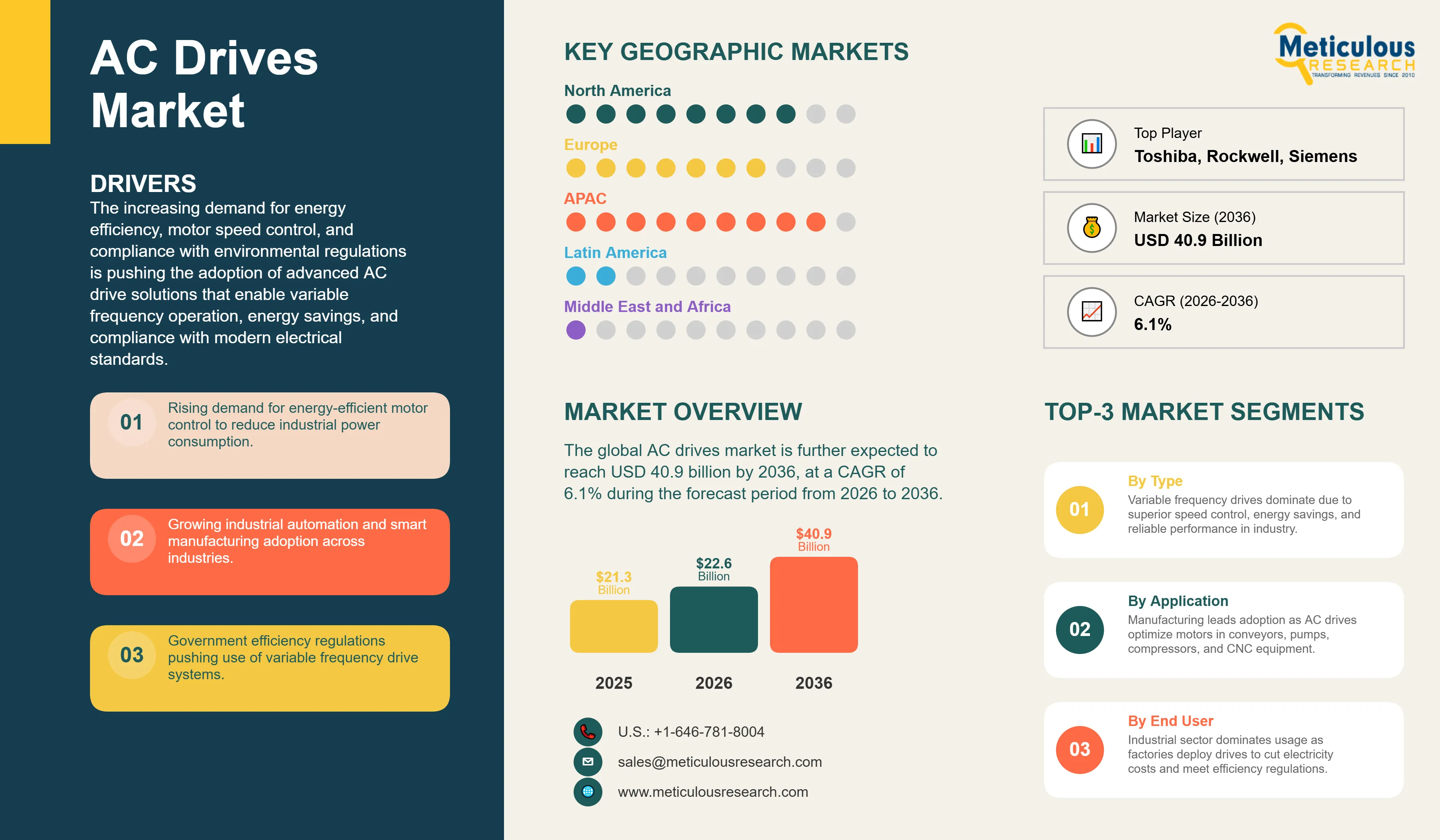
The global AC drives market was valued at USD 21.3 billion in 2025 and is projected to reach around USD 22.6 billion in 2026. The market is further expected to reach USD 40.9 billion by 2036, at a CAGR of 6.1% during the forecast period from 2026 to 2036.
- Published
- Feb 2026
- Pages
- 186
- Format
- PDF + Excel
- Report ID
- MR-1770
- Base year
- 2025
- 2025 · BASELINE
- $21.30B
- 2036
- $40.90B
- CAGR 2026–2036
- 6.1%
2025 baseline · 2026–2036 forecast at 6.1% CAGR · hover a bar for the value
Key highlights
In terms of revenue, the global AC drives market is valued at USD 22.6 billion in 2026 and is projected to reach USD 40.9 billion by 2036.
The market is expected to grow at a CAGR of 6.1% from 2026 to 2036.
Asia-Pacific dominates the global AC drives market with the largest market share of 40-45% in 2026.
North America is expected to witness steady growth during the forecast period, driven by energy efficiency regulations and industrial automation.
By type, the variable frequency drives (VFDs) segment holds the largest market share in 2026.
By type, the soft starters segment is expected to witness the fastest CAGR during the forecast period.
By application, the manufacturing segment contributes the highest market share of 30-40% in 2026.
By application, the renewable energy segment is expected to witness the fastest CAGR during the forecast period.
Report summary
| Particulars | Details |
|---|---|
| Market Size by 2036 | USD 40.9 Billion |
| Market Size in 2026 | USD 22.6 Billion |
| Market Size in 2025 | USD 21.3 Billion |
| Market Growth Rate (CAGR) 2026 to 2036 | 6.1% |
| Format | PDF, Excel & Cloud Portal · 186 pages |
| Dominating Region | Asia-Pacific |
| Fastest Growing Region | Asia-Pacific |
| Base Year | 2025 |
| Forecast Period | 2026 to 2036 |
| Segments Covered | Type, Technology, Application, and Region |
| Regions Covered | North America, Europe, Asia-Pacific, Latin America, and Middle East & Africa |
Report overview
Segments covered: type, application.
The increasing demand for energy efficiency, motor speed control, and compliance with environmental regulations is pushing the adoption of advanced AC drive solutions that enable variable frequency operation, energy savings, and compliance with modern electrical standards. The need for improved energy efficiency, enhanced motor control, reduced power consumption, and integration with smart industrial systems is driving investments in sophisticated AC drive technologies that can deliver reliable performance and seamless integration with modern industrial systems.
The AC drives market encompasses the design, manufacturing, installation, and maintenance of systems that control AC motor speed and torque through variable frequency operation, delivering energy efficiency and compliance with electrical standards across diverse industrial settings. These systems are vital in manufacturing, water treatment, HVAC, and renewable energy applications requiring precise motor control.
Key types of AC drives include variable frequency drives (VFDs) for advanced speed regulation and savings, soft starters for smooth acceleration, direct torque control (DTC) drives for dynamic performance, flux vector and sensorless vector drives for precision, scalar drives for basic functionality, multilevel drives for efficient power handling, and specialized variants tailored to niche needs.
The growth of AC drives market is propelled by stricter energy efficiency regulations, rising demand for automation-driven motor control, and ongoing technological enhancements that boost reliability and performance. These dynamics parallel trends in adjacent sectors like compressed air systems, driving consistent expansion in industrial applications
Technological advancements in power electronics, control systems, and digital monitoring are significantly enhancing the performance and efficiency of AC drives across industrial applications. The adoption of next-generation semiconductor technologies and advanced vector control algorithms in solutions such as ABB’s ACS880 and Siemens’ SINAMICS G120 series is enabling precise motor speed control and improved energy efficiency in dynamic operating environments.
Artificial intelligence (AI) and machine learning (ML) are further supporting real-time optimization and predictive maintenance in modern AC drive systems. For instance, Schneider Electric’s Altivar Process ATV600/900 and Danfoss VLT AutomationDrive FC 302 incorporate built-in condition monitoring capabilities to detect performance anomalies and reduce unplanned downtime. Additionally, IoT-enabled drives such as Rockwell Automation’s PowerFlex 755T facilitate remote monitoring and centralized asset management through industrial cloud platforms.
Design and material innovations are also improving thermal management and operational reliability. Modular drive platforms such as Mitsubishi Electric’s FR-A800 and Yaskawa’s GA800 series enable flexible configuration for pumps, compressors, and conveyor systems. Furthermore, integration with digital engineering tools such as Siemens’ SINAMICS DriveSim supports virtual system testing and optimization prior to physical deployment, reducing commissioning time and enhancing lifecycle efficiency.
Shift Towards Energy Efficiency and Sustainability: A prominent trend in the AC drives market is the shift toward energy efficiency and sustainability, with leading manufacturers integrating advanced monitoring and IoT capabilities into their products. For instance, ABB's SynRM-enabled All-Compatible drives, paired with their Ability Smart Sensor, transmit real-time performance data to cloud platforms for remote analytics and predictive maintenance, reducing energy use by up to 80% in fan and pump applications compared to traditional induction motors. Siemens' SINAMICS G220 series offers built-in IoT connectivity via MindSphere, enabling seamless interoperability and data-driven optimization for HVAC and water treatment systems, while Rockwell Automation's PowerFlex 755T drives feature standardized Ethernet/IP protocols for simplified integration and proactive fault detection.
This focus on sustainability drives adoption by minimizing downtime and supporting compliance with global energy regulations, as seen in Danfoss's VLT iC7 drives, which deliver superior efficiency (up to 98%) through flux optimization and cloud-based dashboards for predictive alerts in manufacturing. Yaskawa's GA800 drives further exemplify the trend with embedded IoT gateways for real-time energy monitoring and scalability across renewables. Overall, these advancements foster data-driven decisions, interoperability via platforms like OPC UA, and significant growth opportunities tied to automation and green initiatives.
Growing Demand for Industrial Automation and Smart Manufacturing: Growing demand for industrial automation and smart manufacturing is fueling expansion in the AC drives market, as factories adopt advanced motor control to boost efficiency and enable Industry 4.0 integration. Leading manufacturers are delivering sophisticated solutions like ABB's Ability™-enabled SynRM drives, which combine precise torque control with real-time analytics for seamless line optimization in automotive assembly; Siemens' SINAMICS S210 servo drives, optimized for high-speed robotics with integrated Safety Integrated functions to minimize disruptions; and Rockwell Automation's Kinetix 5700 drives, featuring CIP Motion protocol for synchronized multi-axis control in packaging lines.
These advancements support continuous monitoring and predictive adjustments, reducing downtime by up to 30% through embedded edge computing, as seen in Schneider Electric's Altivar Process ATV600 series for water/wastewater plants and Yaskawa's Z1000 bypass drives for HVAC systems with Plug-and-Play EtherCAT connectivity. Danfoss's VLT® AutomationDrive FC 301 further exemplifies this with adaptive flux algorithms for dynamic load matching in material handling. Overall, this trend toward digital twins, AI-driven tuning, and connected ecosystems positions AC drive makers to innovate for smart factories, capturing share in high-growth sectors like semiconductors and logistics.
Report infographic
Market dynamics
3 factors across 2 forcesHigh Initial Cost and Complex Installation Requirements
Despite its growth potential, the AC drives market faces significant challenges due to high initial cost and complex installation requirements. Advanced AC drives require substantial upfront investment, with complete systems costing thousands to millions of dollars. For smaller facilities and businesses, these capital requirements represent a major barrier to adoption. The need for specialized installation and customization adds to total project costs. The complexity of AC drive system design and installation requires specialized expertise, further adding to implementation costs.
The risk of technology obsolescence and the need for periodic system upgrades can be costly. For price-sensitive manufacturers, particularly in developing economies, these financial barriers can slow adoption rates. Thus, the high installation complexity can restrict market growth among smaller facilities or those with limited technical expertise.
Lack of Standardization and Compatibility Challenges
The lack of standardization in AC drive designs and interfaces presents a significant restraint to market growth. Different manufacturers use different AC drive architectures and connection types, creating compatibility challenges. The need for custom installation work increases implementation costs and complexity. The lack of standardized interfaces limits the ability to quickly swap components or upgrade systems.
The complexity of ensuring compatibility between AC drive systems and different motor and equipment types can be challenging and costly. The need to maintain compatibility with legacy systems while adopting new technologies creates operational complexity. The uncertainty about which standards will become dominant can make investment decisions difficult. Thus, the fragmentation of the market with multiple competing standards can slow adoption and create barriers for smaller manufacturers.
Table of contents
11 chapters · 130 sections · 186 pages · click to expandSegmental analysis
| Segment | Largest share (2026) | Fastest growth (2026–2036) |
|---|---|---|
| By Type | Variable frequency drives (VFDs) | Soft starters |
| By Application | Manufacturing | Renewable Energy Integration |
By Type
- The variable frequency drives (VFDs) segment commands the largest share of around 40-45% of the overall AC drives market in 2026.
- Variable frequency drives lead the market because they offer excellent motor speed control performance, have proven and reliable designs, provide significant energy savings for many applications, and have well-established service networks.
- These systems provide advanced motor speed control and energy savings.
- This proven technology makes VFDs ideal for manufacturing, water treatment, HVAC systems, and general applications where reliable motor control and energy efficiency are critical.
- Improvements in technology have enhanced VFD performance through better control algorithms that improve reliability, improved materials that enhance durability, and advanced monitoring that improves performance.
- The development of VFDs with connectivity capabilities has improved their applicability to modern industrial systems.
- These factors have contributed to widespread acceptance of VFDs across diverse industrial applications.
- Soft Starters: The Fastest Growing Segment
- While variable frequency drives command the largest market share, soft starters are expected to witness the fastest CAGR during the forecast period.
- Soft starters are gaining rapid adoption due to their ability to provide smooth motor starting, their superior performance in reducing mechanical stress, and their advanced design capabilities compared to traditional starters.
- These systems provide smooth motor starting and reduced mechanical stress.
- Soft starters are particularly valuable for applications requiring gentle motor acceleration or demanding conditions.
By Application
- The manufacturing segment is expected to hold the largest share of the AC drives market in 2026, driven by the extensive use of motor-driven systems across production processes.
- Electric motors account for nearly 65%–70% of industrial electricity consumption, and the integration of AC drives in applications such as conveyors, pumps, compressors, and CNC machines can reduce energy usage by up to 20%–30% through optimized speed and torque control.
- The growing adoption of automation across industries such as automotive, food & beverages, metals, and electronics, along with the modernization of legacy infrastructure and expansion of manufacturing facilities in emerging economies like India and China, is further driving demand for advanced AC drive systems.
- Additionally, increasing focus on energy-efficient manufacturing and compliance with standards such as ISO 50001 is encouraging manufacturers to invest in intelligent motor control solutions, supporting the continued dominance of the manufacturing segment in the AC drives market.
- Renewable Energy Integration Segment: The Fastest Growing Application
- While the manufacturing segment leads in terms of market share, the renewable energy integration segment is projected to register the fastest CAGR during the forecast period.
- This growth is driven by the rapid expansion of global renewable energy capacity, particularly in wind and solar power, where AC drives are essential for applications such as tracking systems, cooling pumps, and power conversion units.
- Additionally, the increasing deployment of grid-connected renewable energy systems and the need for stable power output are driving demand for advanced AC drive solutions that enable precise motor control and efficient energy management.
- As countries accelerate investments in clean energy infrastructure to meet decarbonization targets, the adoption of specialized AC drives in renewable energy facilities is expected to grow significantly over the coming years.
Geographic analysis
North America
The growth of the U.S. AC drives market is primarily driven by the country’s well-established manufacturing base, increasing adoption of industrial automation, and rising emphasis on energy-efficient motor control systems across sectors such as automotive, food & beverages, water & wastewater, oil & gas, and HVAC. Electric motor-driven systems account for a significant share of industrial electricity consumption in the U.S., prompting industries to adopt AC drives to optimize energy usage, improve process reliability, and comply with regulatory standards such as the U.S. Department of Energy (DOE) motor efficiency guidelines. Additionally, ongoing investments in infrastructure modernization, smart manufacturing initiatives, and renewable energy integration are accelerating the deployment of advanced AC drives equipped with real-time monitoring and predictive maintenance capabilities. Furthermore, the presence of leading automation solution providers, system integrators, and a mature industrial ecosystem continues to support the widespread adoption of high-performance AC drive systems. As industries increasingly prioritize operational efficiency and sustainability, investments in upgrading legacy motor control equipment are expected to further drive market growth over the forecast period. U.S. AC Drives Market Size and Growth 2026 to 2036
Asia-Pacific
Largest shareAsia-Pacific is expected to hold the largest share of around 40-50% of the global AC drives market in 2026. This dominance comes from rapid manufacturing expansion, significant industrial development, and growing energy efficiency adoption across the region. China is the world's largest manufacturing hub, creating enormous demand for AC drives. The expansion of manufacturing and industrial operations in China to serve the growing domestic market drives significant equipment demand. India's manufacturing sector is expanding rapidly, creating demand for AC drive equipment. Vietnam, Indonesia, Thailand, and other Southeast Asian countries are experiencing rapid industrial growth driven by foreign direct investment and rising manufacturing demand. The growing manufacturing and industrial operations across Asia-Pacific are creating substantial demand for AC drive equipment. Government initiatives promoting industrial development and energy efficiency are attracting investment and facility development. Infrastructure improvements including reliable power supply, transmission networks, and distribution systems are making these regions increasingly attractive for industrial investments. The region benefits from lower infrastructure costs and growing industrial capacity, which makes it attractive for manufacturing investments. The presence of major multinational corporations establishing or expanding operations in the region is driving demand for modern AC drive equipment that meets global standards. The expansion of industrial systems in Asia-Pacific is creating demand for advanced AC drives. The trend toward industrial modernization is creating demand for intelligent AC drive systems with advanced capabilities.
Frequently asked questions
The global AC drives market was valued at USD 21.3 billion in 2025 and is expected to reach USD 22.6 billion in 2026.
Cite this report
Meticulous Research. (2026). AC Drives Market - Global Opportunity Analysis and Industry Forecast (2026-2036) (Report No. MR-1770). Meticulous Market Research Pvt. Ltd. https://www.meticulousresearch.com/product/ac-drives-market-6453