Wearable Biosensors Market (2026-2036)
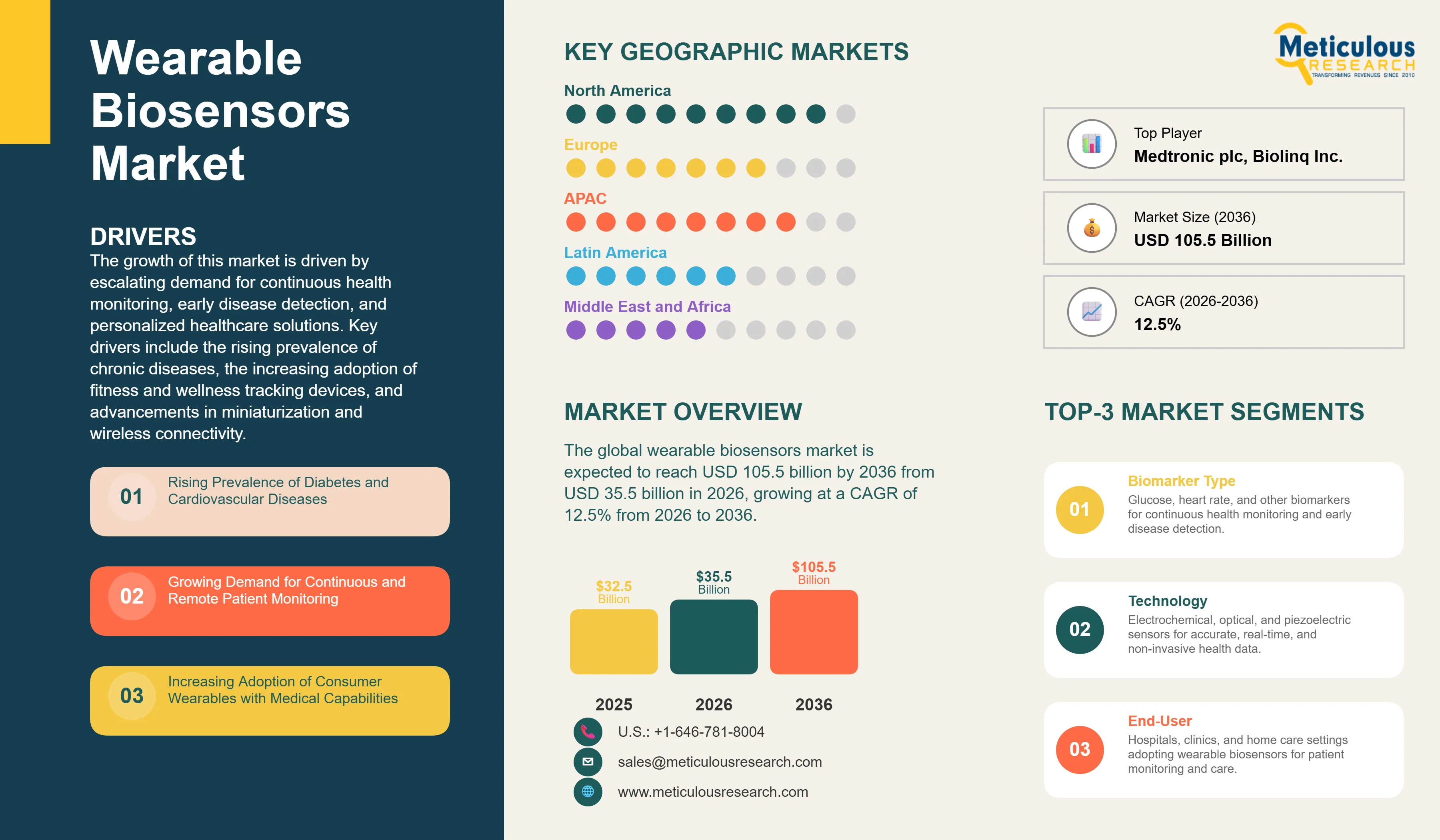
The global wearable biosensors market was valued at USD 32.5 billion in 2025. This market is expected to reach USD 105.5 billion by 2036 from USD 35.5 billion in 2026, growing at a CAGR of 12.5% from 2026 to 2036.
- Published
- Apr 2026
- Pages
- 271
- Format
- PDF + Excel
- Report ID
- MR-1873
- Base year
- 2025
- 2025 · BASELINE
- $32.50B
- 2036
- $105.5B
- CAGR 2026–2036
- 12.5%
2025 baseline · 2026–2036 forecast at 12.5% CAGR · hover a bar for the value
Key highlights
The global wearable biosensors market was valued at USD 32.5 billion in 2025.
This market is expected to reach USD 105.5 billion by 2036 from USD 35.5 billion in 2026, growing at a CAGR of 12.5% from 2026 to 2036.
The glucose monitoring segment is expected to account for the largest share of the overall wearable biosensors market in 2026.
The smartwatches with integrated biosensors segment is expected to account for the largest share of the overall wearable biosensors market in 2026.
The electrochemical biosensors segment is expected to account for the largest share of the overall wearable biosensors market in 2026.
The clinical and medical applications segment is expected to account for the largest share of the overall wearable biosensors market in 2026.
The hospitals and clinics segment is expected to account for the largest share of the overall wearable biosensors market in 2026.
North America is expected to account for the largest share of the overall wearable biosensors market in 2026. The large share of this region is mainly due to its advanced healthcare infrastructure, high adoption of digital health technologies, and strong presence of leading companies such as Apple, Fitbit (Google), and Medtronic.
Report summary
| Particulars | Details |
|---|---|
| Market Size by 2036 | USD 105.5 Billion |
| Market Size in 2026 | USD 35.5 Billion |
| Market Size in 2025 | USD 32.5 Billion |
| Market Growth Rate (2026–2036) | CAGR of 12.5% |
| Format | PDF, Excel & Cloud Portal · 271 pages |
| Dominating Region | North America |
| Fastest Growing Region | Asia-Pacific |
| Base Year | 2025 |
| Forecast Period | 2026 to 2036 |
| Segments Covered | Biomarker Type, Product Type / Form Factor, Technology, Application, End-User, and Region |
| Regions Covered | North America, Europe, Asia-Pacific, Latin America, and Middle East & Africa |
Report overview
Segments covered: biomarker type, product type/form factor, application, end-user.
The growth of this market is driven by escalating demand for continuous health monitoring, early disease detection, and personalized healthcare solutions. Key drivers include the rising prevalence of chronic diseases, the increasing adoption of fitness and wellness tracking devices, and advancements in miniaturization and wireless connectivity. Furthermore, continuous innovations in biosensing technologies, the integration of artificial intelligence for data analysis, and the growing emphasis on preventive healthcare are collectively enhancing the efficacy and market appeal of wearable biosensors worldwide.
Wearable biosensors are advanced devices that can continuously monitor health signals from the human body in a non-invasive or minimally invasive way. These devices use technologies such as electrochemical, optical, and piezoelectric sensing to convert biological or physical changes into measurable data. Unlike traditional diagnostic tools that depend on lab testing, wearable biosensors enable real-time monitoring, portability, and ease of use. They are widely used to track key health parameters such as heart rate, glucose levels, physical activity, and other biomarkers. This helps in early disease detection, proactive health management, and personalized treatment. The market includes a wide range of products—from medical-grade smart patches designed for specific conditions to consumer devices like smartwatches and fitness trackers focused on general wellness.
The market is currently witnessing strong innovation, driven by the need for higher accuracy, better comfort, and seamless integration with digital health platforms. Modern wearable biosensors are increasingly built with advanced materials for improved sensitivity, along with intelligent algorithms that enhance data accuracy and interpretation. They also feature wireless connectivity, enabling real-time data sharing with smartphones and cloud-based systems.
These advancements support remote patient monitoring, predictive analytics, and personalized health insights. Companies are heavily investing in R&D to develop smaller, energy-efficient devices with multi-parameter sensing capabilities. This allows a single device to track multiple health metrics simultaneously, catering to both medical and lifestyle applications—from continuous glucose monitoring to athlete performance tracking.
The growing focus on preventive healthcare and personalized medicine is a key factor driving market growth. Healthcare systems, consumer electronics companies, and fitness industries are increasingly adopting wearable biosensors to improve health outcomes, reduce costs, and enhance user engagement. Rising awareness of lifestyle-related diseases and the limitations of reactive healthcare models is further accelerating adoption. Wearable biosensors are now becoming a critical part of the digital health ecosystem, helping individuals and healthcare providers shift towards continuous monitoring and data-driven decision-making.
Report infographic
Market dynamics
4 factors across 3 forcesRising Prevalence of Chronic Diseases and Aging Population
The growth of the wearable biosensors market is strongly driven by the increasing prevalence of chronic diseases such as diabetes, cardiovascular conditions, and respiratory disorders, along with the rapidly aging global population. These trends are creating a significant need for continuous and remote health monitoring solutions that can help manage disease progression, reduce complications, and improve overall quality of life.
Wearable biosensors provide a convenient, non-invasive way to monitor key health parameters such as heart rate, glucose levels, physical activity, and other vital signs in real time. This allows patients to take a more active role in managing their health, while also enabling healthcare providers to access continuous data for better diagnosis and timely intervention.
In addition, the growing pressure on healthcare systems—due to rising patient volumes and treatment costs—is increasing the demand for cost-effective and scalable monitoring solutions. As a result, wearable biosensors are becoming an essential tool in chronic disease management and elderly care, supporting a shift toward preventive and home-based healthcare.
Table of contents
12 chapters · 171 sections · 271 pages · click to expandSegmental analysis
| Segment | Largest share (2026) | Fastest growth (2026–2036) |
|---|---|---|
| By Biomarker Type | Glucose Monitoring | Heart rate and cardiac biomarkers |
| By Product Type / Form Factor | Smartwatches with Integrated Biosensors | — |
| By Technology | Electrochemical Biosensors Maintain Their | Optical biosensors |
| By Application | Clinical and Medical | — |
| By End-User | Hospitals and Clinics | Home care settings |
By Biomarker Type
- The glucose monitoring segment is expected to account for the largest share of the overall wearable biosensors market in 2026.
- The large share of this segment is primarily due to the escalating global prevalence of diabetes and the critical need for continuous, accurate, and convenient glucose management solutions.
- Wearable glucose biosensors, particularly Continuous Glucose Monitors (CGMs), offer real-time insights into blood glucose levels, enabling proactive management of the condition, reducing the risk of complications, and improving patient quality of life.
- The increasing adoption of CGMs by both Type 1 and Type 2 diabetic patients, coupled with advancements in sensor technology and integration with digital health platforms, solidifies its leading position.
- The significant market size and continuous innovation in this area make it a cornerstone of the wearable biosensors market.
- However, the heart rate and cardiac biomarkers segment is expected to witness rapid growth during the forecast period.
- This growth is fueled by the rising incidence of cardiovascular diseases, increasing awareness about heart health, and the widespread integration of heart rate sensors into consumer wearables like smartwatches and fitness trackers.
- These biosensors provide continuous monitoring of heart rate, heart rate variability, and in some cases, even perform basic ECG measurements, enabling early detection of cardiac anomalies and supporting proactive cardiovascular health management.
- The demand for these features in both medical and fitness applications, coupled with technological advancements making them more accurate and accessible, drives the robust expansion of this segment.
By Product Type / Form Factor
- The smartwatches with integrated biosensors segment is expected to account for the largest share of the overall wearable biosensors market in 2026.
- The large share of this segment is primarily due to their widespread consumer adoption, multi-functional capabilities, and continuous advancements in integrated health monitoring features.
- Smartwatches offer a convenient and discreet platform for tracking a wide array of physiological parameters, including heart rate, SpO2, activity levels, sleep patterns, and increasingly, ECG and skin temperature.
- Their broad appeal, aesthetic design, and seamless integration with smartphone ecosystems make them a popular choice for individuals seeking comprehensive health and wellness insights.
- The continuous innovation by major consumer electronics brands in enhancing sensor accuracy, battery life, and data analytics further solidifies their leading position, serving as a primary gateway for broader biosensor adoption.
- However, the continuous glucose monitoring (CGM) devices segment is expected to witness significant growth during the forecast period.
- This growth is fueled by the increasing global prevalence of diabetes and the critical need for real-time, accurate, and less invasive glucose management solutions.
- CGMs offer a transformative approach to diabetes care, enabling better glycemic control, reducing the risk of complications, and improving patient quality of life.
- The increasing adoption of CGMs by both Type 1 and Type 2 diabetic patients, coupled with advancements in sensor technology and integration with digital health platforms, drives the robust expansion of this segment.
- Their ability to provide continuous data without frequent finger-pricks makes them an indispensable tool for personalized diabetes management.
By Technology
- The electrochemical biosensors segment is expected to account for the largest share of the overall wearable biosensors market in 2026.
- The large share of this segment is attributed to their high sensitivity, selectivity, and cost-effectiveness, making them ideal for the detection of various biomarkers, most notably glucose.
- Electrochemical biosensors operate by measuring the electrical current or potential generated during a biochemical reaction, providing precise and rapid results.
- Their robust design, ease of miniaturization, and compatibility with mass production techniques make them widely adopted in continuous glucose monitoring (CGM) devices, lactate sensors for sports, and various point-of-care diagnostic applications.
- Continuous advancements in electrode materials, enzyme immobilization techniques, and signal processing further reinforce their leading position, offering enhanced accuracy and reliability.
- However, the optical biosensors segment is expected to witness rapid growth during the forecast period.
- This rapid growth is driven by their non-invasive nature, high specificity, and ability to detect a wide range of analytes without the need for reagents.
- Optical biosensors are increasingly used in pulse oximetry, photoplethysmography (PPG) for heart rate monitoring, and emerging applications for detecting various biomarkers through skin contact.
- Their ability to provide continuous, real-time data without requiring blood samples makes them highly attractive for consumer wearables and remote patient monitoring, contributing to their robust market expansion.
By Application
- The clinical and medical applications segment is expected to account for the largest share of the overall wearable biosensors market in 2026.
- The large share of this segment is primarily due to the extensive and critical need for continuous patient monitoring, remote diagnostics, and disease management in clinical and home healthcare settings.
- Wearable biosensors are indispensable for tracking vital signs, glucose levels, cardiac activity, and neurological signals, providing healthcare professionals with real-time data to make informed decisions, manage chronic conditions, and prevent acute events.
- The rising burden of chronic diseases, the shift towards telehealth, and the demand for personalized medicine further amplify this demand.
- The stringent regulatory requirements and the high value placed on accurate and reliable medical data drive the adoption of high-performance wearable biosensors in this sector.
- However, the sports & performance monitoring segment is expected to grow at a rapid CAGR during the forecast period.
- This growth is fueled by the increasing consumer awareness regarding health and wellness, coupled with the demand for performance optimization and injury prevention in athletes.
- Wearable biosensors are extensively used in sports for tracking activity, heart rate, sleep, recovery, and other physiological parameters, providing athletes and coaches with actionable insights to enhance training regimens and prevent overtraining.
- The continuous innovation in sensor technology, data analytics, and the integration with coaching platforms further drives the robust expansion of this application area.
By End-User
- The hospitals and clinics segment is expected to account for the largest share of the overall wearable biosensors market in 2026.
- Wearable biosensors are increasingly integrated into hospital workflows for continuous patient monitoring, particularly in critical care, post-operative recovery, and for managing chronic conditions.
- The ability to collect real-time physiological data remotely helps clinicians make timely interventions, reduce hospital readmissions, and improve patient outcomes.
- The capital-intensive nature of some advanced medical biosensors and the need for clinical validation and regulatory approvals further align their adoption with established healthcare facilities.
- Hospitals and clinics also serve as key drivers for research and development in wearable biosensor technologies, pushing the boundaries of their application.
- However, the home care settings segment is expected to witness rapid growth during the forecast period.
- This rapid growth is driven by the increasing preference for remote patient monitoring, the aging population, and the rising prevalence of chronic diseases that require continuous oversight outside of traditional clinical settings.
- Wearable biosensors enable individuals to manage their health proactively and provide caregivers with essential data, reducing the need for frequent hospital visits and improving patient comfort and independence.
- The cost-effectiveness of home-based monitoring compared to hospital stays, coupled with technological advancements making devices more user-friendly, fuels the robust expansion of this end-user segment.
Geographic analysis
North America
Largest shareNorth America is expected to account for the largest share of the overall wearable biosensors market in 2026. The large share of this region is mainly due to its advanced healthcare infrastructure, high adoption of digital health technologies, and strong presence of leading companies such as Apple, Fitbit (Google), and Medtronic. The region also benefits from high healthcare spending, early adoption of innovative medical devices, and a large patient pool with chronic diseases like diabetes and cardiovascular conditions. In addition, favorable reimbursement policies and strong awareness about preventive healthcare further support market growth.
Asia-Pacific
Fastest growthHowever, Asia-Pacific is the fastest-growing region, driven by factors such as a large and aging population, rising prevalence of chronic diseases, and increasing healthcare awareness. Countries like China, India, and Japan are seeing rapid adoption of wearable devices due to improving healthcare infrastructure, growing disposable incomes, and expanding access to smartphones and digital platforms. Government initiatives promoting digital health and the increasing focus on preventive care are also accelerating market growth in the region.
Competitive landscape
- Abbott Laboratories
- Dexcom, Inc.
- Medtronic plc
- F. Hoffmann-La Roche Ltd.
- Apple Inc.
- Samsung Electronics Co., Ltd.
- Garmin Ltd.
- Google LLC · Fitbit
- Masimo Corporation
- Oura Health Ltd.
- Whoop, Inc.
- VitalConnect, Inc.
- Empatica Inc.
- Biolinq Inc.
- iRhythm Technologies, Inc
Frequently asked questions
The global wearable biosensors market is expected to grow from USD 35.5 billion in 2026 to USD 105.5 billion by 2036.
Cite this report
Meticulous Research. (2026). Wearable Biosensors Market - Global Opportunity Analysis and Industry Forecast (2026-2036) (Report No. MR-1873). Meticulous Market Research Pvt. Ltd. https://www.meticulousresearch.com/product/wearable-biosensors-market-6556