Resources
About Us
Wearable AI Devices Market by Product Type (Smartwatch, Ear Wear, Eye Wear), End-use Industry (Consumer Electronics, Healthcare, Enterprise, Gaming), and Region - Global Forecast to 2036
Report ID: MRSE - 104280 Pages: 227 Feb-2026 Formats*: PDF Category: Semiconductor and Electronics Delivery: 24 to 48 Hours Download Free Sample Report
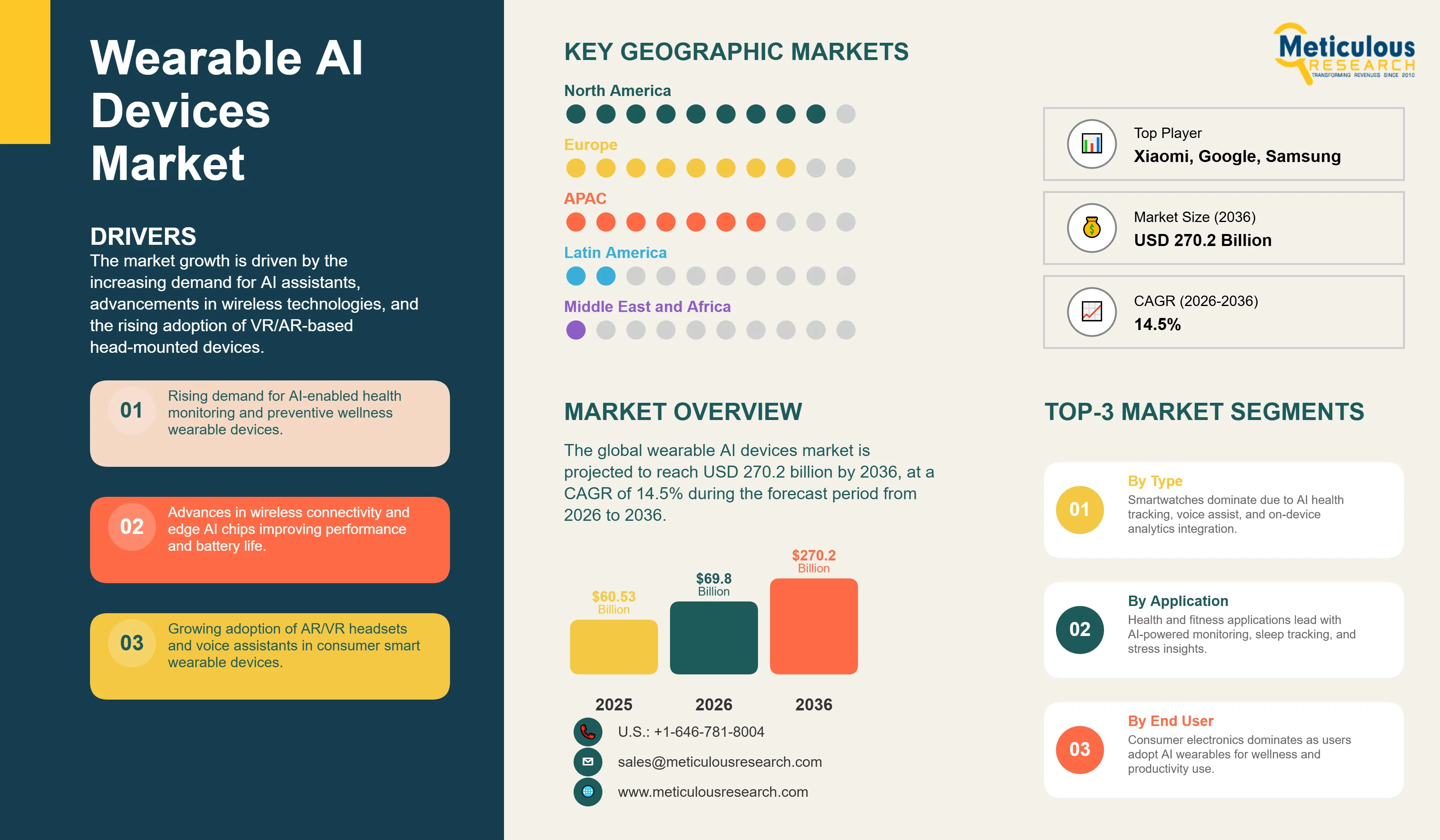
The global wearable AI devices market is valued at USD 60.53 billion in 2025. This market is projected to reach USD 270.2 billion by 2036 from USD 69.8 billion in 2026, at a CAGR of 14.5% during the forecast period from 2026 to 2036. The market growth is driven by the increasing demand for AI assistants, advancements in wireless technologies, and the rising adoption of VR/AR-based head-mounted devices.
Click here to: Get Free Sample Pages of this Report
Wearable AI devices represent a new generation of intelligent consumer electronics that leverage embedded artificial intelligence to deliver personalized, real-time insights based on user behavior and environmental data. These devices are integrated with advanced sensors capable of continuously monitoring physiological parameters such as heart rate variability, sleep patterns, physical activity, and blood oxygen levels. The collected data is processed using on-device or cloud-based AI algorithms to enable predictive health analytics, adaptive fitness coaching, and context-aware automation.
The market is witnessing significant growth driven by increasing consumer demand for multifunctional wearable devices capable of supporting health monitoring, productivity enhancement, and real-time decision-making. In recent years, leading device manufacturers have incorporated AI-enabled features such as irregular heart rhythm detection, sleep apnea monitoring, and stress-level prediction into smartwatches and fitness wearables. Additionally, the growing adoption of edge AI processors in wearable platforms is enabling faster data processing and improved privacy by minimizing reliance on cloud-based computation.
Integration of AI Assistants
The integration of AI-powered virtual assistants into wearable devices is emerging as a key trend driving the evolution of next-generation smart wearables. Voice-enabled assistants such as Apple’s Siri, Google Assistant, and Amazon Alexa are increasingly being embedded into smartwatches and AI-enabled earbuds to facilitate hands-free interaction, contextual notifications, and real-time task management.
For instance, recent advancements in natural language processing (NLP) have enabled wearable devices to support voice-based health queries, navigation assistance, and calendar management directly from the device interface. In addition, several OEMs have introduced AI-enabled earbuds with adaptive sound control and real-time language translation capabilities powered by embedded machine learning algorithms.
The growing ecosystem of connected smart home devices and voice-enabled consumer electronics is further driving the adoption of AI assistants in wearable platforms. As manufacturers continue to enhance edge AI capabilities for improved responsiveness and battery efficiency, the integration of intelligent voice interfaces is expected to remain a key technological trend in the global wearable AI devices market.
|
Parameters |
Details |
|
Market Size by 2036 |
USD 270.2 Billion |
|
Market Size in 2026 |
USD 69.8 Billion |
|
Revenue Growth Rate (2026-2036) |
CAGR of 14.5% |
|
Dominating Product |
Smartwatch |
|
Leading End User |
Consumer Electronics |
|
Leading Geographic Region |
North America |
|
Base Year |
2025 |
|
Forecast Period |
2026 to 2036 |
Drivers: Increasing Demand for Advanced Wearable Devices
The growing consumer preference for multifunctional wearable devices equipped with artificial intelligence capabilities is a key factor driving the growth of the wearable AI devices market. Modern consumers are increasingly seeking wearable technologies that extend beyond basic fitness tracking to offer real-time health monitoring, predictive analytics, and personalized recommendations based on behavioral and physiological data.
AI-enabled wearables are now capable of supporting features such as irregular heart rhythm detection, sleep quality analysis, stress monitoring, and activity-based performance insights through embedded machine learning algorithms. The rising awareness of preventive healthcare and increasing focus on health and wellness management are further contributing to the demand for advanced wearable devices that can continuously monitor vital health parameters and provide actionable insights. As a result, manufacturers are integrating AI-driven analytics and edge computing capabilities into wearable platforms to enhance device intelligence and user experience.
Why are Smartwatches the Dominant Product in the Market?
Smartwatches are expected to account for the largest share of the global wearable AI devices market, holding approximately half of the total wearable shipments in 2025, due to their ability to integrate multiple AI-enabled functionalities within a single device platform. These devices support a wide range of applications, including real-time health monitoring, voice-enabled assistance like Siri and Google Assistant, mobile payments via NFC, and contextual notifications powered by embedded artificial intelligence systems.
Leading wearable device manufacturers are increasingly incorporating AI-based features such as fall detection (Apple Watch Series 11 with second-generation sensor and watchOS 13 on-device AI), sleep pattern analysis (Samsung Galaxy Watch 8's enhanced AI Sleep Apnea Detection cleared by FDA), adaptive fitness coaching (Google Pixel Watch 4's Fitbit AI Personalized Coaching), and anomaly detection in heart rate variability (Huawei Watch GT 6's TruSeen 6.0+ AI) into smartwatch platforms. In addition, the integration of on-device AI processors like Apple's S13 SiP and Qualcomm's Snapdragon Wear 5100 series is enabling smartwatches to perform real-time data analysis without relying heavily on cloud connectivity, thereby improving response time and data privacy.
The growing adoption of AI-enabled smartwatches across consumer health, fitness, and productivity applications, with leading companies like Apple reporting wearables as its third-largest revenue segment in FY2025, is expected to drive the growth of this segment over the forecast period.
Which End-Use Industry is Expected to Dominate the Wearable AI Devices Market?
The consumer electronics segment is expected to account for the largest share of the global wearable AI devices market in 2026. The largest share of this segment is primarily attributed to the increasing adoption of AI-enabled smartwatches, earbuds, and fitness bands for health monitoring, personal productivity, and lifestyle management applications. The integration of advanced AI-driven features such as sleep tracking, activity recognition, and stress-level monitoring into consumer wearable devices is further supporting their widespread adoption across diverse user demographics.
In addition, the healthcare sector is projected to witness significant growth due to the rising deployment of AI-powered wearable devices for remote patient monitoring, chronic disease management, and early detection of health anomalies. These devices enable continuous monitoring of physiological parameters such as heart rate, blood oxygen levels, and physical activity, thereby supporting preventive healthcare initiatives and telemedicine services.
Which Region is Expected to Dominate the Global Wearable AI Devices Market?
North America is expected to account for the largest share of the global wearable AI devices market in 2026. This is primarily attributed to the strong presence of leading wearable technology manufacturers like Apple, which shipped over 20 million Apple Watches in Q4 2024 alone with AI features such as ECG monitoring and fall detection via watchOS, and Google with Pixel Watch's Fitbit AI readiness scores; early adoption of AI-enabled consumer electronics, where U.S. smartwatch penetration exceeds 30% among adults; and growing demand for advanced health monitoring solutions across the region.
Furthermore, increasing investments in digital health technologies, such as Meta's USD 3.5 billion investment in EssilorLuxottica for AI-powered Ray-Ban Meta smart glasses launched in 2024-2025, and the widespread adoption of connected devices are supporting the growth of AI-powered wearable platforms in the U.S. and Canada. The presence of established technology ecosystems and favorable regulatory frameworks for digital healthcare solutions, including FDA clearances for devices like Apple's ECG, is also contributing to the region’s market leadership.
Asia-Pacific is projected to witness the fastest growth over the forecast period, driven by rising consumer demand for smart wearable devices in countries such as China, where Huawei topped shipments via Watch series featuring TruSeen AI heart rate tech, Japan, South Korea with Samsung's Galaxy Watch AI sleep apnea detection, and India. The expansion of consumer electronics manufacturing hubs and increasing penetration of fitness and wellness technologies are expected to support regional market growth.
The key players profiled in the global wearable AI devices market report include Apple Inc., Samsung Electronics Co., Ltd., Google LLC, Huawei Technologies Co., Ltd., Sony Corporation, Garmin Ltd., Meta Platforms, Inc., Xiaomi Corporation, Zepp Health Corporation, and Fitbit (Google LLC), among others.
The global wearable AI devices market is valued at USD 69.8 billion in 2026 and is projected to reach USD 270.2 billion by 2036.
The overall wearable AI devices market is expected to grow at a CAGR of 14.5% during the forecast period from 2026 to 2036.
The key players operating in the global wearable AI devices market include Apple Inc., Samsung Electronics Co., Ltd., Google LLC, Huawei Technologies Co., Ltd., Garmin Ltd., Meta Platforms, Inc., Xiaomi Corporation, and Zepp Health Corporation, among others.
The primary factors driving market growth include the increasing integration of AI-powered virtual assistants, growing demand for personalized health monitoring, and rising adoption of AI-enabled wearable devices across consumer and enterprise applications.
North America is expected to account for the largest share of the market, driven by high consumer adoption of advanced wearable technologies and the strong presence of leading device manufacturers in the region.
























Published Date: Mar-2026
Published Date: Feb-2026
Published Date: Sep-2024
Published Date: Jan-2024
Published Date: Jan-2024
Please enter your corporate email id here to view sample report.
Subscribe to get the latest industry updates


