
Ultrasonic Testing Market (2026-2036)
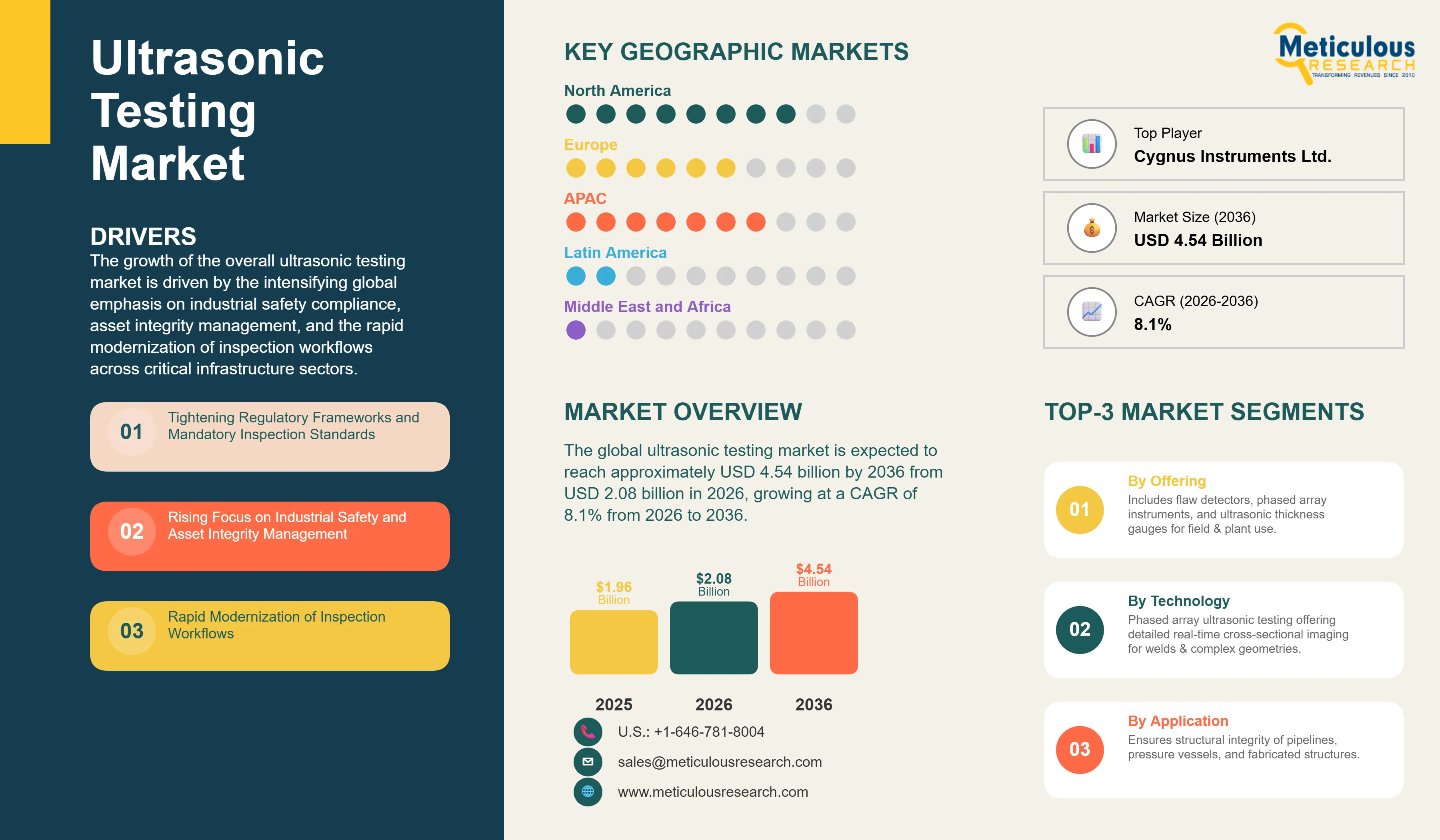
The global ultrasonic testing market was valued at USD 1.96 billion in 2025. The market is expected to reach approximately USD 4.54 billion by 2036 from USD 2.08 billion in 2026, growing at a CAGR of 8.1% from 2026 to 2036.
- Published
- Feb 2026
- Pages
- 294
- Format
- PDF + Excel
- Report ID
- MR-1797
- Base year
- 2025
- 2025 · BASELINE
- $1.96B
- 2036
- $4.54B
- CAGR 2026–2036
- 8.1%
2025 baseline · 2026–2036 forecast at 8.1% CAGR · hover a bar for the value
Key highlights
In terms of revenue, the global ultrasonic testing market is projected to reach USD 4.54 billion by 2036.
The market is expected to grow at a CAGR of 8.1% from 2026 to 2036.
North America dominates the global ultrasonic testing market with the largest market share in 2026, driven by stringent federal inspection mandates, a mature non-destructive testing (NDT) ecosystem, and extensive pipeline, aerospace, and power infrastructure requiring recurring ultrasonic surveys.
Asia-Pacific is expected to witness the fastest growth during the forecast period, supported by rapid industrial expansion in China, India, South Korea, and Southeast Asia, and increasing government investments in infrastructure and manufacturing quality standards.
By offering, the equipment segment holds the largest market share in 2026, led by flaw detectors and phased array instruments, which are seeing widespread deployment in field inspection programs across oil & gas, aerospace, and power generation sectors.
By technology, the phased array ultrasonic testing (PAUT) segment holds the largest market share in 2026, owing to its superior imaging capabilities, faster scan coverage, and ability to simultaneously inspect complex geometries compared to conventional methods.
By application, the weld inspection segment holds the largest share of the overall market in 2026, driven by its critical role in maintaining structural integrity across pipelines, pressure vessels, and fabricated structures.
By end-use industry, the oil & gas segment holds the largest share of the overall market in 2026, driven by extensive pipeline infrastructure, recurring statutory inspection requirements, and heightened focus on corrosion and crack detection in aging upstream and midstream assets.
Report summary
| Particulars | Details |
|---|---|
| Market Size by 2036 | USD 4.54 Billion |
| Market Size in 2026 | USD 2.08 Billion |
| Market Size in 2025 | USD 1.96 Billion |
| Market Growth Rate (2026–2036) | CAGR of 8.1% |
| Format | PDF, Excel & Cloud Portal · 294 pages |
| Dominating Region | North America |
| Fastest Growing Region | Asia-Pacific |
| Base Year | 2025 |
| Forecast Period | 2026 to 2036 |
| Segments Covered | Offering, Technology, Application, End-use Industry, and Geography |
| Geographies Covered | North America, Europe, Asia-Pacific, Latin America, and Middle East & Africa |
Report overview
Segments covered: offering, technology, application, end-use industry—.
The growth of the overall ultrasonic testing market is driven by the intensifying global emphasis on industrial safety compliance, asset integrity management, and the rapid modernization of inspection workflows across critical infrastructure sectors. As asset operators across oil & gas, aerospace, and power generation seek to integrate greater precision and speed into their quality assurance programs, ultrasonic testing technology has emerged as an indispensable tool for detecting structural defects, measuring material thickness, and ensuring the long-term reliability of high-value assets. The accelerating adoption of phased array techniques, the integration of artificial intelligence for real-time defect classification, and the expanding use of robotic and automated scanning systems continue to fuel significant growth across all major geographic regions.
Ultrasonic testing is a well-established non-destructive testing (NDT) method that uses high-frequency sound waves to inspect materials, components, and structures for internal flaws, dimensional variations, and material degradation without causing damage to the test object. The technique works by transmitting ultrasonic pulses into a material through a transducer and analyzing the reflected or transmitted energy to identify discontinuities, measure thickness, or assess material properties. The market encompasses a broad spectrum of instruments, inspection services, and analytical software, ranging from handheld portable flaw detectors used in field maintenance to fully automated multi-axis scanning systems deployed in high-throughput manufacturing environments.
The market is defined by rapid technology evolution, including the widespread shift toward phased array ultrasonic testing (PAUT), which uses multiple piezoelectric elements to electronically steer and focus sound beams, enabling detailed cross-sectional imaging of welds, forgings, and composite components. The time-of-flight diffraction (TOFD) technique, which uses the diffraction of ultrasonic signals at defect tips, is gaining significant adoption in pressure vessel and pipeline weld inspection due to its high sensitivity to planar defects. Guided wave ultrasonic testing, which propagates low-frequency waves along extended pipe lengths from a single sensor ring, is transforming corrosion monitoring in buried and insulated pipelines. The full matrix capture (FMC) and total focusing method (TFM), representing the latest frontier in ultrasonic imaging, are now being commercialized by leading equipment manufacturers for applications requiring maximum defect characterization accuracy, including nuclear and aerospace inspection.
These systems are increasingly integrated with artificial intelligence and machine learning engines that automate defect recognition, reduce operator dependency, and dramatically improve inspection throughput. The rise of robotic and semi-automated ultrasonic scanning solutions — including crawlers, drones, and collaborative robots — is enabling inspections in previously inaccessible or hazardous environments. Cloud-based data platforms now allow inspection teams to stream, store, and analyze ultrasonic data remotely, supporting distributed asset management across multiple geographies. The ability to deliver high-precision, audit-ready inspection records while minimizing asset downtime has made advanced ultrasonic testing a preferred choice across industries where structural failure carries significant safety, operational, and regulatory consequences.
Regulatory authorities worldwide continue to tighten inspection mandates. The U.S. Pipeline and Hazardous Materials Safety Administration (PHMSA) revised its high-consequence pipeline inspection intervals in 2024, requiring ultrasonic surveys every seven years rather than every ten, directly driving incremental equipment and service demand. API RP 1160, Third Edition, published in January 2025, reinforced performance-validation benchmarks for ultrasonic inspection tools. Similar regulatory tightening is taking place in Europe under the Pressure Equipment Directive (PED) and in Asia-Pacific as industrial safety enforcement intensifies.
Report infographic
Market dynamics
4 factors across 3 forcesTightening Regulatory Frameworks and Mandatory Inspection Standards
A key driver of the ultrasonic testing market is the steady tightening of government and industry-body inspection mandates across high-consequence sectors. Regulations governing the integrity of oil and gas pipelines, nuclear plant components, pressure vessels, and aerospace structures are becoming more prescriptive in terms of inspection frequency, technique qualification, and data traceability requirements. The PHMSA's revised pipeline inspection rule, API RP 1160 Third Edition, and nuclear inspection standards enforced by bodies such as the U.S. Nuclear Regulatory Commission and the International Atomic Energy Agency are directly driving recurring demand for advanced ultrasonic inspection equipment and qualified inspection services. In Europe, the Pressure Equipment Directive and EN standards for weld testing are pushing industrial operators to adopt qualified phased array and TOFD systems to satisfy conformity requirements. This regulatory environment creates a sustained, non-discretionary baseline of demand for ultrasonic inspection that remains relatively insulated from short-term industrial downturns, providing a stable foundation for equipment manufacturers, service providers, and software developers operating in the market.
Table of contents
11 chapters · 127 sections · 294 pages · click to expandSegmental analysis
| Segment | Largest share (2026) | Fastest growth (2026–2036) |
|---|---|---|
| By Offering | Equipment | — |
| By Technology | Phased Array Ultrasonic Testing (PAUT) | Full matrix capture and total focusing method (FMC/TFM) |
| By End-use Industry | Oil & Gas | Aerospace & defense |
By Offering
- The equipment segment accounts for the largest share of the overall ultrasonic testing market in 2026.
- This is primarily due to the high capital expenditure associated with the procurement of phased array flaw detectors, ultrasonic thickness gauges, TOFD systems, and specialized transducer arrays across a broad base of end-user industries including oil & gas, aerospace, power generation, and manufacturing.
- Flaw detectors, particularly portable phased array instruments, represent the single largest product category within the equipment segment, with leading products such as Waygate Technologies' Krautkrämer USM 100, Evident Corporation's OmniScan X3, and Eddyfi Technologies' Capture-based instruments driving volume across field inspection programs globally.
- The ongoing shift from conventional single-element flaw detectors to multi-group phased array systems that support simultaneous PAUT and TOFD acquisition in a single pass is accelerating average selling price growth within the equipment segment.
- The services segment, however, is projected to grow at a healthy CAGR during the forecast period, reflecting the increasing trend among asset operators to outsource inspection activities to certified third-party service providers who can deliver qualified inspection data along with regulatory compliance documentation.
By Technology
- The phased array ultrasonic testing (PAUT) segment holds the largest share of the overall market in 2026.
- This is primarily due to its ability to produce detailed, real-time cross-sectional images of internal structures by electronically steering ultrasonic beams at multiple angles without physically moving the probe, dramatically reducing scan times and improving defect detection probability on complex geometries such as nozzle welds, curved surfaces, and dissimilar metal joints.
- PAUT has become the de facto standard for weld inspection in oil & gas pipeline construction, power plant pressure component inspection, and aerospace maintenance, displacing conventional multi-angle manual ultrasonic scanning in a growing proportion of code-qualified applications.
- The full matrix capture and total focusing method (FMC/TFM) segment is expected to witness the fastest growth during the forecast period, as this technique delivers superior spatial resolution and quantitative defect sizing accuracy that is increasingly required for fitness-for-service assessments in nuclear, aerospace, and critical pressure equipment inspection programs.
By End-use Industry
- The oil & gas segment commands the largest share of the global ultrasonic testing market in 2026.
- This dominance is driven by the extensive network of aging pipelines, refineries, offshore platforms, pressure vessels, and storage tanks that require continuous integrity monitoring and periodic statutory inspection under both regulatory mandate and industry codes such as API 570, API 653, and API 580.
- Ultrasonic testing is the primary technique for corrosion mapping of pipe walls and vessel shells, weld inspection during new pipeline construction, and crack sizing in high-consequence areas subject to stress corrosion cracking and fatigue loading.
- The prevalence of guided wave ultrasonic testing for screening long pipeline runs from a single sensor attachment point, combined with the use of robotic crawlers for in-line inspection of operating pipelines, underlines the scale and technical diversity of ultrasonic inspection within the oil & gas segment.
- The aerospace & defense segment is poised for the fastest growth through 2036, fueled by the intensification of composite material inspection requirements on next-generation commercial aircraft and by increased defense spending on maintenance, repair, and overhaul (MRO) of military aviation assets globally.
Geographic analysis
North America
Largest shareNorth America holds the largest share of the global ultrasonic testing market in 2026. The region's leadership is primarily attributed to its mature and well-regulated NDT ecosystem, which encompasses an extensive pipeline and refinery infrastructure subject to recurring federal inspection mandates, a world-leading aerospace manufacturing and MRO sector, and a large installed base of nuclear power plants requiring rigorous in-service inspection programs. The United States alone accounts for a disproportionately large share of global ultrasonic testing expenditure, reflecting the breadth and density of regulated industrial assets and the presence of leading inspection equipment manufacturers and service providers including Waygate Technologies, MISTRAS Group, and Innerspec Technologies. Canada contributes meaningfully through its oil sands and heavy crude pipeline infrastructure in Alberta, which demands high volumes of automated ultrasonic inspection. The PHMSA's mandate tightening pipeline inspection intervals in high-consequence areas, finalized in 2024, is expected to sustain above-average demand for advanced ultrasonic inspection systems and services in North America through the forecast period.
Asia-Pacific
Fastest growthAsia-Pacific is the fastest-growing regional market for ultrasonic testing during the forecast period. This growth is driven by the rapid expansion of manufacturing, energy, and infrastructure sectors across China, India, South Korea, and Southeast Asia, all of which are investing heavily in quality assurance and asset integrity programs as industrial output scales. China's continuing expansion of nuclear power generation capacity, large-scale natural gas pipeline network development, and the rapid growth of domestic aerospace manufacturing are creating significant incremental demand for advanced phased array and TOFD inspection systems. India's expanding refining and petrochemical sector and its ambitious infrastructure development agenda are similarly driving adoption of automated ultrasonic inspection technologies.
Europe
In Europe, the leadership in engineering quality standards and the push for decarbonization across the energy sector are driving sustained demand for high-reliability ultrasonic inspection solutions. Countries such as Germany, France, the United Kingdom, and the Netherlands are at the forefront of adopting advanced digital inspection workflows that integrate ultrasonic data with cloud-based asset management platforms and predictive maintenance programs. Europe's significant offshore wind energy build-out is creating new inspection requirements for marine and subsea structural components, further diversifying the regional demand base.
Competitive landscape
- Waygate Technologies (a Baker Hughes business)
- Evident Corporation
- Eddyfi Technologies Inc.
- MISTRAS Group, Inc.
Frequently asked questions
The global ultrasonic testing market is expected to grow from USD 2.08 billion in 2026 to USD 4.54 billion by 2036.
Cite this report
Meticulous Research. (2026). Ultrasonic Testing Market - Global Opportunity Analysis and Industry Forecast (2026-2036) (Report No. MR-1797). Meticulous Market Research Pvt. Ltd. https://www.meticulousresearch.com/product/ultrasonic-testing-market-6480