Synthetic Medical Data Generation Platforms Market (2026-2036)
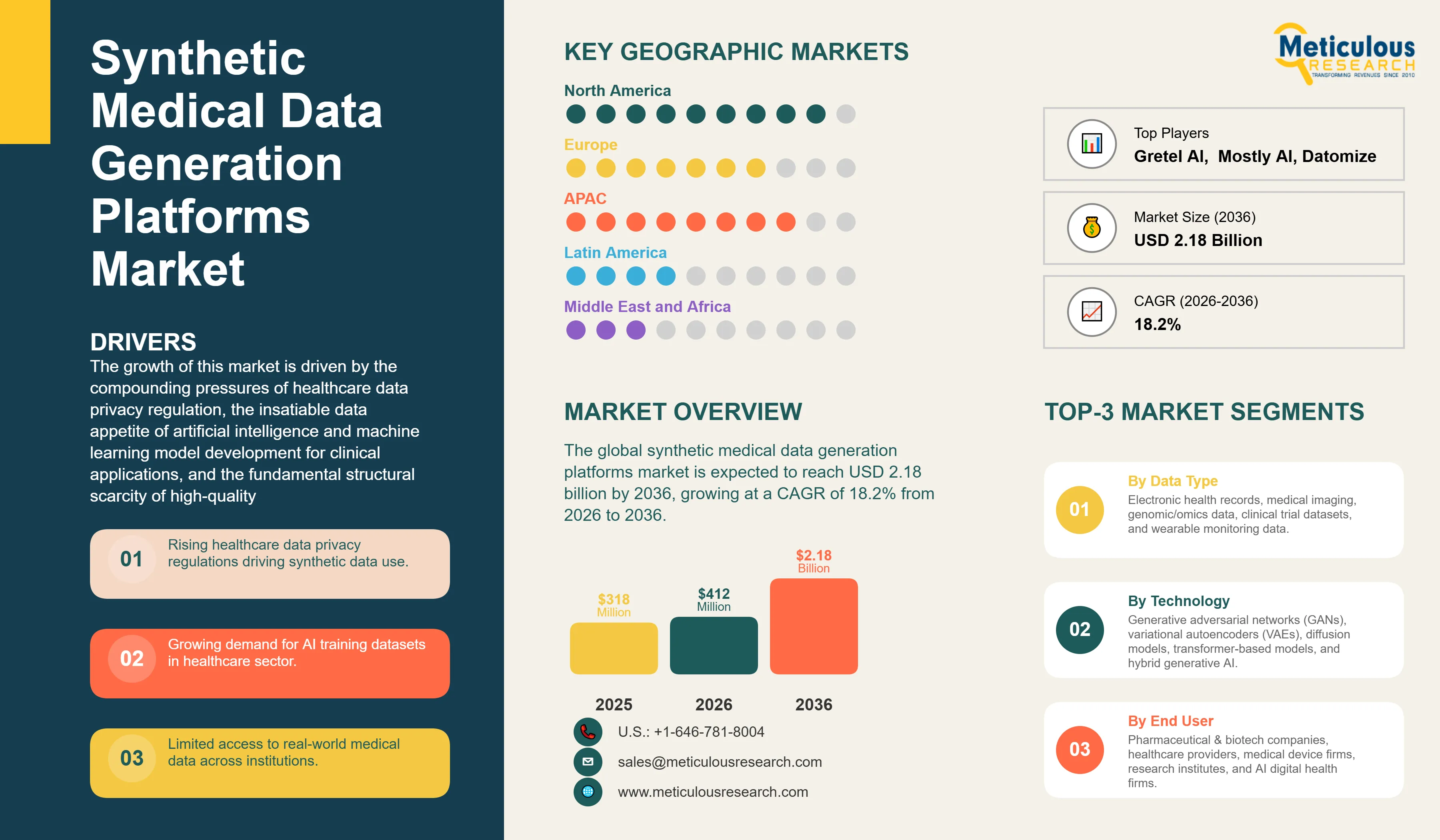
The global synthetic medical data generation platforms market was valued at USD 318 million in 2025. This market is expected to reach USD 2.18 billion by 2036 from USD 412 million in 2026, growing at a CAGR of 18.2% from 2026 to 2036.
- Published
- Mar 2026
- Pages
- 277
- Format
- PDF + Excel
- Report ID
- MR-1846
- Base year
- 2025
- 2025 · BASELINE
- $318.0M
- 2036
- $2.18B
- CAGR 2026–2036
- 18.2%
2025 baseline · 2026–2036 forecast at 18.2% CAGR · hover a bar for the value
Key highlights
In terms of revenue, the global synthetic medical data generation platforms market is projected to reach USD 2.18 billion by 2036.
The market is expected to grow at a CAGR of 18.2% from 2026 to 2036.
North America is expected to dominate the global synthetic medical data generation platforms market with the largest market share in 2026, driven by the region's leading concentration of healthcare AI development activity, the strong regulatory and compliance incentives for synthetic data adoption created by HIPAA's restrictions on patient data sharing, the substantial venture capital investment in healthcare data infrastructure companies, and the presence of leading platform vendors including MDClone, Gretel AI, Syntegra, Tonic.ai, and HealthVerity alongside major technology company investments from Google Health and Microsoft in healthcare synthetic data capabilities.
Asia-Pacific is expected to witness the fastest growth during the forecast period, driven by China's aggressive national AI healthcare investment programs, India's rapidly expanding health technology sector with growing awareness of synthetic data utility for AI development without exposing patient records governed by evolving domestic privacy legislation, and Japan's and South Korea's sophisticated healthcare IT infrastructure and active digital health AI development ecosystems that are increasingly confronting the data sharing constraints that synthetic data generation is designed to resolve.
By data type, the electronic health records (EHR) data segment is expected to hold the largest share of the overall synthetic medical data generation platforms market in 2026, as EHR data represents the most universally collected, highest-volume, and most broadly applicable category of healthcare data for AI model training across clinical decision support, population health management, readmission prediction, and drug safety surveillance applications, and the regulatory barriers to sharing real EHR data across institutional boundaries are the most commercially consequential driver of synthetic EHR data demand.
By data type, the medical imaging data segment is expected to witness the fastest growth during the forecast period, driven by the enormous and rapidly growing demand for labeled medical imaging datasets to train radiology AI algorithms, the extreme cost and physician time requirements of manually annotating real imaging datasets at the scale required for deep learning model development, and the demonstrated ability of GAN and diffusion model-based synthetic imaging platforms to generate clinically realistic synthetic radiographs, CT scans, MRI sequences, and pathology slide images at scale.
By technology, the generative adversarial networks (GANs) segment is expected to hold the largest share of the overall market in 2026, reflecting GANs' established position as the foundational generative architecture for synthetic medical data applications and the maturity of GAN-based platform implementations across both structured EHR data and unstructured medical imaging generation tasks.
By technology, the diffusion models segment is expected to witness the fastest growth during the forecast period, driven by diffusion models' demonstrated superiority over GANs in generating high-fidelity medical images with greater diversity and controllability, and their rapid adoption by medical imaging AI development teams following the publication of landmark research demonstrating diffusion model performance in chest radiograph, dermatology image, and histopathology slide synthesis tasks.
By deployment mode, the cloud-based platforms segment is expected to hold the largest share of the overall market in 2026, as cloud deployment enables the large-scale computational resources required for training and running generative AI models for synthetic data production without requiring healthcare organizations to make substantial on-premise infrastructure investments.
By end user, the pharmaceutical and biotechnology companies segment is expected to hold the largest share of the overall market in 2026, as pharmaceutical companies represent the largest and most resource-intensive users of synthetic medical data for clinical trial simulation, regulatory submission support, drug safety signal detection, and real-world evidence generation applications.
By end user, the AI and digital health companies segment is expected to witness the fastest growth during the forecast period, as the proliferation of AI-powered clinical decision support, diagnostic imaging, and digital therapeutics companies creates rapidly expanding demand for synthetic medical training datasets from organizations that typically lack direct access to large patient datasets but require them to develop and validate their AI products.
Report summary
| Particulars | Details |
|---|---|
| Market Size by 2036 | USD 2.18 Billion |
| Market Size in 2026 | USD 412 Million |
| Market Size in 2025 | USD 318 Million |
| Market Growth Rate (2026–2036) | CAGR of 18.2% |
| Format | PDF, Excel & Cloud Portal · 277 pages |
| Dominating Region | North America |
| Fastest Growing Region | Asia-Pacific |
| Base Year | 2025 |
| Forecast Period | 2026 to 2036 |
| Segments Covered | Data Type, Technology, Deployment Mode, End User, and Region |
| Regions Covered | North America, Europe, Asia-Pacific, Latin America, and Middle East & Africa |
Report overview
Segments covered: data type, technology, deployment mode, end user.
The growth of this market is driven by the compounding pressures of healthcare data privacy regulation, the insatiable data appetite of artificial intelligence and machine learning model development for clinical applications, and the fundamental structural scarcity of high-quality, properly labeled, demographically diverse real-world medical datasets that can be freely shared across organizational boundaries without triggering regulatory liability. Synthetic medical data generation platforms are software systems that use advanced generative artificial intelligence techniques — principally generative adversarial networks, variational autoencoders, diffusion models, and transformer-based large language and multimodal models — to produce artificial healthcare datasets that replicate the statistical properties, structural characteristics, and clinical patterns of real patient data while containing no actual patient information and therefore posing no re-identification risk under applicable privacy frameworks. These platforms generate synthetic versions of electronic health records, medical imaging datasets, genomic sequences, clinical trial datasets, and continuous monitoring data streams that can be freely shared with AI development teams, research collaborators, regulatory bodies, and commercial partners in contexts where sharing the underlying real patient data would be legally prohibited, technically restricted, or ethically problematic.
The synthetic medical data generation market addresses a paradox at the heart of healthcare AI development: the clinical AI systems that could most dramatically improve healthcare outcomes — diagnostic imaging algorithms, sepsis prediction models, drug response predictors, and rare disease classifiers — require training on the largest and most diverse patient datasets, yet the most sensitive and privacy-protected category of personal data in virtually every legal system is medical information. HIPAA in the United States, GDPR in Europe, and equivalent frameworks across Asia and Latin America impose strict access controls, data sharing agreements, and de-identification requirements on real patient data that create substantial barriers to the data aggregation and sharing that AI training requires. Synthetic data generation platforms resolve this tension by producing statistically equivalent artificial datasets that inherit the clinical utility of real patient data for AI training purposes while being legally and technically distinct from the real patient records from which the generative models learned.
Synthetic medical data generation represents one of the most technically sophisticated and commercially consequential applications of generative artificial intelligence to emerge from the broader AI revolution of the past decade. The technical problem that synthetic medical data platforms solve is deceptively straightforward in concept but extraordinarily challenging in practice: training a generative model to learn the complex statistical relationships, clinical coding conventions, temporal dependencies, and population-level distributional properties embedded in large real healthcare datasets well enough that the synthetic outputs it produces are statistically indistinguishable from real data for downstream AI model training and clinical research purposes — while simultaneously providing formal mathematical guarantees that the synthetic data cannot be reversed to reconstruct or re-identify any individual patient record.
The technical architecture of synthetic medical data generation platforms varies significantly across the different data modalities they address, reflecting the fundamentally different structural and statistical properties of structured EHR data, high-dimensional medical imaging, sequential genomic data, and time-series physiological monitoring data. For structured EHR data encompassing demographics, diagnoses, procedures, medications, laboratory results, and clinical notes, platforms including MDClone, Syntegra, and Mostly AI have implemented GAN-based and transformer-based architectures that learn to reproduce the correlational structure of patient records including the temporal sequencing of clinical events, the co-occurrence patterns of diagnoses and medications, and the demographic distributions of clinical variables across patient populations. For medical imaging data, platforms including Gretel AI, Hazy, and specialized radiology AI companies have developed GAN-based and diffusion model-based architectures capable of generating synthetic images that radiologists and pathologists cannot reliably distinguish from real patient images in blinded evaluation studies. For genomic and omics data, highly specialized platforms address the unique challenge of generating synthetic genome sequences that preserve population-level genetic diversity patterns and variant frequency distributions without reproducing any actual patient's genetic information.
The commercial ecosystem of the synthetic medical data generation market encompasses three distinct business model architectures. Pure-play synthetic data platform companies including MDClone, Syntegra, Gretel AI, Mostly AI, Hazy, YData, Datomize, and Betterdata offer dedicated synthetic data generation software as a cloud service or on-premise deployment, targeting healthcare organizations, pharmaceutical companies, and health AI developers as their primary customers. Healthcare data and analytics companies including IQVIA and HealthVerity are integrating synthetic data generation capabilities into broader real-world evidence and healthcare data analytics platform offerings, leveraging their established pharmaceutical industry relationships and large proprietary real-world data assets to provide synthetic data services as a premium complement to their core data products. Major technology platform companies including Google Health and Microsoft are developing synthetic healthcare data capabilities within their broader healthcare cloud and AI platform strategies, competing for enterprise healthcare and pharmaceutical company relationships through integrated platform offerings that combine synthetic data generation with AI model training infrastructure and deployment services.
The privacy-preservation framework that distinguishes synthetic data from conventional de-identification approaches is grounded in the concept of differential privacy — a formal mathematical framework that provides probabilistic guarantees about the maximum amount of information about any individual that can be inferred from the synthetic dataset, regardless of what auxiliary information an adversary might possess. Platforms that implement differential privacy guarantees at provable privacy budget levels provide healthcare organizations with a defensible technical and legal basis for sharing synthetic datasets without triggering HIPAA's covered entity or business associate obligations or GDPR's personal data restrictions, as the synthetic data by construction does not contain personal information as defined under these frameworks. The evolution of privacy-preservation technical standards and the developing body of regulatory guidance on synthetic data's legal status as personal data under HIPAA and GDPR are critical determinants of market adoption pace, as healthcare organizations' willingness to rely on synthetic data for regulatory and commercial purposes depends on regulatory clarity about its privacy status.
Report infographic
Market dynamics
5 factors across 3 forcesIncreasing Need for Privacy-Preserving Healthcare Data
The primary structural driver of the synthetic medical data generation platforms market is the irreducible tension between the data intensity requirements of modern healthcare AI development and the strict legal, regulatory, and ethical constraints that govern the collection, storage, and sharing of real patient health information. Healthcare data is the most comprehensively regulated category of personal data in virtually every jurisdiction globally, subject to HIPAA's covered entity obligations and minimum necessary access standards in the United States, GDPR's lawful basis requirements and explicit prohibition of unnecessary processing of special category health data in Europe, and equivalent comprehensive data protection frameworks in Canada, Australia, Japan, South Korea, India, and Brazil. These regulatory frameworks impose substantial compliance costs, liability exposure, and institutional friction on any process that involves accessing, aggregating, or sharing real patient data across organizational boundaries, which is precisely the activity required to assemble the large, diverse, multi-institutional training datasets that clinical AI systems need to achieve generalizable performance.
The de-identification approaches that HIPAA and GDPR permit as mechanisms for reducing privacy obligations on medical data — such as HIPAA's Safe Harbor standard that requires the removal of 18 specific patient identifiers — are increasingly recognized by privacy researchers and regulators as providing inadequate re-identification protection for high-dimensional datasets including genomic sequences, detailed longitudinal clinical records, and medical imaging data, where re-identification attacks using auxiliary publicly available information can successfully match de-identified records to specific individuals. This recognition is creating institutional pressure on healthcare organizations to move beyond conventional de-identification toward formally privacy-preserving synthetic data generation approaches that provide mathematical guarantees against re-identification, regardless of what auxiliary information an adversary might bring to bear. Synthetic data platforms that implement differential privacy at provable privacy budget levels provide this mathematically rigorous privacy guarantee in a way that conventional de-identification cannot.
Growing Demand for AI Training Datasets in Healthcare
The healthcare AI market is experiencing an unprecedented expansion of algorithm development activity across an increasingly broad range of clinical application domains, from established areas including radiology AI for imaging interpretation and clinical decision support for sepsis and deterioration prediction, to emerging applications including AI-assisted drug discovery, genomics-based precision medicine, digital pathology, AI-powered surgical guidance, and ambient clinical intelligence systems that automatically document clinical encounters. Each of these AI application categories requires training datasets of sufficient scale, diversity, and clinical quality to produce algorithms with the performance characteristics necessary for clinical deployment, yet the datasets available to the AI development organizations pursuing these applications are almost invariably insufficient in size, diversity, or label quality relative to what the technical requirements of state-of-the-art deep learning architectures demand.
The AI training data gap in healthcare is particularly acute for rare diseases and underrepresented patient populations, where the small number of patients with specific conditions or the historical underrepresentation of certain demographic groups in electronic health records creates chronic data scarcity for developing algorithms that can reliably serve these populations. Synthetic data generation platforms that can augment rare disease datasets by generating statistically consistent additional patient records, or that can generate synthetic patient representations for demographic groups underrepresented in training data, address a critical AI fairness and generalizability challenge that is receiving growing attention from both AI developers and healthcare regulatory agencies including the FDA and the European Commission's AI Act implementation bodies.
Table of contents
12 chapters · 151 sections · 277 pages · click to expandSegmental analysis
| Segment | Largest share (2026) | Fastest growth (2026–2036) |
|---|---|---|
| By Data Type | EHR Data | Medical imaging data |
| By Technology | GANs | Diffusion models |
| By Deployment Mode | Cloud-Based Platforms | — |
| By End User | Pharmaceutical and Biotechnology Companies | AI and digital health companies |
By Data Type
- The electronic health records (EHR) data segment is expected to hold the largest share of the synthetic medical data generation platforms market.
- EHR data is the most universally collected, institutionally held, and broadly applicable category of healthcare data for clinical AI development, encompassing patient demographics, diagnoses, procedures, medications, laboratory results, vital signs, and clinical notes that collectively describe the trajectory of a patient's healthcare interactions over time.
- The AI applications that can be developed from EHR training data span the broadest range of clinical decision support, population health management, risk stratification, and healthcare operations optimization use cases, creating large and diverse commercial demand for synthetic EHR data generation capabilities.
- The regulatory restrictions on real EHR sharing under HIPAA and GDPR are among the most commercially consequential barriers to EHR-based AI development, making synthetic EHR data generation one of the most commercially motivated applications of the technology.
- However, the medical imaging data segment is expected to witness the fastest growth during the forecast period.
- The radiology AI market is growing at exceptional pace, with the FDA clearing an increasing number of AI-powered imaging analysis algorithms annually, and the training data requirements for state-of-the-art deep learning radiology algorithms substantially exceed what most individual healthcare institutions can provide from their own imaging archives.
- Diffusion model-based synthetic medical imaging platforms capable of generating radiologically realistic chest radiographs, brain MRI sequences, mammograms, and histopathology slides at scale are providing radiology AI developers with a practical solution to training data scarcity that is driving rapid adoption of synthetic imaging generation platforms.
By Technology
- The generative adversarial networks (GANs) segment is expected to hold the largest share of the synthetic medical data generation platforms market by technology.
- GANs have served as the foundational generative architecture for synthetic medical data applications since their introduction to healthcare data generation research in the mid-2010s, and the decade of research and commercial development investment in GAN-based medical data synthesis has produced a mature ecosystem of GAN architectures specifically optimized for healthcare data modalities, including Wasserstein GANs and conditional GANs for tabular EHR data, and StyleGAN and progressive growing GAN variants for medical image synthesis.
- The commercial platform implementations of GAN-based synthetic medical data generation developed by MDClone, Syntegra, Gretel AI, and Mostly AI are built on GAN foundations refined through years of healthcare-specific validation and deployment experience, representing proven and commercially trusted technologies that healthcare enterprise customers have evaluated and adopted.
- However, the diffusion models segment is expected to witness the fastest growth during the forecast period.
- Diffusion models have demonstrated state-of-the-art performance in medical image synthesis tasks that significantly exceed GAN benchmarks in image fidelity, diversity, and controllability, driven by the same technical advances in denoising diffusion probabilistic models and latent diffusion architectures that have powered the consumer image generation revolution.
- The publication of landmark research demonstrating diffusion model superiority in chest radiograph synthesis, skin lesion image generation, and histopathology slide augmentation has rapidly shifted the preferred generative architecture for medical imaging AI development teams from GAN-based to diffusion-based approaches, creating strong demand growth for platforms offering diffusion model-based synthetic imaging generation capabilities.
By Deployment Mode
- The cloud-based platforms segment is expected to hold the largest share of the synthetic medical data generation platforms market by deployment mode.
- Cloud deployment provides access to the large-scale GPU compute resources required for training and running state-of-the-art generative models without requiring healthcare organizations to make substantial capital investments in on-premise GPU infrastructure, and offers the scalability to generate synthetic datasets of varying sizes on-demand without provisioning peak capacity hardware.
- Cloud-based synthetic data platforms are particularly well-suited to the large pharmaceutical company and AI developer customer segments, which have established cloud data and AI infrastructure and are accustomed to procuring AI capabilities as cloud services.
- The subscription pricing models enabled by cloud deployment align with enterprise software procurement preferences and allow platform vendors to grow revenue proportionally with customer synthetic data generation volume.
- However, the on-premise platforms segment maintains an important market position for healthcare providers and certain highly regulated pharmaceutical and government healthcare customers where organizational data governance policies prohibit uploading patient-derived training data to cloud environments outside the institutional security perimeter, even for the purpose of training synthetic data generation models.
- Hybrid deployment models, which allow the sensitive model training phase to occur within the institutional security perimeter while enabling synthetic data generation and distribution through cloud services, are expected to grow as platform vendors develop architectures that accommodate the security requirements of the most risk-averse enterprise healthcare customers while enabling the operational flexibility of cloud-based synthetic data distribution.
By End User
- The pharmaceutical and biotechnology companies segment is expected to hold the largest share of the synthetic medical data generation platforms market by end user.
- Pharmaceutical companies are the largest and most sophisticated consumers of external healthcare data services globally, with established infrastructure for real-world evidence data procurement, biostatistical data analysis, and clinical informatics that provides organizational context for integrating synthetic data generation capabilities alongside existing real-world data workflows.
- The scale and commercial value of pharmaceutical companies' clinical data needs — spanning drug safety signal detection across large patient populations, clinical trial cohort identification and protocol optimization, post-market surveillance obligations, and payer evidence package development — justify the investment in premium synthetic data platform capabilities that smaller healthcare organizations and research groups cannot easily rationalize.
- However, the AI and digital health companies segment is expected to witness the fastest growth during the forecast period.
- The proliferation of healthcare AI startups, digital therapeutics companies, medical device software developers, and health technology platforms developing AI-powered clinical products has created a large and rapidly expanding community of organizations with urgent synthetic data needs and no practical alternative access to the real patient datasets they require for AI model development.
- Unlike established pharmaceutical companies or hospital systems, these organizations typically lack institutional data access agreements, clinical informatics expertise, or IRB-approved research infrastructure that would enable them to work directly with real patient data, making commercially available synthetic data generation platforms their primary or only practical option for obtaining healthcare AI training data.
Geographic analysis
North America
Largest shareIn 2026, North America is expected to hold the largest share of the global synthetic medical data generation platforms market. The United States is the primary driver of North American market leadership, reflecting the country's dominant position in global healthcare AI development activity, the strong commercial incentive for synthetic data adoption created by HIPAA's restrictive patient data sharing framework, and the substantial venture capital ecosystem supporting healthcare data infrastructure and healthcare AI companies. The United States hosts the headquarters or primary operations of the majority of commercial synthetic data platform vendors including MDClone, Syntegra, Gretel AI, Tonic.ai, and HealthVerity, as well as the Google Health and Microsoft healthcare AI divisions that are integrating synthetic data capabilities into major technology platform offerings. The U.S. healthcare system's advanced electronic health record adoption, with near-universal EHR deployment across hospitals and a rapidly growing proportion of outpatient settings, has created the large digitized patient data assets from which synthetic data generation models can be trained, and has also created the regulatory compliance pressures that motivate synthetic data adoption as an alternative to direct data sharing. The FDA's active Digital Health Center of Excellence program and its evolving guidance on AI/ML-based SaMD create a regulatory context that is progressively clarifying the potential role of synthetic data in clinical AI regulatory submissions, further supporting North American market development. Canada contributes to regional leadership through its strong academic health system research infrastructure, the Canadian Institute for Health Information's synthetic data exploration programs, and the growing ecosystem of Canadian health AI companies requiring synthetic training data.
Asia-Pacific
Fastest growthAsia-Pacific is expected to witness the highest growth rate in the synthetic medical data generation platforms market during the forecast period. China's national artificial intelligence and digital health investment programs, which have established healthcare AI as a strategic priority under the New Generation AI Development Plan and the Healthy China 2030 initiative, are creating large-scale demand for healthcare AI development that is generating growing recognition of synthetic data's role in enabling AI development at scale without compromising patient privacy under China's Personal Information Protection Law (PIPL) and Data Security Law frameworks that impose stringent controls on healthcare data cross-border transfer and institutional sharing. Japan's advanced healthcare digitization infrastructure, including its My Number health record platform and the AMED's national research database programs, is creating a well-organized institutional healthcare data ecosystem that is generating both the data assets from which synthetic data generation models can be trained and the privacy compliance requirements that motivate synthetic data adoption. Japan's pharmaceutical industry, which includes globally significant companies including Takeda, Astellas, and Daiichi Sankyo with active real-world evidence and clinical AI programs, represents an important Asia-Pacific customer segment for synthetic medical data platforms. India's health technology sector, which encompasses a growing ecosystem of digital health companies, clinical research organizations, and AI startups serving both domestic and global pharmaceutical clients, is developing rapidly as a synthetic data adoption market driven by the increasing recognition among Indian health AI developers that synthetic data offers a privacy-compliant pathway to the large medical training datasets their international market ambitions require. Singapore's position as Asia-Pacific's leading health technology hub, supported by the Ministry of Health's Synapxe health data platform and its strong academic-industry collaboration infrastructure, makes it a disproportionately influential synthetic data adoption market relative to its population size.
Competitive landscape
- MDClone
- Synthea (MITRE)
- Gretel AI
- Mostly AI
- Hazy (Hazy Ltd.)
- Replica Analytics (AELIX Therapeutics)
- Syntegra
- Datomize
- YData
- Betterdata
- Tonic.ai
- HealthVerity
- IQVIA
- Google Health
- Microsoft
Frequently asked questions
The global synthetic medical data generation platforms market is expected to grow from USD 412 million in 2026 to USD 2.18 billion by 2036.
Cite this report
Meticulous Research. (2026). Synthetic Medical Data Generation Platforms Market - Global Opportunity Analysis and Industry Forecast (2026-2036) (Report No. MR-1846). Meticulous Market Research Pvt. Ltd. https://www.meticulousresearch.com/product/synthetic-medical-data-platforms-market-6529