Resources
About Us
Supply Chain Analytics Market Size, Share & Trends Analysis by Solution, Deployment Mode, End User, and Geography - Global Opportunity Analysis and Industry Forecast (2026-2036)
Report ID: MRICT - 1042056 Pages: 276 Jun-2026 Formats*: PDF Category: Information and Communications Technology Delivery: 24 to 72 Hours Download Free Sample Report
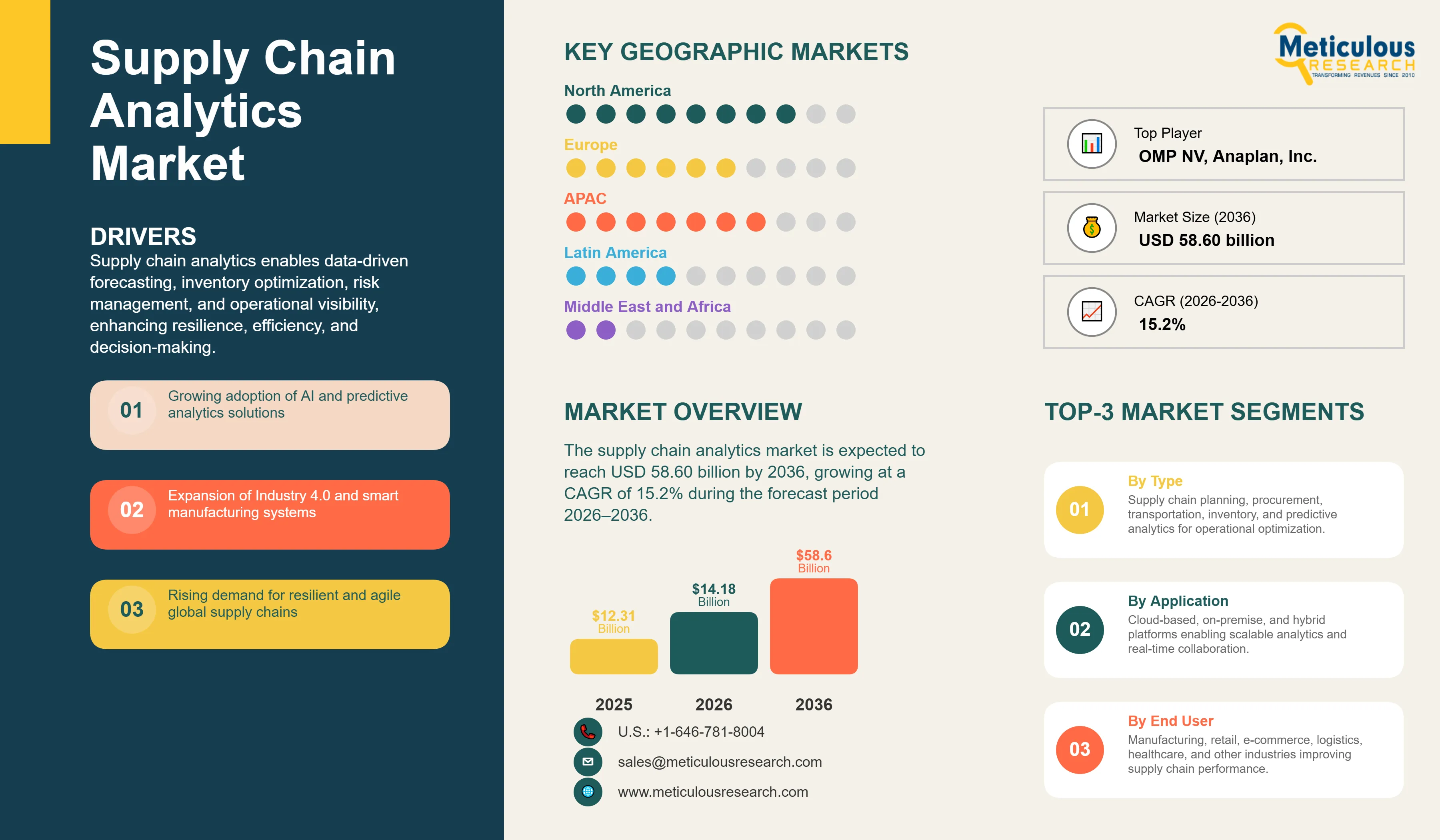
The global supply chain analytics market is estimated to be USD 14.18 billion in 2026. This market is expected to reach USD 58.60 billion by 2036, growing at a CAGR of 15.2% during the forecast period 2026–2036.
 Click here to: Get Free Sample Pages of this Report
The global supply chain analytics market is entering a new phase as organizations increasingly move beyond traditional visibility toward more resilient, predictive, and autonomous supply chains. Supply chain analytics applies advanced statistical, mathematical, and AI-driven techniques to operational data to optimize the flow of goods, information, and capital across increasingly complex networks. Rising geopolitical uncertainty, trade disruptions, and climate-related events have heightened the need for real-time decision support and risk management. According to the Association for Supply Chain Management (ASCM), supply chain resilience depends on visibility, flexibility, collaboration, and control, with technologies such as AI, machine learning, and predictive analytics playing an important role in anticipating and mitigating disruptions. ASCM further emphasizes that data-based decision-making and advanced analytical software enable organizations to respond more effectively to market fluctuations and operational risks. Meanwhile, the increasing frequency of extreme weather events has added to supply chain vulnerabilities; the U.S. National Oceanic and Atmospheric Administration (NOAA) recorded 403 weather and climate disasters exceeding USD 1 billion in losses between 1980 and 2024, with the annual average rising from 9 events historically to 23 events during 2020–2024. Industry organizations such as the Council of Supply Chain Management Professionals (CSCMP) also highlight the growing importance of agility and adaptability in managing persistent disruptions. Consequently, enterprises undergoing digital transformation are investing in supply chain analytics platforms to enhance visibility, improve operational efficiency, and balance cost, responsiveness, and sustainability across global networks.
Drivers: Navigating Global Volatility and Enhancing Agility through Data-Driven Insights
The growth of the global supply chain analytics market is primarily driven by the imperative for operational resilience and the rapid digitalization of logistics and manufacturing processes. Organizations are increasingly leveraging analytics to mitigate risks and capitalize on emerging market opportunities.
Increasing Imperative for Supply Chain Resilience and Risk Mitigation
Recent global disruptions have highlighted the vulnerability of traditional supply chain models. Organizations are now prioritizing resilience over pure cost optimization. Supply chain analytics provides the tools necessary to identify potential bottlenecks, assess the impact of disruptions, and develop robust contingency plans. By analyzing historical data and real-time external signals, companies can build more agile and responsive supply chains that can withstand shocks and recover quickly, driving significant investment in advanced analytics platforms.
Rapid Digitalization and the Shift toward 'Industry 4.0' Supply Chains
The ongoing digital transformation of manufacturing and logistics is generating vast amounts of data across the value chain. The adoption of Industry 4.0 technologies, such as IoT and smart warehousing, provides the granular data necessary for sophisticated analytics. Companies are increasingly using this data to synchronize their production schedules with real-time demand and to optimize their logistics networks. This shift toward a 'Connected Supply Chain' is a powerful driver for the analytics market, as organizations seek to gain a competitive edge through superior operational visibility and control.
Restraints: Overcoming Data Fragmentation and the Global Analytics Talent Shortage
Despite the clear advantages, the adoption of supply chain analytics is hindered by challenges related to data quality and the lack of a skilled workforce capable of interpreting complex analytical models. Many organizations struggle with fragmented data landscapes that prevent a truly holistic view of the supply chain.
Challenges in Harmonizing Fragmented and Poor-Quality Data Across Silos
Global supply chains involve a multitude of partners, each with their own data standards and systems. Harmonizing this fragmented data into a unified analytics platform is a major technical challenge. Poor data quality, including incomplete or inconsistent records, often leads to unreliable insights, undermining the trust in analytical models. The effort required to clean and integrate data from disparate sources remains a significant restraint, often delaying the realization of value from analytics investments.
Significant Global Shortage of Specialized Supply Chain Data Scientists
The effective use of supply chain analytics requires a unique combination of domain expertise and advanced data science skills. However, there is a severe global shortage of professionals who can build and manage complex predictive and prescriptive models. Many organizations find it difficult to attract and retain the talent necessary to derive actionable insights from their data. This skills gap often leads to underutilized platforms and a slower pace of innovation, restraining the overall growth of the market.
Opportunities: Leveraging Cognitive Analytics and Sustainability Mandates for Next-Gen Supply Chains
The future of supply chain analytics lies in the development of cognitive, self-learning systems and the integration of sustainability metrics into operational decision-making. These trends offer significant potential for creating highly efficient and responsible global trade networks.
Advancements in Cognitive and Self-Learning Supply Chain Analytics
The next frontier in analytics is the development of cognitive systems that can learn from their own performance and adapt to changing conditions without human intervention. These 'Self-Healing Supply Chains' offer a significant opportunity for technology vendors to provide autonomous optimization of inventory, production, and logistics. By leveraging deep learning and natural language processing, cognitive analytics can provide a level of agility and foresight that was previously unattainable, opening new avenues for market expansion.
Rising Focus on Circular Economy and Green Supply Chain Analytics
Global sustainability mandates and the shift toward a circular economy are pushing organizations to track and reduce their carbon footprint across the supply chain. Analytics plays a critical role in this by optimizing transportation routes to reduce emissions and identifying opportunities for waste reduction and recycling. The integration of ESG (Environmental, Social, and Governance) metrics into supply chain analytics platforms offers a significant growth opportunity, as companies seek to align their operational strategies with their sustainability goals.
Rapid Proliferation of Real-Time Transportation Visibility Platforms (RTTVP)
A major trend in 2026 is the rapid adoption of real-time transportation visibility platforms (RTTVPs), driven by the need for end-to-end shipment transparency and proactive exception management. Organizations increasingly require continuous tracking of goods across multimodal networks to improve ETA accuracy and mitigate disruptions. According to the Association for Supply Chain Management (ASCM), supply chain visibility enables earlier identification of bottlenecks, better resource allocation, and more timely data-driven decisions. ASCM also highlights that more than half of companies still lack end-to-end visibility, underscoring the significant opportunity for visibility technologies. Consequently, the integration of RTTVPs with supply chain analytics platforms is becoming essential for enhancing customer service, reducing delays, and strengthening supply chain resilience.
Growing Adoption of 'Analytics-as-a-Service' (AaaS) for Rapid Scalability
Another prominent trend is the increasing adoption of cloud-based Analytics-as-a-Service (AaaS) models. As organizations face shortages of analytics talent and seek to reduce infrastructure costs, cloud-native platforms are providing scalable access to advanced forecasting, optimization, and AI capabilities. The U.S. Census Bureau reported that 58% of businesses used cloud computing services in 2023, reflecting the growing acceptance of cloud-based digital infrastructure. In parallel, ASCM emphasizes that advanced analytical software and predictive technologies are central to data-driven decision-making and supply chain resilience. By offering preconfigured analytical models and dashboards with lower upfront investment, AaaS platforms are expanding access to sophisticated analytics among mid-sized enterprises and accelerating digital transformation across global supply chains.
Analysis by Solution
By solution, the supply chain planning segment is expected to hold the largest share of the global supply chain analytics market in 2026. Planning is the foundational pillar of supply chain management, and the need for accurate demand forecasting, inventory optimization, and production scheduling to mitigate global supply shocks makes this the largest revenue-generating segment. Organizations prioritize planning tools to align supply with volatile demand and ensure operational continuity. However, the predictive & prescriptive analytics segment is projected to register the highest CAGR during the forecast period. The shift from historical analysis to forward-looking, AI-driven models that can anticipate disruptions and recommend optimal mitigation strategies is becoming essential for building resilient and autonomous supply chains, driving rapid adoption across all industrial sectors.
Analysis by Deployment Mode
Based on deployment mode, the cloud-based segment is expected to hold the largest share in 2026. The complexity of global supply chains requires high scalability, real-time data sharing, and cross-enterprise collaboration that only cloud platforms can effectively provide. Cloud-based analytics offer the necessary flexibility and lower total cost of ownership (TCO), making them the dominant choice for modern deployments. However, the hybrid deployment segment is projected to grow at the fastest CAGR during the forecast period. Many large-scale manufacturing and logistics enterprises are adopting hybrid models to maintain data sovereignty for sensitive operational data while leveraging the cloud's processing power for deep analytics, effectively balancing security with scalability.
Analysis by End User
By end user, the manufacturing segment is expected to hold the largest share in 2026. Manufacturing is the most complex segment of the supply chain, requiring precise synchronization of materials, production, and distribution. The focus on Industry 4.0 and the need to optimize factory throughput and reduce waste drive the highest spending in this sector. However, the retail & e-commerce segment is projected to register the highest CAGR during the forecast period. The rapid expansion of omnichannel retail and the increasing consumer expectation for fast, transparent delivery are driving massive investments. Retailers are leveraging advanced analytics for hyper-local inventory placement and last-mile delivery optimization to remain competitive in a digital-first economy.
Largest Share: North America
North America is expected to dominate the global supply chain analytics market in 2026, holding a market share of around 40%. This leading position is attributed to the presence of major global technology providers, the early adoption of AI and machine learning, and a strong focus on supply chain resilience among Fortune 500 companies. The region's advanced logistics infrastructure and high labor costs drive significant demand for automation and analytics. The key players operating in the North America market are Oracle Corporation, Blue Yonder, Kinaxis Inc., and IBM Corporation.
Fastest Growing: Asia-Pacific
The Asia-Pacific region is projected to witness the fastest growth in the global supply chain analytics market, with a CAGR of 17.0% during the forecast period. This rapid expansion is fueled by the rapid expansion of the manufacturing and e-commerce sectors in China, India, and Southeast Asia. Massive investments in 'Smart Logistics' and the modernization of regional trade corridors, supported by initiatives like the World Bank's Logistics Performance Index (LPI 2.0), are driving the rapid adoption of analytics solutions to enhance global export competitiveness.
The global supply chain analytics market is characterized by intense innovation and strategic consolidation. Key players are focusing on developing integrated, cloud-native platforms that can handle the scale and complexity of modern supply chain data. Strategic partnerships between software vendors and logistics service providers are common as they seek to provide 'end-to-end' visibility solutions. Furthermore, there is an increasing emphasis on the integration of AI and cognitive computing to provide autonomous performance optimization. The market is also seeing a surge in 'As-a-Service' models to lower the barriers to entry for smaller organizations and to provide continuous value through data-driven insights.
SAP SE, Oracle Corporation, Blue Yonder (Panasonic), Kinaxis Inc., IBM Corporation, Infor (Koch Industries), Coupa Software Inc., o9 Solutions, Inc., Manhattan Associates, Inc., SAS Institute Inc., Microsoft Corporation, Logility, Inc., RELEX Solutions, E2open, LLC, ToolsGroup, Qlik Technologies Inc., Tableau (Salesforce), Anaplan, Inc., Aera Technology, OMP.
The global market is estimated at USD 14.18 billion in 2026, with a projected growth to USD 58.60 billion by 2036, at a CAGR of 15.2%.
Primary drivers include the increasing imperative for supply chain resilience and the rapid digitalization of logistics and manufacturing processes.
Major restraints include challenges in harmonizing fragmented data across silos and a significant global shortage of specialized supply chain data scientists.
Opportunities lie in the development of cognitive and self-learning analytics and the rising focus on circular economy and green supply chain analytics.
The supply chain planning segment is expected to hold the largest share due to the critical need for demand forecasting and inventory optimization
The predictive & prescriptive analytics segment is projected to grow at the fastest CAGR, driven by the shift toward AI-driven proactive risk management.
The cloud-based segment is expected to hold the largest share, offering the scalability and collaboration required for global operations.
North America is expected to dominate the market due to its advanced logistics infrastructure and early adoption of AI-driven resilience solutions
Asia Pacific is projected to witness the fastest growth, fueled by massive investments in 'Smart Logistics' and the expansion of manufacturing in the region.
Key trends include the rapid proliferation of real-time transportation visibility platforms and the growing adoption of Analytics-as-a-Service models.
























Published Date: Feb-2026
Published Date: Jan-2025
Published Date: Aug-2024
Published Date: May-2024
Published Date: May-2024
Please enter your corporate email id here to view sample report.
Subscribe to get the latest industry updates


