Space Logistics Market (2026-2036)
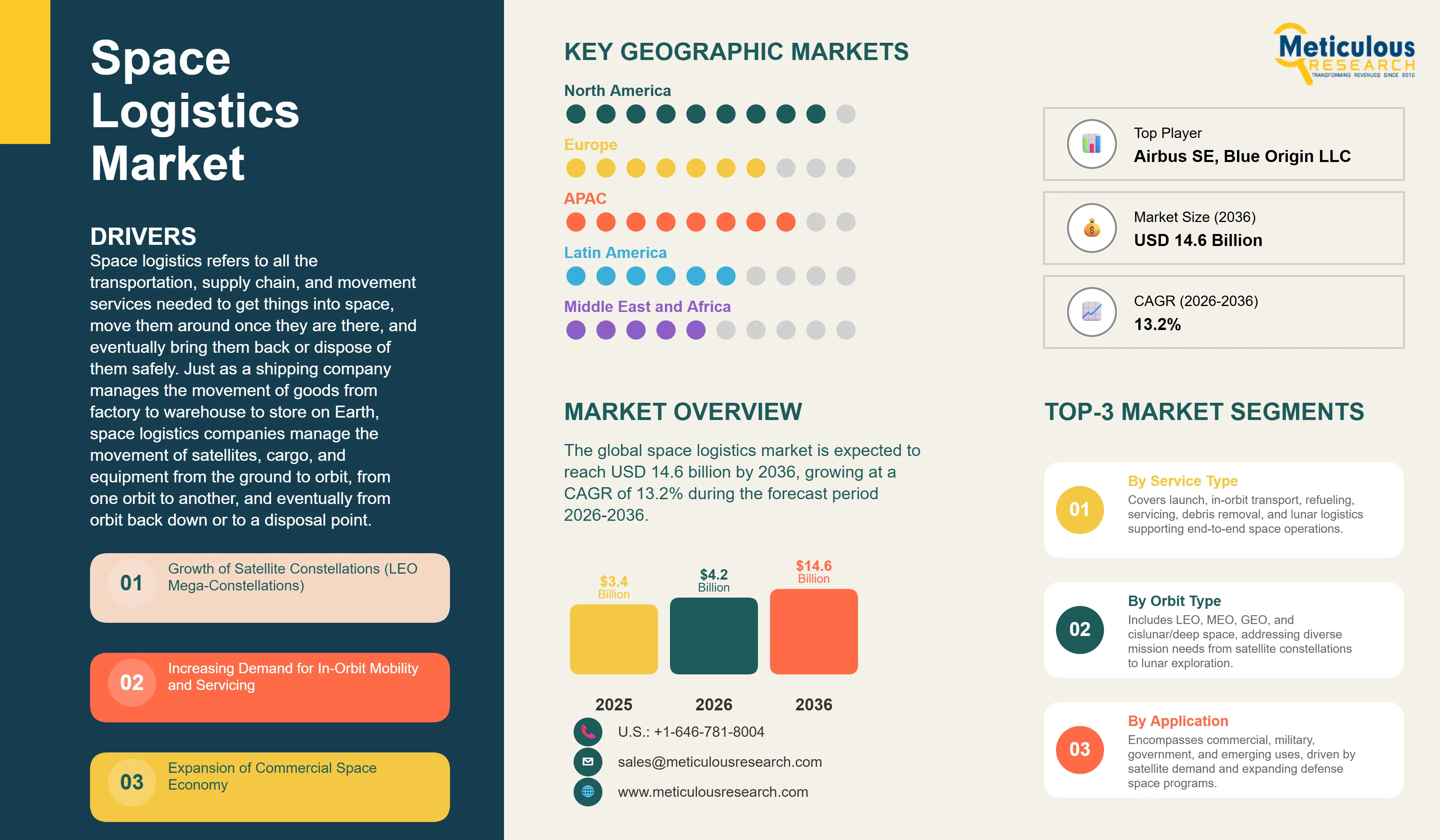
The global space logistics market was valued at USD 3.4 billion in 2025. This market is expected to reach USD 14.6 billion by 2036 from an estimated USD 4.2 billion in 2026, growing at a CAGR of 13.2% during the forecast period 2026-2036.
- Published
- Apr 2026
- Pages
- 289
- Format
- PDF + Excel
- Report ID
- MR-1916
- Base year
- 2025
- 2025 · BASELINE
- $3.40B
- 2036
- $14.60B
- CAGR 2026–2036
- 13.2%
2025 baseline · 2026–2036 forecast at 13.2% CAGR · hover a bar for the value
Key highlights
The global space logistics market is projected to reach USD 14.6 billion by 2036.
The market is expected to grow at a CAGR of 13.2% during the forecast period 2026-2036.
The global space logistics market was valued at USD 3.4 billion in 2025 and is estimated to reach USD 4.2 billion in 2026.
North America is expected to dominate the global space logistics market with the largest market share in 2026, while Asia-Pacific is projected to register the highest CAGR during the forecast period.
By service type, the launch logistics services segment is expected to hold the largest share of the market in 2026, while the space infrastructure logistics segment (including lunar logistics) is projected to register the highest CAGR during the forecast period.
By orbit type, the LEO segment is expected to hold the largest share in 2026, while the cislunar and deep space segment is projected to register the highest CAGR during the forecast period.
By application, the commercial applications segment is expected to hold the largest share in 2026, while the military and defense applications segment is projected to register the highest CAGR during the forecast period.
By end user, the commercial satellite operators segment is expected to hold the largest share in 2026, while the private space companies segment is projected to register the highest CAGR during the forecast period.
By vehicle type, the launch vehicles segment is expected to hold the largest share in 2026, while the orbital transfer vehicles segment is projected to register the highest CAGR during the forecast period.
By operation type, the semi-autonomous operations segment is expected to hold the largest share in 2026, while the autonomous operations segment is projected to register the highest CAGR during the forecast period.
Report summary
| Particulars | Details |
|---|---|
| Market Size by 2036 | USD 14.6 Billion |
| Market Size in 2026 | USD 4.2 Billion |
| Market Size in 2025 | USD 3.4 Billion |
| Revenue Growth Rate (2026-2036) | CAGR of 13.2% |
| Format | PDF, Excel & Cloud Portal · 289 pages |
| Dominating Service Type | Launch Logistics Services |
| Fastest Growing Service Type | Space Infrastructure Logistics (Lunar) |
| Dominating Orbit Type | Low Earth Orbit (LEO) |
| Fastest Growing Orbit Type | Cislunar and Deep Space |
| Dominating Application | Commercial Applications |
| Fastest Growing Application | Military & Defense Applications |
| Dominating End User | Commercial Satellite Operators |
| Fastest Growing End User | Private Space Companies |
| Dominating Vehicle Type | Launch Vehicles |
| Fastest Growing Vehicle Type | Orbital Transfer Vehicles (OTVs) |
| Dominating Operation Type | Semi-Autonomous Operations |
| Fastest Growing Operation Type | Autonomous Operations |
| Dominating Geography | North America |
| Fastest Growing Geography | Asia-Pacific |
| Base Year | 2025 |
| Forecast Period | 2026 to 2036 |
Report overview
Segments covered: service type, orbit type, application, end user, vehicle type.
Space logistics refers to all the transportation, supply chain, and movement services needed to get things into space, move them around once they are there, and eventually bring them back or dispose of them safely. Just as a shipping company manages the movement of goods from factory to warehouse to store on Earth, space logistics companies manage the movement of satellites, cargo, and equipment from the ground to orbit, from one orbit to another, and eventually from orbit back down or to a disposal point. The market includes conventional launch services that carry payloads from Earth to orbit, orbital transfer vehicles and space tugs that move satellites to their final destinations after launch, refueling services that extend satellite operational lives, and the logistics of resupplying space stations and eventually supporting permanent infrastructure on the Moon and beyond.
The market is growing rapidly because the volume and complexity of space activity is growing much faster than the simple launch-and-forget model of the early space industry can support. A decade ago, most satellites were large, expensive, and designed to operate entirely independently once placed in orbit. Today, thousands of small and medium satellites are being deployed in large constellations that need deployment services, orbital optimization support, and eventually end-of-life management. The rapid cost reduction of launch services, led by SpaceX's reusable Falcon 9 and Falcon Heavy rockets and followed by Rocket Lab, Blue Origin, and others, has lowered the barrier to orbit and significantly increased the number of organizations that can afford to send hardware to space, creating a much larger customer base for space logistics services than existed previously.
Two major opportunities are shaping the next phase of market growth. Space tugs and orbital transfer vehicles that can collect satellites released to a standard orbit by a rideshare launch and deliver them to their specific operational destinations are filling a gap in the current space supply chain where satellites launched as rideshares often cannot reach their ideal operating orbit under their own power. Companies including D-Orbit, Momentus, Exolaunch, and Rocket Lab's Photon platform are all offering these last-mile delivery services for small satellites, and this segment is growing very rapidly. Looking further ahead, the development of permanent infrastructure in cislunar space and on the Moon through NASA's Artemis program and its commercial partners is creating an entirely new logistics market category centered on moving cargo between Earth orbit and the Moon, which will require new vehicles, refueling infrastructure, and logistics management services that do not yet exist at commercial scale.
Report infographic
Market dynamics
7 factors across 3 forcesGrowth of Satellite Constellations (LEO Mega-Constellations)
The deployment of large satellite constellations in low earth orbit by SpaceX Starlink, Amazon Kuiper, OneWeb, and a growing number of other operators is the primary driver of the space logistics market, as each constellation represents hundreds to thousands of individual satellites that need to be launched, placed in the correct orbits, maintained in operation, and eventually replaced or decommissioned as they reach the end of their service lives. SpaceX has already launched over 6,000 Starlink satellites and has regulatory approval for up to 42,000, and Amazon's Kuiper constellation targets 3,236 satellites. Deploying, managing, and eventually disposing of these very large satellite populations requires a sophisticated and scalable logistics infrastructure, including rideshare launch coordination, orbital transfer services to optimize constellation geometry, satellite replacement logistics, and debris disposal services for retired satellites. The scale of the logistics requirement created by LEO mega-constellations alone is sufficient to sustain rapid market growth through the forecast period.
Rising Investments in Deep Space Exploration
NASA's Artemis program, SpaceX's Starship deep space ambitions, Blue Origin's cislunar transportation plans, and the national space programs of China, India, Japan, and the European Union are all investing heavily in the capability to conduct missions beyond low earth orbit, including to the Moon, Mars, and eventually beyond. These deep space ambitions require substantial investment in the logistics infrastructure needed to support them, including propellant depots in high earth orbit or at the lunar gateway that would allow deep space missions to refuel before proceeding beyond Earth's gravitational influence, cargo vehicles capable of the long-duration burns needed for cislunar and translunar trajectories, and the ground-based logistics management systems needed to plan and coordinate complex multi-leg space missions. The commercial contracts already awarded under NASA's CLPS program, the significant private investment in lunar transportation companies, and the growing number of national space agency budgets directed toward deep space exploration collectively represent a large and growing demand source for space logistics services that will expand substantially through the forecast period.
Table of contents
15 chapters · 196 sections · 289 pages · click to expandSegmental analysis
| Segment | Largest share (2026) | Fastest growth (2026–2036) |
|---|---|---|
| By Service Type | Launch Logistics Services | Deep space cargo delivery |
| By Orbit Type | LEO | Cislunar and deep space |
| By Application | Commercial | Military and defense applications |
| By End User | Commercial Satellite Operators | Private space companies |
| By Vehicle Type | Launch Vehicles | Orbital transfer vehicles |
| By Operation Type | Semi-Autonomous Operations | Autonomous operations |
By Service Type
- Launch Logistics Services to Dominate
- The launch logistics services segment is expected to account for the largest share of the global space logistics market.
- Launch logistics encompasses the full range of services surrounding a rocket launch, including payload integration and preparation, launch scheduling and coordination, rideshare management for multiple payloads on a single rocket, and launch campaign management.
- The large number of commercial satellite launches driven by LEO constellation deployment programs makes this the highest-volume and highest-revenue service category in the current market.
- SpaceX's Falcon 9 and Falcon Heavy, Rocket Lab's Electron, and the growing fleet of other commercial launch vehicles are all driving this market.
- However, the space infrastructure logistics segment, encompassing space station resupply, lunar logistics, and deep space cargo delivery, is projected to register the highest CAGR during the forecast period.
- The combination of ongoing ISS resupply missions, the transition to commercial space station resupply contracts as the ISS era ends, and the rapidly developing lunar logistics market driven by NASA's Artemis program and commercial lunar activities will make this the fastest-growing service category as new destinations and more permanent space infrastructure create sustained logistics demand beyond low earth orbit.
By Orbit Type
- LEO to Hold the Largest Share
- The LEO segment is expected to account for the largest share of the global space logistics market.
- Low earth orbit is where the vast majority of new satellite deployments are concentrated, driven by the mega-constellation programs of SpaceX, Amazon, OneWeb, and others.
- The combination of very high launch volumes to LEO and the growing need for in-orbit transportation, orbital optimization, and debris management services in the increasingly crowded LEO environment makes this the current dominant revenue category for space logistics providers.
- However, the cislunar and deep space segment is projected to register the highest CAGR during the forecast period.
- The development of lunar exploration infrastructure under NASA's Artemis program and the associated commercial lunar services market is creating a new and growing logistics demand category that did not generate significant commercial revenue before 2020.
- As lunar missions become more frequent and lunar infrastructure becomes more permanent, the logistics market in cislunar space is expected to grow from a very small base to a significant commercial market segment over the forecast period.
By Application
- Commercial Applications to Hold the Largest Share
- The commercial applications segment is expected to account for the largest share of the global space logistics market.
- Commercial satellite constellation deployment, broadband service delivery, and earth observation missions collectively represent the largest volume of space logistics activity globally, driven by the extraordinary scale of LEO constellation deployment programs and the growing commercial earth observation market.
- Commercial satellite operators are the largest and most active buyers of launch logistics and orbital transfer services, and this commercial demand base underpins the market's current revenue leadership in the commercial applications segment.
- However, the military and defense applications segment is projected to register the highest CAGR during the forecast period.
- The U.S. Space Force's growing investment in commercial launch services, satellite repositioning, and space domain awareness programs, combined with allied military space programs in Europe, Japan, and Australia, is creating rapidly growing government defense demand for space logistics services.
- The increasing strategic importance of space assets to military operations and the recognition that resilient space architecture requires the ability to rapidly deploy, reposition, and if necessary replace satellites are driving defense organizations to invest more heavily in the commercial space logistics capabilities that support these requirements.
By End User
- Commercial Satellite Operators to Hold the Largest Share
- The commercial satellite operators segment is expected to account for the largest share of the global space logistics market.
- Commercial satellite operators, including the large constellation operators such as SpaceX Starlink and Amazon Kuiper as well as established GEO satellite fleet operators such as Intelsat, SES, and Eutelsat, represent the largest category of paying customers for space logistics services.
- The enormous scale of LEO constellation deployment programs means that commercial satellite operators generate the majority of launch logistics demand globally, and as these constellations mature and require ongoing management, refueling, and debris disposal services, their demand for in-orbit logistics services will grow substantially.
- However, the private space companies segment is projected to register the highest CAGR during the forecast period.
- The rapid emergence of a new generation of commercial space companies pursuing activities including commercial space stations, lunar exploration, in-orbit manufacturing, and space tourism is creating a fast-growing new customer category for space logistics services that is very different from traditional satellite operators.
- These new space economy companies need transportation, supply chain management, and logistics support for activities that are significantly more complex and varied than conventional satellite deployment, representing a high-growth and high-value segment for space logistics providers with the technical capability to serve diverse customer needs.
By Vehicle Type
- Launch Vehicles to Hold the Largest Share
- The launch vehicles segment is expected to account for the largest share of the global space logistics market.
- Launch vehicles, from SpaceX's Falcon 9 to Rocket Lab's Electron and the growing fleet of emerging rocket providers, generate the largest revenue within the space logistics market by value, as each launch mission represents a significant commercial transaction covering rocket, integration, and associated services.
- The high and growing demand for commercial launches driven by LEO constellation deployment ensures that launch vehicles remain the dominant revenue category.
- However, the orbital transfer vehicles segment is projected to register the highest CAGR during the forecast period.
- OTVs are one of the newest commercially available space logistics vehicle categories, with D-Orbit, Momentus, and Rocket Lab's Photon among the first commercial providers.
- As the market for in-orbit satellite delivery, constellation management, and eventually cislunar transportation grows, OTVs will be among the fastest-growing hardware categories in the space logistics market, transitioning from early commercial demonstrations to high-volume operational services.
By Operation Type
- Semi-Autonomous Operations to Hold the Largest Share
- The semi-autonomous operations segment is expected to account for the largest share of the global space logistics market.
- Most current space logistics vehicles operate in a semi-autonomous mode where routine navigation and orbital maneuvers are handled automatically by onboard computers while ground controllers monitor the mission and intervene for critical decisions such as rendezvous approaches, docking, and anomaly resolution.
- This balance of automation and human oversight is appropriate for the current stage of the technology and the regulatory environment, where human oversight of operations near other space assets is expected by regulatory bodies and satellite operators alike.
- However, the autonomous operations segment is projected to register the highest CAGR during the forecast period.
- As the volume of space logistics missions grows and the operational experience with autonomous space vehicle operations increases, full autonomy will become both technically feasible and commercially necessary.
- Ground control of every maneuver by every vehicle in a large fleet of space tugs or OTVs would require enormous staffing and create latency issues that reduce operational efficiency.
- Fully autonomous operations, validated through demonstrated reliability in semi-autonomous missions, will be essential for scaling commercial space logistics to the volumes that the growing space economy will require.
Geographic analysis
North America
Largest shareIn 2026, North America is expected to account for the largest share of the global space logistics market. The United States dominates this market through a combination of the world's most active commercial launch industry anchored by SpaceX's extraordinary launch rate of over 90 missions per year, a large and diverse group of emerging space logistics companies including D-Orbit, Momentus, Orbit Fab, Firefly Aerospace, and Sierra Space, and the very large NASA and U.S. Space Force procurement programs that provide both direct revenue and technology development funding that stimulates commercial market growth. SpaceX alone accounts for a very significant share of global launch activity by both number of missions and total mass delivered to orbit, making the U.S. the unambiguous leader in the global space logistics market. Rocket Lab's New Zealand launch facility and U.S. headquarters, Blue Origin's New Glenn and lunar logistics programs, and the growing commercial space station ambitions of Axiom Space and Sierra Space collectively make North America the world's most active and commercially advanced space logistics market. Canada's contributions through its robotics expertise and space agency partnerships add further depth to the North American market.
Asia-Pacific
Fastest growthHowever, the Asia-Pacific space logistics market is expected to grow at the fastest CAGR during the forecast period. China has become a major space power with a large and growing commercial launch industry including Long March rocket variants and the emerging commercial launch vehicles of companies including LandSpace, iSpace, and Galactic Energy, alongside China's own satellite constellation programs and its ambitious national plans for a permanent lunar presence. India's space sector is undergoing a significant transformation as private commercial space companies enter the launch and logistics market following ISRO's commercial arm NewSpace India Limited demonstrating the commercial potential of the Indian launch industry. Japan's H3 rocket program, South Korea's Nuri rocket, and Australia's growing commercial space sector are all contributing to the Asia-Pacific market's growth. The region's large satellite operator market, particularly in Japan, South Korea, and the growing Southeast Asian satellite communications sector, provides strong demand for space logistics services alongside the expanding supply-side capabilities of regional launch and space service providers.
Europe
Europe is a significant space logistics market anchored by the Ariane launch family and the European Space Agency's substantial budget for launch services, space exploration, and commercial space development. ESA's commercial contracts for lunar payload delivery, debris removal demonstrations, and orbital transfer services represent important demand for commercial space logistics providers. Airbus Defence and Space, Thales Alenia Space, and Avio provide significant space logistics capabilities including the Ariane 6 rocket, upper stages, and satellite integration services. Luxembourg's SES and other European satellite operators are among the most active commercial customers for launch and in-orbit logistics services, and the European space investor community has backed several important space logistics startups including ClearSpace and others that are developing services for the European and global market.
Competitive landscape
- SpaceX (U.S.)
- Rocket Lab USA Inc. (U.S./New Zealand)
- Northrop Grumman Corporation (U.S.)
- Airbus SE · Netherlands
- Astroscale Holdings Inc. (Japan/UK)
- Maxar Technologies Inc. (U.S.)
- Thales Alenia Space · France/Italy
- Orbit Fab Inc. (U.S.)
- D-Orbit S.p.A · Italy
- Momentus Inc. (U.S.)
- Redwire Corporation (U.S.)
- Firefly Aerospace Inc. (U.S.)
- Blue Origin LLC (U.S.)
- Sierra Space Corporation (U.S.)
- Relativity Space Inc. (U.S.)
Frequently asked questions
The global space logistics market is expected to reach USD 14.6 billion by 2036 from an estimated USD 4.2 billion in 2026, at a CAGR of 13.2% during the forecast period 2026-2036.
Cite this report
Meticulous Research. (2026). Space Logistics Market - Global Opportunity Analysis and Industry Forecast (2026-2036) (Report No. MR-1916). Meticulous Market Research Pvt. Ltd. https://www.meticulousresearch.com/product/space-logistics-market-6599