Space Economy Market (2026-2036)
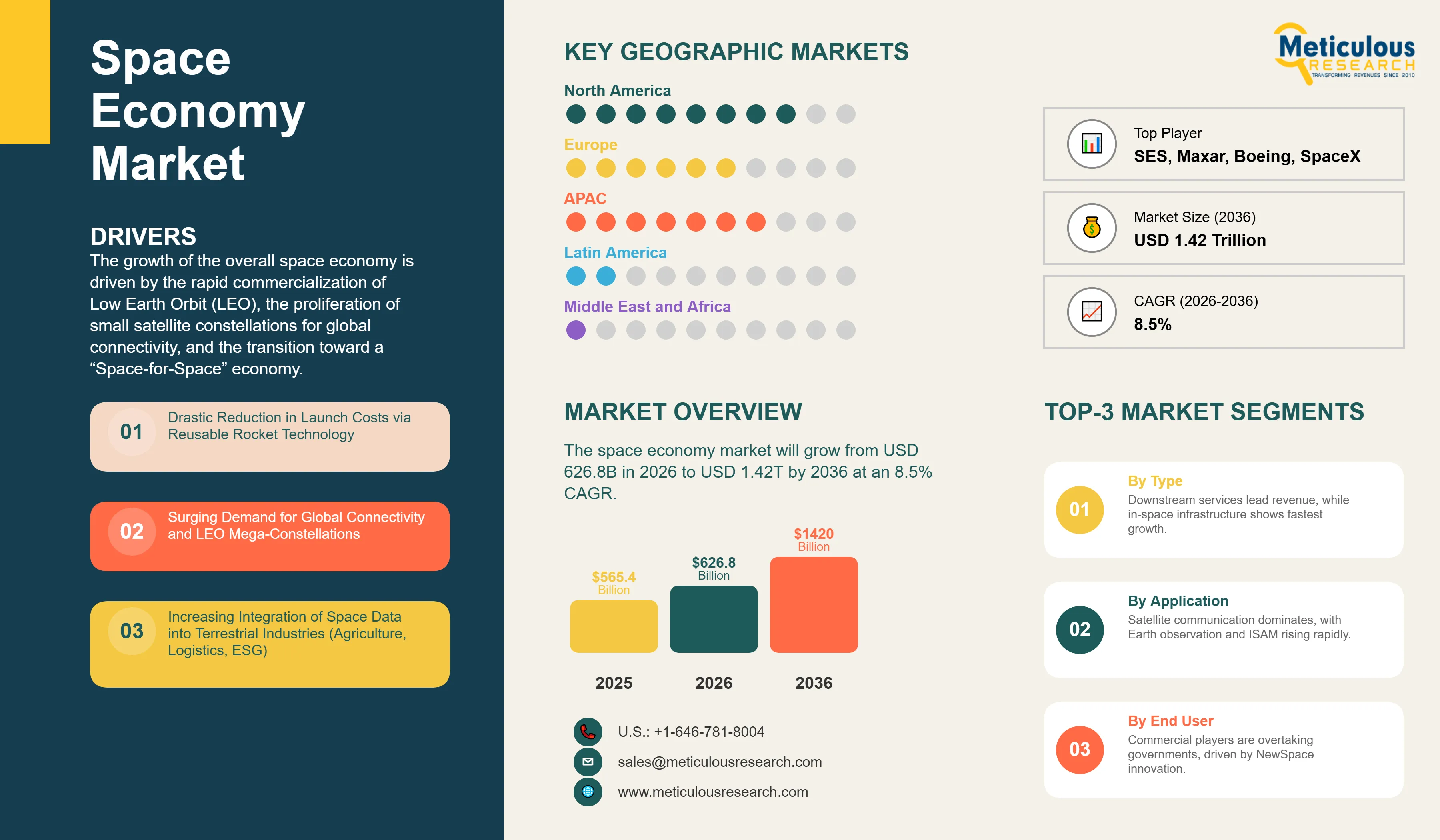
The global space economy was valued at USD 565.4 billion in 2025. The market is expected to reach approximately USD 1.42 trillion by 2036 from USD 626.8 billion in 2026, growing at a CAGR of 8.5% from 2026 to 2036.
- Published
- Feb 2026
- Pages
- 285
- Format
- PDF + Excel
- Report ID
- MR-1708
- Base year
- 2025
- 2025 · BASELINE
- $565.4B
- 2036
- $1.42T
- CAGR 2026–2036
- 8.5%
2025 baseline · 2026–2036 forecast at 8.5% CAGR · hover a bar for the value
Key highlights
In terms of revenue, the global space economy is projected to reach USD 1.42 trillion by 2036.
The market is expected to grow at a CAGR of 8.5% from 2026 to 2036.
North America dominates the global space economy with the largest market share in 2026, driven by the presence of industry giants like SpaceX and Blue Origin, significant NASA and DoD funding, and a robust venture capital ecosystem for space startups.
Asia-Pacific is expected to witness the fastest growth during the forecast period, supported by ambitious national space programs in China and India, and the rapid expansion of commercial satellite services in the region.
By segment, the downstream segment (including satellite-enabled services and data analytics) holds the largest market share in 2026, as businesses increasingly leverage space assets for terrestrial applications.
By application, Satellite Communication remains the largest revenue generator, but In-Space Manufacturing and Space Tourism are expected to witness the highest CAGRs as commercial space stations become operational.
By end-user, the commercial segment is expected to overtake government spending during the forecast period, reflecting the “NewSpace” shift toward private-sector-led innovation.
Report summary
| Particulars | Details |
|---|---|
| Market Size by 2036 | USD 1.42 Trillion |
| Market Size in 2026 | USD 626.8 Billion |
| Market Size in 2025 | USD 565.4 Billion |
| Market Growth Rate (2026-2036) | CAGR of 8.5% |
| Format | PDF, Excel & Cloud Portal · 285 pages |
| Dominating Region | North America |
| Fastest Growing Region | Asia-Pacific |
| Base Year | 2025 |
| Forecast Period | 2026 to 2036 |
| Segments Covered | Segment, Application, End-User, and Region |
| Regions Covered | North America, Europe, Asia-Pacific, Latin America, and Middle East & Africa |
Report overview
Segments covered: segment, application, end-user.
The growth of the overall space economy is driven by the rapid commercialization of Low Earth Orbit (LEO), the proliferation of small satellite constellations for global connectivity, and the transition toward a “Space-for-Space” economy. As launch costs continue to decline due to reusable rocket technology, space has evolved from a government-led strategic domain into a vibrant commercial frontier. The integration of space-based data into terrestrial industries—such as agriculture, logistics, and climate monitoring—coupled with the emergence of in-space manufacturing and lunar exploration initiatives, continues to fuel significant growth of this market across all major geographic regions.
The space economy represents the full range of activities and the use of resources that create value and benefits to human beings in the course of exploring, researching, understanding, managing, and utilizing space. It has moved beyond the traditional “Upstream” activities of building and launching rockets to a massive “Downstream” ecosystem where space-derived data and services are integrated into the fabric of the global economy. The market is currently in the “Space 4.0” era, characterized by a shift from government-exclusive missions to a collaborative environment where private companies drive innovation, reduce costs, and create new markets.
The market includes a diverse range of sectors, from the manufacturing of advanced satellite components and launch vehicles to the provision of high-speed satellite internet, precision navigation (PNT), and high-resolution Earth observation. A critical emerging frontier is the “Space-for-Space” economy, which involves activities that take place entirely in space, such as satellite servicing, orbital debris removal, and the production of specialized materials in microgravity. These activities are laying the groundwork for permanent human presence on the Moon and eventually Mars, creating a self-sustaining economic loop beyond Earth’s atmosphere.
The global geopolitical landscape is also a major factor, with nations viewing space as a critical infrastructure for national security and economic sovereignty. This has led to increased investments in “sovereign space capabilities,” where countries develop their own launch sites and satellite constellations to ensure independent access to space. At the same time, international collaborations like the Artemis Accords are fostering a legal and economic framework for sustainable lunar exploration, opening up new opportunities for commercial partnerships in deep space.
Report infographic
Market dynamics
4 factors across 3 forcesDrastic Reduction in Launch Costs
A primary driver of the space economy is the significant reduction in the cost of reaching orbit, largely due to the success of reusable launch vehicles. Lower launch costs have lowered the barrier to entry for startups and smaller nations, leading to a surge in space-based innovation. This “democratization of space” allows for more frequent launches and the deployment of larger, more complex constellations, creating a virtuous cycle of increased demand and further cost reductions. The emergence of heavy-lift vehicles like Starship is expected to further accelerate this trend, enabling the transport of massive payloads for lunar bases and orbital colonies.
Table of contents
11 chapters · 103 sections · 285 pages · click to expandSegmental analysis
| Segment | Largest share (2026) | Fastest growth (2026–2036) |
|---|---|---|
| By Segment | Why Does the Downstream | “Space-for-Space” |
| By Application | Satellite Communication | In-Space Manufacturing and Space Tourism |
By Segment
- The downstream segment, comprising satellite-enabled services, ground equipment, and data analytics, accounts for around 70-75% of the overall space economy in 2026.
- This dominance is due to the vast array of terrestrial industries that rely on space assets for their daily operations.
- From GPS-guided logistics and satellite TV to weather forecasting and financial transaction timing, the “Space-for-Earth” value proposition is well-established and generates consistent recurring revenue.
- The integration of satellite data with 5G networks and AI is further expanding the downstream market, creating new applications in autonomous driving and precision agriculture.
- The upstream segment (launch vehicles and satellite manufacturing) is also growing, but it is increasingly seen as an “enabler” for the more lucrative downstream services.
- However, the “Space-for-Space” segment is expected to witness the highest growth rate as the orbital infrastructure for servicing and manufacturing matures.
By Application
- The Satellite Communication segment holds the largest share of the overall market in 2026, accounting for around 40-45% of the overall market.
- The shift from traditional Geostationary (GEO) satellites to LEO constellations is the primary trend here, enabling high-speed internet that competes with terrestrial fiber.
- This is particularly critical for bridging the digital divide and supporting the “connected everything” vision of the future.
- The Earth Observation segment is also witnessing significant growth, driven by the need for climate monitoring and ESG (Environmental, Social, and Governance) reporting.
- High-revisit-rate constellations allow for near-real-time monitoring of any point on Earth, providing invaluable insights for insurance, commodity trading, and disaster management.
Geographic analysis
North America
Largest shareNorth America holds the largest share of the global space economy in 2026. The largest share of this region is primarily attributed to the massive investments from both the public and private sectors. The U.S. government remains the world’s largest spender on space, but it is the vibrant “NewSpace” ecosystem—led by companies like SpaceX, Blue Origin, and Lockheed Martin—that drives the majority of the innovation. The region’s well-developed supply chain, access to capital, and favorable regulatory environment make it the global hub for space activity.
Asia-Pacific
Fastest growthAsia-Pacific is expected to witness the fastest growth, driven by the rapid advancement of China’s space program and the commercial success of India’s ISRO. China is building its own satellite constellations and lunar infrastructure, while India is becoming a preferred destination for low-cost commercial launches.
Europe
Europe’s growth is supported by the European Space Agency (ESA) and the EU’s focus on “Strategic Autonomy,” with significant investments in the Galileo (navigation) and Copernicus (Earth observation) programs. The region is also a leader in space sustainability and debris removal technologies.
Competitive landscape
- SpaceX
- Lockheed Martin Corporation
- Northrop Grumman Corporation
- Boeing Company
Frequently asked questions
The global space economy is projected to reach a valuation of USD 1.42 trillion by 2036, expanding from USD 626.8 billion in 2026. This significant growth trajectory is underpinned by a robust Compound Annual Growth Rate (CAGR) of 8.5% over the forecast period, reflecting the transition toward a fully commercialized orbital and lunar economy.
Cite this report
Meticulous Research. (2026). Space Economy Market - Global Opportunity Analysis and Industry Forecast (2026-2036) (Report No. MR-1708). Meticulous Market Research Pvt. Ltd. https://www.meticulousresearch.com/product/space-economy-market-6391