Resources
About Us

Solid-State Transformers Market by Power Rating (Below 100 kVA, 100 kVA to 1 MVA, Above 1 MVA), Mounting and Installation Type, Application (EV Charging Infrastructure, Renewable Energy Grid Integration), and End User - Global Forecast to 2036
Report ID: MREP - 1041842 Pages: 271 Mar-2026 Formats*: PDF Category: Energy and Power Delivery: 24 to 72 Hours Download Free Sample Report
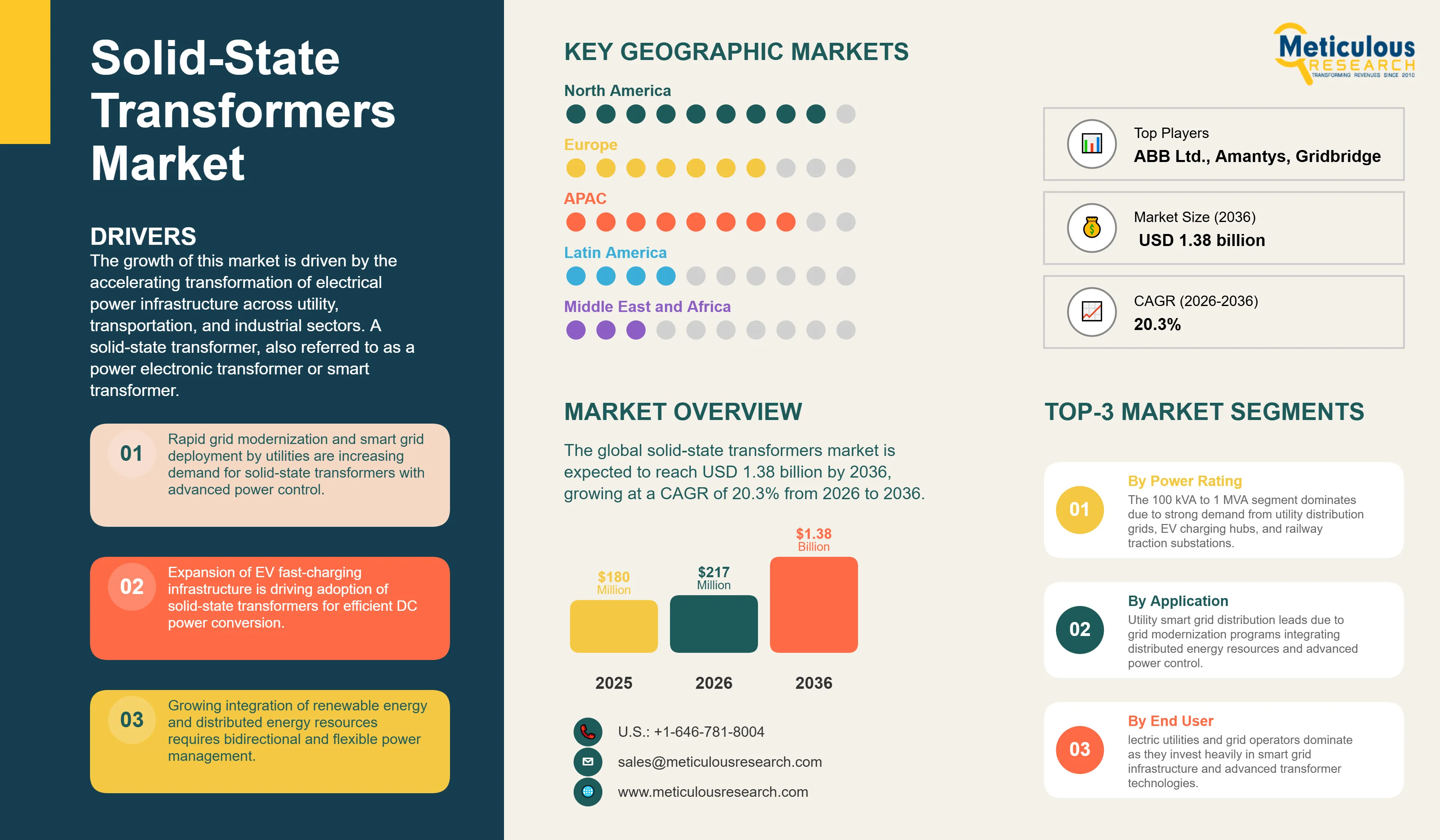
The global solid-state transformers market was valued at USD 180 million in 2025. This market is expected to reach USD 1.38 billion by 2036 from USD 217 million in 2026, growing at a CAGR of 20.3% from 2026 to 2036.
The growth of this market is driven by the accelerating transformation of electrical power infrastructure across utility, transportation, and industrial sectors. A solid-state transformer, also referred to as a power electronic transformer or smart transformer, is an advanced power conversion device that replaces the copper windings and iron core of a conventional electromagnetic transformer with power semiconductor switches, high-frequency transformers, and active control electronics. This architecture allows the solid-state transformer to perform voltage conversion between different AC or DC levels while simultaneously providing functions that conventional transformers cannot offer, including bidirectional power flow, reactive power compensation, harmonic filtering, voltage regulation under varying load conditions, and direct DC port interfaces that conventional transformers cannot provide. These combined capabilities make solid-state transformers a critical enabling technology for power grids that must accommodate large volumes of distributed solar and wind generation, bidirectional EV charging infrastructure, and high-speed railway electrification systems.
Conventional electromagnetic transformers have served power grids reliably for over a century, but their passive architecture imposes fundamental limitations in applications where active power quality management, DC connectivity, or dynamic voltage control is required. The rapid expansion of EV charging networks requiring DC fast charging at distribution voltage levels, the integration of distributed solar and battery storage systems that generate and store DC electricity, and the modernization of railway traction power systems to support regenerative braking energy recovery are all driving demand for the active power conversion capabilities that only solid-state transformer technology can provide. In addition, utilities in North America, Europe, and Asia are investing in smart grid modernization programs that require transformer-level intelligence, remote monitoring, and dynamic power flow control, all of which align with the capabilities of solid-state transformer systems.
Solid-state transformers perform the core function of a conventional transformer, voltage conversion between different levels of an electrical power system, using a fundamentally different technical approach. A conventional electromagnetic transformer achieves voltage conversion through electromagnetic induction between primary and secondary copper windings wound around a silicon steel core, operating at the grid frequency of 50 or 60 hertz. A solid-state transformer instead uses power semiconductor devices, typically silicon carbide or gallium nitride transistors, to convert the input AC voltage to a high-frequency AC signal, pass it through a compact high-frequency transformer, and convert the output back to the desired AC or DC voltage level. Operating at frequencies of 1 to 20 kilohertz rather than 50 to 60 hertz allows the internal transformer to be dramatically smaller and lighter than an equivalent conventional transformer, while the surrounding power electronics provide active control over the output voltage waveform, power factor, and harmonic content that passive conventional transformers cannot offer.
The three-stage architecture of most solid-state transformer designs creates a device with three functional ports: an AC input port at the medium-voltage grid level, a high-frequency AC isolation stage, and an output stage that can provide AC power at the desired voltage and frequency, DC power at a controlled voltage level, or both simultaneously through separate output ports. This multi-port architecture is particularly valuable for distribution grid applications where a single installation point must simultaneously serve conventional AC loads, DC EV charging stations, rooftop solar inverter grid connections, and battery storage systems, all of which have historically required separate power conversion equipment with multiple conventional transformer installations. Companies including ABB, Siemens, GE Research, Schneider Electric, and specialized developers including Amantys and Varentec are developing solid-state transformer products targeting these multi-port distribution applications.
The competitive landscape of the solid-state transformers market is at an earlier stage of commercialization than most other power electronics markets, with the majority of deployed units representing demonstration projects, pilot installations, and early commercial deployments rather than volume production. The technology has been actively developed in research programs at the Electric Power Research Institute, major universities, and national laboratories for more than two decades, and the transition to commercial products has accelerated significantly since 2018 as silicon carbide power semiconductor devices achieved the cost, efficiency, and reliability levels required for grid-connected power conversion equipment. ABB and Siemens have the most advanced commercial solid-state transformer product lines, targeting railway traction power and utility distribution applications respectively. The market also includes a growing number of specialist companies developing solid-state transformer solutions for specific applications such as EV charging grid integration and offshore wind farm power collection systems.
Silicon Carbide Power Semiconductors Enabling Commercial-Grade Solid-State Transformers
The maturation of silicon carbide power semiconductor technology is the most important enabling trend for the commercialization of solid-state transformers. Silicon carbide transistors and diodes can operate at much higher voltages, temperatures, and switching frequencies than conventional silicon devices, and these properties are essential for the medium-voltage, high-frequency switching circuits at the core of solid-state transformer designs. At the medium-voltage levels required for distribution grid applications, typically 1 to 35 kilovolts, silicon devices would require large series stacks of multiple components with complex voltage balancing circuits, whereas silicon carbide devices rated at 3.3 to 15 kilovolts can operate directly at the required voltage levels with simpler circuit architectures. The operating temperature tolerance of silicon carbide, which can function at junction temperatures above 200 degrees Celsius compared with 150 degrees Celsius for silicon, reduces cooling system requirements and improves reliability in the demanding outdoor environments where distribution transformers are installed.
The cost of silicon carbide power devices has declined significantly since 2020, driven by capacity expansion at Wolfspeed, STMicroelectronics, Infineon Technologies, and Onsemi, all of which have made large investments in silicon carbide wafer and device manufacturing to serve the EV drivetrain market. This cost reduction, which has brought silicon carbide device prices to within a factor of two to three of equivalent silicon devices compared with a factor of five to ten a decade ago, is making solid-state transformer power stage costs increasingly competitive with the copper, silicon steel, and transformer oil content of large conventional transformers, particularly as copper and silicon steel commodity prices remain elevated.
EV Charging Infrastructure Expansion Creating Large-Scale Deployment Opportunities
The global expansion of DC fast charging infrastructure for electric vehicles is creating one of the largest near-term commercial deployment opportunities for solid-state transformers. Conventional DC fast charging installations at highway charging hubs and urban charging depots require a power architecture that converts medium-voltage AC power from the distribution grid to low-voltage DC for direct charging of vehicle batteries. The conventional approach uses a medium-voltage to low-voltage AC transformer followed by separate AC-DC rectifier units for each charging point, resulting in a multi-equipment installation with significant footprint, weight, and conversion efficiency losses from the multiple power conversion stages.
A solid-state transformer can replace this entire multi-stage architecture with a single device that directly interfaces the medium-voltage distribution grid with a DC bus at the appropriate charging voltage, connecting multiple charging points to the DC bus without individual AC-DC converters for each point. This integrated architecture reduces installation footprint, improves energy efficiency, simplifies the addition of on-site battery storage to the same DC bus, and enables bidirectional power flow that allows the charging hub to provide grid support services. Companies including ABB with its Terra platform integration work, Siemens with its SivaGrid solid-state transformer development, and several North American and European startup companies are developing solid-state transformer products specifically designed for EV charging hub power infrastructure. The U.S. National Electric Vehicle Infrastructure program, which is funding installation of DC fast charging at approximately 500,000 locations across the U.S. highway system, and equivalent programs in Europe and China, represent a substantial and growing procurement pipeline for solid-state transformer technology.
|
Parameter |
Details |
|
Market Size by 2036 |
USD 1.38 Billion |
|
Market Size in 2026 |
USD 217 Million |
|
Market Size in 2025 |
USD 180 Million |
|
Market Growth Rate (2026-2036) |
CAGR of 20.3% |
|
Dominating Region |
North America |
|
Fastest Growing Region |
Asia-Pacific |
|
Base Year |
2025 |
|
Forecast Period |
2026 to 2036 |
|
Segments Covered |
Power Rating, Mounting and Installation Type, Application, End User, and Region |
|
Regions Covered |
North America, Europe, Asia-Pacific, Latin America, and Middle East & Africa |
Driver: Grid Modernization Investment and Distributed Energy Resource Integration
A primary driver of the solid-state transformers market is the large-scale investment by electric utilities in grid modernization programs that require the active power flow management, bidirectional operation, and DC interface capabilities that conventional electromagnetic transformers cannot provide. The increasing penetration of distributed solar generation, battery energy storage, and EV charging loads at the distribution grid level is fundamentally changing the power flow patterns that distribution transformers must manage. Conventional distribution transformers are passive devices designed for unidirectional power flow from the high-voltage transmission network down to low-voltage consumer loads. As distributed solar panels feed power back into the distribution network and EV chargers draw large, intermittent power loads, the distribution grid experiences voltage fluctuations, reverse power flow, and harmonic disturbances that conventional transformers cannot mitigate. Solid-state transformers provide active voltage regulation that maintains stable output voltage regardless of upstream fluctuations or downstream load variability, power factor correction that reduces reactive power demand on the distribution network, and harmonic filtering that reduces distortion from nonlinear loads such as EV chargers and variable speed drives.
The U.S. Infrastructure Investment and Jobs Act allocated significant funding for grid modernization and resilience projects, a portion of which is being directed toward advanced grid technologies including solid-state transformer demonstration and early commercial deployment programs. The European Union's REPowerEU plan and associated grid investment programs are creating similar procurement opportunities in European utility markets. In Asia, China's State Grid Corporation is investing heavily in smart grid infrastructure that incorporates solid-state transformer technology at the distribution level, and Japan's utility sector is pursuing transformer modernization programs following the lessons of the Fukushima disaster regarding grid resilience.
Opportunity: Railway Traction Power Modernization
The modernization of railway traction power systems represents a well-defined and commercially mature application opportunity for solid-state transformers. Conventional railway traction transformers are large, heavy devices that convert high-voltage AC catenary supply to the lower voltages required by locomotive traction drives. Modern electric trains increasingly use AC traction drives that could benefit from direct connection to the high-frequency DC link of a solid-state transformer, and the regenerative braking capability of modern trains generates substantial electrical energy during deceleration that conventional traction power systems waste as heat in braking resistors. A solid-state transformer in the railway traction application can recover regenerative braking energy and feed it back to the catenary supply or to adjacent trains accelerating in the same section, significantly reducing the net energy consumption of the railway system. ABB has been the most active company in commercial deployment of solid-state traction transformers, with its PETT product deployed on Deutsche Bahn and Swiss Federal Railways rolling stock, providing documented weight reductions of up to 50% compared with conventional traction transformers and enabling measurable energy recovery from regenerative braking. The global railway electrification expansion, particularly in Asia and the Middle East where new high-speed rail networks are being constructed, creates a growing procurement pipeline for solid-state traction transformer technology.
How Does the 100 kVA to 1 MVA Segment Lead the Market?
In 2026, the 100 kVA to 1 MVA power rating segment is expected to hold the largest share of the solid-state transformers market. This range covers the majority of near-term commercial deployment applications for solid-state transformer technology. Distribution-level utility applications, including smart grid node installations and distributed energy resource integration points, typically require solid-state transformers in the 250 kVA to 750 kVA range that fits within this segment. Commercial EV charging hub installations at highway rest areas and urban charging depots generally require between 200 kVA and 1 MVA of total charging capacity, with individual solid-state transformer units in the 500 kVA range providing the preferred balance between single-unit capacity and system redundancy. Railway traction substation upgrade applications also fall predominantly within this power range for suburban and regional rail electrification projects. The combination of these three application areas makes the 100 kVA to 1 MVA range the most commercially active power rating segment in the current market.
However, the above 1 MVA segment is expected to witness the fastest growth during the forecast period. This growth is driven by the expansion of solid-state transformer applications into utility transmission-level smart grid applications and large-scale renewable energy collection systems. Offshore wind farms and large ground-mounted solar installations increasingly use medium-voltage DC collection networks to reduce cabling losses, and connecting these DC collection networks to the AC transmission grid requires high-power solid-state transformer systems rated at several megawatts. In addition, as utility confidence in solid-state transformer technology grows through experience with smaller commercial deployments, utilities are expected to specify larger solid-state transformer units for high-capacity distribution substations serving dense urban load areas and industrial zones.
Why Does the Substation and Rack-Mounted Segment Lead the Market?
In 2026, the substation and rack-mounted segment is expected to hold the largest share of the solid-state transformers market. Substation environments provide the most controlled and accessible installation context for early commercial solid-state transformer deployments. Unlike pole-mounted and pad-mounted distribution transformers, which are installed in exposed outdoor locations and must operate with minimal maintenance for decades, substation-installed equipment benefits from protected enclosures, accessible maintenance access, established power and cooling infrastructure, and skilled operations personnel on site. These conditions reduce the operational risk of deploying a relatively new technology category and make substation installations the preferred starting point for utility customers evaluating solid-state transformer performance before committing to more demanding outdoor distribution locations. Railway traction substations represent an important sub-category of this segment, with ABB's solid-state traction transformer installations at Deutsche Bahn and SBB substations being among the most commercially advanced solid-state transformer deployments globally.
However, the pad-mounted and ground-mounted segment is expected to witness the fastest growth during the forecast period. As solid-state transformer technology matures and vendors develop products with the environmental protection ratings, thermal management, and reliability track records required for outdoor distribution installation, pad-mounted solid-state transformers are expected to enter volume deployment in utility distribution network upgrade programs. Pad-mounted installations are the standard format for underground-fed distribution transformer installations serving suburban residential areas, commercial districts, and industrial facilities, making this installation type the largest volume segment of the conventional distribution transformer market and the largest long-term opportunity for solid-state transformer technology as it progressively replaces conventional units.
How Does the Utility Smart Grid Distribution Application Lead the Market?
In 2026, the utility smart grid distribution segment is expected to hold the largest share of the solid-state transformers market. Utilities represent the largest and most established procurement channel for transformer technology, and utility smart grid modernization programs in North America, Europe, and Asia are the primary source of solid-state transformer pilot and early commercial deployment projects. The U.S. Department of Energy's ARPA-E and Office of Electricity programs have funded multiple solid-state transformer development and grid demonstration projects, several of which have progressed to utility field trials with partners including Duke Energy, Commonwealth Edison, and Pacific Gas and Electric. European utility programs under the EU Horizon research funding framework and national grid modernization schemes in Germany, France, and the United Kingdom are similarly funding solid-state transformer grid integration projects. These utility-led programs create the field performance data, operational experience, and commercial procurement frameworks that will support broader market adoption as the technology matures.
However, the EV charging infrastructure segment is expected to witness the fastest growth during the forecast period. The rapid global expansion of DC fast charging networks is creating a large and growing demand for power conversion equipment at charging hub locations, and solid-state transformers offer a more efficient and compact solution than conventional transformer plus rectifier architectures for high-power DC charging installations. Government investment programs including the U.S. National Electric Vehicle Infrastructure program, the European Alternative Fuels Infrastructure Regulation mandating charging installation at regular intervals on the TEN-T road network, and China's national EV charging expansion plans are creating a defined and expanding pipeline of charging hub installations that solid-state transformer suppliers are actively targeting. The combination of government mandate-driven deployment timelines and the technical advantages of solid-state transformer architecture for DC charging applications makes this the highest-growth application segment over the forecast period.
Why Do Electric Utilities and Grid Operators Lead the End User Market?
In 2026, the electric utilities and grid operators segment is expected to hold the largest share of the solid-state transformers market. Utilities are the primary buyers of transformer technology globally, and their grid modernization investment programs represent the largest near-term procurement opportunity for solid-state transformer suppliers. Utility procurement processes for grid equipment are thorough, standards-driven, and based on extended field performance evaluation, which means that solid-state transformer suppliers must engage with utilities early in the product development cycle through demonstration projects and technical working groups to build the track record required for volume procurement consideration. The Electric Power Research Institute plays an important role in this process, conducting independent technical evaluation of solid-state transformer products and publishing performance data that utility procurement teams use in equipment selection decisions. ABB, Siemens, and GE Research have all engaged with EPRI evaluation programs as a pathway to utility market adoption.
However, the EV charging network operators segment is expected to witness the fastest growth during the forecast period. The rapid growth of commercial EV charging network operators including ChargePoint, EVgo, Electrify America, IONITY, and BP Pulse is creating a new category of large-volume power equipment buyer that is evaluating solid-state transformer technology for charging hub infrastructure. Unlike utility buyers who follow multi-year procurement cycles, EV charging network operators are deploying infrastructure on aggressive timelines driven by EV adoption growth and government funding program requirements, creating faster commercial adoption dynamics for suppliers that can demonstrate cost-effective solid-state transformer solutions suited to charging hub power architecture. The alignment between the technical capabilities of solid-state transformers and the power architecture requirements of DC fast charging installations makes this the most commercially promising near-term growth channel outside of the established utility market.
How is North America Maintaining Market Leadership?
In 2026, North America is expected to hold the largest share of the global solid-state transformers market. This position is primarily supported by the United States, where the combination of significant federal funding for grid modernization, active research and commercialization programs at major power technology companies, and the world's most rapidly expanding EV charging infrastructure program is creating the strongest near-term commercial deployment environment for solid-state transformer technology.
The U.S. Department of Energy has been the largest single funder of solid-state transformer research and development globally, with investments through ARPA-E, the Office of Electricity, and national laboratories including Oak Ridge, Argonne, and the National Renewable Energy Laboratory supporting development programs at ABB, GE Research, Eaton, and multiple university research groups. These federally funded programs have produced commercial-ready technology that is now transitioning from demonstration projects to early utility field deployments. The rapid build-out of the U.S. national EV charging network under NEVI program funding is creating additional near-term demand, with charging hub developers evaluating solid-state transformer solutions for high-power DC charging infrastructure installations across the Interstate highway system.
Which Factors Drive Asia-Pacific's Rapid Growth?
Asia-Pacific is expected to witness the highest growth rate in the solid-state transformers market during the forecast period. This growth is driven by China's large-scale smart grid investment, Japan's railway and utility modernization programs, and India's grid infrastructure expansion.
China is the largest single national market for solid-state transformer deployment in Asia-Pacific. China's State Grid Corporation and Southern Power Grid are operating among the world's most ambitious smart grid programs, and solid-state transformers are incorporated into the flexible AC transmission system and active distribution network technology roadmaps that these utilities are implementing. Chinese domestic power equipment manufacturers including TBEA, NARI Group, and Pinggao Electric are developing solid-state transformer products supported by national research funding, creating a competitive domestic supply base that is accelerating deployment within China while also positioning for export markets.
Japan's contribution to regional growth is driven primarily by the railway sector. Japan has one of the world's most developed and heavily used urban railway networks, and the Japan Railway group companies have been early adopters of solid-state traction transformer technology for both new rolling stock and existing fleet upgrades. The energy recovery benefits of solid-state traction transformers are particularly valuable in Japan's dense urban transit systems where braking energy recovery provides measurable reductions in the electricity consumption of high-frequency train operations. India's grid expansion programs, which are adding significant new transmission and distribution infrastructure to serve its growing economy, represent a longer-term but large-volume opportunity as the country moves toward smart grid standards that incorporate active power flow management at the distribution level.
Some of the key companies operating in the global solid-state transformers market are ABB Ltd., Siemens AG, General Electric Company (GE Research), Schneider Electric SE, Eaton Corporation plc, Mitsubishi Electric Corporation, Hitachi Energy Ltd., Fuji Electric Co. Ltd., Amantys Ltd., Varentec Inc., EPRI (Electric Power Research Institute), NARI Group Corporation, Gridbridge Inc., Falck Renewables (Grid solutions division), and Wolfspeed Inc.
The global solid-state transformers market is expected to grow from USD 217 million in 2026 to USD 1.38 billion by 2036.
The global solid-state transformers market is projected to grow at a CAGR of 20.3% from 2026 to 2036.
The 100 kVA to 1 MVA segment is expected to dominate the overall market in 2026. However, the above 1 MVA segment is expected to witness the fastest CAGR, driven by utility transmission-level smart grid applications, large-scale renewable energy grid connection projects, and the expansion of commercial solid-state transformer deployments into higher-capacity substation applications as technology maturity and vendor confidence increase.
The utility smart grid distribution segment is expected to dominate the overall market in 2026. However, the EV charging infrastructure segment is expected to witness the fastest CAGR, driven by the rapid global expansion of DC fast charging networks under government-funded programs including the U.S. NEVI program and the European Alternative Fuels Infrastructure Regulation, which are creating a large and growing pipeline of charging hub installations suited to solid-state transformer power architecture.
The electric utilities and grid operators segment is expected to dominate the overall market in 2026. However, the EV charging network operators segment is expected to witness the fastest CAGR, as commercial charging network operators deploying infrastructure on aggressive timelines create faster adoption dynamics than traditional multi-year utility procurement cycles.
North America is expected to lead the global market in 2026. However, Asia-Pacific is expected to witness the fastest CAGR, driven by China's smart grid investment programs, Japan's railway traction transformer modernization, and India's large-scale grid infrastructure expansion incorporating active distribution network technology.
The major players are ABB Ltd., Siemens AG, General Electric (GE Research), Schneider Electric SE, Eaton Corporation, Mitsubishi Electric, Hitachi Energy, Fuji Electric, Amantys, Varentec, NARI Group, and Gridbridge Inc.
























Published Date: Aug-2026
Published Date: Feb-2026
Published Date: Jan-2026
Please enter your corporate email id here to view sample report.
Subscribe to get the latest industry updates