Resources
About Us
Smart Lock Market by Lock Type (Deadbolt Locks, Lever Handle Locks, Knob Locks, Other Lock Types), Connectivity (Single Connectivity, Multi-Connectivity), Operating Mode (Single Operating Mode, Multi-Operating Mode), Application (Access Control & Authentication, Asset Control), End User, and Geography – Global Forecast to 2036
Report ID: MRICT - 104675 Pages: 300 Feb-2026 Formats*: PDF Category: Information and Communications Technology Delivery: 24 to 48 Hours Download Free Sample Report
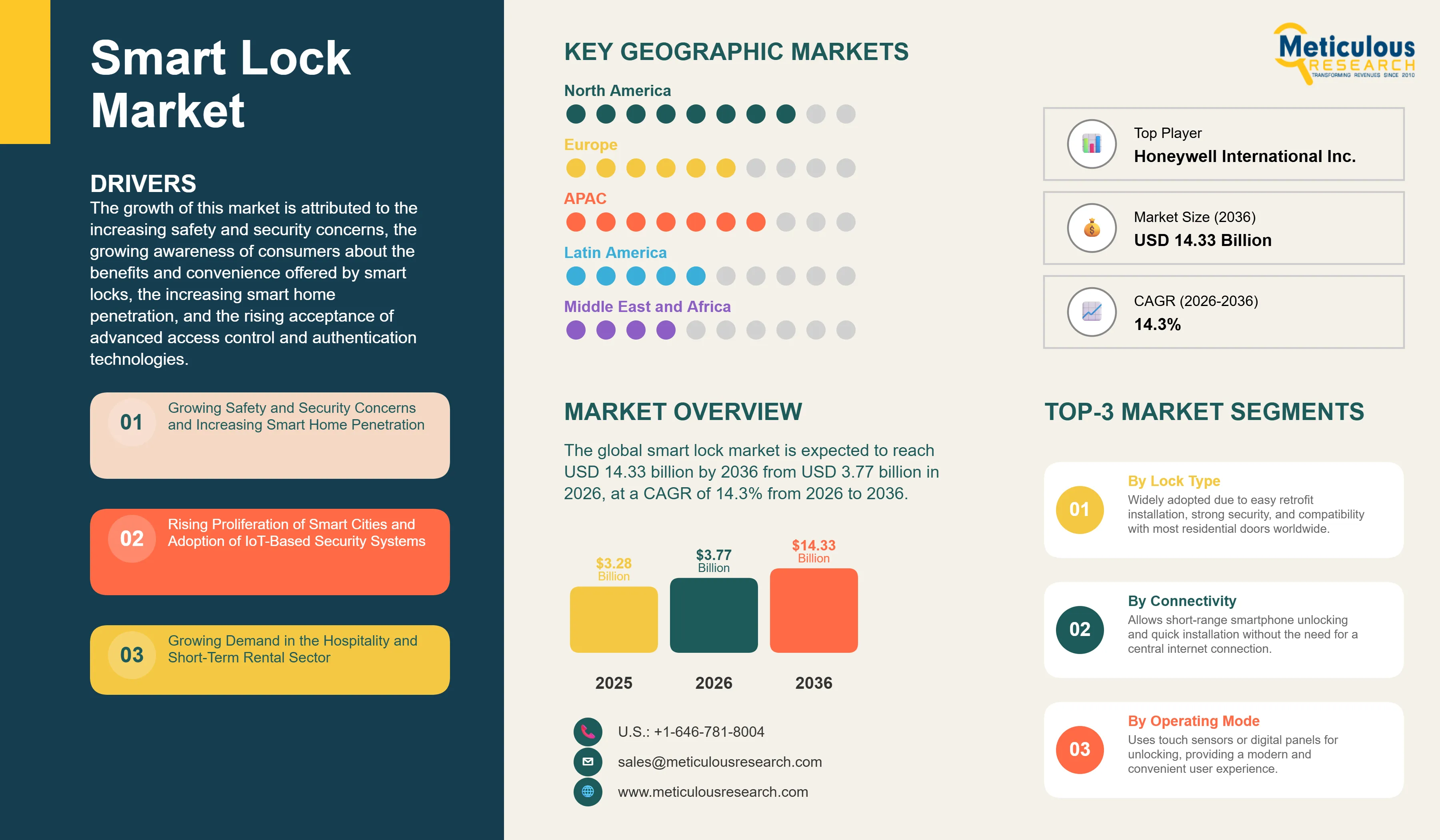
The global smart lock market was valued at USD 3.28 billion in 2025. This market is expected to reach USD 14.33 billion by 2036 from USD 3.77 billion in 2026, at a CAGR of 14.3% from 2026 to 2036. Based on volume, the global smart lock market is projected to reach 110.5 million units by 2036, at a CAGR of 15.1% during the forecast period.
The growth of this market is attributed to the increasing safety and security concerns, the growing awareness of consumers about the benefits and convenience offered by smart locks, the increasing smart home penetration, and the rising acceptance of advanced access control and authentication technologies. Additionally, the increasing adoption of IoT-based security systems, the rising proliferation of smart cities, and the growing integration of biometric technologies into smart locks are expected to offer significant opportunities for the growth of this market. However, the high cost of smart locks compared to conventional mechanical locks and the perception of unreliability in certain consumer segments can restrain the growth of this market.
 Click here to: Get Free Sample Pages of this Report
Smart locks are advanced electromechanical locking systems that enable users to lock and unlock doors through digital and wireless means, rather than a traditional mechanical key. Smart locks operate using connectivity technologies including Bluetooth, Wi-Fi, Z-Wave, Zigbee, Near Field Communication (NFC), and Radio Frequency Identification (RFID), allowing users to control access through smartphones, keypads, smart cards, biometric authentication, key fobs, and voice assistants. Smart locks can be integrated with broader smart home ecosystems and security platforms, offering features including remote access, real-time access notifications, access logs, temporary digital key sharing, and automated locking and unlocking based on geofencing.
The smart lock market has undergone significant consolidation since 2022. In June 2023, ASSA ABLOY AB completed its USD 4.3 billion acquisition of Spectrum Brands Holdings, Inc.'s Hardware and Home Improvement business, bringing the Kwikset and Baldwin brands into its portfolio. As part of a settlement with the U.S. Department of Justice to address antitrust concerns, ASSA ABLOY simultaneously divested its Emtek and Schaub premium mechanical hardware businesses, along with its U.S. and Canadian Yale and August residential smart lock businesses, to Fortune Brands Innovations, Inc. for a gross purchase price of USD 800 million, or approximately USD 700 million net of anticipated tax benefits. This transaction transferred two of the most recognized residential smart lock brands in North America to Fortune Brands, which now manages them within its Security reporting segment alongside its existing Master Lock and SentrySafe portfolios.
These developments reflect the ongoing competitive intensity and strategic significance of the residential smart lock segment, with both companies continuing to invest in product innovation, including the 2025 launch of the Yale Smart Lock with Matter for Google Home, to capture growth in connected access solutions.
Growing Adoption of Matter and Thread Standards to Accelerate Smart Lock Interoperability
The growing adoption of the Matter smart home connectivity standard, developed by the Connectivity Standards Alliance and supported by Apple, Google, Amazon, and major lock manufacturers, is reducing interoperability barriers between smart lock brands and smart home ecosystems.
In March 2025, Yale announced the Yale Smart Lock with Matter, featuring Matter-over-Thread connectivity designed to enable lower standby power consumption and extended battery life; the product launched commercially in June 2025 at a retail price of $189.99. Allegion plc's Schlage brand also introduced its first Matter-over-Thread compatible smart lock, the Schlage Sense Pro™ Smart Deadbolt, at CES in January 2025, alongside the Schlage Arrive™ Smart WiFi Deadbolt for value-oriented consumers.
The adoption of Matter and Thread standards is expected to accelerate residential smart lock adoption by simplifying setup, enabling broader compatibility across existing smart home platforms, and supporting features such as voice-controlled unlocking with PIN verification and unified activity monitoring across ecosystems.
Growing Adoption of Matter Smart Home Standard and Ultra-Wideband Technology
One of the significant trends in the smart lock market is the growing adoption of the Matter smart home interoperability standard and ultra-wideband (UWB) technology in smart lock products. Matter, supported by major technology platforms including Apple HomeKit, Google Home, Amazon Alexa, and Samsung SmartThings, enables smart locks from different manufacturers to work seamlessly within a shared smart home ecosystem without brand-specific hubs or complex configuration. The adoption of Matter is reducing one of the primary barriers to the adoption of smart locks, which has historically been the complexity of integration with existing smart home devices.
In January 2025, Lockly unveiled the Secure Pro Deadbolt UWB Edition at the Consumer Electronics Show, priced at USD 379.99, incorporating ultra-wideband technology for precise proximity detection and hands-free unlocking; the product is scheduled to launch commercially in late 2025. Also at CES 2025, U-tec introduced the Ultraloq Bolt Mission UWB + NFC, the world's first smart lock with integrated Ultra-Wideband technology, enabling centimeter-level accuracy for passive hands-free unlocking as users approach; the product is priced at USD 399 and began shipping in Q1 2025.
UWB technology enables smart locks to detect and authenticate users with sub-centimeter spatial precision, enabling passive hands-free unlocking that distinguishes the user's approaching smartphone from nearby devices. This technology, already present in flagship smartphones from Apple and Samsung, is enabling a new category of premium smart lock products that offer a more seamless and secure access experience. The growing availability of UWB chipsets in mainstream smartphones is expected to drive the broader adoption of UWB-enabled smart locks in both residential and commercial settings during the forecast period.
Increasing Integration of Biometric Authentication and AI-Based Access Management
The increasing integration of advanced biometric authentication methods, including fingerprint recognition, facial recognition, and palm-vein recognition, into smart lock products is a significant trend driving demand for premium smart lock devices. Declining biometric sensor prices and improving sensor accuracy are enabling the incorporation of biometric authentication into a wider range of smart lock products across residential and commercial price points. In May 2025, SwitchBot released the SwitchBot Lock Ultra Vision Combo, integrating 3D facial recognition via the Vision Keypad alongside fingerprint, NFC, PIN, and geofencing access modes; the combo package is priced at USD 249.99 and began shipping in June 2025. In September 2025, Wyze launched the Palm Lock, incorporating palm-vein biometric recognition at a consumer price point of USD 129.98, demonstrating the growing accessibility of advanced biometric authentication in residential smart lock products.
The integration of AI and machine learning in smart lock access management platforms is enabling more intelligent and adaptive access control for both residential and commercial applications. AI-based platforms can analyze access patterns, detect anomalous entry attempts, and provide predictive security alerts. ASSA ABLOY's Centrios platform, initially launched in 2024 and expanded through 2025, offers a cloud-based, mobile-first access control solution for small and medium-sized businesses, including a free tier supporting up to five door openings.
|
Report Coverage |
Details |
|
Market Size by 2036 |
USD 14.33 Billion |
|
Market Size in 2025 |
USD 3.28 Billion |
|
Market Size in 2026 |
USD 3.77 Billion |
|
Market Growth Rate (2026–2036) |
CAGR of 14.3% |
|
Volume Projection by 2036 |
110.5 Million Units (CAGR of 15.1% from 2026) |
|
Dominating Region |
North America |
|
Fastest Growing Region |
Asia-Pacific |
|
Base Year |
2025 |
|
Forecast Period |
2026 to 2036 |
|
Segments Covered |
By Lock Type: Deadbolt Locks, Lever Handle Locks, Mortise Locks, Rim Locks, Others |
|
Regions Covered |
North America, Europe, Asia-Pacific, Latin America, and Middle East & Africa |
Growing Safety and Security Concerns and Increasing Smart Home Penetration
Growing safety and security concerns among residential and commercial consumers are a primary driver of the smart lock market. The increasing incidence of property crimes, unauthorized access incidents, and the growing need for remote access management in multi-resident buildings, short-term rental properties, and commercial premises are increasing demand for smart locks that offer keyless entry, real-time access notifications, and remote locking capabilities. Unlike traditional mechanical locks, smart locks allow users to monitor and manage access logs and grant temporary digital access credentials without the need to physically transfer keys.
The growing penetration of smart home systems is also driving demand for smart locks as an entry point into broader smart home ecosystems. According to industry estimates, voice assistants are present in approximately 70% of households in the U.S., and the integration of smart locks with voice-controlled home automation platforms including Amazon Alexa, Google Home, and Apple HomeKit is increasing consumer adoption of connected access control. The growing availability of smart lock products at accessible price points and the simplification of installation and setup through the adoption of the Matter standard are expected to further support the growth of the smart lock market during the forecast period.
Rising Proliferation of Smart Cities and Adoption of IoT-Based Security Systems
The rising proliferation of smart city initiatives globally is increasing government and institutional investment in advanced access control and security systems, including smart locks. Governments across Asia-Pacific, the Middle East, and North America are investing in smart city infrastructure that requires scalable, remotely managed access control for public buildings, transportation hubs, utilities, and government facilities. These investments are creating demand for commercial and institutional-grade smart locks that can be centrally managed and integrated with broader building management and security platforms.
The increasing adoption of IoT-based security systems in the commercial and industrial end-user segments is further driving demand for smart locks that can be integrated with enterprise access control systems, workforce management platforms, and building automation systems. The growing adoption of cloud-based access control management platforms is enabling organizations to deploy and manage large numbers of smart locks across multiple locations through centralized software interfaces, supporting demand for smart locks with Wi-Fi, cellular, and multi-connectivity capabilities.
Growing Demand in the Hospitality and Short-Term Rental Sector
The hospitality and short-term rental sector offers a significant growth opportunity for the smart lock market. Hotels, serviced apartments, and short-term rental properties managed through platforms such as Airbnb and Vrbo require flexible, remotely managed access systems that can generate and revoke digital access credentials for guests without requiring physical key handovers. Smart locks with cloud-based management platforms enable property managers to issue time-limited digital keys, monitor access in real time, and automate check-in and check-out processes, improving operational efficiency and guest experience. The rapid growth of the short-term rental sector and the increasing adoption of property technology solutions in the hospitality industry are creating growing commercial demand for cloud-connected smart lock systems.
Why Does the Deadbolt Locks Segment Dominate the Smart Lock Market?
Based on lock type, in 2026, the deadbolt locks segment is expected to account for the largest share of the global smart lock market. The large market share of this segment is attributed to the low installation cost, high durability, and effective protection against forced intrusion offered by deadbolt smart locks in residential, commercial, and other applications. Deadbolt smart locks provide a seamless retrofit solution for existing standard door preparations, making them accessible to a wide range of consumers without the need for extensive door modifications. This convenience appeals to homeowners and renters seeking to upgrade their home security without replacing entire door hardware systems. The segment is further supported by the strong consumer recognition and brand equity of leading deadbolt smart lock brands, including Schlage (Allegion plc), Kwikset and Baldwin (ASSA ABLOY), and the former Yale and August brands now under Fortune Brands Innovations.
However, the lever handle locks segment is expected to witness the fastest CAGR during the forecast period. The faster growth of this segment is driven by the growing demand for lever handle smart locks from commercial and multi-residential applications where high-frequency access and compliance with the Americans with Disabilities Act (ADA) and equivalent accessibility standards in other markets are required. Lever handle smart locks are increasingly preferred in hotels, hospitals, office buildings, and public facilities due to their ease of operation, ergonomic design, and suitability for high-traffic environments.
Why is the Multi-Connectivity Segment Expected to Register the Fastest Growth?
Based on connectivity, the multi-connectivity segment is projected to grow at the fastest CAGR in the smart lock market during the forecast period of 2026 to 2036. Multi-connectivity smart locks, which combine two or more wireless protocols such as Bluetooth, Wi-Fi, Z-Wave, Zigbee, NFC, and UWB, offer greater flexibility and reliability in access control compared to single-connectivity products. The growing consumer preference for smart locks that integrate seamlessly with a wider range of smart home platforms and maintain connectivity even if one wireless protocol is temporarily unavailable is driving adoption of multi-connectivity products. The adoption of the Matter smart home standard, which requires support for both Wi-Fi and Thread connectivity, is further driving the development and adoption of multi-protocol smart lock products across both residential and commercial segments.
Why Does the Access Control & Authentication Segment Dominate the Smart Lock Market?
Based on application, in 2026, the access control and authentication segment is expected to account for the largest share of the overall smart lock market. This segment is also projected to register the highest CAGR during the forecast period. The large market share of this segment is attributed to the rising acceptance of advanced access control and authentication technologies including fingerprint recognition, facial recognition, iris recognition, voice recognition, and smart cards, along with the increasing consumer demand for modern, keyless access control and authentication devices. Consistent technological advancements in biometric authentication, declining sensor costs, and the expanding range of authentication options available in both residential and commercial smart lock products are supporting the growth of this segment.
Why Does the Residential Segment Dominate the Smart Lock Market?
Based on end user, in 2026, the residential segment is expected to account for the largest share of the global smart lock market. The large market share of this segment is attributed to the growing penetration of smart home devices among residential consumers, the increasing availability of smart lock products at a range of accessible price points, and the growing consumer awareness of the convenience, security, and remote management capabilities offered by smart locks in residential settings. The integration of smart locks with popular smart home platforms including Amazon Alexa, Google Home, and Apple HomeKit is supporting adoption among residential consumers who already use connected home devices.
However, the commercial segment is expected to witness the fastest CAGR during the forecast period. The faster growth of the commercial segment is driven by the growing need for centralized security management, employee access control, and access audit trails in commercial premises. Organizations including hotels, co-working spaces, healthcare facilities, retail stores, and corporate offices are increasingly adopting smart lock and access management systems that can be managed remotely, support multiple users, and integrate with workforce management and building security platforms. The rise of hybrid work models and the growth of flexible office and co-working spaces are also supporting demand for dynamic, scalable access management systems in the commercial segment.
U.S. Smart Lock Market Size and Growth 2026 to 2036
The U.S. smart lock market is projected to grow at a significant CAGR from 2026 to 2036, supported by high consumer penetration of smart home devices, the presence of leading market participants including ASSA ABLOY AB (Kwikset, Baldwin), Fortune Brands Innovations (Yale, August), Allegion plc (Schlage), dormakaba Group, and a growing range of consumer and commercial smart lock brands.
How is North America Maintaining Dominance in the Smart Lock Market?
Based on geography, in 2026, North America is expected to account for the largest share of the global smart lock market. The largest share of this region is attributed to the high penetration of smart home devices among residential consumers, the large installed base of residential properties with standard door preparations compatible with retrofit smart lock installation, the presence of leading smart lock manufacturers and brand owners in the region, and the relatively high consumer willingness to invest in home security and convenience technology. The U.S. market in particular benefits from a well-developed retail and e-commerce distribution infrastructure for smart home products, high consumer awareness of smart lock benefits, and the growing availability of insurance discounts for properties equipped with smart security devices.
Which Factors Support the Growth of the Asia-Pacific Smart Lock Market?
Asia-Pacific is expected to register the fastest CAGR during the forecast period of 2026 to 2036. The growth in this market is attributed to the presence of rapidly developing economies, consistent technological advancements in access control and authentication technology, and government initiatives to integrate access control and authentication technologies in various public services across countries, including China, India, Singapore, and South Korea. Moreover, the increased adoption of advanced technologies including artificial intelligence, IoT, and biometric recognition, rising urbanization and disposable incomes, and the rapid expansion of residential and commercial construction activity are contributing to the growth of the smart lock market in Asia-Pacific.
China is a key market in the region, supported by large-scale smart city programs and the growing adoption of smart home technologies among a rapidly expanding urban middle class. Local manufacturers, including Dessmann Schliessanlagen GmbH, Shenzhen Vians Electric Lock Co., Ltd., and Avent Security (China) are active in the Chinese and broader Asian market, alongside global brands. South Korea, Singapore, Japan, and India are also growing markets for smart lock adoption, supported by high smartphone penetration, expanding smart home ecosystems, and increasing investment in commercial and public building security infrastructure.
The report includes a competitive landscape based on an extensive assessment of the key growth strategies adopted by the leading market participants in the smart lock market between 2023 and 2026. The key players profiled in the smart lock market report are ASSA ABLOY AB (Sweden), Fortune Brands Innovations, Inc. (U.S.), Allegion plc (Ireland), dormakaba Group (Switzerland), SALTO Systems, S.L. (Spain), Honeywell International Inc. (U.S.), Samsung SDS Co., Ltd. (South Korea), ZKTECO CO., LTD. (China), igloocompany Pte Ltd. (Singapore), RemoteLock (U.S.), Spectrum Brands Holdings, Inc. [Kwikset, Baldwin; acquired by ASSA ABLOY in 2023] (U.S.), SentriLock, LLC (U.S.), Zhejiang Dahua Technology Co., Ltd. (China), DESSMANN Schliessanlagen GmbH (Germany), Shenzhen Vians Electric Lock Co., Ltd. (China), and Avent Security (China) among others.
Smart Lock Market, by Lock Type
Smart Lock Market, by Connectivity
Smart Lock Market, by Operating Mode
Smart Lock Market, by Application
Smart Lock Market, by End User
Smart Lock Market, by Geography
This study offers a detailed assessment of the smart lock market, including market sizes and forecasts by value and volume for various segmentations such as lock type, connectivity, operating mode, application, end user, and geography. The smart lock market study also involves the value analysis of various segments at regional and country levels.
The global smart lock market is projected to reach USD 14.33 billion by 2036, at a CAGR of 14.3% during the forecast period from 2026 to 2036. Based on volume, the market is projected to reach 110.5 million units by 2036, growing at a CAGR of 15.1% during the forecast period.
The deadbolt locks segment is estimated to hold the largest share in 2026. The low installation cost, high durability, and effective protection against forced intrusion offered by deadbolt smart locks in residential and commercial applications contribute to the largest market share.
The multi-connectivity segment is expected to grow at the highest CAGR over the forecast period. The growing consumer preference for smart locks that integrate with multiple wireless protocols and smart home platforms, and the adoption of the Matter smart home standard requiring support for multiple connectivity modes, are key factors driving this segment’s growth.
The growth of this market is attributed to increasing safety and security concerns, growing awareness of the benefits of smart locks, increasing smart home penetration, and the rising acceptance of advanced access control and authentication technologies. Additionally, the increasing adoption of IoT-based security systems, the rising proliferation of smart cities, and the growing integration of biometric technologies into smart locks are expected to offer significant opportunities for market growth.
The key players operating in the global smart lock market are ASSA ABLOY AB (Sweden), Fortune Brands Innovations, Inc. (U.S.), Allegion plc (Ireland), dormakaba Group (Switzerland), SALTO Systems, S.L. (Spain), Honeywell International Inc. (U.S.), Samsung SDS Co., Ltd. (South Korea), ZKTECO CO., LTD. (China), igloocompany Pte Ltd. (Singapore), RemoteLock (U.S.), SentriLock, LLC (U.S.), Zhejiang Dahua Technology Co., Ltd. (China), DESSMANN Schliessanlagen GmbH (Germany), Shenzhen Vians Electric Lock Co., Ltd. (China), and Avent Security (China) among others.
Asia-Pacific is projected to offer the most significant growth opportunities for vendors during the forecast period, driven by rapid urbanization, growing smart home adoption, increasing disposable incomes, government-supported smart city programs, and expanding residential and commercial construction activity across countries including China, India, South Korea, and Singapore. Latin America and the Middle East & Africa also represent growing markets supported by smart infrastructure investment and construction activity.









Published Date: Jan-2025
Published Date: Aug-2024
Published Date: Oct-2022
Published Date: Sep-2025
Published Date: Sep-2025
Please enter your corporate email id here to view sample report.
Subscribe to get the latest industry updates


