Resources
About Us
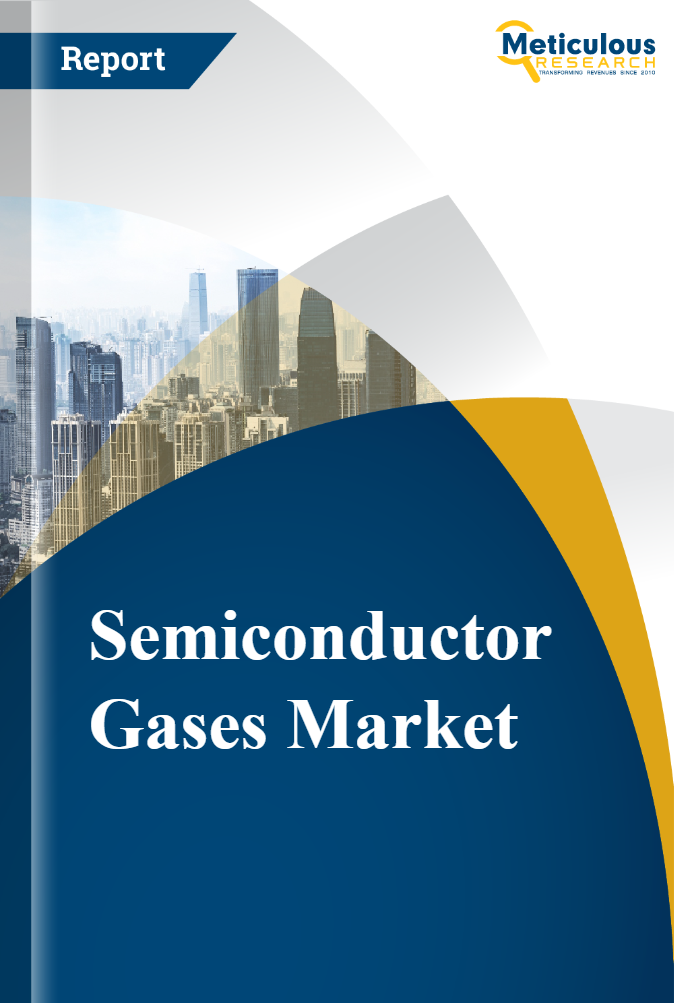
Semiconductor Gases Market by Gas Type (Etching Gases, Deposition Gases, Doping Gases, Cleaning Gases), Semiconductor Manufacturing Process, Semiconductor Type, Wafer Size, Supply Mode, End User, and Geography - Global Forecast to 2036
Report ID: MRSE - 1042130 Pages: 304 Aug-2026 Formats*: PDF Category: Semiconductor and Electronics Delivery: 24 to 72 Hours Download Free Sample Report
Semiconductor Gases Market Size
The global Semiconductor Gases Market was valued at USD 10.8 billion in 2026 and is projected to reach USD 19.7 billion by 2036, registering a CAGR of 6.2% during the forecast period (2026–2036).
Key Highlights
Market Overview
The Semiconductor Gases Market comprises specialty and bulk gases used throughout semiconductor manufacturing and advanced packaging processes. These gases are essential for processes including deposition, etching, cleaning, doping and ion implantation, lithography, oxidation, thermal processing, and advanced packaging. The market encompasses etching gases, deposition gases, doping gases, cleaning gases, carrier and inert gases, and other specialty gases.
Semiconductor gases are critical process materials because they enable precise deposition and removal of material layers during wafer fabrication. As semiconductor geometries become smaller and device structures become more complex, manufacturers require increasingly precise control over gas composition, flow, purity, and contamination levels. Electronic-grade and ultra-high-purity gases are therefore essential for maintaining process consistency and semiconductor yield. According to SEMI's 2026 300mm Fab Outlook, global 300mm front-end fab equipment spending is expected to reach a record US$142 billion in 2026, representing a 25% year-on-year increase. The report tracks 413 fabs and production lines worldwide, highlighting the scale of semiconductor manufacturing capacity requiring high-purity process gases.
The increasing complexity of semiconductor manufacturing is expanding gas requirements across multiple process steps. Advanced logic devices require highly controlled deposition and etching processes, while 3D NAND manufacturing relies extensively on multilayer deposition and high-aspect-ratio etching. Similarly, HBM and other advanced memory technologies require increasingly sophisticated fabrication processes. SEMI forecasts that global advanced semiconductor manufacturing capacity at 7nm and below will increase approximately 69%, from 850,000 wafers per month in 2024 to 1.4 million wafers per month by 2028. In 2026 alone, advanced-process capacity is expected to reach approximately 1.16 million wafers per month, surpassing one million wafers for the first time. The growing production of GPUs, AI accelerators, CPUs, and ASICs is further increasing demand for advanced semiconductor manufacturing capacity and associated process gases.
The market is also being shaped by the geographic expansion of semiconductor manufacturing. New and expanded fabs across North America, Europe, and Asia-Pacific are increasing local demand for semiconductor gases and associated purification, storage, distribution, and point-of-use delivery infrastructure. SEMI's 2026 outlook indicates that global 300mm installed semiconductor capacity is projected to increase by approximately 7% in 2026, while five new 200mm volume-production fabs are expected to begin operations during the year, bringing the total number of such fabs to 256. The localization of semiconductor supply chains is also encouraging gas producers to establish production and supply capabilities closer to major semiconductor manufacturing clusters. This localization trend is reinforced by major government-backed investments; for example, the U.S. Department of Commerce reported in 2025 that Micron planned US$200 billion in U.S. semiconductor manufacturing and R&D investments, including expansion of advanced memory production supporting AI and high-performance computing.
Market Drivers
Expansion of Semiconductor Manufacturing Capacity
The expansion of semiconductor manufacturing capacity worldwide is a major driver of the Semiconductor Gases Market. New semiconductor fabs require continuous supplies of process gases for deposition, etching, cleaning, doping, oxidation, and other fabrication processes. Capacity expansions at existing fabs also increase gas consumption as manufacturers add wafer-processing equipment and increase production volumes.
Semiconductor manufacturing investments are expanding beyond traditional production centers as governments and industry players seek to strengthen domestic and regional supply chains. New fabrication projects across the U.S., Europe, India, China, Taiwan, South Korea, Japan, and Southeast Asia are therefore creating additional demand for both specialty and bulk semiconductor gases.
The impact is particularly significant for fabs manufacturing advanced logic and memory devices, where increasing process complexity requires a greater variety of high-purity gases. The expansion of fabs across North America, Europe, and Asia-Pacific is expected to remain a key source of demand during the forecast period.
Growing Demand for Advanced Semiconductor Nodes
The shift toward advanced semiconductor nodes is increasing the complexity and intensity of semiconductor gas consumption. Advanced nodes require highly controlled deposition, etching, cleaning, and doping processes to manufacture increasingly small and sophisticated device structures.
The continued development of advanced processors for AI, high-performance computing, data centers, smartphones, and high-end computing applications is supporting investment in leading-edge manufacturing capabilities. These manufacturing processes require high-purity gases with tightly controlled impurity levels to maintain process uniformity and yield.
Advanced etching and deposition techniques, including plasma etching, CVD, ALD, selective deposition, and selective etching, are becoming increasingly important as manufacturers transition toward more complex transistor architectures and advanced memory structures.
Increasing Adoption of 3D NAND and Advanced Memory Technologies
The growing production of 3D NAND, DRAM, and High Bandwidth Memory (HBM) is creating significant demand for semiconductor gases. 3D NAND requires repeated deposition and etching of vertically stacked layers, resulting in intensive use of deposition and etching gases.
HBM production is also gaining importance due to increasing demand from AI accelerators and high-performance computing systems. Advanced memory manufacturing requires precise deposition, etching, cleaning, and other process steps, increasing consumption of specialty gases.
The increasing deployment of HBM and advanced memory technologies is therefore creating opportunities for suppliers of silane, ammonia, nitrogen trifluoride, fluorine-based etching gases, and other specialized process gases.
Rising Demand for AI Accelerators and High-Performance Computing Chips
The rapid expansion of AI and high-performance computing is increasing demand for advanced semiconductors, including GPUs, AI accelerators, CPUs, and application-specific integrated circuits (ASICs). Manufacturing these devices requires advanced process technologies and increasingly complex wafer fabrication processes.
AI-related semiconductor demand is also increasing the need for advanced packaging and HBM integration. Processes such as 2.5D packaging, 3D packaging, wafer-level packaging, and hybrid bonding require specialized process environments and gases, creating additional opportunities for semiconductor gas suppliers.
Market Restraints
High Purity and Contamination Control Requirements
The stringent purity requirements associated with semiconductor manufacturing create significant production and quality-control challenges. Even trace levels of contaminants can affect wafer processing, device performance, and manufacturing yield. Semiconductor gas suppliers therefore require advanced purification technologies, analytical testing, contamination-control systems, and specialized packaging.
Electronic-grade and ultra-high-purity gases must maintain tightly controlled levels of moisture, particles, and other impurities throughout production, filling, transportation, storage, and point-of-use delivery. These requirements increase production complexity and operating costs.
Complex Gas Handling and Distribution Infrastructure
Semiconductor manufacturing uses gases with different physical and chemical characteristics, including toxic, corrosive, pyrophoric, and highly reactive materials. Their handling requires specialized cylinders, containers, gas cabinets, distribution networks, monitoring systems, and point-of-use delivery infrastructure.
Large semiconductor fabs require highly reliable gas delivery systems to ensure uninterrupted production. Any contamination, leakage, pressure instability, or interruption in supply can affect manufacturing operations and potentially result in wafer losses. As fabs become larger and more technologically advanced, the complexity of gas distribution infrastructure continues to increase.
High Manufacturing and Qualification Costs
Semiconductor-grade gases require sophisticated purification, quality assurance, packaging, and analytical capabilities. In addition, new gas chemistries generally require extensive qualification before being adopted in high-volume semiconductor production.
These requirements create high barriers to entry for new suppliers and increase the cost of developing alternative gas formulations. The challenge is particularly relevant for advanced etching and cleaning gases, where semiconductor manufacturers require consistent performance and extremely tight impurity specifications.
Market Opportunities
Expansion of Advanced Logic and Memory Manufacturing
The continued expansion of advanced logic and memory manufacturing is creating significant opportunities for semiconductor gas suppliers. Advanced logic devices, GPUs, AI accelerators, and high-performance processors require increasingly sophisticated deposition, etching, cleaning, and doping processes, creating demand for high-purity and application-specific gas chemistries.
Similarly, the expansion of DRAM, 3D NAND, and HBM manufacturing is increasing the use of deposition and etching gases. The increasing complexity of vertically stacked memory structures and advanced device architectures is expected to support higher demand for specialty gases across leading-edge semiconductor fabs.
Growing Demand for Low-Global-Warming-Potential Etching and Cleaning Gases
Environmental concerns associated with fluorinated semiconductor gases are encouraging the development and adoption of lower-global-warming-potential alternatives. Etching and chamber-cleaning processes traditionally rely on fluorinated gases, some of which have high global-warming potential.
Semiconductor manufacturers and gas suppliers are therefore investing in alternative chemistries and process technologies that can reduce environmental impact while maintaining etch performance, selectivity, and manufacturing yield. This transition is expected to create opportunities for suppliers with capabilities in next-generation etching and cleaning gas formulations.
Increasing Semiconductor Manufacturing Investments in India, the U.S., and Europe
The geographic expansion of semiconductor manufacturing is creating new opportunities for localized semiconductor gas production and supply. Investments in semiconductor fabs in India, the U.S., and Europe are increasing the need for reliable local supplies of specialty gases, bulk gases, purification systems, cylinders, distribution infrastructure, and on-site gas supply.
The development of regional semiconductor ecosystems is also encouraging gas suppliers to establish manufacturing, purification, filling, storage, and distribution capabilities closer to major fabrication clusters. This localization can improve supply reliability and reduce dependence on long-distance transportation of critical gases.
Growth of Advanced Packaging and Heterogeneous Integration
The rapid adoption of advanced packaging is creating an additional demand center for semiconductor gases beyond conventional wafer fabrication. Wafer-level packaging, 2.5D packaging, 3D packaging, and hybrid bonding are increasingly important for high-performance processors, AI accelerators, and advanced memory systems.
These processes require controlled deposition, cleaning, etching, surface treatment, and other specialized process steps, creating opportunities for specialty gas suppliers to develop application-specific solutions for advanced packaging environments.
Market Challenges
Environmental Regulations on Fluorinated Semiconductor Gases
Increasing environmental regulations targeting fluorinated gases are creating challenges for semiconductor gas manufacturers and semiconductor fabs. Several gases used in semiconductor etching and cleaning have high global-warming potential, creating pressure to reduce emissions and identify alternative chemistries.
Gas suppliers must increasingly invest in lower-GWP alternatives, emission-abatement technologies, process optimization, and regulatory compliance. These requirements can increase development costs and accelerate the need for qualification of replacement gases.
Supply Chain Risks for Critical Specialty Gases
The semiconductor industry depends on a continuous supply of highly purified specialty gases, making supply-chain resilience a critical issue. Production interruptions, transportation disruptions, shortages of feedstocks, geopolitical restrictions, or concentration of production capacity in specific countries can affect the availability of critical gases.
The increasing geographic concentration of advanced semiconductor manufacturing also increases the importance of establishing localized gas production and distribution capabilities. Gas producers are therefore increasingly evaluating regional manufacturing, purification, storage, and inventory strategies to improve supply security.
Stringent Safety Requirements for Toxic, Corrosive, and Pyrophoric Gases
Many semiconductor gases require specialized handling because they can be toxic, corrosive, flammable, or pyrophoric. Gases such as phosphine, diborane, hydrogen chloride, hydrogen bromide, and certain fluorinated gases require stringent safety protocols throughout production, filling, transportation, storage, and point-of-use delivery.
Semiconductor fabs and gas suppliers must invest in leak detection, gas monitoring, specialized containment, automated gas cabinets, emergency response systems, and trained personnel. These requirements increase infrastructure and operating costs while making safety compliance an important consideration in semiconductor gas supply.
Market Trends
Increasing Localization of Semiconductor Gas Supply Chains
Semiconductor supply-chain localization is increasingly extending beyond wafer fabrication to critical process materials such as semiconductor gases. New fabs in North America, Europe, and other emerging manufacturing regions are encouraging gas producers to establish local production, purification, filling, storage, and distribution capabilities.
Localized supply chains can improve delivery reliability, reduce transportation risks, support rapid response to fab requirements, and reduce dependence on overseas specialty gas supplies. This trend is expected to become increasingly important as governments promote domestic semiconductor manufacturing capabilities.
Growing Investments in AI Semiconductor Manufacturing
Rapid investment in AI semiconductor manufacturing is increasing demand for advanced process gases. AI chips, GPUs, CPUs, and ASICs increasingly rely on advanced fabrication nodes, complex transistor structures, and sophisticated packaging technologies.
The resulting increase in advanced wafer fabrication and packaging capacity is supporting demand for etching, deposition, cleaning, doping, and carrier gases. Continued expansion of AI semiconductor production is therefore expected to remain an important demand driver for semiconductor gas suppliers.
Expansion of HBM and Advanced Memory Manufacturing
The growing adoption of High Bandwidth Memory (HBM) for AI accelerators and high-performance computing is increasing investment in advanced memory manufacturing. HBM involves sophisticated wafer fabrication and packaging processes and requires high levels of process control.
Increasing HBM production is therefore supporting demand for specialty gases used in deposition, etching, cleaning, and other semiconductor manufacturing processes. The broader expansion of DRAM and 3D NAND manufacturing is expected to reinforce this
Market Analysis by Gas Type
Based on gas type, the global Semiconductor Gases Market is segmented into Etching Gases, Deposition Gases, Doping Gases, Cleaning Gases, Carrier & Inert Gases, and Other Semiconductor Gases.
In 2026, the Etching Gases segment is expected to account for the largest share of the global Semiconductor Gases Market. The large share of this segment is mainly due to the increasing complexity of semiconductor device architectures, growing adoption of high-aspect-ratio etching, and extensive use of etching processes in advanced logic, DRAM, and 3D NAND manufacturing.
However, the Deposition Gases segment is projected to register the fastest growth during the forecast period. The rapid growth of this segment is attributed to increasing adoption of CVD and ALD processes, growing demand for conformal thin-film deposition in advanced semiconductor nodes, and increasing production of multilayer memory and advanced logic devices.
Market Analysis by Gas Category
Based on gas category, the global Semiconductor Gases Market is segmented into Specialty Gases and Bulk Gases.
In 2026, the Specialty Gases segment is expected to account for the largest share of the global Semiconductor Gases Market. The large share of this segment is mainly due to their extensive use in critical semiconductor processes, including etching, deposition, doping, and chamber cleaning, along with stringent purity requirements for advanced semiconductor manufacturing.
However, the Bulk Gases segment is projected to register the fastest growth during the forecast period. The rapid growth of this segment is attributed to expanding semiconductor fab capacity, increasing wafer production volumes, and rising consumption of nitrogen, oxygen, argon, hydrogen, and helium across semiconductor manufacturing facilities.
Market Analysis by Semiconductor Manufacturing Process
Based on semiconductor manufacturing process, the global Semiconductor Gases Market is segmented into Deposition, Etching, Cleaning, Doping & Ion Implantation, Lithography, Oxidation & Thermal Processing, and Advanced Packaging Processes.
In 2026, the Etching segment is expected to account for the largest share of the global Semiconductor Gases Market. The large share of this segment is mainly due to the increasing number of etching steps required for advanced logic and memory devices, growing adoption of high-aspect-ratio structures, and increasing complexity of 3D semiconductor architectures.
However, the Advanced Packaging Processes segment is projected to register the fastest growth during the forecast period. The rapid growth of this segment is attributed to increasing adoption of 2.5D and 3D packaging, wafer-level packaging, hybrid bonding, and heterogeneous integration, particularly for AI accelerators, HBM, and high-performance computing applications.
Market Analysis by Semiconductor Type
Based on semiconductor type, the global Semiconductor Gases Market is segmented into Logic & Microprocessors, Memory, Analog & Power Semiconductors, Compound Semiconductors, and Microcontrollers & Connectivity Semiconductors.
In 2026, the Logic & Microprocessors segment is expected to account for the largest share of the global Semiconductor Gases Market. The large share of this segment is mainly due to increasing production of CPUs, GPUs, AI accelerators, and ASICs, along with continued investments in advanced logic and foundry manufacturing capacity.
However, the Memory segment is projected to register the fastest growth during the forecast period. The rapid growth of this segment is attributed to increasing demand for HBM, DRAM, and 3D NAND, rising AI-driven memory requirements, and continued investments in advanced memory manufacturing. SEMI projects 300 mm memory equipment investment to increase 29% to USD 52 billion in 2026, supporting continued expansion of memory production capacity.
Market Analysis by Wafer Size
Based on wafer size, the global Semiconductor Gases Market is segmented into 150 mm or Smaller, 200 mm, 300 mm, and Above 300 mm.
In 2026, the 300 mm segment is expected to account for the largest share of the global Semiconductor Gases Market. The large share of this segment is mainly due to the widespread use of 300 mm wafers in high-volume manufacturing of advanced logic, memory, and high-performance semiconductor devices.
However, the Above 300 mm segment is projected to register the fastest growth during the forecast period. The rapid growth of this segment is attributed to ongoing industry efforts toward larger wafer formats, potential manufacturing cost advantages, and continued development of high-productivity semiconductor fabrication technologies.
Market Analysis by Supply Mode
Based on supply mode, the global Semiconductor Gases Market is segmented into Cylinders, Bundled Cylinders, Bulk Supply, On-Site Gas Generation, and On-Site Gas Supply & Management.
In 2026, the Bulk Supply segment is expected to account for the largest share of the global Semiconductor Gases Market. The large share of this segment is mainly due to high-volume consumption of gases such as nitrogen, oxygen, argon, hydrogen, and helium in large semiconductor fabrication facilities.
However, the On-Site Gas Supply & Management segment is projected to register the fastest growth during the forecast period. The rapid growth of this segment is attributed to increasing fab scale, rising requirements for uninterrupted gas availability, growing emphasis on supply-chain security, and increasing adoption of integrated gas management solutions.
Market Analysis by End User
Based on end user, the global Semiconductor Gases Market is segmented into Semiconductor Foundries, Integrated Device Manufacturers (IDMs), Memory Manufacturers, Compound Semiconductor Manufacturers, Outsourced Semiconductor Assembly & Test (OSAT) Providers, and Research & Development Institutions.
In 2026, the Semiconductor Foundries segment is expected to account for the largest share of the global Semiconductor Gases Market. The large share of this segment is mainly due to large-scale wafer fabrication operations, increasing demand for advanced-node manufacturing, and continued investments in foundry capacity for AI, high-performance computing, and other advanced applications.
However, the Memory Manufacturers segment is projected to register the fastest growth during the forecast period. The rapid growth of this segment is attributed to increasing production of HBM, DRAM, and 3D NAND, growing demand from AI infrastructure, and continued investment in advanced memory fabrication capacity.
Geographic Analysis
Based on geography, the global Semiconductor Gases Market is segmented into North America, Europe, Asia-Pacific, Latin America, and the Middle East & Africa.
In 2026, Asia-Pacific is expected to account for the largest share of the global Semiconductor Gases Market. The large share of this region is mainly due to the concentration of semiconductor foundries, memory manufacturers, advanced packaging facilities, and semiconductor chemical and gas suppliers across Taiwan, South Korea, China, Japan, Singapore, and Southeast Asia. Taiwan and South Korea are particularly important for advanced logic and memory manufacturing, while China is expanding domestic semiconductor production capacity.
However, North America is projected to register the fastest growth during the forecast period. The rapid growth of this region is attributed to increasing investments in semiconductor fabrication capacity in the U.S., government support for domestic semiconductor manufacturing, expansion of advanced-node production, and development of localized semiconductor supply chains. The geographic expansion of semiconductor manufacturing is also increasing demand for localized specialty gas production, purification, and distribution infrastructure.
Competitive Landscape
The global Semiconductor Gases Market is characterized by the presence of major industrial gas companies, specialty chemical manufacturers, and semiconductor material suppliers. Competition is primarily based on gas purity, product consistency, process performance, supply reliability, technical qualification, production capabilities, safety standards, geographic presence, and customer support.
Leading companies are focusing on expanding semiconductor-grade gas production and purification capabilities, developing advanced gas chemistries, strengthening supply infrastructure near semiconductor manufacturing clusters, and supporting customers with integrated gas management solutions. The increasing localization of semiconductor manufacturing is also encouraging suppliers to establish regional production and distribution networks to improve supply reliability.
Environmental considerations are increasingly influencing competitive strategies, particularly for etching and cleaning gases with high global-warming potential. Suppliers are therefore investing in lower-GWP alternatives and technologies that can meet semiconductor process requirements while reducing environmental impact.
The key companies profiled in the global Semiconductor Gases Market include Linde plc, Air Liquide S.A., Air Products and Chemicals, Inc., Merck KGaA, SK Inc. Materials, Entegris, Inc., Resonac Holdings Corporation, Taiyo Nippon Sanso Corporation, Messer SE & Co. KGaA, Iwatani Corporation, Nippon Sanso Holdings Corporation, Korea Industrial Gases Co., Ltd., Sumitomo Seika Chemicals Co., Ltd., Fujikin Incorporated, and Versum Materials.
Semiconductor Gases Market Research Summary:
|
Particulars |
Details |
|
Forecast Period |
2026–2036 |
|
Base Year |
2025 |
|
Estimated Year |
2026 |
|
CAGR (Value) |
6.2% |
|
Market Size (Value) in 2026 |
USD 10.8 Billion |
|
Market Size (Value) in 2036 |
USD 19.7 Billion |
|
Segments Covered |
By Gas Type: Etching Gases, Deposition Gases, Doping Gases, Cleaning Gases, Carrier & Inert Gases, Other Semiconductor Gases. By Gas Category: Specialty Gases, Bulk Gases. By Semiconductor Manufacturing Process: Deposition, Etching, Cleaning, Doping & Ion Implantation, Lithography, Oxidation & Thermal Processing, Advanced Packaging Processes. By Semiconductor Type: Logic & Microprocessors, Memory, Analog & Power Semiconductors, Compound Semiconductors, Microcontrollers & Connectivity Semiconductors. By Wafer Size: 150 mm ≤, 200 mm, 300 mm, >300 mm. By Supply Mode: Cylinders, Bundled Cylinders, Bulk Supply, On-Site Gas Generation, On-Site Gas Supply & Management. By End User: Semiconductor Foundries, Integrated Device Manufacturers (IDMs), Memory Manufacturers, Compound Semiconductor Manufacturers, Outsourced Semiconductor Assembly & Test (OSAT) Providers, Research & Development Institutions. |
|
Countries Covered |
North America: U.S., Canada. Europe: Germany, France, U.K., Netherlands, Ireland, Italy, Belgium, Rest of Europe. Asia-Pacific: China, Taiwan, South Korea, Japan, Singapore, India, Malaysia, Vietnam, Rest of Asia-Pacific. Latin America: Brazil, Mexico, Argentina, Rest of Latin America. Middle East & Africa: Israel, UAE, Saudi Arabia, South Africa, Rest of Middle East & Africa. |
|
Key Companies |
Linde plc, Air Liquide S.A., Air Products and Chemicals, Inc., Merck KGaA, SK Inc. Materials, Entegris, Inc., Resonac Holdings Corporation, Taiyo Nippon Sanso Corporation, Messer SE & Co. KGaA, Iwatani Corporation, Nippon Sanso Holdings Corporation, Korea Industrial Gases Co., Ltd., Sumitomo Seika Chemicals Co., Ltd., Fujikin Incorporated, and Versum Materials. |
Key Questions Answered in the Report
The global Semiconductor Gases Market is estimated at USD 10.8 billion in 2026.
The market is projected to reach USD 19.7 billion by 2036.
The market is expected to grow at a CAGR of 6.2%.
The primary growth factors include expansion of semiconductor manufacturing capacity, increasing adoption of advanced process nodes, growing production of 3D NAND and HBM, rising demand for AI accelerators, and expansion of advanced packaging.
Etching Gases are expected to account for the largest market share due to increasing etching requirements associated with advanced logic, memory, and 3D semiconductor structures.
Etching is expected to account for the largest share due to increasing process complexity and the growing number of etching steps required for advanced semiconductor devices.
Semiconductor Foundries are expected to account for the largest share due to their large-scale wafer fabrication operations and increasing advanced-node production.
Asia-Pacific is expected to account for the largest share due to its concentration of semiconductor manufacturing and advanced memory production.
Leading companies include Linde, Air Liquide, Air Products and Chemicals, Merck, SK Inc. Materials, Entegris, Resonac, Taiyo Nippon Sanso, Messer, Iwatani, Nippon Sanso Holdings, Korea Industrial Gases, Sumitomo Seika Chemicals, Fujikin, and Versum Materials.





















Published Date: Aug-2026
Published Date: Jun-2026
Published Date: Feb-2026
Published Date: Feb-2026
Please enter your corporate email id here to view sample report.
Subscribe to get the latest industry updates


