
Reusable Launch Vehicle Market (2026-2036)
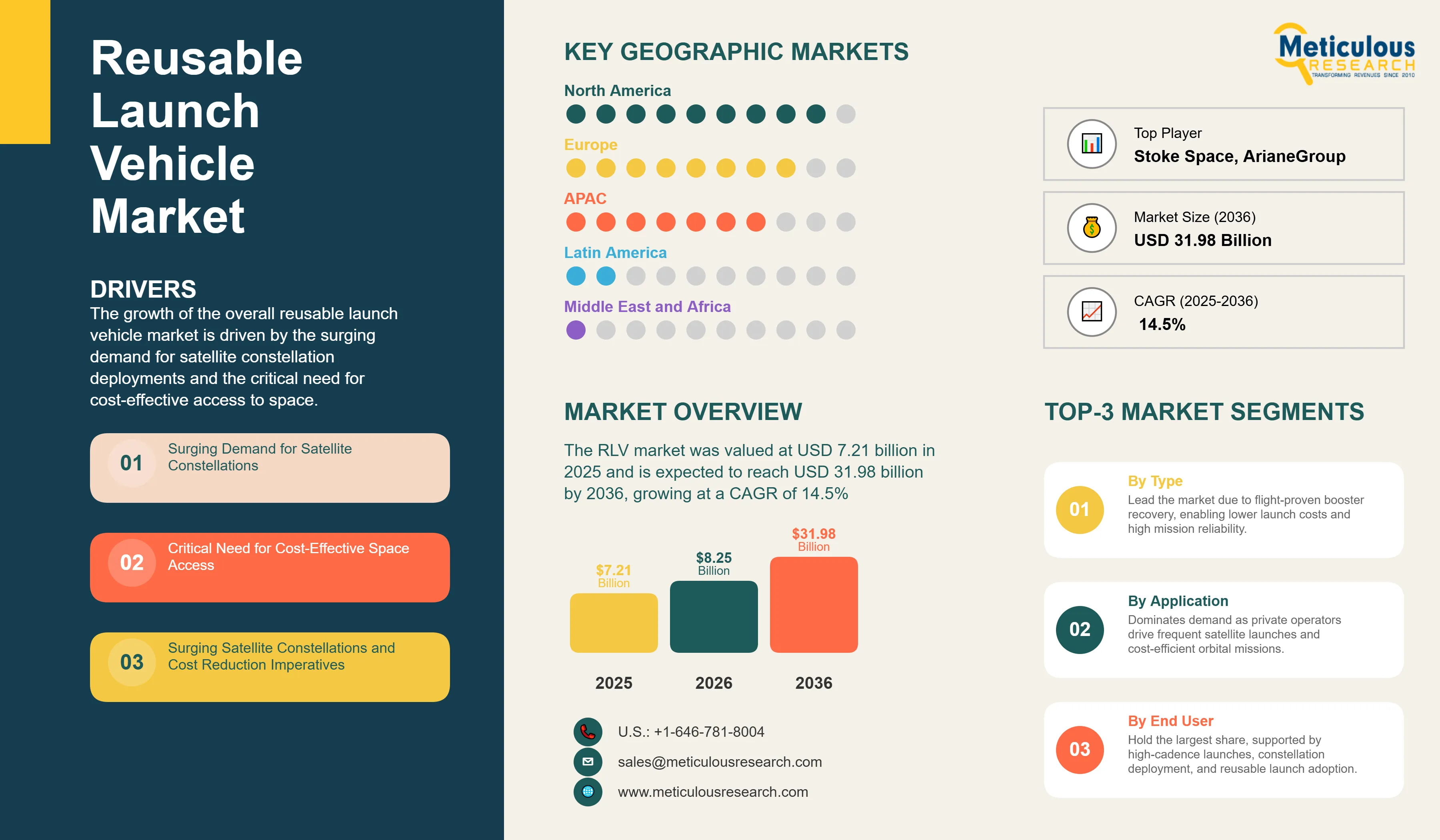
The global reusable launch vehicle (RLV) market was valued at USD 7.21billion in 2025. The market is expected to reach approximately USD 31.98 billion by 2036 from USD 8.25 billion in 2026, growing at a CAGR of 14.5% from 2026 to 2036.
- Published
- Feb 2026
- Pages
- 288
- Format
- PDF + Excel
- Report ID
- MR-1698
- Base year
- 2025
- 2025 · BASELINE
- $7.21B
- 2036
- $31.98B
- CAGR 2026–2036
- 14.5%
2025 baseline · 2026–2036 forecast at 14.5% CAGR · hover a bar for the value
Key highlights
In terms of revenue, the global reusable launch vehicle market is projected to reach USD 31.98 billion by 2036.
The market is expected to grow at a CAGR of 14.9% from 2026 to 2036.
North America dominates the global reusable launch vehicle market with the largest market share in 2026, driven by the presence of pioneering private aerospace companies and substantial NASA and Department of Defense (DoD) contract awards.
Asia-Pacific is expected to witness the fastest growth during the forecast period, supported by aggressive indigenous launch programs in China and India and the rising participation of private space startups in the region.
By type, the partially reusable segment holds the largest market share in 2026, primarily due to the established operational success of flight-proven first-stage boosters.
By orbit type, the Low-Earth Orbit (LEO) segment is expected to witness the fastest CAGR during the forecast period due to the massive proliferation of broadband satellite constellations.
By vehicle capacity, the medium-lift segment holds the largest share of the overall market in 2026.
By application, the commercial segment holds the largest share of the overall market in 2026.
Report summary
| Particulars | Details |
|---|---|
| Market Size by 2036 | USD 31.98 Billion |
| Market Size in 2026 | USD 8.25 Billion |
| Market Size in 2025 | USD 7.21 Billion |
| Market Growth Rate (2026-2036) | CAGR of 14.5% |
| Format | PDF, Excel & Cloud Portal · 288 pages |
| Dominating Region | North America |
| Fastest Growing Region | Asia-Pacific |
| Base Year | 2025 |
| Forecast Period | 2026 to 2036 |
| Segments Covered | Type, Orbit Type, Vehicle Capacity, Propulsion, Application, and Region |
| Regions Covered | North America, Europe, Asia-Pacific, Latin America, and Middle East & Africa |
Report overview
Segments covered: type, orbit type, vehicle capacity, propulsion, application.
The growth of the overall reusable launch vehicle market is driven by the surging demand for satellite constellation deployments and the critical need for cost-effective access to space. As space agencies and private enterprises seek to reduce the cost per kilogram of payload delivered to orbit, RLV technology has become the cornerstone of modern orbital logistics and deep-space exploration. The rapid expansion of the commercial space sector, coupled with the increasing frequency of national security launches and space tourism initiatives, continues to fuel significant growth of this market across all major geographic regions.
A Reusable Launch Vehicle (RLV) is a sophisticated space transportation system designed to be recovered and flown multiple times, significantly reducing the financial burden associated with traditional expendable rockets. These systems utilize advanced vertical takeoff and vertical landing (VTVL) or horizontal landing technologies to return boosters and, increasingly, upper stages to Earth. The market is defined by high-performance propulsion systems and thermal protection materials that enable vehicles to withstand the extreme stresses of atmospheric reentry while maintaining structural integrity for subsequent missions.
The market includes a diverse range of vehicles, from small-lift rockets designed for dedicated nanosatellite missions to super heavy-lift systems capable of supporting lunar and Martian exploration. These vehicles are increasingly integrated with autonomous flight control systems and AI-driven predictive maintenance to ensure rapid turnaround times and high mission reliability. The ability to process advanced propellants, such as liquid methane and liquid oxygen (Methalox), while minimizing the environmental impact of frequent launches has made RLVs the technology of choice for a sustainable and resilient space economy.
The global aerospace sector is pushing hard to modernize launch capabilities, aiming to enhance orbital asset resilience and reduce the barriers to space entry. This drive has increased the adoption of RLVs for diverse missions ranging from Earth observation to point-to-point global cargo delivery. At the same time, the rapid growth in the space exploration and orbital manufacturing markets is increasing the need for high-cadence, low-cost launch services.
Report infographic
Market dynamics
4 factors across 3 forcesSurging Satellite Constellations and Cost Reduction Imperatives
A key driver of the RLV market is the rapid movement of the global telecommunications industry toward mega-constellations in Low-Earth Orbit. Global requirements for high-speed internet and real-time Earth observation have created significant incentives for the adoption of reusable technologies. The ability to launch hundreds of satellites annually with minimal hardware waste drives manufacturers toward scalable RLV solutions. It is estimated that as the demand for orbital bandwidth rises through 2036, the need for cost-efficient launch services increases significantly; therefore, RLV systems, with their ability to reduce launch costs by up to 50%, are considered a crucial enabler of modern space strategies.
Table of contents
13 chapters · 106 sections · 288 pages · click to expandSegmental analysis
| Segment | Largest share (2026) | Fastest growth (2026–2036) |
|---|---|---|
| By Type | Why Do Partially Reusable Systems | Fully reusable |
| By Orbit Type | How Does the LEO | Low-Earth Orbit (LEO) |
By Type
- The partially reusable segment accounts for around 70-75% of the overall RLV market in 2026.
- This is mainly attributed to the proven operational reliability of first-stage booster recovery, which has become the industry standard for medium and heavy-lift missions.
- These systems offer the most immediate way to manage launch costs while utilizing existing infrastructure.
- The commercial satellite and defense sectors alone consume the vast majority of partially reusable launches, with major projects in North America demonstrating the technology’s capability to handle high-cadence mission profiles.
- However, the fully reusable segment is expected to grow at the fastest CAGR during the forecast period, driven by the development of next-generation heavy and super heavy-lift vehicles.
- The ability to recover the entire vehicle stack makes fully reusable systems highly attractive for long-term deep-space exploration and large-scale orbital infrastructure projects.
By Orbit Type
- The Low-Earth Orbit (LEO) segment holds the largest share of the overall market in 2026, accounting for around 60-65% of the overall market.
- From broadband constellation deployment to the servicing of space stations, the use of RLV technology is central to modernizing LEO infrastructure.
- Current large-scale projects are increasingly specifying RLVs for their ability to deliver payloads with high efficiency and lower costs compared to traditional expendable rockets.
Geographic analysis
North America
Largest shareNorth America holds the largest share of the global RLV market in 2026. The largest share of this region is primarily attributed to the massive investments in space exploration and the presence of the world’s leading private launch providers, particularly in the United States. The U.S. alone accounts for a significant portion of global RLV consumption, with its position as a leading hub for both commercial space innovation and military space dominance driving sustained growth. The presence of leading manufacturers like SpaceX, Blue Origin, and Rocket Lab, along with a well-developed spaceport ecosystem, provides a robust market for both standard and high-capacity RLV solutions.
Asia-Pacific
Fastest growthAsia-Pacific is expected to witness the fastest growth, driven by the need for autonomous space access and the expansion of the commercial satellite sectors. Countries like China and India are at the forefront, with significant focus on integrating reusability into their Long March and GSLV rocket families.
Europe
In Europe, the leadership in aerospace engineering and the push for sustainable space access are driving the adoption of RLV technologies. France, Germany, and the UK are leading the way, with a strong focus on public-private partnerships and the development of next-generation reusable boosters through players like ArianeGroup and various emerging startups.
Competitive landscape
- Space Exploration Technologies Corp. (SpaceX)
- Blue Origin Enterprises
- L.P.
- Rocket Lab USA, Inc.
- ArianeGroup
Frequently asked questions
The global RLV market is projected to reach a valuation of USD 31.98 billion by 2036, expanding from USD 8.25 billion in 2026. This significant growth trajectory is underpinned by a robust CAGR of 14.5% over the forecast period, reflecting the technology’s transition from a disruptive innovation to the industry standard for space access.
Cite this report
Meticulous Research. (2026). Reusable Launch Vehicle Market - Global Opportunity Analysis and Industry Forecast (2026-2036) (Report No. MR-1698). Meticulous Market Research Pvt. Ltd. https://www.meticulousresearch.com/product/reusable-launch-vehicle-market-6381