Resources
About Us
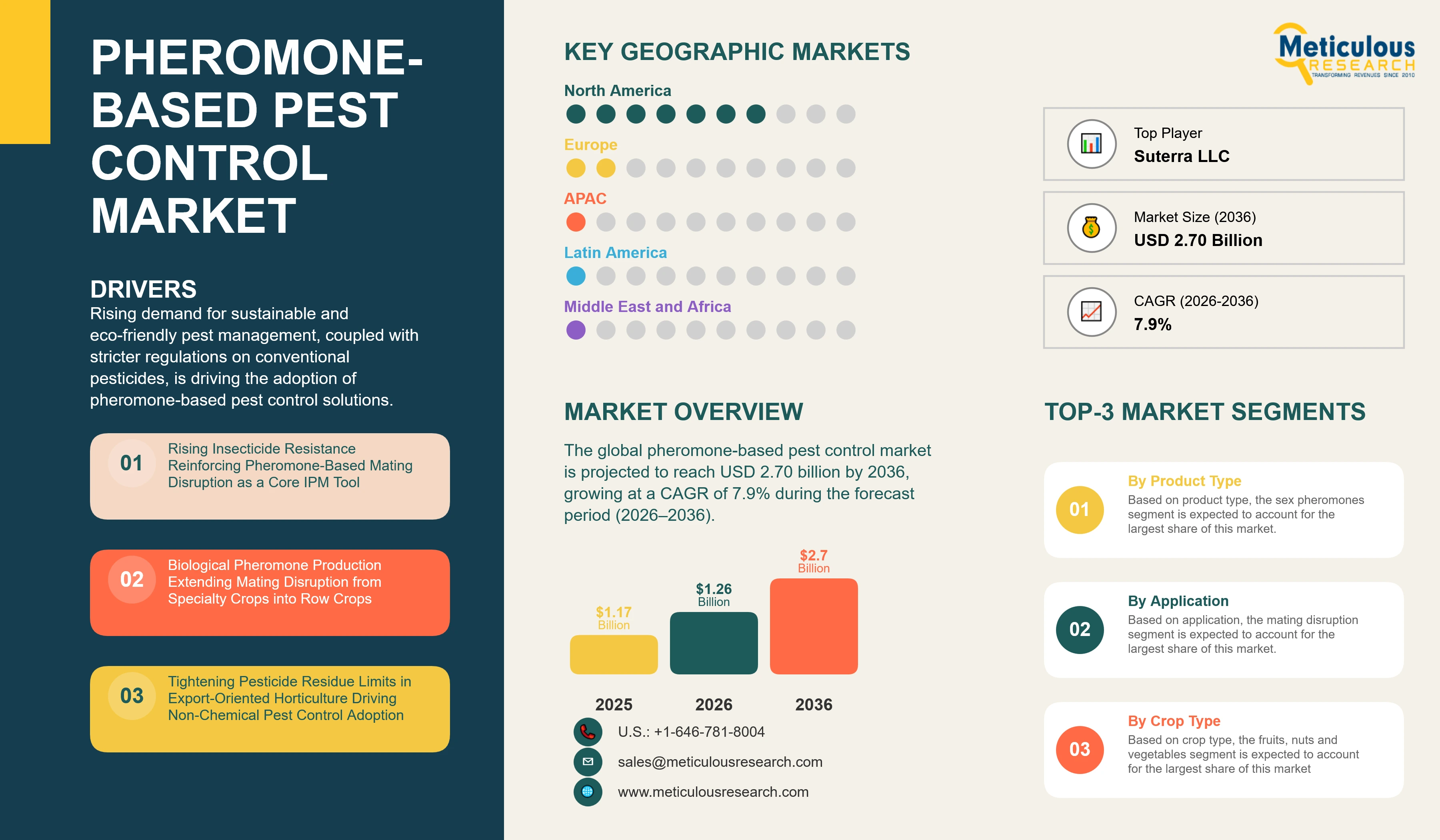
The global pheromone-based pest control market was valued at USD 1.17 billion in 2025. The market is projected to reach USD 2.70 billion by 2036, growing from USD 1.26 billion in 2026 at a CAGR of 7.9% during the forecast period (2026–2036).
Click here to: Get Free Sample Pages
The global pheromone-based pest control market comprises products that use naturally occurring or synthetically produced pheromones and related semiochemicals to modify insect behavior, disrupt mating, attract pests to traps, and suppress pest populations. The market includes sex and aggregation pheromones delivered through passive and hand-applied dispensers, aerosol and puffer systems, sprayable and microencapsulated formulations, traps, and monitoring lures. Key applications include mating disruption, mass trapping, monitoring and detection, and attract-and-kill across agricultural, forestry, stored-product, and selected public-health settings.
Pheromone-based pest management is gaining adoption as growers seek species-specific alternatives to broad-spectrum insecticides. Increasing insecticide resistance, stricter residue requirements, expansion of integrated pest management (IPM), and demand for lower-impact crop protection solutions are supporting market growth. FAO estimates that plant pests and diseases reduce global crop yields by 20% to 40% annually, while economic losses exceed USD 220 billion annually; invasive insects account for at least USD 70 billion of these losses.
Technological advances in pheromone synthesis, formulation, controlled-release dispensers, and digital monitoring are expanding applications beyond traditional high-value fruit and vineyard crops. Fermentation-based production and improved dispenser technologies are also supporting the development of scalable solutions for broader agricultural applications.
However, adoption remains constrained by the species-specific nature of pheromone products, the need for accurate pest identification, variable field longevity, weather sensitivity, and the requirement for adequate area-wide coverage for effective mating disruption. Continued integration of pheromone products with digital pest monitoring, remote trap-counting technologies, and broader IPM programs is expected to create opportunities for suppliers offering integrated pest-management solutions.
Biological Pheromone Production Extending Mating Disruption from Specialty Crops into Large-Acreage Row Crops
The shift from conventional multi-step chemical synthesis to biologically produced pheromones represents one of the most significant technology-level developments reshaping the addressable market for pheromone-based pest control. The high cost of chemical synthesis of pheromones has encouraged the development of microbial cell factories for pheromone production through fermentation of renewable feedstocks, an approach that has moved from academic research into commercial-scale manufacturing over the past several years.
FMC Corporation's acquisition of Danish biotechnology company BioPhero ApS added a yeast fermentation platform to its biologicals portfolio, with the stated goal of expanding the pheromone addressable market beyond today's focus on specialty fruit and vegetables into the large row crop market. Provivi, Inc. has similarly scaled production of its pheromone dispensers through manufacturing partnerships in Europe to serve rising demand across maize-growing regions in Latin America and Asia, and has reduced its production costs through the combined use of olefin metathesis and biocatalysis while expanding its regulatory footprint. These lower-cost production routes are the primary enabler behind pheromone-based control's expansion beyond its traditional base in tree fruit, tree nut, citrus, and vineyard applications and into commodity row crops, where per-hectare treatment economics had previously ruled out widespread mating disruption adoption.
Insecticide Resistance and Residue-Sensitive Export Markets Reinforcing Mating Disruption as a Core IPM Tool
Rising resistance to conventional insecticides among key Lepidopteran and Coleopteran pests, combined with tightening maximum residue limit requirements in major fresh produce export markets, is reinforcing pheromone-based mating disruption and monitoring as a core component of integrated pest management programs rather than a supplementary tool. Because pheromone-based mating disruption relies on the insect's own mate-location behavior rather than a toxic mode of action, target pests face substantially lower resistance-development pressure than they do against repeated insecticide applications, a characteristic that manufacturers including FMC Corporation position as a central advantage of pheromone-based row crop solutions where resistance to insecticidal traits and chemistries has become a growing management concern.
In parallel, European Union pesticide policy continues to shape demand even after the withdrawal of the proposed Sustainable Use Regulation. With the binding EU-wide chemical pesticide reduction targets no longer advancing, EU officials have indicated that future efforts will center on trade policy and accelerating the approval pathway for biopesticides rather than mandated use restrictions, a shift that favors faster market access for pheromone-based products relative to the slower path envisioned under the withdrawn regulation. Existing obligations under Directive 2009/128/EC continue to require member states to promote integrated pest management and non-chemical alternatives, sustaining a structural policy tailwind for pheromone adoption across European fruit, vegetable, and vineyard production even in the absence of new binding targets.
Digital Pest Monitoring and Remote Trap Networks Transforming Pheromone Product Deployment
The integration of digital monitoring platforms, connected traps, and remote data collection into pheromone-based pest management programs is changing both the commercial model and the field performance of mating disruption and monitoring products. Conventional pheromone trap monitoring has historically relied on manual field counts performed at fixed intervals, a labor-intensive process that limits how quickly growers can detect emerging pest pressure and adjust dispenser coverage or spray timing.
Companies such as SemiosBio Technologies Inc. have built pest management platforms around networks of remote-sensing traps and pheromone dispensers that transmit real-time pest count and environmental data to growers, allowing intervention decisions to be based on current field conditions rather than historical averages. This data-driven approach is increasingly bundled with the pheromone products themselves, shifting large commercial growers toward subscription-style service relationships that combine dispenser hardware, pheromone lures, and monitoring analytics rather than standalone product purchases. Established pheromone manufacturers are responding by expanding their own digital monitoring capabilities or partnering with monitoring technology providers, reflecting a broader industry shift toward integrated, data-supported pest management programs.
By Product Type: In 2026, the Sex Pheromones Segment to Dominate the Global Pheromone-Based Pest Control Market
Based on product type, the pheromone-based pest control market is segmented into sex pheromones, aggregation pheromones, and other semiochemicals including trail and alarm pheromones. In 2026, the sex pheromones segment is expected to account for the largest share of this market. The leading position of this segment is attributed to its established role as the primary tool for mating disruption programs targeting key Lepidopteran pests such as codling moth, navel orangeworm, oriental fruit moth, pink bollworm, and grape berry moth, where synthetic replication of the female sex pheromone floods the crop canopy and prevents males from locating mates. Suterra LLC, Trécé, Inc., and Shin-Etsu Chemical Co., Ltd. maintain some of the broadest species-specific sex pheromone product portfolios supporting this segment's continued dominance across tree fruit, tree nut, citrus, and vineyard applications.
However, the aggregation pheromones segment is projected to register the highest growth during the forecast period. The high growth of this segment is driven by expanding adoption of mass trapping and attract-and-kill programs for pests such as bark beetles, palm weevils, and coffee berry borer, where sex pheromone-based mating disruption is not effective and aggregation signals that draw both sexes to a trapping point provide a more suitable control mechanism, as well as growing use of aggregation pheromone-based monitoring in stored product protection.
By Formulation & Delivery System: In 2026, the Passive and Hand-Applied Dispensers Segment to Hold the Largest Share
Based on formulation and delivery system, the pheromone-based pest control market is segmented into passive and hand-applied dispensers, aerosol and puffer dispensers, sprayable and microencapsulated formulations, and traps and lures. In 2026, the passive and hand-applied dispensers segment is expected to account for the largest share of this market. The growth of this segment is driven by its long-established position as the standard format for mating disruption in tree fruit, tree nut, and vineyard applications, where individual dispensers are manually placed within the crop canopy at the start of the season and release pheromone at a controlled rate over several months.
However, the sprayable and microencapsulated formulations segment is projected to register the highest growth during the forecast period. The high growth of this segment is driven by the suitability of sprayable pheromone formulations for aerial and mechanized application across large-acreage row crops such as corn, soybean, and cotton, where placing individual hand-applied dispensers across thousands of hectares is not commercially practical, as well as the flexibility sprayable products offer growers to integrate pheromone application into existing spray programs alongside synthetic and biological crop protection products
By Application: In 2026, the Mating Disruption Segment to Hold the Largest Share
Based on application, the pheromone-based pest control market is segmented into mating disruption, mass trapping, monitoring and detection, and attract-and-kill. In 2026, the mating disruption segment is expected to account for the largest share of this market, reflecting its position as the most mature and widely adopted use case for pheromone-based products across permanent tree fruit and vine crops, where season-long suppression of pest reproduction is the primary management objective.
However, the mass trapping and attract-and-kill segment is projected to register the highest growth during the forecast period. The high growth of this segment is driven by rising adoption in tropical commodity crops such as cocoa, coffee, and oil palm, where labor-intensive manual scouting is otherwise impractical and pheromone-baited traps combined with an insecticidal or physical kill mechanism offer growers a more direct population reduction tool than mating disruption alone.
By Pest Type: In 2026, the Lepidoptera (Moths) Segment to Hold the Largest Share
Based on pest type, the pheromone-based pest control market is segmented into Lepidoptera, Coleoptera, Diptera, and other pests including stored product insects. In 2026, the Lepidoptera segment is expected to account for the largest share of this market, reflecting the decades-long focus of pheromone product development on economically damaging moth species across tree fruit, tree nut, cotton, and vegetable crops, where mating disruption technology is most mature and best supported by field efficacy data.
However, the Coleoptera segment is projected to register the highest growth during the forecast period. The high growth of this segment is driven by expanding aggregation pheromone-based mass trapping programs for bark beetles in forestry applications, red palm weevil and other palm-damaging beetles in tropical plantation crops, and rootworm species in row crop agriculture, where growing pest pressure and limited insecticide options are increasing grower reliance on pheromone-based monitoring and trapping.
By Crop Type: In 2026, the Fruits, Nuts and Vegetables Segment to Hold the Largest Share
Based on crop type, the pheromone-based pest control market is segmented into fruits, nuts and vegetables, row crops, forestry, stored grain and food storage, and turf, ornamental and public health applications. In 2026, the fruits, nuts and vegetables segment is expected to account for the largest share of this market, reflecting the historical concentration of pheromone-based mating disruption and monitoring programs in high-value tree fruit, tree nut, citrus, and vineyard production, where residue sensitivity and export quality requirements make non-chemical pest control particularly valuable.
However, the row crops segment is projected to register the highest growth during the forecast period. The high growth of this segment is driven by the commercial availability of lower-cost, biologically produced pheromone formulations suited to mechanized application across large-acreage corn, soybean, and cotton production, a shift that is opening a substantially larger area of cultivated farmland to pheromone-based pest control than was previously commercially viable.
Based on geography, the overall pheromone-based pest control market is segmented into North America, Europe, Asia Pacific, Latin America, and the Middle East and Africa. In 2026, North America is expected to account for the largest share of this market. This growth is driven by extensive tree fruit, tree nut, and vineyard acreage across California and the Pacific Northwest that has adopted mating disruption as a standard pest management practice over several decades, a mature grower cooperative and extension network that supports pheromone monitoring adoption, and the presence of leading pheromone manufacturers and formulators including Suterra LLC, Trécé, Inc., ISCA Technologies, Inc., Provivi, Inc., and Scentry Biologicals, Inc. that maintain domestic production and field support infrastructure.
However, the Asia Pacific pheromone-based pest control market is expected to grow at the fastest rate from 2026 to 2036. The rapid growth of this market is driven by expanding fruit, vegetable, and rice cultivation area across China, India, Japan, and Southeast Asia, tightening pesticide residue limits in horticultural produce destined for export to Europe, Japan, and North America, and government-backed integrated pest management initiatives promoting non-chemical alternatives to broad-spectrum insecticides. Shin-Etsu Chemical Co., Ltd., headquartered in Japan, maintains a particularly strong regional manufacturing and distribution presence supporting this growth, and recent distribution partnerships between semiochemical developers and established agrochemical companies targeting rice and cereal pests across Asian markets are further expanding regional product availability.
Europe represents a large and well-established market for pheromone-based pest control, supported by a regulatory environment that continues to promote integrated pest management under Directive 2009/128/EC even following the withdrawal of the proposed Sustainable Use Regulation, alongside a dense concentration of residue-sensitive tree fruit, vineyard, and vegetable production. European manufacturers including Russell IPM Ltd., Pherobank B.V., Koppert B.V., Biobest Group NV, and International Pheromone Systems Ltd. maintain strong positions in their home markets, supported by close integration with the region's biological crop protection distribution networks.
The Middle East and Africa region represents a growing market for pheromone-based pest control, driven primarily by mass trapping and monitoring programs for red palm weevil in date palm cultivation and expanding integrated pest management adoption in North African and Gulf horticultural exports. The Latin America market is supported primarily by tree fruit and row crop pest management across Brazil, Mexico, Chile, and Argentina, alongside growing biological crop protection investment from global manufacturers expanding their regional manufacturing footprint.
The global pheromone-based pest control market is moderately consolidated, with competition primarily driven by species-specific product breadth, dispenser field longevity and controlled-release engineering, pheromone synthesis and production cost efficiency, regulatory registration coverage across target geographies, and the strength of grower-facing technical and agronomic support. Key differentiators among leading manufacturers include the depth of species-specific pheromone libraries covering economically important pest complexes, proprietary controlled-release dispenser technologies, the scale and cost efficiency of pheromone production processes, and the extent of integration with broader biological crop protection or digital pest monitoring offerings.
Large specialized pheromone manufacturers such as Suterra LLC and Trécé, Inc. compete through extensive species-specific product portfolios spanning mating disruption, monitoring, and detection formats, deep field-level agronomic support, and long-standing grower relationships built over several decades of dedicated pheromone product development. Diversified crop protection companies including FMC Corporation and BASF SE compete through the integration of pheromone technologies into broader biologicals and crop protection portfolios, supported by proprietary biosynthesis platforms and established global commercial and regulatory infrastructure. Innovation-focused developers including Provivi, Inc. and ISCA Technologies, Inc. compete through advanced pheromone production and formulation technologies aimed at extending pheromone-based control into new crop and pest segments. Digital-first providers such as SemiosBio Technologies Inc. compete by combining pheromone dispensers with remote pest monitoring platforms, while biological crop protection networks including Koppert B.V. and Biobest Group NV compete by offering pheromones alongside beneficial insects and other biocontrol agents as part of integrated programs. Regionally focused manufacturers including Russell IPM Ltd., Pherobank B.V., International Pheromone Systems Ltd., and Scentry Biologicals, Inc. maintain competitive positions through customized species-specific product development and close regional distribution relationships, while Bedoukian Research, Inc. supports the broader industry through specialized pheromone compound synthesis and manufacturing.
The report provides a comprehensive competitive analysis based on an assessment of key players' product portfolios, geographic presence, and strategic initiatives undertaken over the past few years.
Some of the key players operating in the global pheromone-based pest control market include Suterra LLC (U.S.), Trécé, Inc. (U.S.), Shin-Etsu Chemical Co., Ltd. (Japan), BASF SE (Germany), Russell IPM Ltd. (U.K.), ISCA Technologies, Inc. (U.S.), Provivi, Inc. (U.S.), SemiosBIO Technologies Inc. (Canada), M2i Group (France), Pherobank B.V. (Netherlands), Koppert B.V. (Netherlands), Biobest Group NV (Belgium), Bedoukian Research, Inc. (U.S.), Hercon Environmental (U.S.), and Scentry Biologicals, Inc. (U.S.), among others.
|
Parameters |
Details |
|
Market Size by 2036 |
USD 2.70 Billion |
|
Market Size in 2026 |
USD 1.26 Billion |
|
Market Size in 2025 |
USD 1.17 Billion |
|
Revenue Growth Rate (2026–2036) |
CAGR of 7.9% |
|
Dominating Product Type |
Sex Pheromones |
|
Fastest Growing Product Type |
Aggregation Pheromones |
|
Dominating Formulation |
Passive and Hand-Applied Dispensers |
|
Fastest Growing Formulation |
Sprayable and Microencapsulated Formulations |
|
Dominating Application |
Mating Disruption |
|
Fastest Growing Application |
Mass Trapping and Attract-and-Kill |
|
Dominating Pest Type |
Lepidoptera (Moths) |
|
Fastest Growing Pest Type |
Coleoptera (Beetles) |
|
Dominating Crop Type |
Fruits, Nuts and Vegetables |
|
Fastest Growing Crop Type |
Row Crops |
|
Dominating Geography |
North America |
|
Fastest Growing Geography |
Asia Pacific |
|
Base Year |
2025 |
|
Forecast Period |
2026 to 2036 |
The global pheromone-based pest control market is expected to reach USD 9.1 billion by 2036 from an estimated USD 3.7 billion in 2026, at a CAGR of 9.4% during the forecast period 2026–2036.
In 2026, the sex pheromones segment is expected to hold the largest share of this market, driven by its established role in mating disruption programs targeting major Lepidopteran pests across tree fruit, tree nut, and vineyard crops.
The aggregation pheromones segment is expected to register the highest CAGR during the forecast period 2026–2036, driven by expanding mass trapping adoption for bark beetles, palm weevils, and stored product pests.
In 2026, the passive and hand-applied dispensers segment is expected to hold the largest share of this market, reflecting its established position as the standard mating disruption format in tree fruit, tree nut, and vineyard applications.
In 2026, the fruits, nuts and vegetables segment is expected to hold the largest share of this market, reflecting the historical concentration of pheromone-based programs in high-value, residue-sensitive specialty crop production.
North America is expected to account for the largest share of the global pheromone-based pest control market in 2026, driven by extensive specialty crop acreage under established mating disruption programs and the presence of leading domestic pheromone manufacturers.
The growth of this market is primarily driven by rising insecticide resistance among key pest populations, tightening pesticide residue limits in export horticulture, continued integrated pest management adoption under EU Directive 2009/128/EC and comparable programs in other regions, advances in lower-cost biological pheromone production extending mating disruption into row crops, and growing integration of digital pest monitoring with pheromone dispenser networks.
Key players in the global pheromone-based pest control market include Suterra LLC (U.S.), Trécé, Inc. (U.S.), Shin-Etsu Chemical Co., Ltd. (Japan), FMC Corporation (U.S.), BASF SE (Germany), Russell IPM Ltd. (U.K.), ISCA Technologies, Inc. (U.S.), Provivi, Inc. (U.S.), SemiosBio Technologies Inc. (Canada), Pherobank B.V. (Netherlands), Koppert B.V. (Netherlands), Biobest Group NV (Belgium), Bedoukian Research, Inc. (U.S.), International Pheromone Systems Ltd. (U.K.), and Scentry Biologicals, Inc. (U.S.).
Asia Pacific is expected to register the highest growth rate in the global pheromone-based pest control market during the forecast period 2026–2036, driven by expanding fruit, vegetable, and rice cultivation area, tightening export residue requirements, and government-backed integrated pest management programs across China, India, Japan, and Southeast Asia.
1. Introduction
1.1 Market Definition and Scope
1.2 Market Ecosystem
1.3 Currency and Limitations
1.3.1 Currency
1.3.2 Limitations
1.4 Key Stakeholders
2. Research Methodology
2.1 Research Approach
2.2 Data Collection & Validation Process
2.2.1 Secondary Research
2.2.2 Primary Research & Validation
2.2.2.1 Primary Interviews with Experts
2.2.2.2 Country-/Region-Level Analysis
2.3 Market Estimation
2.3.1 Bottom-Up Approach
2.3.2 Top-Down Approach
2.4 Data Triangulation
2.5 Assumptions for the Study
3. Executive Summary
3.1 Market Overview
3.2 Market Analysis by Product Type
3.3 Market Analysis by Formulation & Delivery System
3.4 Market Analysis by Application
3.5 Market Analysis by Pest Type
3.6 Market Analysis by Crop Type
3.7 Market Analysis by Geography
4. Market Dynamics
4.1 Overview
4.2 Drivers
4.2.1 Rising Insecticide Resistance Reinforcing Pheromone-Based Mating Disruption as a Core IPM Tool
4.2.2 Biological Pheromone Production Extending Mating Disruption from Specialty Crops into Row Crops
4.2.3 Tightening Pesticide Residue Limits in Export-Oriented Horticulture Driving Non-Chemical Pest Control Adoption
4.2.4 Integration of Digital Pest Monitoring with Pheromone Dispenser Networks Improving Program Economics
4.3 Restraints
4.3.1 Species-Specific Formulation Requirements Limiting Broad-Spectrum Convenience Relative to Conventional Insecticides
4.3.2 Field Longevity, Weather Sensitivity and Area-Wide Coverage Requirements Constraining Standalone Adoption Among Small Growers
4.4 Opportunities
4.4.1 Lower-Cost Fermentation-Based Pheromone Production Opening Large-Acreage Row Crop Segments
4.4.2 EU Policy Shift Toward Accelerated Biopesticide Approvals Following Withdrawal of the Sustainable Use Regulation
4.4.3 Expansion of Mass Trapping and Attract-and-Kill Programs in Tropical Commodity Crops
4.5 Challenges
4.5.1 Accurate Pest Identification and Timing Requirements Complicating Product Selection and Deployment
4.5.2 Regulatory Registration Timelines for New Semiochemical Active Ingredients Across Emerging Markets
4.6 Porter's Five Forces Analysis
5. Pheromone-Based Pest Control Market, by Product Type
5.1 Overview
5.2 Sex Pheromones
5.3 Aggregation Pheromones
5.4 Other Semiochemicals (Trail and Alarm Pheromones)
6. Pheromone-Based Pest Control Market, by Formulation & Delivery System
6.1 Overview
6.2 Passive and Hand-Applied Dispensers
6.3 Aerosol and Puffer Dispensers
6.4 Sprayable and Microencapsulated Formulations
6.5 Traps and Lures
7. Pheromone-Based Pest Control Market, by Application
7.1 Overview
7.2 Mating Disruption
7.3 Mass Trapping
7.4 Monitoring and Detection
7.5 Attract-and-Kill
8. Pheromone-Based Pest Control Market, by Pest Type
8.1 Overview
8.2 Lepidoptera (Moths)
8.3 Coleoptera (Beetles)
8.4 Diptera (Flies)
8.5 Other Pests (Stored Product Insects and Others)
9. Pheromone-Based Pest Control Market, by Crop Type
9.1 Overview
9.2 Fruits, Nuts and Vegetables
9.3 Row Crops (Corn, Soybean, Cotton)
9.4 Forestry
9.5 Stored Grain and Food Storage
9.6 Turf, Ornamental and Public Health
10. Pheromone-Based Pest Control Market, by Geography
10.1 Overview
10.2 North America
10.2.1 U.S.
10.2.2 Canada
10.3 Europe
10.3.1 Germany
10.3.2 U.K.
10.3.3 France
10.3.4 Italy
10.3.5 Spain
10.3.6 Netherlands
10.3.7 Rest of Europe
10.4 Asia Pacific
10.4.1 China
10.4.2 Japan
10.4.3 India
10.4.4 South Korea
10.4.5 Australia
10.4.6 Southeast Asia
10.4.7 Rest of Asia Pacific
10.5 Latin America
10.5.1 Brazil
10.5.2 Mexico
10.5.3 Chile
10.5.4 Rest of Latin America
10.6 Middle East and Africa
10.6.1 Saudi Arabia
10.6.2 UAE
10.6.3 South Africa
10.6.4 Rest of Middle East and Africa
11. Competitive Landscape
11.1 Overview
11.2 Key Growth Strategies
11.3 Competitive Benchmarking
11.4 Competitive Dashboard
11.4.1 Industry Leaders
11.4.2 Market Differentiators
11.4.3 Vanguards
11.4.4 Emerging Companies
11.5 Market Share/Ranking Analysis (2025)
12. Company Profiles
12.1 Suterra LLC
12.2 Trécé, Inc.
12.3 Shin-Etsu Chemical Co., Ltd.
12.4 BASF SE
12.5 Russell IPM Ltd.
12.6 ISCA Technologies, Inc.
12.7 Provivi, Inc.
12.8 SemiosBIO Technologies Inc.
12.9 M2i Group
12.10 Pherobank B.V.
12.11 Koppert B.V.
12.12 Biobest Group NV
12.13 Bedoukian Research, Inc.
12.14 Hercon Environmental
12.15 Scentry Biologicals, Inc.
13. Appendix
13.1 Questionnaire
13.2 Available Customization Options
13.3 Related Reports
























Published Date: Jul-2023
Published Date: Mar-2025
Subscribe to get the latest industry updates