Resources
About Us
Optoelectronics Market by LED, Image Sensors, Infrared, Optocouplers, Photovoltaics & Displays | GaN, GaAs, SiC Materials | Automotive, Consumer Electronics & Telecom Applications – Global Trends & Forecast to 2036
Report ID: MRSE - 104457 Pages: 312 Feb-2026 Formats*: PDF Category: Semiconductor and Electronics Delivery: 24 to 48 Hours Download Free Sample Report
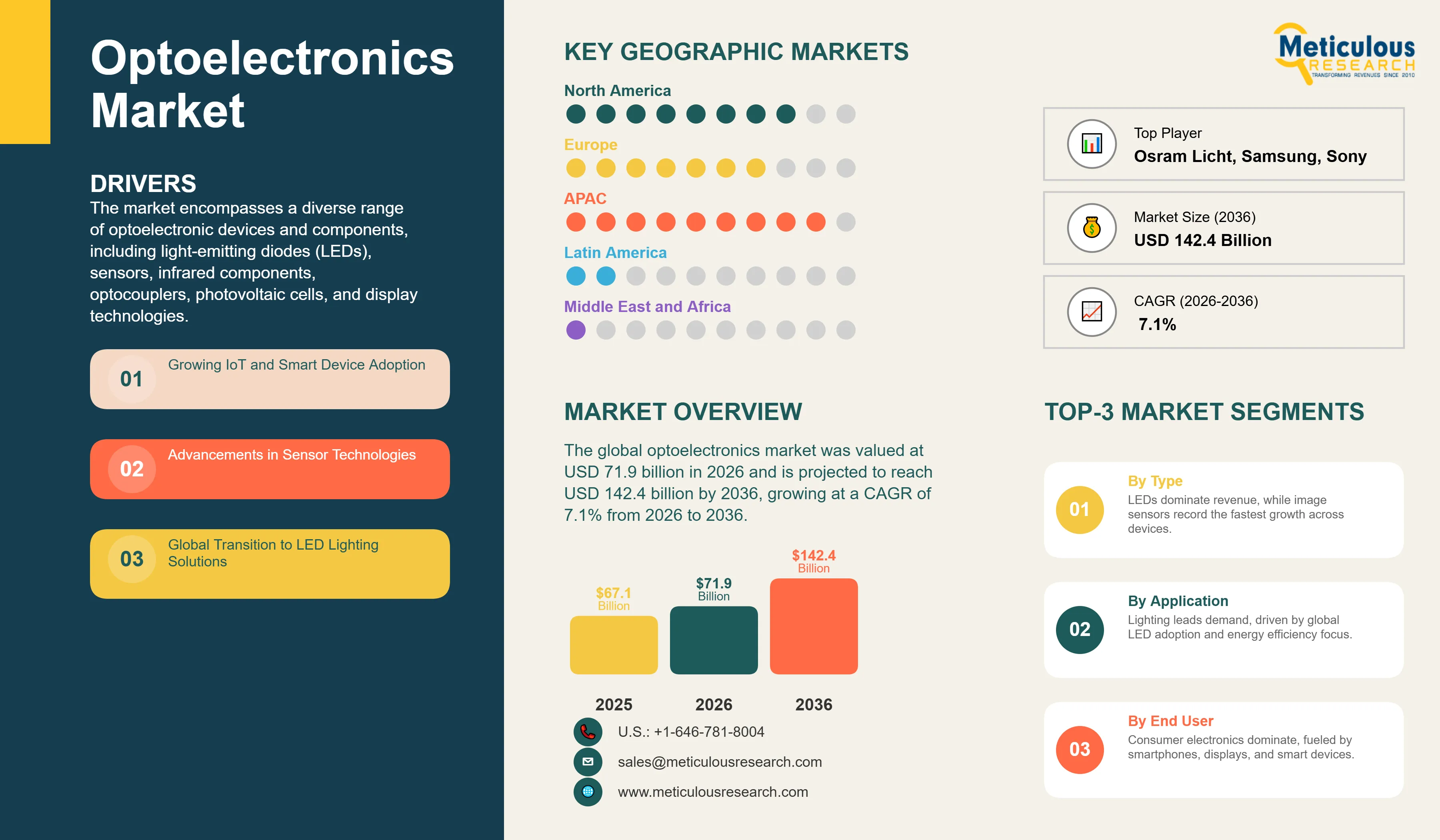
The global optoelectronics market was valued at USD 71.9 billion in 2026 and is expected to reach USD 142.4 billion by 2036, growing at a CAGR of 7.1% from 2026 to 2036. The market encompasses a diverse range of optoelectronic devices and components, including light-emitting diodes (LEDs), sensors, infrared components, optocouplers, photovoltaic cells, and display technologies. The growth of the optoelectronics market is driven by the increasing adoption of LED lighting solutions, rising demand for advanced sensor technologies in automotive and consumer electronics applications, and the proliferation of Internet of Things (IoT) devices. Additionally, the growing emphasis on energy-efficient lighting solutions and the expansion of 5G communication infrastructure are expected to support market expansion throughout the forecast period.
 Click here to: Get Free Sample Pages of this Report
The global optoelectronics market has experienced significant evolution over the past decade, driven by technological advancements, changing consumer preferences, and the emergence of new applications across diverse industries.
Optoelectronic devices are fundamental components in modern electronics, enabling applications ranging from simple indicator lights to sophisticated imaging systems and high-speed communication networks. The market includes established manufacturers such as Sony Corporation, Samsung Electronics Co., Ltd., Osram Licht AG, Renesas Electronics Corporation, Hamamatsu Photonics K.K., and ROHM Co., Ltd., alongside emerging specialized manufacturers focusing on specific device categories and applications.
The transition from traditional incandescent and fluorescent lighting to LED-based solutions has been one of the most significant market drivers. LEDs offer superior energy efficiency, longer operational lifespan, and greater design flexibility compared to conventional lighting technologies. This shift has created substantial demand for LED devices across residential, commercial, and industrial lighting applications. Furthermore, the integration of advanced sensors and imaging technologies into consumer electronics, automotive systems, and industrial automation equipment has expanded the addressable market for optoelectronic components. The development of high-performance image sensors, particularly CMOS sensors, has revolutionized smartphone cameras and enabled advanced driver-assistance systems (ADAS) in vehicles.
What are the Key Trends in the Optoelectronics Market?
Advancement in LED Technology and Miniaturization
The optoelectronics market is witnessing rapid advancement in LED technology, characterized by improvements in luminous efficiency, color rendering, and miniaturization. High-brightness LEDs (HB-LEDs) have become increasingly prevalent in applications requiring intense illumination, such as automotive headlights and industrial lighting. The development of micro-LEDs and mini-LEDs is enabling new applications in display technologies, including high-resolution screens for consumer electronics and advanced visualization systems. Additionally, the integration of ultraviolet (UV) LEDs is expanding into disinfection applications, water purification, and medical diagnostics. Manufacturers including Nichia Corporation, Cree/Wolfspeed, and Samsung Electronics are investing heavily in LED innovation to maintain competitive advantage. The trend toward miniaturization and enhanced performance is expected to continue, creating opportunities for manufacturers capable of developing cutting-edge LED solutions.
Integration of Advanced Sensor Technologies in IoT and Smart Devices
The proliferation of Internet of Things (IoT) devices and smart electronics is driving significant demand for advanced optoelectronic sensors. Image sensors, particularly CMOS sensors, are becoming increasingly sophisticated, with higher resolution, improved low-light performance, and integrated processing capabilities. The adoption of 3D sensing technologies for facial recognition, gesture control, and depth mapping is expanding the application scope of optoelectronic sensors. Infrared sensors are experiencing growing demand in thermal imaging, motion detection, and non-contact temperature measurement applications. The integration of optical sensors in autonomous vehicles for object detection and navigation is creating substantial market opportunities. Companies such as Sony Corporation, Samsung Electronics, and OmniVision Technologies are developing next-generation sensor solutions to address emerging market demands. The convergence of sensor technology with artificial intelligence and machine learning is expected to drive further innovation and market expansion.
|
Parameters |
Details |
|
Market Size by 2036 |
USD 142.4 Billion |
|
Market Size in 2026 |
USD 71.9 Billion |
|
Revenue Growth Rate (2026-2036) |
CAGR of 7.1% |
|
Dominating Device Type |
LEDs |
|
Fastest Growing Sensor Type |
Image Sensors |
|
Largest Application Segment |
Lighting |
|
Dominant End-User Segment |
Consumer Electronics |
|
Leading Geographic Region |
Asia-Pacific |
|
Base Year |
2025 |
|
Forecast Period |
2026 to 2036 |
Drivers: LED Adoption and Sensor Technology Expansion
The primary drivers of the optoelectronics market include the global transition toward LED-based lighting solutions and the expanding adoption of advanced sensor technologies. The superior energy efficiency of LEDs compared to traditional lighting sources is driving widespread adoption in residential, commercial, and industrial applications. Government regulations promoting energy-efficient lighting, combined with declining LED prices, are accelerating market penetration. The increasing demand for advanced imaging and sensing capabilities in consumer electronics, automotive systems, and industrial automation is fueling growth in the sensor segment. The proliferation of IoT devices and smart electronics is creating sustained demand for optical sensors and components. Additionally, the expansion of 5G communication infrastructure is driving demand for optoelectronic components used in high-speed data transmission.
Opportunity: Emerging Applications and Technological Innovation
The optoelectronics market presents substantial opportunities through emerging applications and continuous technological innovation. The development of advanced display technologies, including micro-LEDs and mini-LEDs, is creating new market segments with significant growth potential. The expansion of UV LED applications in disinfection, sterilization, and medical diagnostics is opening new revenue streams. The integration of 3D sensing technologies in consumer devices and automotive applications is driving demand for sophisticated optoelectronic components. The growing adoption of autonomous vehicles is creating opportunities for advanced imaging and sensing solutions. Additionally, the development of organic light-emitting diodes (OLEDs) for flexible displays and wearable electronics represents a significant growth opportunity. Manufacturers investing in research and development to address these emerging applications are well-positioned to capture market share.
Why Do LEDs Dominate the Market?
Light-emitting diodes (LEDs) represent the largest device segment in the optoelectronics market, driven by their widespread adoption across lighting applications. The superior energy efficiency of LEDs, which consume significantly less power than traditional incandescent and fluorescent lighting, has made them the preferred choice for lighting applications globally. The declining cost of LED technology, combined with improving luminous efficiency and color quality, has accelerated market adoption. LEDs are utilized in diverse applications, including general illumination, automotive lighting, display backlighting, and indicator lights. The development of high-brightness LEDs and specialty LEDs (UV, infrared) has expanded the addressable market. Major manufacturers including Nichia Corporation, Cree/Wolfspeed, and Samsung Electronics have established strong market positions through continuous innovation and product development.
How Are Image Sensors Driving Growth?
Image sensors represent the fastest-growing device segment within the optoelectronics market. The proliferation of smartphones with advanced camera systems has created substantial demand for high-performance image sensors. CMOS image sensors have become the dominant technology due to their superior performance, lower power consumption, and integration capabilities. The adoption of advanced imaging technologies in automotive applications, particularly for driver-assistance systems and autonomous vehicles, is driving significant growth. The expansion of 3D sensing technologies for facial recognition and gesture control in consumer devices is creating new market opportunities. Manufacturers such as Sony Corporation, Samsung Electronics, and OmniVision Technologies are investing heavily in image sensor development to address emerging market demands.
Why Does Lighting Lead the Market?
Lighting is the largest application segment for optoelectronic devices, driven by the global transition from traditional lighting sources to LED-based solutions. The energy efficiency benefits of LED lighting, combined with government regulations promoting energy conservation, have accelerated market adoption. LED lighting is utilized in residential buildings, commercial facilities, industrial plants, and outdoor applications. The development of connected lighting systems, which integrate LEDs with smart controls and IoT capabilities, is creating new market opportunities. The expansion of human-centric lighting, which adjusts color temperature and intensity to optimize circadian rhythms, represents an emerging application trend. The declining cost of LED components and the increasing availability of diverse color options have further expanded the addressable market for lighting applications.
What Are Emerging Application Areas?
Emerging applications of optoelectronic devices are expanding beyond traditional lighting and imaging. The adoption of UV LEDs in disinfection and sterilization applications has gained significant momentum, particularly following the COVID-19 pandemic. Infrared optoelectronic components are increasingly utilized in thermal imaging, non-contact temperature measurement, and motion detection applications. The integration of optical sensors in autonomous vehicles for object detection and navigation is creating substantial demand. The development of advanced medical diagnostic and therapeutic applications utilizing optoelectronic technologies is opening new market segments. Additionally, the expansion of Li-Fi (light fidelity) technology for high-speed wireless communication represents a potential future growth area.
How Does Consumer Electronics Lead the Market?
Consumer electronics represents the largest end-user segment for optoelectronic devices, driven by the proliferation of smartphones, tablets, laptops, and other personal electronic devices. The integration of advanced image sensors in smartphone cameras has become a key differentiator in the competitive consumer electronics market. Display technologies, including LED backlighting and OLED displays, are essential components in consumer electronics products. The adoption of 3D sensing technologies for facial recognition and gesture control in consumer devices is driving demand for sophisticated optoelectronic components. The expansion of wearable electronics, including smartwatches and fitness trackers, is creating new opportunities for miniaturized optoelectronic devices. Major consumer electronics manufacturers are continuously investing in optoelectronic technology to enhance product performance and user experience.
How is Automotive Experiencing Rapid Growth?
The automotive industry is experiencing rapid growth in optoelectronic device adoption, driven by the advancement of driver-assistance systems and the development of autonomous vehicles. LED lighting technologies are increasingly utilized in automotive headlights, tail lights, and interior lighting applications. Advanced image sensors are essential components in camera-based driver-assistance systems, enabling features such as lane departure warning and collision avoidance. Infrared sensors are utilized in night vision systems and occupant detection applications. The integration of LiDAR technology, which relies on optoelectronic components, is critical for autonomous vehicle navigation and object detection. The expansion of vehicle electrification is creating opportunities for optoelectronic components used in battery management and power distribution systems.
How Does Asia-Pacific Maintain Its Leadership in the Global Optoelectronics Market?
Asia-Pacific is expected to hold the largest market share for optoelectronics, driven by the dominance of this region in semiconductor manufacturing and the rapid growth of consumer electronics markets. China has emerged as a major manufacturing hub for optoelectronic devices, with numerous companies producing LEDs, sensors, and other components at scale. Japan remains a leader in advanced optoelectronic technology development, with companies such as Sony Corporation, Hamamatsu Photonics, and Nichia Corporation driving innovation. South Korea is a significant player in the optoelectronics market, with Samsung Electronics and other manufacturers producing high-performance devices. India is experiencing rapid growth in optoelectronics adoption, driven by the expansion of consumer electronics manufacturing and increasing demand for LED lighting solutions. The key companies operating in the Asia-Pacific optoelectronics market are Sony Corporation, Samsung Electronics, Hamamatsu Photonics K.K., Nichia Corporation, and various Chinese manufacturers.
Which Regions Are Experiencing Steady Growth?
North America and Europe are projected to experience steady growth in the optoelectronics market, driven by the adoption of advanced lighting and sensing technologies. North America is characterized by strong demand for energy-efficient lighting solutions and advanced automotive technologies. The focus of this region on research and development has resulted in significant innovations in optoelectronic device design and manufacturing. Europe is experiencing growth driven by stringent energy efficiency regulations and the adoption of smart lighting systems. The expansion of renewable energy applications is creating demand for optoelectronic components used in solar cells and power conversion systems. Latin America and the Middle East & Africa are emerging markets with growing demand for optoelectronic devices, driven by infrastructure development and increasing adoption of consumer electronics.
The key players profiled in the global optoelectronics market report include Sony Corporation, Samsung Electronics Co., Ltd., Osram Licht AG, Renesas Electronics Corporation, Hamamatsu Photonics K.K., ROHM Co., Ltd., Vishay Intertechnology, Inc., Panasonic Corporation, Nichia Corporation, and Cree/Wolfspeed, Inc., among others.
The global optoelectronics market is valued at USD 71.9 billion in 2026 and is expected to reach approximately USD 142.4 billion by 2036.
The market is expected to grow at a CAGR of 7.1% from 2026 to 2036.
The key players include Sony Corporation, Samsung Electronics Co., Ltd., Osram Licht AG, Renesas Electronics Corporation, Hamamatsu Photonics K.K., and ROHM Co., Ltd.
The main factors include the global transition to LED lighting, advancement in sensor technologies, growing IoT adoption, expansion of 5G infrastructure, and increasing demand for advanced automotive technologies.
Asia-Pacific is expected to maintain leadership, while North America and Europe are projected to experience steady growth during the forecast period.
























Published Date: Oct-2025
Published Date: Aug-2026
Please enter your corporate email id here to view sample report.
Subscribe to get the latest industry updates


