
Industrial Cable Management Systems Market (2026-2036)
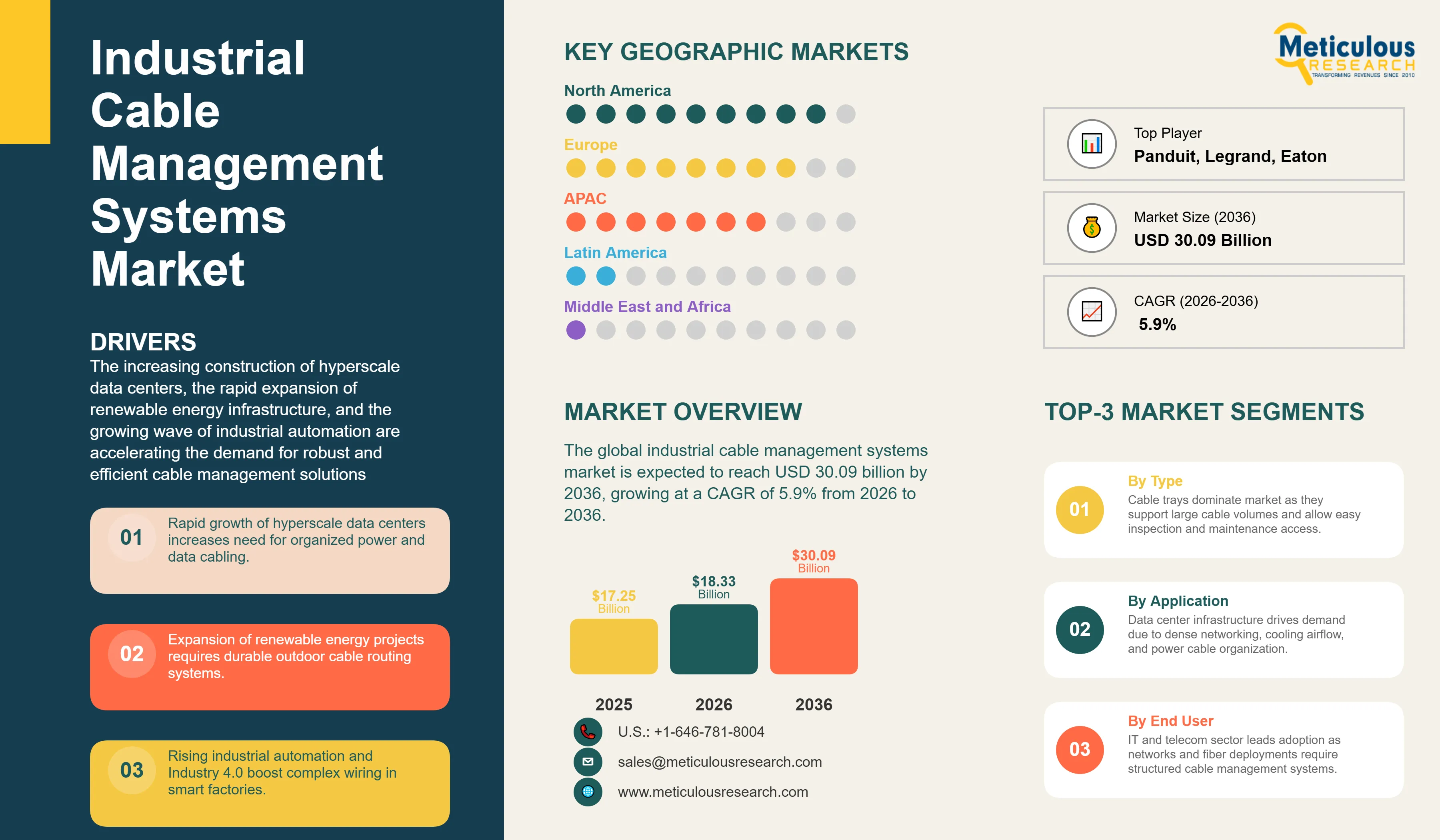
The global industrial cable management systems market size was valued at USD 17.25 billion in 2025. This market is expected to reach USD 30.09 billion by 2036 from USD 18.33 billion in 2026, growing at a CAGR of 5.9% from 2026 to 2036.
- Published
- Feb 2026
- Pages
- 234
- Format
- PDF + Excel
- Report ID
- MR-1773
- Base year
- 2025
- 2025 · BASELINE
- $17.25B
- 2036
- $30.09B
- CAGR 2026–2036
- 5.9%
2025 baseline · 2026–2036 forecast at 5.9% CAGR · hover a bar for the value
Key highlights
In terms of revenue, the global industrial cable management systems market is valued at USD 18.33 billion in 2026 and is projected to reach USD 30.09 billion by 2036.
The market is expected to grow at a CAGR of 5.9% from 2026 to 2036.
North America dominates the global industrial cable management systems market with the largest market share of 35-40% in 2026.
Asia-Pacific is expected to witness the fastest CAGR during the forecast period.
By product, the Cable Trays segment holds the largest market share of 30-35% in 2026.
By product, the Cable Connectors and Glands segment is expected to witness the fastest CAGR during the forecast period.
By end-user, the IT and Telecommunications segment contributes the highest market share in 2026.
By end-user, the Data Centers sub-segment is expected to witness the fastest CAGR during the forecast period.
Report summary
| Particulars | Details |
|---|---|
| Report Coverage | Details |
| Market Size by 2036 | USD 30.09 Billion |
| Market Size in 2026 | USD 18.33 Billion |
| Market Growth Rate from 2026 to 2036 | CAGR of 5.9% |
| Format | PDF, Excel & Cloud Portal · 234 pages |
| Dominating Region | North America |
| Fastest Growing Region | Asia-Pacific |
| Base Year | 2025 |
| Forecast Period | 2026 to 2036 |
| Segments Covered | Product, Material, End-User, and Geography |
| Regions Covered | North America, Europe, Asia-Pacific, Latin America, and Middle East & Africa |
Report overview
Segments covered: product, material, end-user.
The increasing construction of hyperscale data centers, the rapid expansion of renewable energy infrastructure, and the growing wave of industrial automation are accelerating the demand for robust and efficient cable management solutions across IT & telecommunications, manufacturing, energy, and commercial construction sectors worldwide.
The industrial cable management systems are critical for ensuring operational safety, simplifying maintenance, and maintaining the integrity of power and communication networks. The market includes a diverse range of products such as cable trays, conduits, raceways, cable glands, connectors, and cable carriers, which are manufactured from materials like steel, aluminum, and various polymers (metallic and non-metallic) to suit different environmental conditions and load requirements.
The market is mainly driven by the global expansion of industrial infrastructure, including manufacturing plants, power generation facilities, and data centers. The relentless growth in data consumption fuels the construction of hyperscale data centers, which require extensive and highly organized cable management to handle high-density networking. Similarly, the global transition to renewable energy sources necessitates sophisticated cable management for solar farms and wind turbines. Industrial automation and the adoption of Industry 4.0 principles further propel demand, as factories integrate more robotics, sensors, and connected devices, leading to a more complex cabling infrastructure that must be managed effectively.
Technology is reshaping the industrial cable management market through the integration of smart capabilities, the use of advanced materials, and the adoption of modular designs. Innovations include the embedding of RFID tags and sensors into cable trays and connectors, which enable real-time asset tracking, temperature monitoring, and predictive maintenance alerts. This intelligence helps prevent downtime by identifying potential issues before they lead to failures.
The development of halogen-free, flame-retardant polymers and fiber-reinforced plastics (FRP) is leading to safer, lighter, and more durable cable management products that offer superior corrosion resistance, making them ideal for harsh industrial environments. For instance, Panduit Corp. and HellermannTyton offer solutions made from advanced polymers that meet stringent safety standards.
Modular and pre-fabricated systems are also gaining traction, significantly reducing installation time and labor costs on-site. Companies like Legrand and Schneider Electric are pioneering click-and-connect systems that simplify assembly and allow for greater design flexibility, making these solutions more efficient and adaptable to the evolving needs of modern industrial facilities.
A major trend is the focus on solutions designed for high-density data center environments. As server racks become more powerful and compact, the volume of power and data cabling increases exponentially. This creates significant challenges for airflow and thermal management. In response, manufacturers are developing specialized cable trays with better ventilation, vertical cable managers that optimize rack space, and liquid cooling-compatible pathways. For example, nVent Electric plc offers targeted solutions that improve airflow dynamics around high-density cabling, which is critical for preventing overheating and ensuring the reliability of data center operations.
There is a growing trend towards the adoption of sustainable and environmentally friendly cable management solutions. This is driven by corporate sustainability goals and stricter environmental regulations, such as the EU's Construction Products Regulation (CPR). Manufacturers are increasingly using recycled materials and developing products made from halogen-free, low-smoke polymers that are less toxic in the event of a fire. This shift not only helps companies meet their environmental targets but also enhances safety in industrial and commercial buildings.
Report infographic
Market dynamics
3 factors across 3 forcesProliferation of Data Centers and Growth in Digital Infrastructure
The primary driver for the industrial cable management market is the exponential growth in data generation and consumption, which is fueling the construction of hyperscale data centers and the expansion of digital infrastructure globally. These facilities require vast and complex networks of power and data cables to support servers, storage, and networking equipment. Effective cable management is essential to ensure optimal performance, facilitate maintenance, and manage airflow for cooling. The continuous demand for cloud computing, big data analytics, and IoT services is driving sustained investment in data center construction, creating a massive and ongoing demand for cable trays, raceways, and high-density connectors.
Table of contents
12 chapters · 127 sections · 234 pages · click to expandSegmental analysis
| Segment | Largest share (2026) | Fastest growth (2026–2036) |
|---|---|---|
| By Product | Cable trays | Cable Connectors and Glands |
| By End-User | IT and Telecommunications Sector | Simultaneously, the data centers |
By Product
- The cable trays segment holds the largest share of the industrial cable management market in 2026.
- This is because cable trays offer a highly versatile, scalable, and cost-effective solution for supporting large volumes of cables in a wide variety of industrial and commercial applications.
- They provide excellent ventilation, which is crucial for preventing the derating of cables, and their open design simplifies the installation, inspection, and maintenance of cabling systems.
- The availability of different types of trays, such as ladder, perforated, and wire mesh, in various materials allows them to be adapted to different load requirements and environmental conditions, making them the go-to solution for everything from data centers to heavy industrial plants.
By End-User
- The IT and Telecommunications sector is the largest end-user of industrial cable management systems, accounting for the highest market share in 2026.
- This is driven by the continuous expansion of communication networks, including fiber optic infrastructure and 5G mobile networks, as well as the relentless growth of data centers.
- Telecom providers and data center operators are constantly upgrading and expanding their infrastructure to meet the growing demand for high-speed data services.
- This involves the deployment of massive quantities of fiber optic and copper cables, all of which require systematic and organized management to ensure network reliability and performance.
- The high-density nature of these environments makes effective cable management an absolute necessity.
- Simultaneously, the data centers sub-segment is projected to grow at the fastest CAGR during the forecast period.
- The rise of artificial intelligence, cloud computing, and big data is fueling a global boom in the construction of hyperscale data centers.
- These facilities have an insatiable appetite for power and connectivity, leading to unprecedented cabling densities.
- The need to manage thousands of cables per rack while ensuring adequate cooling and accessibility is driving innovation in specialized cable management products, such as high-capacity vertical managers and airflow-optimized trays, creating a high-growth market for suppliers.
- The industrial cable management systems market in Asia-Pacific is poised to grow at the fastest CAGR from 2026 to 2036.
- This rapid growth is fueled by strong economic development, rapid urbanization, and massive government-led investments in infrastructure across the region.
- Countries like China, India, and Southeast Asian nations are experiencing a manufacturing boom and are heavily investing in industrial automation, smart cities, and transportation networks.
- The proliferation of data centers to serve the region's massive and growing internet population is another key factor.
- Furthermore, the increasing adoption of renewable energy, particularly solar power, in countries like China and India, is creating significant demand for specialized outdoor cable management solutions.
Geographic analysis
North America
Largest shareThe U.S. industrial cable management systems market is projected to be worth around USD 11.14 billion by 2036, growing at a CAGR of 5.4% from 2026 to 2036. North America is expected to command the largest share of the global industrial cable management systems market in 2026. This is due to its highly developed industrial base, significant investments in technology and infrastructure, and the presence of a large number of hyperscale data centers. The U.S. is home to the world's largest concentration of data centers, and major technology companies continue to invest billions in expanding their cloud infrastructure. Additionally, government initiatives to modernize the electrical grid, expand renewable energy production, and promote domestic manufacturing are driving demand for cable management solutions across the energy, manufacturing, and construction sectors. The stringent building and safety codes also mandate the use of high-quality, certified cable management products, further driving the growth of industrial cable management systems market in the region. U.S. Industrial Cable Management Systems Market Size and Growth 2026 to 2036 By Geography
Competitive landscape
- —
October 2025 – Eaton announced the development of a next-generation 800 VDC power infrastructure architecture in collaboration with NVIDIA to support high-density AI data centers, integrating power distribution and cable routing systems required for megawatt-scale rack deployments
- —
June 2025 – Schneider Electric announced a partnership with NVIDIA to accelerate the deployment of AI factories through scalable electrical and digital infrastructure platforms, supporting integrated cable containment and routing requirements for high-performance computing environments
- —
July 2025 – Eaton commenced construction of a new advanced manufacturing and engineering center in Dubai to expand its regional electrical infrastructure capabilities, including support systems deployed across industrial facilities and mission-critical installations.
Frequently asked questions
The industrial cable management systems market is expected to increase from USD 18.33 billion in 2026 to USD 30.09 billion by 2036.
Cite this report
Meticulous Research. (2026). Industrial Cable Management Systems Market - Global Opportunity Analysis and Industry Forecast (2026-2036) (Report No. MR-1773). Meticulous Market Research Pvt. Ltd. https://www.meticulousresearch.com/product/industrial-cable-management-systems-market-6456