Resources
About Us

Healthcare Knowledge Management Market Size, Share & Trends Analysis by Solution Type (Platforms, CDS Systems, NLP Tools), Deployment Mode, End User (Providers, Payers, Pharma, Research), and Geography — Global Opportunity Analysis and Industry Forecast (2026–2036)
Report ID: MRHC - 1042017 Pages: 273 Jun-2026 Formats*: PDF Category: Healthcare Delivery: 24 to 72 Hours Download Free Sample Report
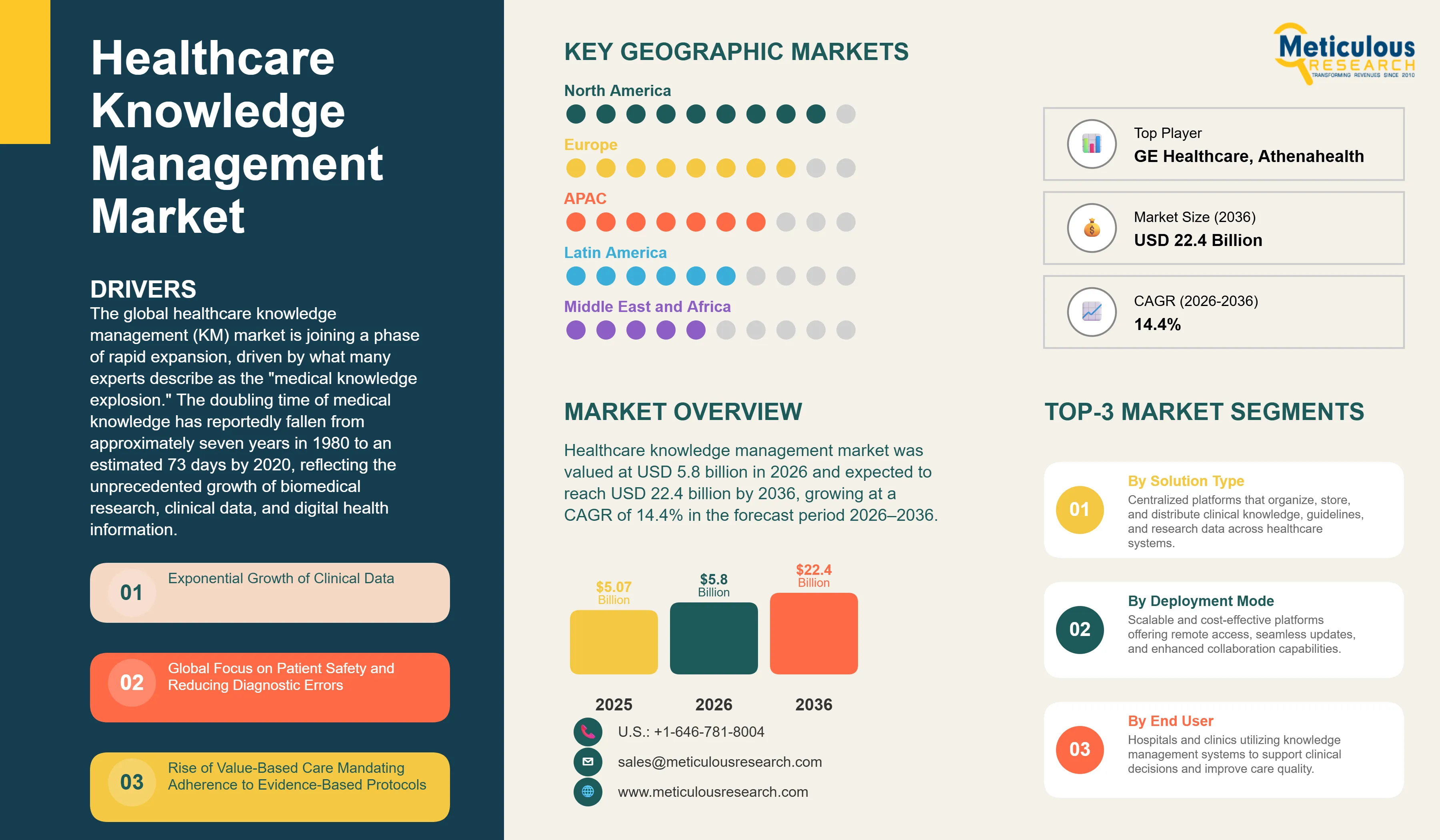
The global healthcare knowledge management market was valued at USD 5.8 billion in 2026. This market is expected to reach USD 22.4 billion by 2036, growing at a CAGR of 14.4% during the forecast period 2026–2036.
 Click here to: Get Free Sample Pages of this Report
The global healthcare knowledge management (KM) market is joining a phase of rapid expansion, driven by what many experts describe as the "medical knowledge explosion." The doubling time of medical knowledge has reportedly fallen from approximately seven years in 1980 to an estimated 73 days by 2020, reflecting the unprecedented growth of biomedical research, clinical data, and digital health information. As the volume of available evidence continues to expand, clinicians face increasing challenges in remaining current across all relevant domains of practice. Consequently, knowledge management systems—defined as the systematic process of capturing, organizing, sharing, and applying medical knowledge—have evolved from administrative support tools into critical components of modern healthcare delivery. The market is increasingly focused on "just-in-time" knowledge delivery, ensuring that the latest evidence-based insights are available at the point of care to enhance diagnostic accuracy, clinical decision-making, and patient safety.
The economic and clinical implications of effective knowledge management are substantial. Research indicates that approximately 12 million U.S. adults experience diagnostic errors in outpatient settings each year, highlighting the importance of timely access to reliable clinical knowledge. Knowledge management platforms and clinical decision support (CDS) systems help bridge the gap between rapidly evolving scientific evidence and clinical practice by delivering relevant information at the point of care. Administrative efficiency is also a key driver of adoption, as healthcare professionals devote considerable time to locating clinical documentation, guidelines, and research evidence. Modern KM systems, particularly those incorporating artificial intelligence (AI), natural language processing (NLP), and semantic search capabilities, can significantly improve information retrieval and knowledge accessibility through centralized digital repositories.
Technological advances in Generative AI and Large Language Models (LLMs) are further expanding the capabilities of healthcare KM platforms. These technologies can synthesize large volumes of unstructured information—including clinical notes, medical literature, and genomic data—into concise, actionable insights for clinicians. In parallel, the transition toward value-based care models is increasing demand for systems that support evidence-based practice, quality improvement, and standardized clinical workflows.
From a regional perspective, North America remains the largest healthcare KM market due to its advanced healthcare IT infrastructure and high concentration of academic and integrated healthcare organizations. Meanwhile, Asia-Pacific is expected to experience the fastest growth, driven by expanding healthcare infrastructure, digital transformation initiatives, and government investments in health information technology. As healthcare data volumes continue to grow rapidly worldwide, demand for sophisticated knowledge management solutions is expected to remain strong across all major regions.
The primary driver for the healthcare knowledge management market is the exponential growth of clinical data and research, often referred to as the 'medical knowledge explosion.' With knowledge doubling every 73 days, clinicians can no longer keep pace without technological assistance. Furthermore, a global focus on patient safety and the reduction of diagnostic errors is a major catalyst. KM systems provide the evidence-based alerts and guidelines necessary to mitigate risks in outpatient and inpatient settings. The transition to value-based care models also drives adoption, as these models require providers to demonstrate adherence to standardized, high-quality clinical protocols to ensure full reimbursement.
Persistent data silos and a lack of universal interoperability remain significant restraints. Integrating KM systems with a wide variety of legacy Electronic Health Record (EHR) and Laboratory Information Systems (LIS) is often technically challenging and costly. Additionally, the high cost of implementation and the ongoing need for clinical experts to curate and validate the knowledge base can be prohibitive for smaller community hospitals. Ensuring that the knowledge remains current in a rapidly changing scientific landscape requires continuous investment, which can strain the budgets of resource-limited healthcare organizations.
The emergence of Generative AI and Large Language Models (LLMs) represents a monumental opportunity for the market. These technologies can automate the summarization of vast libraries of clinical literature, providing clinicians with 'just-in-time' answers to complex medical questions. There is also significant potential in the development of personalized medicine knowledge bases that integrate genomic data with traditional clinical guidelines. Furthermore, the rapid digitization of healthcare in emerging markets like India, China, and Brazil offers a vast untapped opportunity for KM vendors as these regions modernize their clinical workflows and infrastructure.
A critical challenge is maintaining knowledge currency in real-time. As new clinical trials and guideline changes occur almost daily, KM systems must be updated instantly to avoid providing outdated or incorrect recommendations. User adoption also remains a hurdle; clinicians often face 'alert fatigue' from multiple digital systems. Ensuring that KM tools are seamlessly integrated into the clinical workflow without adding to the cognitive load is essential for long-term success. Finally, navigating the complex regulatory and privacy requirements for handling patient data within KM platforms remains a continuous challenge for global vendors.
The integration of NLP and semantic search is becoming a core capability of healthcare KM platforms as organizations seek to unlock value from unstructured data, which accounts for an estimated 80% of healthcare information, including clinical notes, medical images, pathology reports, and scientific literature. By extracting clinical concepts and contextual relationships rather than relying on keyword matching, NLP-enabled KM systems improve knowledge retrieval, support evidence-based decision-making, and accelerate access to relevant information at the point of care. Growing adoption is further supported by increasing investments in AI-powered healthcare technologies and the need to manage rapidly expanding volumes of clinical and research data.
Growing recognition of diagnostic complexity and knowledge-sharing gaps is driving adoption of case-based social learning platforms within KM systems. According to the National Academy of Medicine, most individuals are expected to experience at least one diagnostic error during their lifetime, increasing demand for collaborative environments where clinicians can share anonymized cases, discuss uncommon presentations, and disseminate best practices across institutions. These platforms support continuous learning and accelerate the diffusion of clinical knowledge beyond traditional training channels.
Based on solution type, the market is segmented into Knowledge Management Platforms, Clinical Decision Support (CDS) Systems, Semantic Search & NLP Tools, and Collaboration & Social Learning Tools. In 2026, the Knowledge Management Platforms segment is expected to hold the largest share. These platforms serve as the foundational infrastructure for aggregating and distributing clinical guidelines and research across entire health systems.
The Clinical Decision Support (CDS) Systems segment is projected to witness the fastest growth. This growth is driven by the direct impact of these tools on patient outcomes and their essential role in meeting the reimbursement requirements of value-based care models.
Based on end user, the market is segmented into Healthcare Providers, Healthcare Payers, Pharmaceutical & Biotech Companies, and Academic & Research Institutes. In 2026, the Healthcare Providers segment is expected to hold the largest share. Hospitals and clinics have the most immediate and critical need for point-of-care knowledge to ensure clinical excellence and patient safety.
The Pharmaceutical & Biotech Companies segment is projected to witness the fastest growth. These organizations are increasingly leveraging advanced KM systems to accelerate drug discovery, manage clinical trial data, and ensure global regulatory compliance.
North America is expected to remain the largest regional market for healthcare knowledge management in 2026, supported by advanced healthcare IT infrastructure, widespread adoption of digital health technologies, and a high concentration of academic medical centers, research institutions, and pharmaceutical companies. The region's leadership is further reinforced by the rapid growth of healthcare data and increasing demand for evidence-based clinical decision support.
Europe also represents a significant market, with strong adoption of standardized clinical pathways, digital health initiatives, and evidence-based care models across countries such as United Kingdom and Germany. Meanwhile, Asia-Pacific is projected to be the fastest-growing region over the forecast period, driven by healthcare modernization efforts, expanding hospital infrastructure, and government-led digital health programs in China and India. Key market participants include Microsoft, Oracle, and Wolters Kluwer.
The global healthcare knowledge management market is highly competitive, characterized by the presence of large technology conglomerates, specialized medical publishers, and healthcare IT giants. Competition is focused on the ability to provide seamless integration with EHR workflows, the clinical accuracy of the knowledge base, and the integration of advanced AI and NLP capabilities. Strategic partnerships between technology vendors and medical institutions are a key trend for content validation.
Key players in the global market include Microsoft Corporation (Nuance) (U.S.), Oracle Corporation (Cerner) (U.S.), IBM Corporation (Watson Health/Merative) (U.S.), Wolters Kluwer N.V. (UpToDate) (Netherlands), Elsevier (ClinicalKey) (RELX Group) (Netherlands/UK), Hearst Health (Zynx Health/MCG) (U.S.), Epic Systems Corporation (U.S.), GE Healthcare (U.S.), Siemens Healthineers (Germany), Philips Healthcare (Netherlands), Athenahealth (U.S.), Allscripts Healthcare Solutions (U.S.), McKesson Corporation (U.S.), NextGen Healthcare (U.S.), Infor (Koch Industries) (U.S.), OpenText Corporation (Canada), RightAnswers (Upland Software) (U.S.), KMS Lighthouse (Israel), Bloomfire (U.S.), and Panopto (U.S.).
The market is projected to reach USD 22.4 billion by 2036, growing at a CAGR of 14.4% from 2026 to 2036.
Medical knowledge is estimated to double every 73 days, compared with approximately seven years in 1980.
Approximately 12 million U.S. adults are affected by diagnostic errors each year in outpatient settings, according to published research on diagnostic safety.
The Asia-Pacific region is projected to witness the fastest growth due to rapid healthcare modernization and infrastructure investments.
Clinicians spend a substantial portion of their time on information retrieval and documentation tasks, including searching for clinical records and research evidence.
The medical knowledge explosion, focus on patient safety, and the shift toward value-based care are the primary drivers.
The market is expected to grow at a CAGR of 14.4% during the forecast period 2026–2036.
Knowledge Management Platforms hold the largest share as they provide the foundational infrastructure for health systems.
Adoption of AI-powered semantic search, NLP, and generative AI is rapidly increasing across healthcare knowledge management systems.
Leading players include Microsoft, Oracle, IBM, Wolters Kluwer, and Elsevier.
















Published Date: Jan-2025
Published Date: Aug-2024
Published Date: May-2018
Please enter your corporate email id here to view sample report.
Subscribe to get the latest industry updates


