Resources
About Us
Healthcare Asset Tracking Market Size, Share & Trends Analysis by Technology, Component, Application, End User, and Geography - Global Opportunity Analysis and Industry Forecast (2026-2036)
Report ID: MRHC - 1042048 Pages: 309 Jun-2026 Formats*: PDF Category: Healthcare Delivery: 24 to 72 Hours Download Free Sample Report
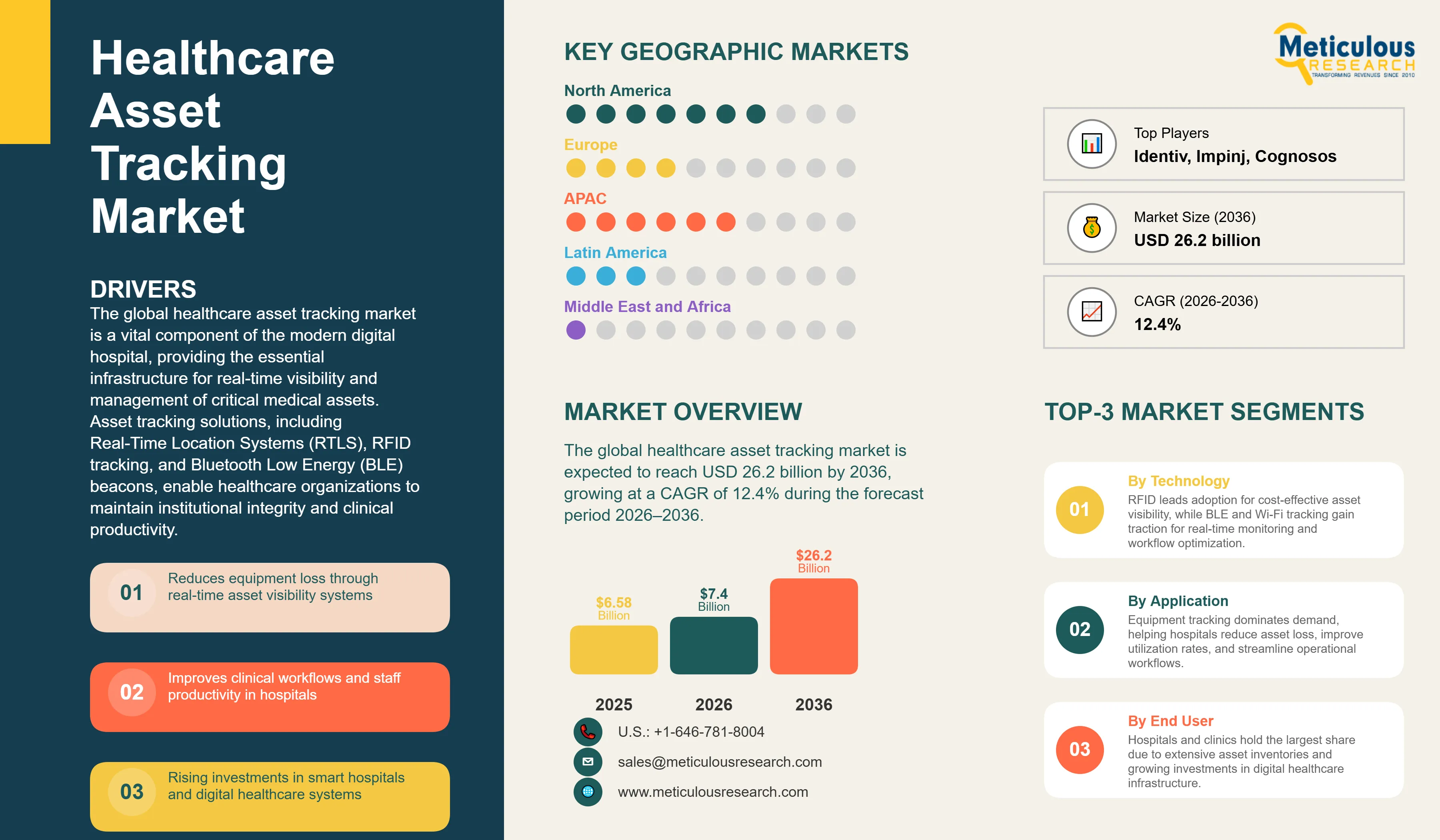
The global healthcare asset tracking market is valued at USD 7.4 billion in 2026. This market is expected to reach USD 26.2 billion by 2036, growing at a CAGR of 12.4% during the forecast period 2026–2036.
Click here to: Get Free Sample Pages of this Report
The global healthcare asset tracking market is a vital component of the modern digital hospital, providing the essential infrastructure for real-time visibility and management of critical medical assets. Asset tracking solutions, including Real-Time Location Systems (RTLS), RFID tracking, and Bluetooth Low Energy (BLE) beacons, enable healthcare organizations to maintain institutional integrity and clinical productivity. As of 2026, the market is undergoing a significant transformation, driven by the global imperative to address rising healthcare costs and the increasing complexity of hospital operations. According to the World Health Organization (WHO), global health expenditure databases now track spending across 195 countries, reflecting the growing emphasis on efficient utilization of healthcare resources. In parallel, studies cited by the American Hospital Association (AHA) indicate that 77% of hospital leaders believe clinical staff spend excessive time searching for medical equipment and supplies, while nurses in large facilities may spend 30–60 minutes per shift locating assets, reducing time available for patient care and increasing operational costs. Peer-reviewed research published in BMJ Open Quality further found that clinicians can lose several working days annually gathering equipment, highlighting the economic burden of poor asset visibility.
The transition toward integrated and cloud-native asset tracking platforms is essential for improving clinical workflows and asset utilization in the healthcare industry. Modern asset tracking solutions leverage advanced sensors and AI-driven analytics to provide a unified view of the location and status of mobile medical equipment. Furthermore, the integration of asset tracking with hospital information systems and clinical communication platforms ensures that stakeholders have immediate access to actionable insights. The broader trend toward smart hospitals and digitally connected care environments is accelerating adoption, as healthcare providers seek to maximize utilization of increasingly expensive medical assets and improve operational efficiency. A recent AHA analysis reported that hospital spending on supplies increased by nearly 10% through 2025, underscoring the importance of technologies that can reduce unnecessary purchases and optimize inventory management. As healthcare systems transition toward value-based care models, demand for tracking solutions that can demonstrably improve equipment availability, streamline workflows, and enhance patient outcomes is expected to surge.
Drivers: Mitigating Equipment Loss and Optimizing Clinical Workflows with RTLS Integration
The primary driver for the healthcare asset tracking market is the escalating global cost of healthcare and the increasing volume of mobile medical assets, which necessitates a more efficient and data-driven approach to equipment management. According to the AHA, equipment loss and underutilization account for significant annual losses in hospital capital budgets. This massive financial burden is driving the adoption of integrated tracking platforms to manage the high volume of assets and clinical documentation. Furthermore, the shift toward digital health and the increasing demand for real-time location visualization are significant drivers. Government initiatives promoting the adoption of connected health solutions and the exchange of health information are compelling healthcare organizations to invest in asset tracking solutions that can seamlessly integrate with broader healthcare IT ecosystems.
Restraints: High Implementation Costs and Technical Integration Challenges
Market growth is restrained by the high cost of implementing comprehensive asset tracking solutions and the technical challenges of achieving seamless data interoperability across disparate device platforms and legacy IT systems. For many mid-sized hospitals, the initial capital investment and ongoing maintenance costs of a facility-wide RTLS network can be a significant barrier. Additionally, the lack of standardized data protocols between different tracking technology providers often leads to data silos, making it difficult to achieve a truly unified clinical asset record. Concerns regarding data privacy and cybersecurity in centralized information hubs also act as deterrents to market expansion. Furthermore, the significant organizational change management and specialized training required for successful tracking implementation can lead to slower adoption rates.
Opportunities: Advancing AI-Driven Asset Analytics and Cloud-Native Platforms
The integration of artificial intelligence (AI) and machine learning (ML) into asset tracking platforms offers substantial growth opportunities. AI-powered tools can analyze complex location data and clinical evidence to identify potential workflow bottlenecks, facilitating more precise clinical intervention. By 2026, AI-driven predictive analytics are being used to forecast the demand for mobile medical equipment, enabling proactive asset distribution and improving patient safety. Furthermore, the shift toward cloud-native (SaaS) asset tracking platforms provides healthcare organizations with superior scalability, flexibility, and lower upfront costs. Cloud-based solutions also facilitate real-time data sharing among diverse clinical specialists, supporting multi-disciplinary collaboration, which is particularly beneficial for regional healthcare networks.
Evolution toward Holistic and AI-Powered Clinical Care Orchestration
A defining trend in 2026 is the evolution of asset tracking from siloed location tools into holistic, AI-powered clinical care orchestration hubs. These platforms increasingly integrate data from medical devices, wearables, and electronic health records to provide a unified view of assets and patient workflows. According to the American Hospital Association (AHA), nearly 94% of U.S. hospitals have adopted certified EHR systems, creating the digital foundation for enterprise-wide interoperability and intelligent workflow orchestration. Meanwhile, the World Health Organization (WHO) estimates that medication errors alone cost healthcare systems approximately USD 42 billion annually, highlighting the need for AI-enabled technologies that enhance clinical safety and operational efficiency. Furthermore, the U.S. Food and Drug Administration (FDA) has authorized more than 1,000 AI-enabled medical devices, reflecting the accelerating adoption of AI-driven analytics and decision-support capabilities across healthcare environments. This shift is driving healthcare providers toward proactive, data-driven patient and asset management models.
Integration of Advanced Sensors and Edge Computing in Tracking Solutions
The integration of advanced sensors and edge computing into asset tracking solutions is gaining significant traction. Edge-enabled devices process information locally, enabling faster response times and reducing dependence on centralized infrastructure. According to the International Data Corporation (IDC), nearly 30% of all data generated globally is expected to be processed at the edge by 2026, while the IEEE estimates that billions of IoT-connected devices are supporting real-time analytics applications across industries. In healthcare, low-power BLE sensors, RFID tags, and embedded processors are enabling continuous monitoring of critical assets and environmental conditions at the point of care. Additionally, the U.S. Centers for Medicare & Medicaid Services (CMS) reports that more than 38 million Medicare beneficiaries are enrolled in accountable care models emphasizing coordinated and technology-enabled care, further supporting the deployment of intelligent edge-based tracking systems that improve patient safety and workflow efficiency.
Radio Frequency Identification (RFID)
Based on technology, the Radio Frequency Identification (RFID) segment is expected to hold the largest share in 2026. RFID technology is foundational for hospital inventory and equipment tracking due to its scalability and relatively low cost of entry. Active RFID systems, which utilize battery-powered tags, are preferred for high-value assets that require continuous, real-time visibility across large facility footprints. In contrast, Passive RFID systems are widely deployed for high-volume, low-cost inventory items, where proximity-based tracking at checkpoints is sufficient. The integration of RFID with cloud-native platforms is enabling hospitals to achieve granular visibility into asset utilization patterns, driving significant operational efficiency.
Bluetooth Low Energy (BLE)
Bluetooth Low Energy (BLE) is projected to witness the fastest growth during the forecast period. This growth is driven by the increasing demand for cost-effective, energy-efficient, and easy-to-deploy tracking solutions. BLE beacons can leverage existing Wi-Fi access points or smartphone ecosystems, significantly reducing the infrastructure investment required compared to traditional RTLS. In 2026, BLE-based tracking is becoming a standard for staff workflow optimization and patient flow management, providing the high-precision location data necessary for clinical care orchestration without the complexity of wired sensor networks.
Wi-Fi Tracking Systems and Advanced Sensors
Wi-Fi tracking systems continue to be a significant segment, particularly for facilities looking to leverage their existing enterprise-grade wireless infrastructure for location services. While Wi-Fi provides broad coverage, it is often supplemented with ultrasound and infrared technology in critical care settings where room-level or bed-level precision is required. Ultrasound and infrared sensors provide the highest level of location accuracy, making them indispensable for applications such as infant protection and high-acuity patient monitoring. Emerging technologies like Zigbee and GPS are also finding niche applications in regional healthcare networks and for tracking assets across multiple facility sites.
Software
The software segment is expected to account for the largest share in 2026, reflecting the critical role of data processing and visualization in asset tracking. This segment includes Real-Time Location Systems (RTLS) software, which serves as the 'brain' of the tracking ecosystem, and RFID asset tracking software, which manages tag data and inventory records. The shift toward cloud-native asset orchestration platforms is a major trend, allowing health systems to aggregate data from multiple facilities into a single 'source of truth.' Advanced inventory and utilization analytics software are also becoming essential for identifying underutilized equipment and optimizing capital replacement cycles, directly impacting hospital profitability.
Hardware and Services
The hardware segment remains vital, providing the physical infrastructure for data collection, including a wide array of tags, beacons, sensors, and readers. The evolution of hardware toward smaller, longer-lasting, and more cost-effective devices is lowering the barrier to facility-wide adoption. Simultaneously, the services segment—including strategic consulting, custom implementation, and post-deployment support—is growing in importance. As tracking solutions become more integrated with clinical workflows, the need for expert change management and technical integration services is becoming a critical success factor for healthcare organizations.
Analysis by Application
By application, the equipment tracking and management segment is expected to dominate the market in 2026. This reflects the primary operational focus on reducing equipment loss and improving the availability of critical mobile medical assets. However, the patient tracking and staff workflow optimization segments are projected to grow rapidly. Patient tracking is becoming essential for improving throughput and reducing length of stay (LOS), while staff tracking is increasingly used to optimize nurse rounding and reduce administrative burden. Supply chain and inventory management also remain key applications, particularly for high-value surgical implants and pharmaceuticals.
Analysis by End User
Hospitals and clinics are expected to hold the largest share in 2026, as these facilities manage the most extensive and diverse fleets of mobile medical assets. Specialized care facilities, such as ambulatory surgery centers and long-term care homes, are also increasing their adoption of tracking solutions to improve operational efficiency. Diagnostic laboratories and academic research institutes represent smaller but growing segments, utilizing tracking for high-value specimens and laboratory equipment. The trend toward enterprise-wide deployments across large integrated delivery networks (IDNs) is a major driver of market growth among hospital end users.
North America is expected to dominate the global healthcare asset tracking market in 2026, accounting for an estimated 44.5% of total revenue. The region's leadership is supported by widespread adoption of RTLS technologies, a mature healthcare IT ecosystem, and substantial investments in digital health infrastructure by healthcare providers. Strong regulatory emphasis on patient safety, operational efficiency, and clinical quality continues to support market growth in the U.S. and Canada. The presence of leading asset tracking vendors and a robust medical innovation ecosystem further reinforce North America's dominant position.
The Asia Pacific region is projected to witness the fastest growth during the forecast period. This growth is driven by increasing hospital workloads and government-led initiatives aimed at modernizing healthcare infrastructure across China, India, and Japan. Programs such as Healthy China 2030 and the Ayushman Bharat Digital Mission are accelerating the adoption of digital health technologies and smart hospital solutions. As healthcare providers expand access to specialized care and invest in cloud-based platforms and IoT-enabled infrastructure, demand for integrated asset tracking solutions is expected to rise significantly, creating substantial opportunities for both global and regional vendors.
The competitive landscape of the global healthcare asset tracking market is characterized by intense innovation and strategic consolidations as vendors seek to provide end-to-end clinical care orchestration platforms. Leading players are differentiating themselves through the sophistication of their AI engines and their ability to provide seamless integration with EHRs and other clinical management platforms. Strategic acquisitions of niche sensor and analytics companies are a common trend as vendors seek to enhance their diagnostic capabilities. The market is also seeing increased collaboration between tracking vendors and healthcare providers to ensure seamless asset monitoring across the care continuum.
Key players operating in the global market include Zebra Technologies Corp. (U.S.), Stanley Healthcare (Securitas) (U.S.), CenTrak (Halma) (U.S.), GE HealthCare Technologies Inc. (U.S.), Midmark Corporation (U.S.), Sonitor Technologies (Norway), AiRISTA Flow (U.S.), TeleTracking Technologies, Inc. (U.S.), Guardman (U.S.), and various emerging technology providers specializing in BLE sensors and AI-driven diagnostic tools.
The market is projected to reach USD 26.2 billion by 2036, growing at a CAGR of 12.4% from 2026 to 2036.
Hospitals report a significant reduction in equipment loss and an improvement in the accuracy of asset monitoring.
The Bluetooth Low Energy (BLE) segment is expected to grow the fastest as hospitals prioritize cost-effective and scalable tracking.
Around 65–75% of new healthcare asset tracking deployments are cloud-native, reflecting healthcare providers' growing preference for scalable, interoperable, and remotely managed platforms.
North America holds the largest share, estimated at 44.5% in 2026, driven by high RTLS adoption and mature IT infrastructure.
AI enables the prediction of equipment demand and automates routine data curation, improving diagnostic consistency and patient safety.
The pressure to reduce capital expenditure is driving the demand for integrated platforms to manage the high volume of assets.
Hospitals and clinics are the primary adopters, managing the highest volumes of diverse mobile medical equipment fleets.
These systems provide the continuous, data-driven asset management necessary to improve clinical outcomes and reduce the total cost of care.
The top 5 players are Zebra Technologies, Stanley Healthcare, CenTrak, GE HealthCare, and Midmark Corporation.






















Published Date: Aug-2024
Published Date: Sep-2013
Published Date: Sep-2013
Published Date: Jan-2025
Published Date: Jan-2025
Please enter your corporate email id here to view sample report.
Subscribe to get the latest industry updates


