Resources
About Us

Endpoint Security Market by Component, Enforcement Point (Workstation, Mobile Devices, Server, Point of Sale Terminal), Deployment, Industry Size, End User (Aerospace and Defense, Government, BFSI, Healthcare, Manufacturing) - Global Forecast to 2036
Report ID: MRICT - 104398 Pages: 222 Feb-2026 Formats*: PDF Category: Information and Communications Technology Delivery: 24 to 48 Hours Download Free Sample Report
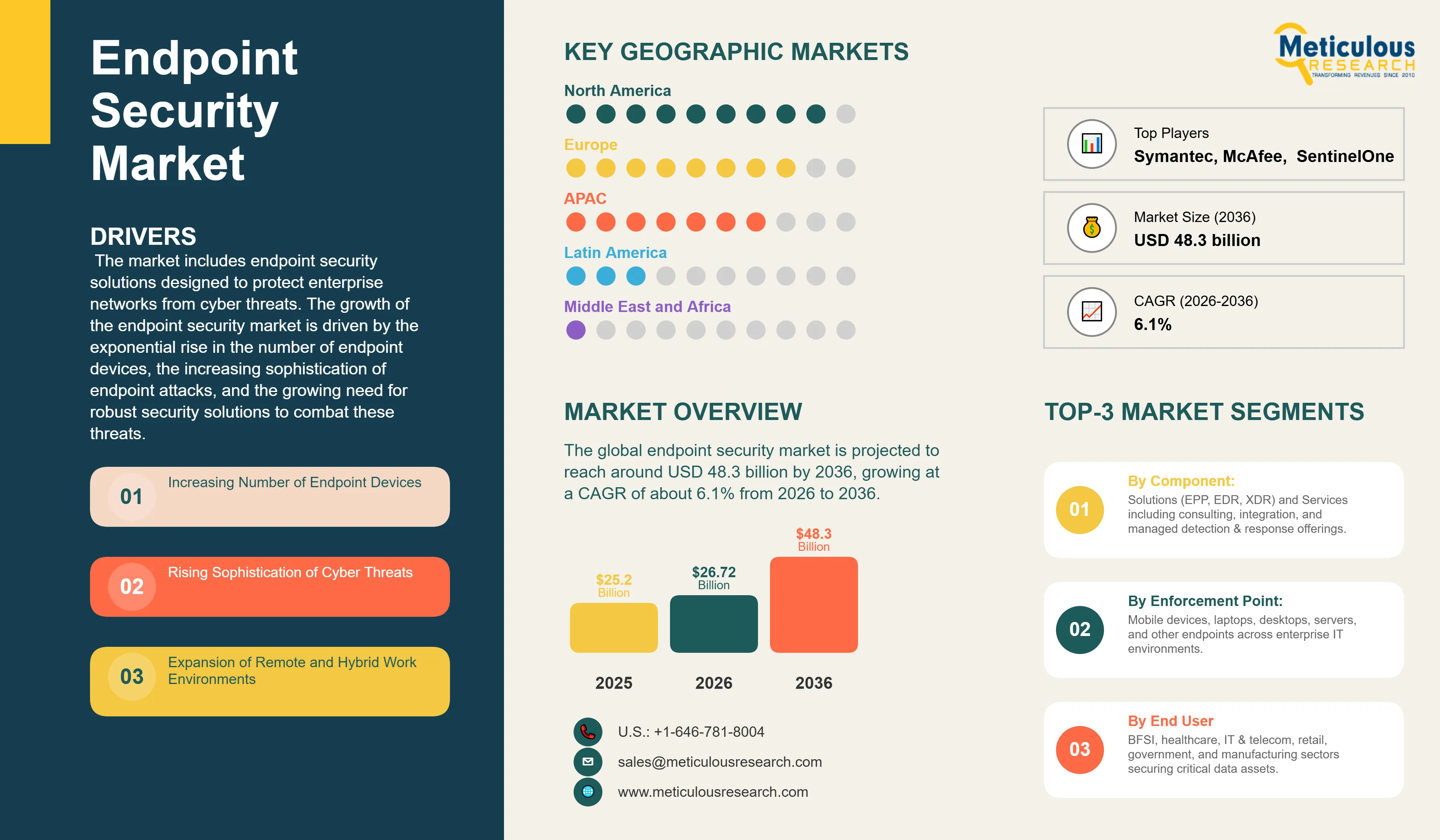
The global endpoint security market was valued at USD 26.72 billion in 2026 and is projected to reach around USD 48.3 billion by 2036, growing at a CAGR of about 6.1% from 2026 to 2036. The market includes endpoint security solutions designed to protect enterprise networks from cyber threats. The growth of the endpoint security market is driven by the exponential rise in the number of endpoint devices, the increasing sophistication of endpoint attacks, and the growing need for robust security solutions to combat these threats. Additionally, the proliferation of IoT, AI, and Big Data technologies, coupled with a rapidly evolving regulatory landscape, is expected to support market expansion throughout the forecast period.
Click here to: Get Free Sample Pages of this Report
The global endpoint security market is driven by the ever-increasing sophistication of cyber threats and the proliferation of endpoint devices in enterprise environments. Endpoint security solutions are fundamental components of a comprehensive cybersecurity strategy, providing protection for devices such as laptops, smartphones, and servers. The market includes established manufacturers such as Microsoft Corporation, CrowdStrike, and Symantec (a division of Broadcom), alongside emerging specialized vendors focusing on specific threat vectors and security technologies.
According to a report by the Ponemon Institute, 68% of organizations have experienced one or more endpoint attacks that successfully compromised data assets or IT infrastructure. This has created substantial demand for advanced endpoint security solutions that can detect and respond to sophisticated threats in real-time. For example, Microsoft Defender for Endpoint provides a comprehensive suite of EPP and EDR capabilities. Furthermore, the integration of artificial intelligence and machine learning into endpoint security solutions has expanded the market for proactive threat detection and prevention. The development of cloud-based endpoint security solutions has also revolutionized the deployment and management of endpoint protection, making it more accessible to organizations of all sizes.
Integration of AI and Machine Learning for Advanced Threat Detection
The endpoint security market is witnessing rapid advancement in the integration of AI and machine learning, characterized by improvements in threat detection accuracy and response times. Advanced endpoint security solutions are increasingly incorporating AI-powered analytics to identify and block sophisticated threats that evade traditional signature-based detection methods. For example, CrowdStrike's Falcon platform uses AI to analyze trillions of endpoint events per week to identify and stop breaches. This development is enabling new capabilities in behavioral analysis, anomaly detection, and automated threat hunting. Manufacturers including Palo Alto Networks and SentinelOne are investing heavily in AI-enabled endpoint security solutions to maintain a competitive advantage. The trend toward AI-driven security is expected to continue, creating opportunities for vendors that can deliver proactive and automated endpoint protection.
Shift Towards Cloud-Native Endpoint Security Solutions
The endpoint security market is experiencing a significant shift towards cloud-native solutions, driven by the need for scalability, flexibility, and centralized management. Cloud-native endpoint security platforms offer several advantages over traditional on-premises solutions, including easier deployment, automatic updates, and a reduced infrastructure footprint. For instance, VMware Carbon Black Cloud provides a cloud-native endpoint protection platform that consolidates multiple security capabilities into a single agent and console. The adoption of cloud-based security is enabling organizations to protect their endpoints regardless of their location, which is particularly important in the era of remote work. Companies such as Cybereason and Sophos are developing innovative cloud-native endpoint security solutions to address the evolving needs of modern enterprises. The convergence of cloud computing and endpoint security is expected to drive further innovation and market expansion.
|
Parameters |
Details |
|
Market Size by 2036 |
USD 48.3 Billion |
|
Market Size in 2026 |
USD 26.72 Billion |
|
Revenue Growth Rate (2026-2036) |
CAGR of 6.1% |
|
Fastest Growing Component |
Services |
|
Dominant Enforcement Point |
Mobile Devices |
|
Fastest Growing Deployment |
Cloud |
|
Leading Geographic Region |
North America |
Drivers: Increasing Number of Endpoint Devices and Sophistication of Cyber Threats
The primary drivers of the endpoint security market include the exponential growth in the number of endpoint devices and the increasing sophistication of cyber threats. The proliferation of IoT devices, mobile devices, and remote work has expanded the attack surface for enterprises, making endpoint security a critical priority. According to the Identity Theft Resource Center, the number of data breaches in 2023 increased by 78% compared to the previous year. Government regulations such as the GDPR and CCPA are also driving the adoption of endpoint security solutions to protect sensitive data. The increasing demand for cloud-based security solutions and the growing adoption of BYOD policies are also fueling market growth.
Why is the Services Segment Witnessing Rapid Growth?
The services segment is expected to witness the fastest growth in the endpoint security market, driven by the increasing demand for professional and managed security services. The complexity of modern cyber threats and the shortage of skilled cybersecurity professionals are driving organizations to outsource their endpoint security operations. Professional services such as consulting, training, and support help organizations to effectively deploy and manage their endpoint security solutions. Managed services provide continuous monitoring and management of endpoint security, enabling organizations to proactively detect and respond to threats. For example, Secureworks offers a managed detection and response (MDR) service that combines its Taegis XDR platform with 24/7 monitoring by security experts.
Why Do Mobile Devices Dominate the Market?
Mobile devices represent the dominant enforcement point segment in the endpoint security market, driven by the widespread adoption of smartphones and tablets in the workplace. The increasing use of mobile devices for accessing corporate data and applications has made them a prime target for cyberattacks. According to a report by Verizon, mobile devices are involved in 42% of all security incidents. Mobile endpoint security solutions provide protection against a wide range of threats, including malware, phishing, and data leakage. For example, Lookout Mobile Endpoint Security provides comprehensive protection for iOS and Android devices.
Why is Cloud Deployment Growing at the Fastest Rate?
Cloud deployment is expected to grow at the fastest CAGR in the endpoint security market, driven by the increasing adoption of cloud-based security solutions. Cloud-based endpoint security offers several advantages over on-premises solutions, including scalability, flexibility, and ease of management. The growing trend of remote work and the increasing use of cloud applications are also driving the demand for cloud-based endpoint security. For example, Cisco Secure Endpoint (formerly AMP for Endpoints) is a cloud-managed endpoint security solution that provides comprehensive protection against advanced threats.
Why Does the BFSI Sector Dominate the Market?
The BFSI sector represents the largest end-use industry segment in the endpoint security market, driven by the high risk of cyberattacks and the stringent regulatory requirements for data protection. The financial services industry is a prime target for cybercriminals due to the large volume of sensitive financial data it handles. According to a report by the Financial Services Information Sharing and Analysis Center (FS-ISAC), the financial services industry experiences 300 times more cyberattacks than any other industry. Endpoint security solutions help financial institutions to protect their networks and data from a wide range of threats, including malware, phishing, and ransomware. For example, Symantec Endpoint Security is widely used in the BFSI sector to protect endpoints from advanced threats.
How Does North America Maintain Its Leadership in the Global Endpoint Security Market?
North America is expected to hold the largest market share for endpoint security, driven by the high adoption of advanced cybersecurity solutions and the presence of a large number of endpoint security vendors. The U.S. dominates the North American market due to its large and technologically advanced economy. The region is characterized by strong demand for cloud-based security solutions and the early adoption of new technologies such as AI and machine learning. The key companies operating in the North American endpoint security market are Microsoft Corporation, CrowdStrike, and Palo Alto Networks.
Key Players in the Global Endpoint Security Market
The key players profiled in the global endpoint security market report include Microsoft Corporation (U.S.), CrowdStrike (U.S.), Symantec (a division of Broadcom) (U.S.), Trend Micro Incorporated (Japan), McAfee, LLC (U.S.), Palo Alto Networks, Inc. (U.S.), SentinelOne (U.S.), Sophos Ltd. (U.K.), VMware, Inc. (U.S.), Cisco Systems, Inc. (U.S.), Fortinet, Inc. (U.S.), Check Point Software Technologies Ltd. (Israel), and FireEye, Inc. (U.S.), among others.
The global endpoint security market is valued at USD 26.72 billion in 2026 and is expected to reach USD 48.3 billion by 2036, growing at a CAGR of 6.1%.
The endpoint security market is expected to grow at a CAGR of 6.1% from 2026 to 2036.
The key players include Microsoft Corporation, CrowdStrike, Symantec, Trend Micro Incorporated, McAfee, LLC, Palo Alto Networks, Inc., SentinelOne, Sophos Ltd., VMware, Inc., Cisco Systems, Inc., Fortinet, Inc., Check Point Software Technologies Ltd., and FireEye, Inc.
The main factors include the increasing number of endpoint devices, the growing sophistication of cyber threats, and the rising need for robust security solutions.
North America is expected to lead the global endpoint security market during the forecast period 2026 to 2036.
























Published Date: Feb-2026
Published Date: Jul-2024
Published Date: Apr-2024
Published Date: Jan-2024
Published Date: Aug-2022
Please enter your corporate email id here to view sample report.
Subscribe to get the latest industry updates


