Zero Trust Security Market (2026-2036)
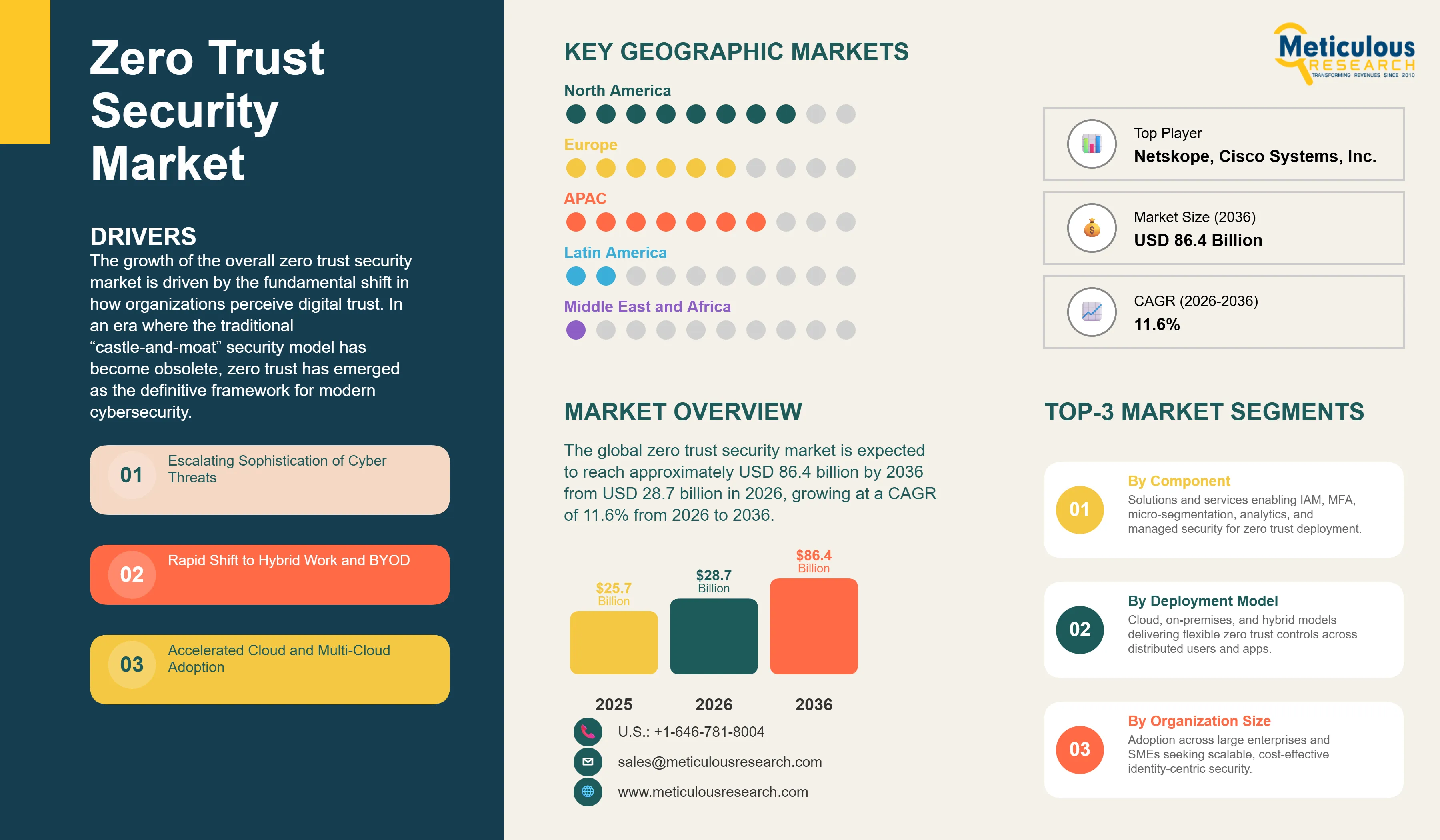
The global zero trust security market was valued at USD 25.7 billion in 2025. The market is expected to reach approximately USD 86.4 billion by 2036 from USD 28.7 billion in 2026, growing at a CAGR of 11.6% from 2026 to 2036.
- Published
- Feb 2026
- Pages
- 267
- Format
- PDF + Excel
- Report ID
- MR-1704
- Base year
- 2025
- 2025 · BASELINE
- $25.70B
- 2036
- $86.40B
- CAGR 2026–2036
- 11.6%
2025 baseline · 2026–2036 forecast at 11.6% CAGR · hover a bar for the value
Key highlights
In terms of revenue, the global zero trust security market is projected to reach USD 86.4 billion by 2036.
The market is expected to grow at a CAGR of 11.6% from 2026 to 2036.
North America dominates the global zero trust security market with the largest market share in 2026, driven by a mature cybersecurity landscape, high cloud adoption rates, and proactive government mandates like the U.S. Executive Order 14028.
Asia-Pacific is expected to witness the fastest growth during the forecast period, supported by rapid digital transformation, increasing investments in IT infrastructure, and a surge in cyber-awareness across emerging economies like China and India.
By component, the solutions segment (including IAM, MFA, and micro-segmentation tools) holds the largest market share in 2026, as organizations prioritize the deployment of foundational security technologies.
By deployment model, the cloud segment is expected to witness the highest growth, reflecting the shift toward flexible, scalable, and cloud-delivered security services that support distributed work environments.
By organization size, large enterprises currently lead the market due to their complex IT environments and substantial security budgets, though SMEs are rapidly adopting zero trust to protect against increasingly targeted cyber threats.
By vertical, the financial services industry holds a significant share, driven by the critical need to protect high-value transactions and sensitive customer data in a highly regulated environment.
Report summary
| Particulars | Details |
|---|---|
| Market Size by 2036 | USD 86.4 Billion |
| Market Size in 2026 | USD 28.7 Billion |
| Market Size in 2025 | USD 25.7 Billion |
| Market Growth Rate (2026-2036) | CAGR of 11.6% |
| Format | PDF, Excel & Cloud Portal · 267 pages |
| Dominating Region | North America |
| Fastest Growing Region | Asia-Pacific |
| Base Year | 2025 |
| Forecast Period | 2026 to 2036 |
| Segments Covered | Component, Deployment, Org Size, Authentication, Vertical, and Region |
| Regions Covered | North America, Europe, Asia-Pacific, Latin America, and Middle East & Africa |
Report overview
Segments covered: component, deployment model, organization size, authentication method, industry vertical.
The growth of the overall zero trust security market is driven by the fundamental shift in how organizations perceive digital trust. In an era where the traditional “castle-and-moat” security model has become obsolete, zero trust has emerged as the definitive framework for modern cybersecurity. By operating on the core principle of “never trust, always verify,” this architecture ensures that every access request—whether it originates from inside or outside the network—is continuously authenticated and authorized. The rapid expansion of the hybrid workforce, the proliferation of cloud-native applications, and the increasing sophistication of ransomware attacks have made zero trust a business necessity rather than a technical luxury. As enterprises look to build resilient digital ecosystems, the adoption of zero trust principles continues to fuel significant growth across all major geographic regions.
Zero trust security represents a profound shift in the cybersecurity mindset—moving away from protecting a fixed perimeter to protecting individual data flows and identities. In today’s world, where employees work from anywhere and applications live in the cloud, the “perimeter” has effectively disappeared. Zero trust addresses this reality by assuming that threats are already present within the network. It treats every user, device, and application as a potential risk, requiring explicit verification through multiple layers of security—such as identity checks, device health assessments, and behavioral analytics—before granting the minimum necessary access. This “least-privilege” approach ensures that even if an attacker gains entry, their ability to move laterally and cause widespread damage is severely restricted.
The market is defined by a convergence of advanced technologies, including Identity and Access Management (IAM), Multi-Factor Authentication (MFA), and network micro-segmentation. These tools work together to create a dynamic security environment that adapts to the risk level of each access request. For instance, a user logging in from a known corporate laptop might have a different access profile than the same user connecting from a personal mobile device in a public space. This contextual awareness is what makes zero trust so effective against modern threats like credential theft and social engineering. By focusing on the “who, what, where, and when” of every interaction, organizations can build a security posture that is both robust and flexible.
The global push for digital modernization is a major catalyst for zero trust adoption. As businesses migrate to multi-cloud environments and integrate millions of IoT devices, the attack surface expands exponentially. Zero trust provides a consistent security framework that spans these diverse environments, ensuring that data remains protected regardless of where it resides. Furthermore, the rise of “Security-as-a-Service” (SECaaS) has made zero trust more accessible, allowing organizations to leverage cloud-native security tools that are easier to deploy and manage than traditional on-premises appliances.
Report infographic
Market dynamics
4 factors across 3 forcesThe Escalating Sophistication of Cyber Threats
The primary driver for zero trust adoption is the sheer scale and complexity of modern cyberattacks. High-profile ransomware incidents have shown that even the most well-defended perimeters can be breached. Attackers are increasingly using legitimate credentials and exploiting trust relationships to move undetected within networks for months. Zero trust directly addresses this by assuming a “breach mindset”—it assumes the attacker is already inside and uses continuous monitoring and micro-segmentation to limit their impact. For many organizations, the cost of a single data breach far outweighs the investment required to implement a zero trust framework, making it a clear strategic priority.
Table of contents
13 chapters · 123 sections · 267 pages · click to expandSegmental analysis
| Segment | Largest share (2026) | Fastest growth (2026–2036) |
|---|---|---|
| By Component | Security Solutions | — |
| By Deployment Model | — | Cloud deployment model |
By Component
- The solutions segment, which includes the hardware and software required to build a zero trust environment, accounts for the majority of the market share in 2026.
- This is because the initial phase of zero trust adoption typically involves significant capital investment in foundational technologies like IAM, MFA, and endpoint security.
- Organizations are prioritizing the “tools of the trade” to establish a baseline of continuous verification.
- As these technologies become more integrated and automated, the focus is shifting toward comprehensive platforms that can manage security policies across the entire enterprise.
- However, the services segment is expected to grow at a rapid pace.
- Implementing zero trust is a complex, multi-year journey that requires expert guidance.
- From initial consulting and architecture design to ongoing managed security services, organizations are increasingly relying on third-party experts to help them navigate the technical and cultural challenges of the transition.
By Deployment Model
- The cloud deployment model is witnessing the highest growth rate as organizations move away from managing physical security appliances.
- Cloud-delivered zero trust solutions offer several advantages, including faster deployment, automatic updates, and the ability to scale security as the business grows.
- This is particularly important for supporting a hybrid workforce, where security needs to be as mobile as the employees.
- By leveraging the global infrastructure of cloud providers, businesses can ensure that their security policies are enforced consistently, regardless of where their data or users are located.
- On-premises and hybrid models remain relevant for organizations with strict data residency requirements or significant investments in legacy data centers.
- However, even these organizations are increasingly adopting “cloud-managed” security, where the control plane lives in the cloud while the enforcement points remain local.
Geographic analysis
North America
North America continues to lead the global zero trust market, largely due to a combination of early adoption and strong regulatory pressure. The U.S. federal government’s mandate for agencies to adopt zero trust has set a high bar for the private sector, encouraging businesses of all sizes to follow suit. Additionally, the region is home to many of the world’s leading cybersecurity vendors, fostering a highly competitive and innovative market. The high concentration of data-intensive industries, such as finance and healthcare, further drives the demand for advanced security frameworks.
Asia-Pacific
Fastest growthAsia-Pacific is the fastest-growing region, driven by a massive wave of digital transformation and cloud migration. As countries like China, India, and Singapore build out their digital economies, they are leapfrogging traditional security models in favor of zero trust.
Europe
In Europe, growth is supported by stringent data privacy laws like GDPR, which require organizations to implement robust access controls and data protection measures. The European market is also seeing increased collaboration between governments to build sovereign, secure digital infrastructures.
Competitive landscape
- Microsoft Corporation
- Cisco Systems, Inc.
- Palo Alto Networks, Inc.
- Zscaler, Inc.
Frequently asked questions
The zero trust security market is expected to grow from USD 28.7 billion in 2026 to USD 86.4 billion by 2036.
Cite this report
Meticulous Research. (2026). Zero Trust Security Market - Global Opportunity Analysis and Industry Forecast (2026-2036) (Report No. MR-1704). Meticulous Market Research Pvt. Ltd. https://www.meticulousresearch.com/product/zero-trust-security-market-6387