Electrical Substation Automation Market (2026-2036)
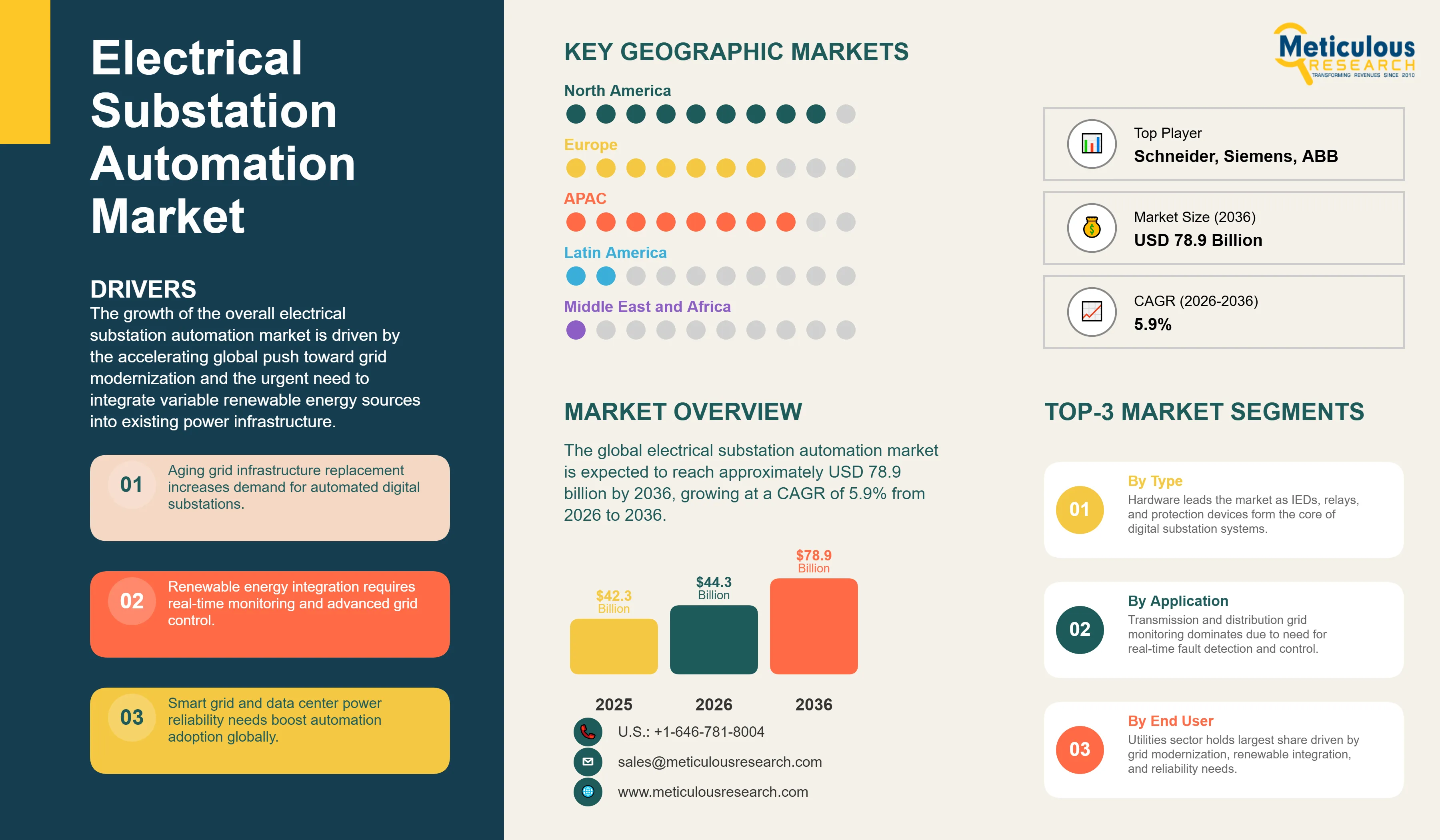
The global electrical substation automation market was valued at USD 42.3 billion in 2025. The market is expected to reach approximately USD 78.9 billion by 2036 from USD 44.3 billion in 2026, growing at a CAGR of 5.9% from 2026 to 2036.
- Published
- Feb 2026
- Pages
- 267
- Format
- PDF + Excel
- Report ID
- MR-1749
- Base year
- 2025
- 2025 · BASELINE
- $42.30B
- 2036
- $78.90B
- CAGR 2026–2036
- 5.9%
2025 baseline · 2026–2036 forecast at 5.9% CAGR · hover a bar for the value
Key highlights
In terms of revenue, the global electrical substation automation market is projected to reach USD 78.9 billion by 2036.
The market is expected to grow at a CAGR of 5.9% from 2026 to 2036.
North America dominates the global electrical substation automation market with the largest market share in 2026, driven by extensive grid modernization programs and substantial government funding for critical infrastructure upgrades in the United States and Canada.
Asia-Pacific is expected to witness the fastest growth during the forecast period, supported by massive investments in power infrastructure expansion and the rapid adoption of digital substation technologies in China, India, and Southeast Asia.
By component, the hardware segment holds the largest market share in 2026, particularly in supporting utility-scale substation deployments, advanced protection systems, and intelligent electronic device installations across transmission and distribution networks.
By communication technology, the wired segment holds the largest market share in 2026, due to its reliability and widespread implementation in mission-critical substation environments.
By end-use, the utilities segment holds the largest share of the overall market in 2026.
Report summary
| Particulars | Details |
|---|---|
| Market Size by 2036 | USD 78.9 Billion |
| Market Size in 2026 | USD 44.3 Billion |
| Market Size in 2025 | USD 42.3 Billion |
| Market Growth Rate (2026-2036) | CAGR of 5.9% |
| Format | PDF, Excel & Cloud Portal · 267 pages |
| Dominating Region | North America |
| Fastest Growing Region | Asia-Pacific |
| Base Year | 2025 |
| Forecast Period | 2026 to 2036 |
| Segments Covered | Component, Communication Technology, Substation Type, Installation, End-use, and Region |
| Regions Covered | North America, Europe, Asia-Pacific, Latin America, and Middle East & Africa |
Report overview
Segments covered: component, communication technology, substation type, installation, end-use.
The growth of the overall electrical substation automation market is driven by the accelerating global push toward grid modernization and the urgent need to integrate variable renewable energy sources into existing power infrastructure. As utility providers transition from legacy electromechanical systems to intelligent digital platforms, substation automation has emerged as the cornerstone technology for enabling real-time monitoring, advanced fault detection, and seamless remote control capabilities. The rapid deployment of smart grid initiatives and the increasing complexity of distributed energy resources continue to fuel significant growth of this market across all major geographic regions.
Electrical substation automation represents a transformative approach to managing power distribution networks through the integration of intelligent electronic devices, advanced communication protocols, and sophisticated software platforms that enable centralized monitoring and control of substation operations. These systems leverage standardized frameworks such as IEC 61850 to provide interoperable data exchange between protection relays, circuit breakers, transformers, and control units, creating a unified digital environment for optimal grid performance. The market is characterized by cutting-edge technologies including virtualized protection systems, AI-driven predictive maintenance algorithms, and process bus architectures that significantly enhance operational reliability and resource efficiency in high-stakes utility environments. These systems are essential for grid operators seeking to modernize their infrastructure and meet stringent performance and safety requirements.
The market encompasses a comprehensive range of solutions, from basic supervisory control and data acquisition platforms for distribution substations to sophisticated digital substation architectures featuring sampled values, generic object-oriented substation events, and cloud-based analytics. These systems are increasingly enhanced with advanced capabilities such as cyber-secure communication networks, real-time load forecasting, and automated fault isolation to deliver services including dynamic grid optimization and remote diagnostics of electrical assets. The ability to deliver stable, high-precision protection while enabling rapid restoration of service has made substation automation technology the preferred choice for operators where grid resilience and operational excellence are paramount.
The global energy sector is aggressively pursuing infrastructure modernization initiatives, aiming to accommodate bidirectional power flows from distributed generation and achieve ambitious decarbonization targets. This transformation has accelerated the adoption of high-performance automation solutions, with advanced digital substations helping to maintain grid stability during the integration of intermittent renewable sources. At the same time, the exponential growth in data center power consumption and the electrification of transportation are creating unprecedented demand for robust, intelligent electrical infrastructure.
Report infographic
Market dynamics
4 factors across 3 forcesAging Grid Infrastructure and Renewable Energy Integration Mandates
A key driver of the electrical substation automation market is the critical need to replace obsolete electromechanical infrastructure that was never designed to handle current load demands or accommodate bidirectional power flows from distributed generation. Global momentum toward sustainable energy systems, real-time fault detection, and data-driven grid management has created compelling incentives for the deployment of intelligent substation infrastructure. The convergence of variable renewable generation and the modernization of transmission networks drives utilities toward scalable automation solutions that only advanced digital platforms can reliably deliver. It is estimated that as renewable capacity additions accelerate and grid complexity intensifies through 2036, the demand for sophisticated, interoperable automation systems increases exponentially; therefore, high-performance SCADA platforms and IEC 61850-compliant intelligent electronic devices, with their proven ability to manage complex operational workflows, are considered essential enablers of next-generation grid reliability and efficiency.
Table of contents
12 chapters · 126 sections · 267 pages · click to expandSegmental analysis
| Segment | Largest share (2026) | Fastest growth (2026–2036) |
|---|---|---|
| By Component | Hardware | — |
| By Communication Technology | Wired Communication | — |
| By End-use | Utilities | — |
By Component
- The hardware segment accounts for a significant portion of the overall electrical substation automation market in 2026.
- This is primarily attributed to the fundamental role of intelligent electronic devices in enabling protection, control, and monitoring functions within modern digital substations.
- These systems represent the physical foundation ensuring operational integrity across diverse voltage applications.
- The utilities and industrial sectors alone consume a substantial share of hardware deployments, with major modernization projects in North America and Asia-Pacific demonstrating the technology's capability to support high-density automation requirements and stringent reliability standards.
- However, the software segment is expected to grow at a rapid CAGR during the forecast period, driven by the increasing need for advanced analytics platforms, cloud-based monitoring solutions, and sophisticated human-machine interfaces in complex grid transformation initiatives.
By Communication Technology
- The wired segment holds the largest share of the overall market in 2026.
- This is primarily due to the proven reliability of fiber-optic and Ethernet-based networks and the rigorous performance requirements for mission-critical substation communication infrastructure.
- Current large-scale deployment strategies are increasingly specifying high-bandwidth fiber-optic platforms to ensure compliance with stringent latency standards and cybersecurity expectations for dependable grid operation environments.
- The wireless communication segment is expected to witness substantial growth during the forecast period.
- The evolution toward distributed automation architectures and the complexity of integrating remote monitoring points are driving the requirement for advanced wireless systems capable of supporting mobile workforce applications and temporary installation scenarios while maintaining secure connectivity for operational data transmission.
By End-use
- The utilities segment commands the largest share of the global electrical substation automation market in 2026.
- This dominance stems from its critical responsibility for operating vast transmission and distribution networks, renewable energy interconnections, and bulk power delivery systems, making it the primary end-use sector for comprehensive substation automation.
- Large-scale modernization programs in grid infrastructure, renewable integration projects, and regulatory compliance initiatives drive sustained demand, with advanced platforms from providers like Hitachi Energy and Schweitzer Engineering Laboratories enabling reliable performance in complex utility environments.
- However, the industrial segment is positioned for steady growth through 2036, fueled by expanding manufacturing automation, mining operations, and heavy process industries requiring dedicated electrical infrastructure.
- Industrial facilities face mounting pressure to enhance power quality and implement predictive maintenance for high-value production lines, where automated substations provide cost-effective solutions for sophisticated electrical management and operational continuity.
Geographic analysis
North America
Largest shareNorth America holds the largest share of the global electrical substation automation market in 2026. The largest share of this region is primarily attributed to the substantial government funding for grid modernization and the presence of leading technology innovators, particularly in the United States. The United States alone accounts for a significant portion of global substation automation investment, with federal infrastructure programs and utility commitments to digital transformation driving sustained market expansion. The presence of industry leaders like General Electric and Schweitzer Engineering Laboratories combined with a well-established ecosystem of system integrators provides a robust foundation for both conventional upgrades and cutting-edge digital deployments.
Europe
Asia-Pacific and Europe together represent substantial growth opportunities in the global electrical substation automation market. The expansion of these markets is mainly driven by aggressive infrastructure development and renewable energy integration mandates. The demand for advanced automation systems in Asia-Pacific is predominantly fueled by massive grid expansion projects in China and India, alongside smart city initiatives in Southeast Asian nations. In Europe, the leadership in sustainable energy policy and the commitment to carbon neutrality targets are accelerating the adoption of intelligent grid solutions. Countries like Germany, France, and the United Kingdom are at the forefront, with significant investments in integrating distributed renewable generation into sophisticated automation frameworks and deploying advanced protection systems to ensure the highest levels of grid stability and operational performance.
Competitive landscape
- ABB Ltd.
- Siemens AG
- Schneider Electric SE
- General Electric Company
Frequently asked questions
he global electrical substation automation market is expected to grow from USD 44.3 billion in 2026 to USD 78.9 billion by 2036.
Cite this report
Meticulous Research. (2026). Electrical Substation Automation Market - Global Opportunity Analysis and Industry Forecast (2026-2036) (Report No. MR-1749). Meticulous Market Research Pvt. Ltd. https://www.meticulousresearch.com/product/electrical-substation-automation-market-6432