
Industrial Automation Software Market (2022-2029)
The Industrial Automation Software Market is expected to reach a value of $59.5 billion by 2029, at a CAGR of 7.4% during the forecast period 2022–2029.
- Published
- Jul 2022
- Pages
- 233
- Format
- PDF + Excel
- Report ID
- MRSE - 104593
- Base year
- 2021
- 2029 · FORECAST
- $59.50B
- 2029
- $59.50B
- CAGR 2022–2029
- 7.4%
2021 baseline · 2022–2029 forecast at 7.4% CAGR · hover a bar for the value
Key highlights
The Human Machine Interface (HMI) Segment Projected to Grow at the Highest CAGR During the Forecast Period
The Cloud-based Segment is Projected to Grow at the Highest CAGR During the Forecast Period
The Chemicals & Materials Segment is Projected to Grow at Highest CAGR During the Forecast Period
North America to Witness Fastest Market Growth Rate
Report summary
| Particulars | Details |
|---|---|
| Base Year | 2021 |
| Estimated Year | 2022 |
| Forecast Period | 2022–2029 |
| Market Size (2029) | USD 59.50 billion |
| CAGR (2022–2029) | 7.4% |
| Format | PDF, Excel & Cloud Portal · 233 pages |
| Segments Covered | By Product: Supervisory Control and Data Acquisition (SCADA), Distributed Control System (DCS), Manufacturing Execution Systems (MES), Human Machine Interface (HMI), Programmable Logic Controller (PLC), IT and Software Environment Integration Solutions, Production Process Test Systems, Automated Material Handling Systems, Coordinated Data Management Systems, Automatic Storage and Retrieval Systems · By Deployment Type: On-premise, Cloud-based · By End User: Oil & Gas, Chemicals & Materials, Paper & Pulp, Pharmaceuticals & Biotech, Mining & Metals, Food & Beverage, Power, Consumer Goods, Automotive, Machines & Tools, Semiconductors & Electronics, Aerospace & Defense, Other End Users |
| Countries Covered | North America (Canada), Europe (U.K., Germany, France, Italy, Spain, Netherlands, Sweden, Rest of Europe), Asia-Pacific (China, India, Japan, South Korea) |
| Key Companies | ABB Ltd, Siemens AG, Schneider Electric SE, Honeywell International Inc., Rockwell Automation Inc., HCL Technologies Ltd., Parsec Automation Corporation, SAP SE, Tata Consultancy Services Limited, Hitachi, Ltd., OMRON Corporation, Aegis Industrial Software Corporation, IBM Corporation |
Report overview
Segments covered: product, deployment type, end user. Regions: North America, Europe, Asia-Pacific.
An increase in demand for automation for qualitative & reliable manufacturing, the growing need for mass production with reduced operation costs, and the emergence of Industry 4.0 & enabling technologies are the key factors driving the growth of the global industrial automation software market. The emerging automation-driven industries in developing countries provide significant growth opportunities for players operating in this market.
The outbreak of the COVID-19 pandemic has led to a widespread economic downturn as several countries imposed strict lockdowns to contain the infection. These lockdowns have affected diverse industries, primarily due to the impact on manufacturing operations. There has been a significant impact on supply chains globally. Manufacturing & processing companies faced huge losses in the first and second quarters of 2020 due to disrupted supply chains and delayed production schedules. The rapid spread of the coronavirus in the U.S., Europe, and Asian countries resulted in nationwide lockdowns and a temporary halting of production facilities to prevent further spread.
The COVID-19 pandemic led to the downsizing of various businesses and negatively impacted the growth of the industrial automation software market. Many small- and medium-sized enterprises are unable to afford the large investment needed for deploying automation for processes. New strategies with the objective being on the rapid recovery of losses as restrictions have been lifted and more mobility and functionality resume.
The automation software market is growing due to government support and initiatives, high demand for industrial automation for mass production, and mounting pressure to reduce operational costs. Product lifecycle management and enterprise-level solutions are gaining high demand globally. Mass production enables companies to produce larger quantities with fewer workers. Instead of paying several workers to complete a task by hand, manufacturers use machines to produce goods faster. This allows companies to sell their products at a lower cost without losing profit. The increased use of automation in manufacturing shows how rapid advancements in technology have reduced the need for the human touch in refining, developing, and assembling the individual parts of a product. Automated inspection and identification of parts save time and are also less prone to errors, so the likelihood of damage control will be drastically lower. Even though it requires a significant investment, an automated system has an extremely positive return in the long run in terms of operational costs. This is expected to drive the demand for industrial automation software in the coming years.
Report infographic
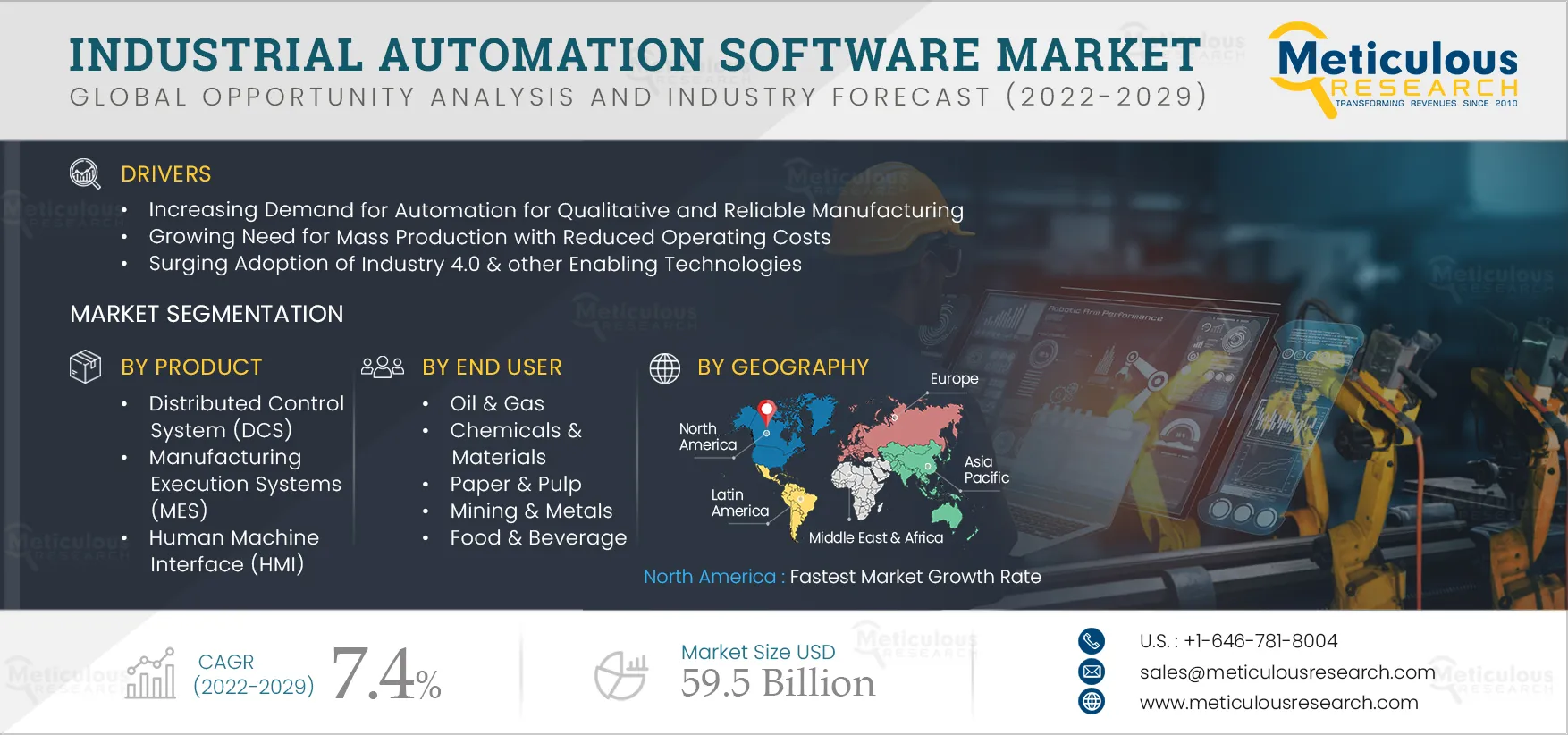
Table of contents
12 chapters · 104 sections · 233 pages · click to expandSegmental analysis
| Segment | Largest share (2022) | Fastest growth (2022–2029) |
|---|---|---|
| By Product | — | Human machine interface (HMI) |
| By Deployment Type | — | Cloud-based |
| By End User | — | Chemicals & materials |
By Product
- The human machine interface (HMI) segment is projected to grow at the highest CAGR during the forecast period.
- HMI enables workers to perform duties with the help of concise automation equipment via an interface instead of switches and levers.
- As a tool for convergence of visual computing and automation control systems, industrial automation with HMI systems usually consist of LCD panels, often with touch screen capability, mounted on the control consoles of industrial automation equipment.
- In industrial automation, HMI systems face challenges of creating scalable HMI product families with varying performance levels, scalable graphics resolutions, and different display types.
By Deployment Type
- The Cloud-based Segment is Projected to Grow at the Highest CAGR During the Forecast Period
- The cloud-based segment is expected to grow at the highest CAGR during the forecast period.
- The number of vendors supplying cloud industrial automation software systems is rapidly growing due to the benefits offered by these systems, such as improved efficiency, mobility, business productivity, and capability.
By End User
- The chemicals & materials segment is expected to grow at the highest CAGR during the forecast period due to the increasing implementation of IoT and process automation solutions.
- The chemical industry is witnessing intense global competition and low product differentiation, making cost control necessary.
- In such an environment, automation solutions offer dual benefits of innovation in the areas that matter to consumers and improved cost efficiency throughout optimized production.
- The chemicals & materials industry also needs to control raw material & energy costs, which can be achieved using IIoT and automation technologies.
Geographic analysis
North America
Fastest growthNorth America is expected to register the highest growth rate during the forecast period. Key factors contributing to this growth rate are increasing initiatives across various industries for boosting digitalization, the presence of key market players, growing demand for robotic solutions, and the need to improve productivity, quality, & safety of products. North America to Witness Fastest Market Growth Rate
Competitive landscape
- ABB Ltd
- Siemens AG
- Schneider Electric SE
- Honeywell International Inc.
- Rockwell Automation Inc.
- HCL Technologies Ltd.
- Parsec Automation Corporation
- SAP SE
- Tata Consultancy Services Limited
- Hitachi, Ltd.
- OMRON Corporation
- Aegis Industrial Software Corporation
- IBM Corporation
Frequently asked questions
Cite this report
Meticulous Research. (2022). Industrial Automation Software Market - Global Opportunity Analysis and Industry Forecasts (2022-2029) (Report No. MRSE - 104593). Meticulous Market Research Pvt. Ltd. https://www.meticulousresearch.com/product/industrial-automation-software-market-5279