
Vector Database Market (2026-2036)
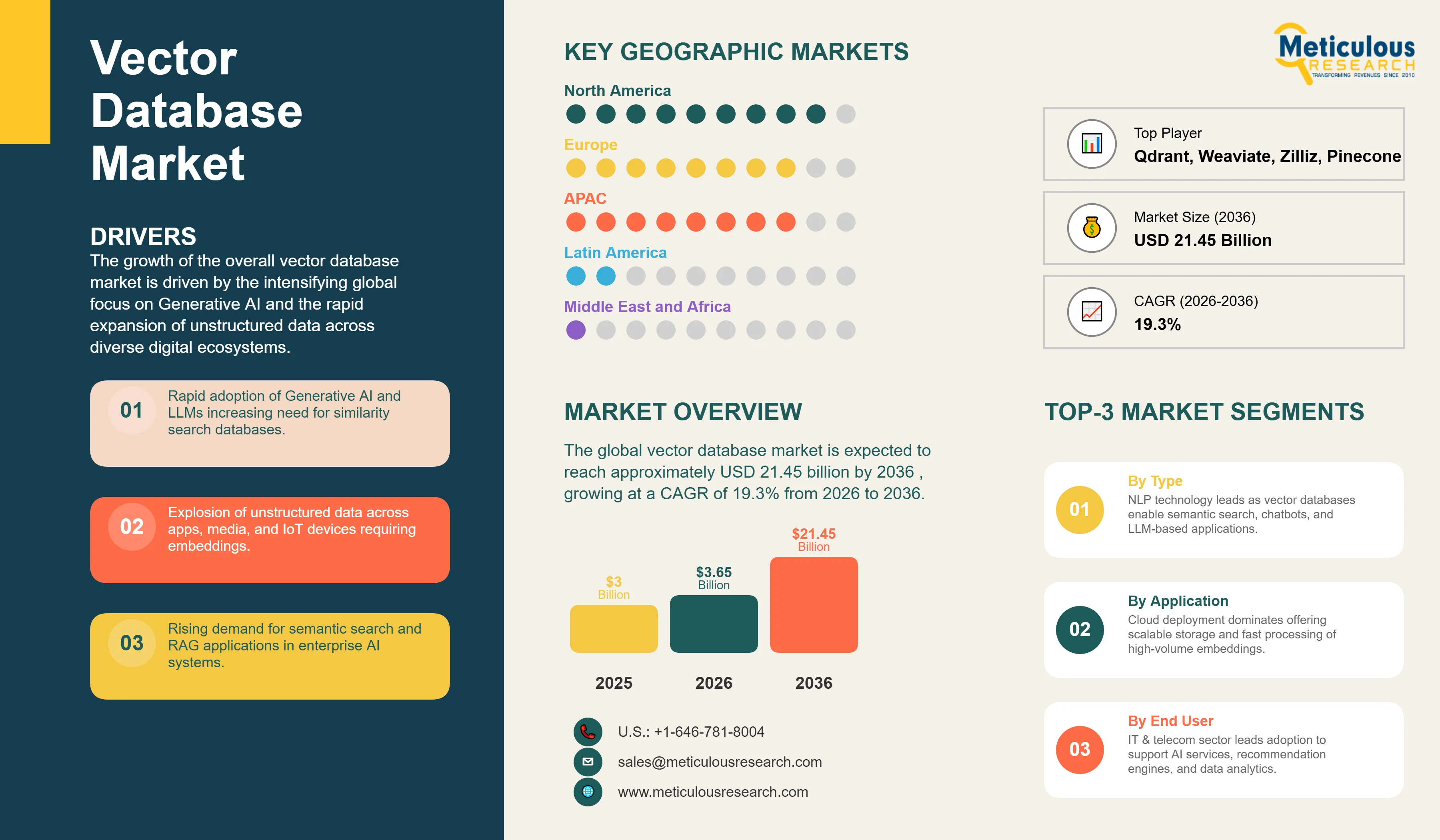
The global vector database market was valued at USD 3.0 billion in 2025. The market is expected to reach approximately USD 21.45 billion by 2036 from USD 3.65 billion in 2026, growing at a CAGR of 19.3% from 2026 to 2036.
- Published
- Feb 2026
- Pages
- 268
- Format
- PDF + Excel
- Report ID
- MR-1767
- Base year
- 2025
- 2025 · BASELINE
- $3.00B
- 2036
- $21.45B
- CAGR 2026–2036
- 19.3%
2025 baseline · 2026–2036 forecast at 19.3% CAGR · hover a bar for the value
Key highlights
In terms of revenue, the global vector database market is projected to reach USD 21.45 billion by 2036.
The market is expected to grow at a CAGR of 19.3% from 2026 to 2036.
North America dominates the global vector database market with the largest market share in 2026, driven by massive investments in AI R&D and the presence of leading technology innovators in the United States and Canada.
Asia-Pacific is expected to witness the fastest growth during the forecast period, supported by aggressive digital transformation initiatives and the rapid adoption of AI-driven consumer services in China, India, and Japan.
By technology, the Natural Language Processing (NLP) segment holds the largest market share in 2026, particularly in supporting semantic search and chatbot interactions in diverse enterprise environments.
By deployment, the cloud-based segment holds the largest market share in 2026, due to its proven efficacy in handling high-volume vector embeddings and providing scalable, remote access to database clusters.
By end-user, the IT & Telecom segment holds the largest share of the overall market in 2026.
Report summary
| Particulars | Details |
|---|---|
| Market Size by 2036 | USD 21.45 Billion |
| Market Size in 2026 | USD 3.65 Billion |
| Market Size in 2025 | USD 3.0 Billion |
| Market Growth Rate (2026-2036) | CAGR of 19.3% |
| Format | PDF, Excel & Cloud Portal · 268 pages |
| Dominating Region | North America |
| Fastest Growing Region | Asia-Pacific |
| Base Year | 2025 |
| Forecast Period | 2026 to 2036 |
| Segments Covered | Technology, Deployment, End-User, and Region |
| Regions Covered | North America, Europe, Asia-Pacific, Latin America, and Middle East & Africa |
Report overview
Segments covered: technology, deployment, end-user.
The growth of the overall vector database market is driven by the intensifying global focus on Generative AI and the rapid expansion of unstructured data across diverse digital ecosystems. As technology providers seek to integrate more intelligence into their data architectures and address the increasing demand for high-dimensional similarity search and Retrieval-Augmented Generation (RAG), advanced vector database platforms have become essential for maintaining computational efficiency and model accuracy. The rapid expansion of Large Language Models (LLMs) and the increasing need for high-performance semantic search and recommendation engines continue to fuel significant growth of this market across all major geographic regions.
Vector database systems represent critical digital frameworks used to provide high-dimensional data storage while allowing for efficient similarity search and embedding management throughout the AI lifecycle. These systems include specialized indexing algorithms such as HNSW and IVF, which are designed to withstand high-frequency query usage and fit into diverse machine learning ecosystems. The market is defined by high-efficiency modules such as real-time vector updates and metadata filtering protocols, which significantly enhance search precision and system durability in complex AI applications. These systems are indispensable for developers seeking to optimize their internal data architecture and meet aggressive model performance targets.
The market includes a diverse range of solutions, ranging from simple open-source libraries for basic vector search to complex multilayer management systems for high-performance global enterprises and professional AI services. These systems are increasingly integrated with advanced components such as hybrid search capabilities and AI-powered data sharding to provide services such as cross-modal retrieval and improved query stability. The ability to provide stable, high-precision results while minimizing computational downtime has made advanced vector database technology the choice for industries where data intelligence and scalability are paramount.
The global technology sector is pushing hard to modernize data capabilities, aiming to meet AI-driven automation and hyper-connected intelligence targets. This drive has increased the adoption of high-density software platforms, with advanced data analytics techniques helping to stabilize embedding yields for ultra-fine data architectures. At the same time, the rapid growth in the healthcare and professional utility markets is increasing the need for high-reliability, clinically-proven data management solutions.
Report infographic
Market dynamics
4 factors across 3 forcesGenerative AI Boom and Rise of Unstructured Data
A key driver of the vector database market is the rapid movement of the global technology industry toward data-backed, highly functional AI infrastructure. Global demand for seamless semantic access, effective model support, and embedding-monitoring software systems has created significant incentives for the adoption of vector database products. The trend toward “intelligent” search and the integration of AI into daily digital patches drive organizations toward scalable solutions that vector database technology can uniquely provide. It is estimated that as developer adoption of automated routines rises and diagnostic tools become more decentralized through 2036, the need for robust, effective management platforms increases significantly; therefore, software modules and cloud-based delivery, with their ability to ensure high-density data delivery, are considered a crucial enabler of modern AI design strategies.
Table of contents
9 chapters · 96 sections · 268 pages · click to expandSegmental analysis
| Segment | Largest share (2026) | Fastest growth (2026–2036) |
|---|---|---|
| By Technology | Natural Language Processing (NLP) | — |
| By Deployment | Cloud-Based | — |
| By End-User | IT & Telecom | — |
By Technology
- The NLP segment accounts for a significant portion of the overall vector database market in 2026.
- This is mainly attributed to the versatile use of this technology in supporting semantic search and complex remote diagnostics within extremely diverse environments, such as in customer support and legal research.
- These systems offer the most comprehensive way to ensure data integrity across diverse high-frequency applications.
- The IT and BFSI sectors alone consume a large share of software production, with major projects in North America and Asia Pacific demonstrating the technology’s capability to handle high-density data requirements.
- However, the computer vision segment is expected to grow at a rapid CAGR during the forecast period, driven by the growing need for robust image retrieval in smart cities, clinical procedures, and luxury technology systems.
By Deployment
- The cloud-based segment holds the largest share of the overall market in 2026.
- This is primarily due to the massive volume of AI development projects and the rigorous performance standards required for modern technology networks.
- Current large-scale AI hubs are increasingly specifying high-density management platforms to ensure compliance with global performance standards and developer expectations for faster, visible results.
- The on-premise segment is expected to witness steady growth during the forecast period.
- The shift toward secure corporate data management and the complexity of specialized research suites are pushing the requirement for advanced active systems that can handle varied data types and mechanical stresses while ensuring absolute reliability for safety-critical technology systems.
By End-User
- The IT & Telecom segment commands the largest share of the global vector database market in 2026.
- This dominance stems from its superior data management capacity, data consistency, and excellent mechanical properties, making it the technology of choice for high-performance technology systems.
- Large-scale operations in software development, network optimization, and high-end beauty drive demand, with advanced platforms from suppliers like Pinecone and Weaviate enabling reliable performance in extreme environments.
- However, the healthcare segment is poised for steady growth through 2036, fueled by expanding applications in commercial logistics and simple delivery formulations.
- Manufacturers face mounting pressure to optimize costs for high-volume, less demanding applications, where standardized software modules provide a cost-effective alternative for basic technology connectivity.
Geographic analysis
North America
Largest shareNorth America holds the largest share of the global vector database market in 2026. The largest share of this region is primarily attributed to the massive investments in AI R&D and the presence of the world’s largest technology hubs, particularly in the United States and Canada. The U.S. alone accounts for a significant portion of global software production, with its position as a leading exporter of high-end technology driving sustained growth. The presence of leading manufacturers like Microsoft and Google and a well-developed technology supply chain provides a robust market for both standard and high-density software solutions.
Europe
Asia-Pacific and Europe together account for a substantial share of the global vector database market. The growth of these markets is mainly driven by the need for technological modernization in the professional, luxury, and commercial technology sectors. The demand for advanced software systems in Asia-Pacific is mainly due to its large-scale digital transformation projects and the presence of innovators like Zilliz and Qdrant. In Europe, the leadership in data privacy engineering and the push for AI innovation are driving the adoption of high-reliability technology products. Countries like Germany, the UK, and France are at the forefront, with significant focus on integrating smart software solutions into daily routines and advanced technology treatments to ensure the highest levels of performance and reliability.
Competitive landscape
- Pinecone Systems Inc.
- Zilliz · Milvus
- Weaviate B.V.
- Qdrant Solutions GmbH
Frequently asked questions
The global vector database market is expected to grow from USD 3.65 billion in 2026 to USD 21.45 billion by 2036.
Cite this report
Meticulous Research. (2026). Vector Database Market - Global Opportunity Analysis and Industry Forecast (2026-2036) (Report No. MR-1767). Meticulous Market Research Pvt. Ltd. https://www.meticulousresearch.com/product/vector-database-market-6450