Resources
About Us
Natural Preservatives Market Size, Share & Trends Analysis by Type Function, Application, and End-Use Industry - Global Opportunity Analysis & Industry Forecast (2026-2036)
Report ID: MRFB - 1041964 Pages: 288 May-2026 Formats*: PDF Category: Food and Beverages Delivery: 24 to 72 Hours Download Free Sample Report
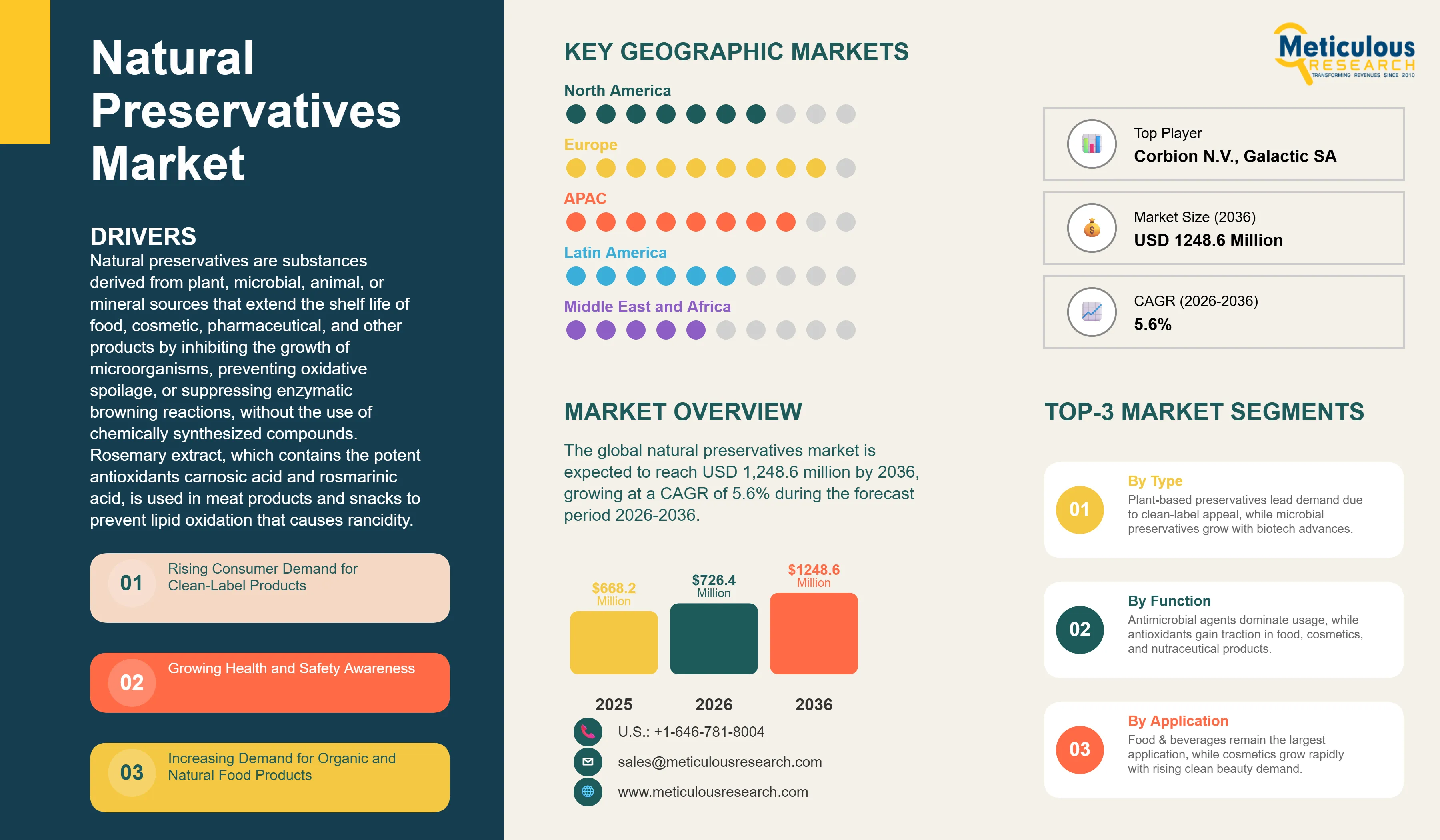
The global natural preservatives market was valued at USD 668.2 million in 2025. This market is expected to reach USD 1,248.6 million by 2036 from an estimated USD 726.4 million in 2026, growing at a CAGR of 5.6% during the forecast period 2026-2036.
 Click here to: Get Free Sample Pages of this Report
Natural preservatives are substances derived from plant, microbial, animal, or mineral sources that extend the shelf life of food, cosmetic, pharmaceutical, and other products by inhibiting the growth of microorganisms, preventing oxidative spoilage, or suppressing enzymatic browning reactions, without the use of chemically synthesized compounds. Rosemary extract, which contains the potent antioxidants carnosic acid and rosmarinic acid, is used in meat products and snacks to prevent lipid oxidation that causes rancidity. Nisin, a bacteriocin produced by the fermentation of Lactococcus lactis bacteria, is one of the few naturally derived antimicrobial peptides approved for food use globally and is used in dairy products, meat products, and beverages to inhibit Listeria and Clostridium growth. Salt, vinegar, and citric acid derived from natural fermentation processes represent the most ancient category of natural preservatives that have been used in food preservation for thousands of years.
The market is growing because consumer demand for clean label products, meaning products whose ingredient lists contain recognizable and natural-sounding ingredients rather than coded chemical names, has intensified consistently over the past decade and is now a mainstream purchasing criterion rather than a niche preference. The consumers are actively reading ingredient labels before purchasing food products, and the presence of preservatives with chemical names such as sodium benzoate or potassium sorbate is identified as a purchase barrier by a large proportion of this label-reading population. The European Union's food labeling regulations under Regulation (EU) 1169/2011 require clear disclosure of all additives including preservatives, and European consumer surveys conducted by BEUC, the European Consumer Organisation, in 2025 show that the majority of European consumers prefer products without synthetic additives when comparable natural alternatives are available.
Two particularly important growth areas are defining the market's trajectory. The cosmetics and personal care sector is the fastest-growing application for natural preservatives, as the global clean beauty movement drives formulators to replace parabens, formaldehyde-releasing preservatives, and other synthetic cosmetic preservatives with plant-derived and fermentation-derived alternatives. Microbial-based preservatives derived from fermentation, including lactic acid, natamycin, and novel bacteriocins, are the fastest-growing technology category as fermentation biotechnology advances allow new biopreservative compounds to be produced at commercially viable scales with demonstrated efficacy.
|
Parameters |
Details |
|
Market Size by 2036 |
USD 1,248.6 Million |
|
Market Size in 2026 |
USD 726.4 Million |
|
Market Size in 2025 |
USD 668.2 Million |
|
Revenue Growth Rate (2026-2036) |
CAGR of 5.6% |
|
Dominating Preservative Type |
Plant-Based Preservatives |
|
Fastest Growing Preservative Type |
Microbial-Based Preservatives |
|
Dominating Function |
Antimicrobial Agents |
|
Fastest Growing Function |
Antioxidants |
|
Dominating Application |
Food and Beverages |
|
Fastest Growing Application |
Cosmetics and Personal Care |
|
Dominating End-Use Industry |
Food Industry |
|
Fastest Growing End-Use Industry |
Cosmetics & Personal Care |
|
Dominating Form |
Liquid |
|
Fastest Growing Form |
Powder |
|
Dominating Source |
Plant-Based |
|
Fastest Growing Source |
Microbial-Based |
|
Dominating Geography |
Europe |
|
Fastest Growing Geography |
Asia-Pacific |
|
Base Year |
2025 |
|
Forecast Period |
2026 to 2036 |
Clean Label Movement Becoming a Mainstream Commercial Requirement
The clean label movement, which began as a premium or organic niche market trend, has evolved into a mainstream commercial requirement for food and beverage manufacturers across all price points and retail channels. Major food manufacturers including Nestlé, Unilever, General Mills, and Conagra Brands have all made public commitments to remove or replace synthetic additives including preservatives from their product portfolios, driving ingredient substitution programs that create direct commercial demand for natural preservative alternatives.
The commercial consequence for natural preservative suppliers is substantial. Every large food manufacturer that reformulates a product to replace a synthetic preservative with a natural alternative creates a new supply agreement with a natural ingredient company. Kerry Group, DSM-Firmenich, and Kemin Industries have all reported growing revenues from their natural preservation ingredient portfolios in their 2025 financial communications, with Kerry Group specifically highlighting its natural preservation category as one of its highest-growth ingredient segments.
Fermentation Biotechnology Expanding the Biopreservative Product Range
Fermentation-derived natural preservatives represent the fastest-growing technology category in the market because advances in industrial fermentation biotechnology are enabling the commercial production of a growing range of biopreservative compounds with efficacy profiles that can match or approach synthetic preservatives in specific applications, while meeting the clean label and natural sourcing requirements that consumers and regulators demand. Nisin, derived from Lactococcus lactis fermentation and approved by the FDA and EFSA as a natural food preservative, has been commercially available for decades, but newer fermentation-derived compounds including natamycin, epsilon-polylysine, and novel bacteriocin formulations are expanding the biopreservative toolkit available to food formulators.
Corbion N.V., which specializes in fermentation-based ingredients including lactic acid and its derivatives, reported in its 2025 annual results that its food and beverage preservation segment was growing above average, driven by demand from both clean label reformulation programs and the growing market for shelf-stable minimally processed foods that require effective preservation without synthetic additives. Galactic SA, a Belgian company specializing in lactic acid fermentation products, has been expanding its portfolio of fermentation-derived food preservation ingredients including antimicrobial vinegar and natamycin products. According to the European Food Safety Authority's 2024 Scientific Panel on Food Additives, several fermentation-derived biopreservative compounds are currently under evaluation for broader food use approval, indicating a regulatory pipeline that may expand the range of approved fermentation-based natural preservatives within the forecast period.
Clean Beauty Driving Natural Preservative Adoption in Cosmetics
The global cosmetics and personal care industry is undergoing a profound transformation driven by consumer demand for products free from synthetic preservatives, with parabens, phenoxyethanol, and formaldehyde-releasing compounds increasingly targeted for removal by brands responding to consumer and activist pressure. The clean beauty segment, defined by the Environmental Working Group, Sephora Clean, and Ulta Beauty's conscious beauty standards as products free from a specified list of synthetic ingredients including several preservative classes, has grown from a specialty niche to a mainstream retail category.
This shift is creating strong demand for natural cosmetic preservatives including rosemary extract, vitamin E (tocopherol), grapefruit seed extract, radish root ferment filtrate, and Leuconostoc ferment filtrate, which are among the most commercially adopted plant-derived and fermentation-derived alternatives to conventional cosmetic preservatives. DSM-Firmenich, through its Pentiol Green and natural preservation ingredient lines, IFF through its Lucas Meyer Cosmetics natural preservation portfolio, and specialty companies including Lonza's natural cosmetic preservation range are all active in this growing market. The technical challenge in natural cosmetic preservation is achieving the broad-spectrum antimicrobial efficacy required to pass challenge testing under ISO 11930 cosmetic preservation standards, and the ingredient industry is investing significantly in developing more effective natural preservation systems to meet this technical bar.
Rising Consumer Demand for Clean-Label Products
Consumer demand for clean label food products has reached levels where it now shapes product development strategy at the world's largest food and beverage companies. According to the International Food Information Council's 2025 Food and Health Survey, most of U.S. consumers reported that the presence of artificial ingredients makes them less likely to purchase a product. These data points reflect a consumer preference that food manufacturers cannot ignore commercially: products with synthetic preservative names on their labels are increasingly disadvantaged relative to comparable products with natural preservation systems. The commercial consequence is a sustained and growing demand for effective natural preservative ingredients that allow food companies to reformulate existing products and develop new ones with clean label positioning.
Regulatory Pressure on Synthetic Preservatives
Regulatory scrutiny of synthetic food preservatives has intensified in major markets, creating an additional institutional driver for natural preservative adoption beyond consumer preference. The European Food Safety Authority's ongoing review of approved food additives under Regulation (EC) No 1333/2008 has resulted in reduced acceptable daily intakes or pending re-evaluations for several synthetic preservatives including some benzoates and sulphites. The EU's Farm to Fork Strategy, published in 2020 and being implemented progressively through 2025 and beyond, explicitly targets the reduction of food additives and processing aids in the European food supply chain, providing policy direction that encourages manufacturers to reformulate with natural alternatives. In the U.S., the FDA's Generally Recognized as Safe re-evaluation program and growing state-level regulation, including California's Food Safety Act which came into force progressively from 2025, are raising the regulatory risk profile of certain synthetic food additives and creating commercial incentives for manufacturers to proactively reformulate with natural alternatives.
Innovation in Plant-Based and Bio-Based Preservatives
The research and commercial pipeline for novel plant-derived and fermentation-derived natural preservatives is more active than at any point in the industry's history, driven by the convergence of strong market demand, advances in extraction and fermentation technology, and growing investment in food ingredient innovation. Encapsulation technologies that protect natural antimicrobial compounds like essential oil components from degradation during food processing and storage are enabling the use of volatile plant-derived preservatives in applications where they were previously too unstable to be effective. Microencapsulated rosemary extract, encapsulated nisin, and nanoencapsulated curcumin are examples of commercial ingredient innovations that extend the functional range of natural preservatives into previously inaccessible applications. According to DSM-Firmenich's 2025 innovation pipeline communications, the company has several natural preservation systems in late-stage development targeting specific unmet needs in dairy, bakery, and beverage applications where effective natural preservation has been technically difficult to achieve.
Natural Preservation in Cosmetics and Personal Care
The cosmetics and personal care industry's transition away from synthetic preservatives is creating one of the fastest-growing demand opportunities for natural preservation ingredients. Mintel’s 2025 Global New Products Database and beauty-and-personal-care insights point to continued growth in cleaner formulations and preservative alternatives, representing a very large and growing procurement demand for natural cosmetic preservation systems. The technical challenge is significant because cosmetic products contain water, emollients, and other materials that support microbial growth and must pass ISO 11930 challenge testing to demonstrate adequate preservation, creating a strong innovation incentive for cosmetic preservation ingredient developers.
By Type: In 2026, Plant-Based Preservatives to Dominate
Based on type, the global natural preservatives market is segmented into plant-based preservatives (essential oils, herbal extracts, and spices and oleoresins), microbial-based preservatives (bacteriocins and fermentation-derived preservatives), animal-based preservatives (chitosan and enzymes), and mineral-based preservatives (salt and vinegar). In 2026, the plant-based preservatives segment is expected to account for the largest share of the global natural preservatives market. Rosemary extract, which is approved for food use under EU Regulation (EU) 1169/2011 as E392 and is widely used as a natural antioxidant in meat, bakery, and snack applications, is among the most commercially adopted natural preservative ingredients globally. Essential oil-derived compounds including thymol from thyme oil and carvacrol from oregano oil are growing in antimicrobial applications. Herbal extracts and spice oleoresins represent a broad and commercially diverse category that serves food, cosmetic, and pharmaceutical preservation applications.
However, the microbial-based preservatives segment is projected to register the highest CAGR during the forecast period. Fermentation biotechnology advances are expanding the range of commercially available biopreservative compounds beyond the established nisin and natamycin products, and the clean label positioning of fermentation-derived ingredients, which can often be described simply as fermented ingredient or culture-derived on labels, aligns well with consumer clean label preferences. Corbion's lactic acid-based preservation systems and the growing range of bacterial ferment filtrates adopted in cosmetics are driving above-average growth in the microbial-based segment.
By Application: In 2026, Food and Beverages to Hold the Largest Share
Based on application, the global natural preservatives market is segmented into food and beverages (bakery and confectionery, dairy products, meat and poultry, and beverages), cosmetics and personal care (skincare and haircare products), pharmaceuticals, nutraceuticals, and animal feed. In 2026, the food and beverages segment is expected to account for the largest share of the global natural preservatives market. The global packaged food and beverage market is very large and heavily dependent on preservation to enable the supply chain distances and shelf lives that modern food retail requires, and the clean label reformulation wave sweeping across this sector is creating growing and sustained demand for natural preservative ingredients.
However, the cosmetics and personal care segment is projected to register the highest CAGR during the forecast period, driven by the clean beauty movement reaching mainstream retail scale, the removal of parabens and other synthetic preservatives from a growing proportion of new cosmetic product launches, and the very large addressable market of the global personal care industry.
Natural Preservatives Market by Region: Europe Leading by Share, Asia-Pacific by Growth
Based on geography, the global natural preservatives market is segmented into Europe, North America, Asia-Pacific, Latin America, and the Middle East and Africa.
In 2026, Europe is expected to account for the largest share of the global market for natural preservatives. Europe leads because it has the world's most demanding regulatory environment for synthetic food additives, the most mature clean label consumer culture, and the highest concentration of natural ingredient manufacturers and food technology companies that have developed and commercialized natural preservation systems. The EU's food additive regulation framework under Regulation (EC) No 1333/2008, with its ongoing re-evaluation program and the Farm to Fork Strategy's stated goal of reducing additives in the food supply, creates a regulatory pressure environment that makes natural preservative adoption a business necessity rather than purely an aspirational marketing choice for European food manufacturers. Germany, France, Switzerland, and the Netherlands are home to major natural ingredient companies including Corbion, DSM-Firmenich, and BASF's natural ingredient divisions that collectively represent a significant share of global natural preservative production. According to the Innova Market Insights 2025 data, European new product launches making clean label or free-from-artificial-additives claims account for a higher proportion of total launches than in any other major region, confirming Europe's clean label maturity.
However, the Asia-Pacific natural preservatives market is expected to grow at the fastest CAGR during the forecast period. The region's growth is driven by several converging forces. China's rapidly growing middle class and its increasing adoption of Western-style packaged food consumption patterns, combined with Chinese consumers' well-documented sensitivity to food safety and ingredient transparency following multiple food scandals, is creating growing demand for clean label products among China's urban consumer population. According to the China National Bureau of Statistics' 2025 data, China's packaged food market continued to grow rapidly in 2024 as urbanization and income growth drive conversion from traditional fresh food consumption toward packaged and processed food formats that require preservation. India's very large and growing food processing industry, expanding personal care market, and regulatory modernization under the FSSAI (Food Safety and Standards Authority of India) are all contributing to growing natural preservative demand. Japan's well-established preference for natural and minimally processed food ingredients makes it an important premium market for high-quality natural preservation systems. The clean beauty movement is spreading rapidly across South Korea, which is a global leader in cosmetics innovation, Indonesia, Thailand, and other Southeast Asian markets where rising incomes are driving premiumization in personal care.
The natural preservatives market is served by large diversified food ingredient companies that offer natural preservation as part of comprehensive ingredient portfolios, specialist fermentation and biopreservation companies, plant extract specialists, and a growing number of smaller innovation companies developing next-generation natural preservation systems. Competition is based on preservation efficacy and spectrum of activity, regulatory approval status across key markets, clean label positioning and labeling compatibility, supply security and consistency of natural raw materials, and technical service capability for customer formulation support.
The report provides a comprehensive competitive analysis based on a thorough review of leading players' ingredient portfolios, application expertise, regulatory approvals, and recent strategic developments. Some of the key players operating in the global natural preservatives market include BASF SE (Germany), Kerry Group plc (Ireland), DSM-Firmenich (Netherlands/Switzerland), Corbion N.V. (Netherlands), Cargill Incorporated (U.S.), DuPont de Nemours Inc. (U.S.), Ingredion Incorporated (U.S.), Kemin Industries Inc. (U.S.), Archer Daniels Midland Company (U.S.), Naturex/Givaudan (France/Switzerland), Tate & Lyle PLC (UK), IFF International Flavors & Fragrances Inc. (U.S.), Galactic SA (Belgium), Prinova Group LLC (U.S.), and Barentz International (Netherlands), among others.
The global natural preservatives market is expected to reach USD 1,248.6 million by 2036 from an estimated USD 726.4 million in 2026, at a CAGR of 5.6% during the forecast period 2026-2036.
In 2026, the plant-based preservatives segment is expected to hold the largest share of the global natural preservatives market, driven by rosemary extract, herbal extracts, and essential oil-derived compounds being the most widely adopted natural preservative ingredients across food, beverage, and cosmetic applications globally.
The microbial-based preservatives segment is projected to register the highest CAGR during the forecast period, driven by fermentation biotechnology advances expanding the commercial range of biopreservative compounds available to food and cosmetic formulators, and by the clean label appeal of fermentation-derived ingredients that can be labeled simply as culture-derived or fermented on product packaging.
In 2026, the food and beverages segment is expected to hold the largest share of the global natural preservatives market, reflecting the very large packaged food and beverage industry's sustained clean label reformulation wave that is converting synthetic preservative use to natural alternatives across bakery, dairy, meat, and beverage applications.
Europe is expected to dominate the global natural preservatives market in 2026, driven by the EU's stringent regulatory framework for synthetic food additives, the Farm to Fork Strategy's direction toward reduced additive use, and the world's most mature clean label consumer culture that makes natural preservation a commercial standard across European food manufacturing.
Key players are BASF SE (Germany), Kerry Group plc (Ireland), DSM-Firmenich (Netherlands/Switzerland), Corbion N.V. (Netherlands), Cargill Incorporated (U.S.), DuPont de Nemours Inc. (U.S.), Ingredion Incorporated (U.S.), Kemin Industries Inc. (U.S.), Archer Daniels Midland Company (U.S.), Naturex/Givaudan (France/Switzerland), Tate & Lyle PLC (UK), IFF International Flavors & Fragrances Inc. (U.S.), Galactic SA (Belgium), Prinova Group LLC (U.S.), and Barentz International (Netherlands), among others.
Asia-Pacific is expected to register the highest growth rate in the global natural preservatives market during the forecast period 2026-2036, driven by China's rapidly growing urban packaged food market, India's large and expanding food processing industry, South Korea's global leadership in clean beauty cosmetics innovation, and the broader spread of clean label food and cosmetic preferences across rising-income Southeast Asian consumer markets.
























Published Date: Mar-2026
Published Date: Feb-2026
Published Date: May-2025
Published Date: Jan-2025
Published Date: Nov-2024
Please enter your corporate email id here to view sample report.
Subscribe to get the latest industry updates


