
Industrial Mixers Market (2026-2036)
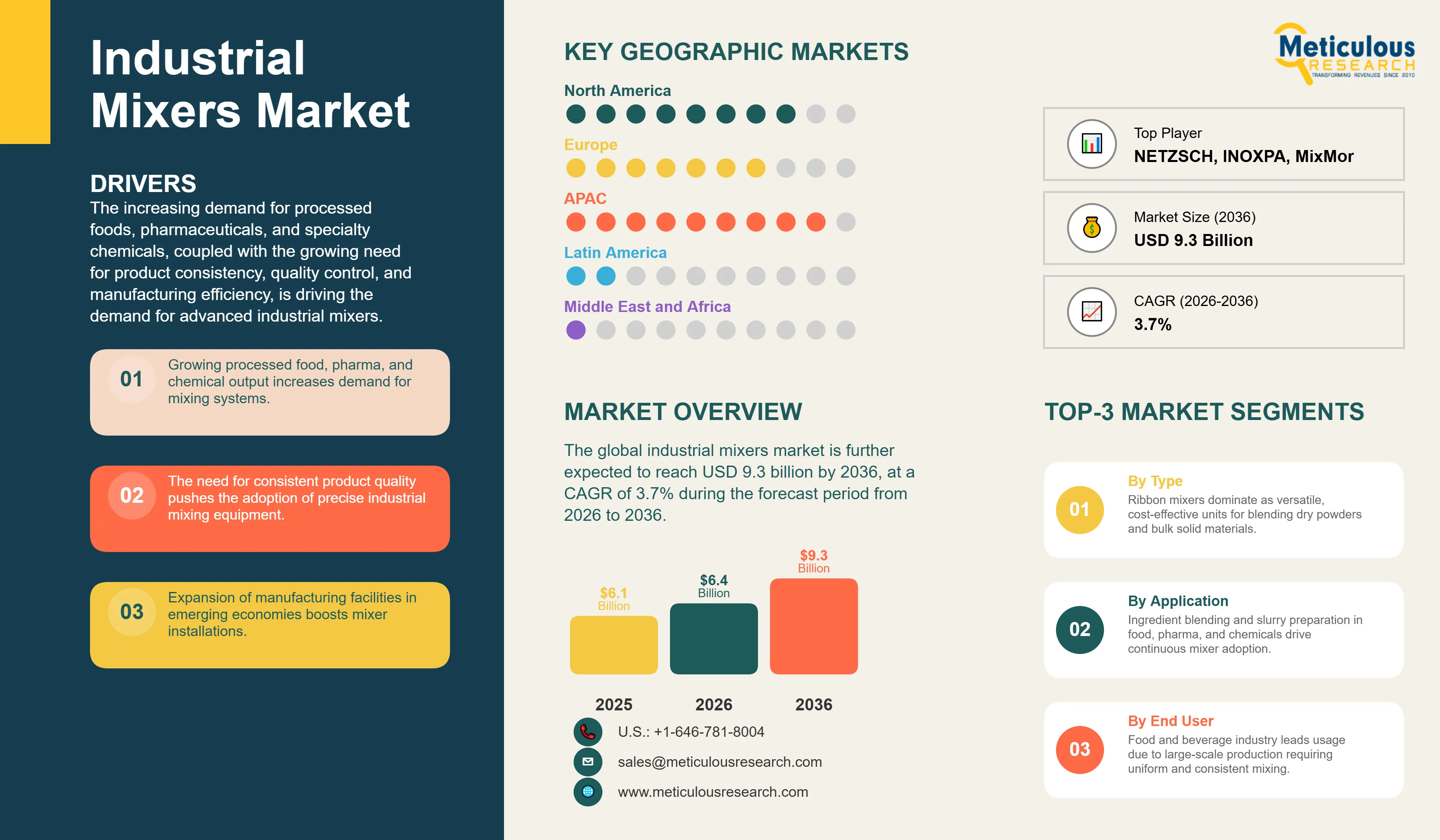
The global industrial mixers market was valued at USD 6.1 billion in 2025 and is projected to reach around USD 6.4 billion in 2026. The market is further expected to reach USD 9.3 billion by 2036, at a CAGR of 3.7% during the forecast period from 2026 to 2036.
- Published
- Feb 2026
- Pages
- 267
- Format
- PDF + Excel
- Report ID
- MR-1775
- Base year
- 2025
- 2025 · BASELINE
- $6.10B
- 2036
- $9.30B
- CAGR 2026–2036
- 3.7%
2025 baseline · 2026–2036 forecast at 3.7% CAGR · hover a bar for the value
Key highlights
In terms of revenue, the global industrial mixers market is valued at USD 6.4 billion in 2026 and is projected to reach USD 9.3 billion by 2036.
The market is expected to grow at a CAGR of 3.7% from 2026 to 2036.
Asia-Pacific dominates the global industrial mixers market with the largest market share and is also expected to witness the fastest CAGR during the forecast period.
By type, the Ribbon Mixer segment holds the largest market share due to its versatility and cost-effectiveness in mixing dry powders and solids.
By end-user, the Food & Beverage and Chemical industries are the largest contributors to the market, driven by the need for large-scale, consistent production.
Report summary
| Particulars | Details |
|---|---|
| Report Coverage | Details |
| Market Size by 2036 | USD 9.3 Billion |
| Market Size in 2026 | USD 6.4 Billion |
| Market Growth Rate from 2026 to 2036 | CAGR of 3.7% |
| Format | PDF, Excel & Cloud Portal · 267 pages |
| Dominating Region | Asia-Pacific |
| Fastest Growing Region | Asia-Pacific |
| Base Year | 2025 |
| Forecast Period | 2026 to 2036 |
| Segments Covered | Type, Technology, End-User, and Geography |
| Regions Covered | North America, Europe, Asia-Pacific, Latin America, and Middle East & Africa |
Report overview
Segments covered: type, technology, end-user.
The increasing demand for processed foods, pharmaceuticals, and specialty chemicals, coupled with the growing need for product consistency, quality control, and manufacturing efficiency, is driving the demand for advanced industrial mixers.
An industrial mixer is a machine designed to blend, emulsify, homogenize, or agitate a wide range of materials, from powders and granules to liquids and viscous pastes. These machines are fundamental to countless manufacturing processes, ensuring that different components are combined into a uniform, consistent substance. The core function of an industrial mixer is to apply mechanical energy to the materials, using various types of impellers, blades, or agitators to achieve the desired level of mixing. The design of a mixer can vary significantly based on the application, with key considerations including the viscosity of the materials, the required degree of shear, the batch size, and whether the process is batch or continuous. Common types include ribbon blenders for dry powders, high-shear mixers for creating emulsions and dispersions, planetary mixers for viscous pastes, and paddle mixers for gentle blending. The ultimate goal is to produce a final product with consistent quality, texture, and composition, which is critical for performance and consumer satisfaction.
The market for industrial mixers is driven by the fundamental need for quality and consistency across a broad spectrum of manufacturing industries. In the food and beverage sector, mixers are essential for creating everything from cake batter and sauces to powdered drink mixes. The pharmaceutical industry relies on highly precise mixers to ensure the uniform distribution of active pharmaceutical ingredients (APIs) in tablets and creams, a critical factor for dosage accuracy and efficacy. In the chemical industry, mixers are used to produce paints, adhesives, plastics, and a vast array of other products. According to technical sources like Palamatic Process, the choice of mixer technology is dictated by the specific rheology of the materials and the desired outcome, whether it's simple blending, particle size reduction, or creating a stable emulsion. As consumer demand for high-quality, consistent products grows, and as manufacturing processes become more sophisticated, the role of the industrial mixer as a critical piece of process equipment becomes ever more important.
Report infographic
Market dynamics
10 factors across 4 forcesGrowing Demand from Process Industries (Food, Pharma, Chemical)
The relentless growth of the global population and rising disposable incomes are fueling the expansion of key process industries such as food and beverage, pharmaceuticals, and chemicals. These industries are the largest consumers of industrial mixers. The increasing demand for processed foods, the development of new drugs and therapies, and the production of specialty chemicals all rely on precise and efficient mixing processes. As these industries continue to grow, particularly in emerging economies, the demand for industrial mixers to equip new and expanding production facilities will also increase, acting as a primary driver for the market.
Stringent Quality Standards and Need for Product Consistency
In today's competitive market, product quality and consistency are paramount. Consumers expect the products they buy, whether it's a jar of mayonnaise, a life-saving drug, or a can of paint, to be the same every time. Industrial mixers play a critical role in achieving this consistency. By ensuring that all ingredients are thoroughly and uniformly blended, mixers help to eliminate batch-to-batch variations and ensure that the final product meets all quality specifications. The increasing stringency of quality standards and regulatory requirements, particularly in the food and pharmaceutical industries, is a powerful driver for the adoption of advanced mixing technologies that can deliver a high degree of precision and repeatability.
Table of contents
12 chapters · 122 sections · 267 pages · click to expandSegmental analysis
| Segment | Largest share (2026) | Fastest growth (2026–2036) |
|---|---|---|
| By Type | Ribbon Mixers | — |
| By End-User Industry | — | — |
By Type
- Ribbon mixers account for a significant share of the overall industrial mixers market in 2026, due to their widespread adoption across dry blending applications in the food processing, specialty chemicals, and construction materials industries.
- These mixers are primarily used for bulk blending of free-flowing powders such as flour, cement additives, polymer resins, and premix ingredients, where uniform distribution of materials is required without intensive shear.
- Their relatively low operational complexity and ability to process large batch volumes make them a preferred choice among manufacturers operating in high-throughput environments.
- As a result, ribbon mixers continue to be extensively deployed in applications such as seasoning blends, dry chemical formulations, and powdered construction materials, supporting their position as one of the most commonly used mixing technologies in industrial processing facilities.
By End-User Industry
- The food & beverage industry is a major end user of industrial mixers due to the extensive use of blending equipment in ingredient preparation and product formulation processes.
- Industrial mixers are deployed for applications such as dry ingredient blending, beverage formulation, sauce preparation, and seasoning production across food processing facilities.
- The increasing demand for processed and convenience food products has led to higher production volumes, thereby driving the installation of standalone mixing equipment for batch and continuous processing operations.
- Additionally, compliance with sanitary processing standards is encouraging food manufacturers to adopt mixing systems designed for hygienic operation, supporting equipment replacement and upgrade activities across the sector.
- U.S. Industrial Mixers Market Size and Growth 2026 to 2036
- The U.S. industrial mixers market is projected to reach approximately USD 2.2 billion by 2036, growing at a CAGR of 3.2% during the forecast period from 2026 to 2036.
Geographic analysis
Asia-Pacific
Largest shareThe Asia-Pacific region commands the largest share of the global industrial mixers market in 2026. The largest share of this market is mainly due to the significant demand for standalone blending equipment across powder processing and slurry preparation applications. Countries such as China, India, and South Korea have emerged as major production hubs for food premixes, polymer compounds, battery materials, and specialty chemicals, all of which require uniform blending of powders and viscous formulations prior to downstream processing. The growing production of dry ingredient mixes, construction additives, and nutraceutical powders is driving the deployment of ribbon and paddle mixers across food processing and materials manufacturing facilities. In addition, the rapid expansion of lithium-ion battery manufacturing capacity across China and Southeast Asia has increased the demand for high-shear mixing systems used in electrode slurry preparation. Battery production processes require uniform dispersion of active materials and binders before coating operations, which is contributing to the adoption of continuous and inline mixing systems across gigafactory installations. Similarly, the strong presence of this region in polymer compounding and agrochemical formulation is supporting the use of batch and continuous mixers for additive blending and material homogenization. The increasing establishment of ingredient manufacturing plants and specialty chemical processing facilities across Asia-Pacific is also further driving equipment replacement and capacity expansion activities. As a result, standalone industrial mixers are being increasingly deployed to support bulk material preparation processes across high-volume production environments, enabling Asia-Pacific to maintain its leadership position in the global industrial mixers market. By Geography Asia-Pacific
Competitive landscape
- —
December 2025 – ITT Inc. announced a definitive agreement to acquire SPX FLOW (parent of Lightnin® and Philadelphia Mixing Solutions), positioning those mixer brands to join ITT’s Industrial Process segment upon close
- EIRICH Machines GmbH
- Silverson Machines Ltd.
- Hosokawa Micron B.V.
- GMM Pfaudler Ltd.
- Charles Ross & Son Company
- Readco Kurimoto, LLC
- Marion Process Solutions
- EKATO Holding GmbH
- NETZSCH Group
- INOXPA S.A.U
- Bachiller Group
- MixMor (NOV Inc.)
Frequently asked questions
The industrial mixers market is expected to increase from USD 6.4 billion in 2026 to USD 9.3 billion by 2036.
Cite this report
Meticulous Research. (2026). Industrial Mixers Market - Global Opportunity Analysis and Industry Forecast (2026-2036) (Report No. MR-1775). Meticulous Market Research Pvt. Ltd. https://www.meticulousresearch.com/product/industrial-mixers-market-6458