
Electric Boiler Market (2026-2036)
The global electric boiler market was valued at USD 10.78 billion in 2025. This market is expected to reach approximately USD 29.3 billion by 2036 from USD 11.81 billion in 2026, at a CAGR of 9.5% from 2026 to 2036.
- Published
- Jan 2026
- Pages
- 235
- Format
- PDF + Excel
- Report ID
- MR-1666
- Base year
- 2025
- 2025 · BASELINE
- $10.78B
- 2036
- $29.30B
- CAGR 2026–2036
- 9.5%
2025 baseline · 2026–2036 forecast at 9.5% CAGR · hover a bar for the value
Key highlights
The global electric boiler market was valued at USD 10.78 billion in 2025.
This market is expected to reach approximately USD 29.3 billion by 2036 from USD 11.81 billion in 2026, at a CAGR of 9.5% from 2026 to 2036.
The resistance boilers segment accounts for around 60-65% of the overall electric boiler market in 2026.
Europe holds the largest share of the global electric boiler market in 2026. The largest share of this region is primarily attributed to the massive government-led investments in energy transition infrastructure, particularly in Germany, Norway, and the UK.
North America accounts for around 20 to 25% of the global electric boiler market. The growth of this market is mainly driven by the need to replace aging boiler assets and the implementation of stringent local emission mandates in cities like New York and Vancouver.
In Asia Pacific, the rapid industrialization and the push for air quality improvement are driving the adoption of electric boilers.
Report summary
| Particulars | Details |
|---|---|
| Base Year | 2025 |
| Estimated Year | 2026 |
| Forecast Period | 2026–2036 |
| Market Size (2025) | USD 10.78 billion |
| Market Size (2026) | USD 11.81 billion |
| Market Size (2036) | USD 29.30 billion |
| CAGR (2026–2036) | 9.5% |
| Format | PDF, Excel & Cloud Portal · 235 pages |
| Segments Covered | By Capacity: Up to 10 MW, 10–50 MW, Above 50 MW · By Application: Industrial, Commercial, Residential · By Voltage Rating |
Report overview
Segments covered: capacity, application, voltage rating.
The growth of the overall electric boiler market is driven by the increasing push for the decarbonization of industrial and commercial heating systems and the rapid transition toward "Power-to-Heat" (P2H) solutions. As nations implement stringent carbon emission regulations and carbon taxes, electric boilers, including high-voltage electrode and resistance-type systems, have become essential for industries seeking to eliminate onsite combustion emissions and leverage surplus renewable energy from wind and solar. The rapid expansion of district heating networks, coupled with the increasing need for grid balancing and the electrification of manufacturing processes, continues to fuel significant growth of this market across all major geographic regions.
Electric boilers are advanced thermal energy systems that convert electrical energy into heat, typically in the form of steam or hot water, without the need for fossil fuel combustion. These systems are categorized into two primary technologies: resistance boilers, which use immersion heating elements to transfer heat to the water, and electrode boilers, which utilize the conductive properties of water itself to generate heat through an electrical current. Unlike traditional fuel-fired boilers, electric units offer nearly 100% efficiency, zero onsite emissions, and a significantly smaller physical footprint, making them indispensable for modern urban and industrial environments.
The market includes a diverse range of configurations, ranging from compact wall-mounted units for residential use to massive high-voltage electrode systems capable of producing over 100 MW of thermal power. These systems are increasingly integrated with thermal energy storage (TES) and intelligent control platforms to provide services such as peak shaving and frequency regulation for power grids. The ability to provide rapid start-up and precise temperature control has made electric boilers the technology of choice for food processing, pharmaceuticals, and district heating operators seeking to manage the intermittency of renewable power.
The overall electric boiler market is expected to witness robust growth during the forecast period, driven by several factors. The global energy sector is pushing hard to electrify heat, aiming to meet net-zero emission targets. This drive has increased the adoption of high-capacity units, with advanced electrode boilers helping to stabilize grids by consuming excess renewable generation during periods of low demand. At the same time, the rapid growth in the commercial building market is increasing the need for sustainable HVAC solutions. Electric boilers offer crucial features like low maintenance and high safety to support the sustainability requirements of modern digital and urban infrastructure.
Manufacturers are increasingly moving beyond small-scale resistance units to massive jet-type electrode boilers that can operate at voltages up to 20 kV. Leading companies are deploying these systems in district heating networks and large industrial complexes to serve as "virtual batteries" for the grid. The recent commissioning of large-scale electrode boiler projects in Northern Europe marks a key milestone in this transition. These advanced designs allow for rapid response to grid signals, enabling operators to absorb surplus wind and solar energy and convert it into storable heat, making electric boilers increasingly competitive with traditional gas-fired peaker plants.
As the industry moves toward decentralized energy management, manufacturers are creating units that feature advanced IoT sensors and predictive control modules. This approach allows for real-time optimization of heating schedules based on electricity price signals and weather forecasts, significantly reducing operational costs. Furthermore, manufacturers are investing in hybrid boiler research to provide a bridge for facilities transitioning from fossil fuels, further enhancing the technological profile of the market.
Report infographic
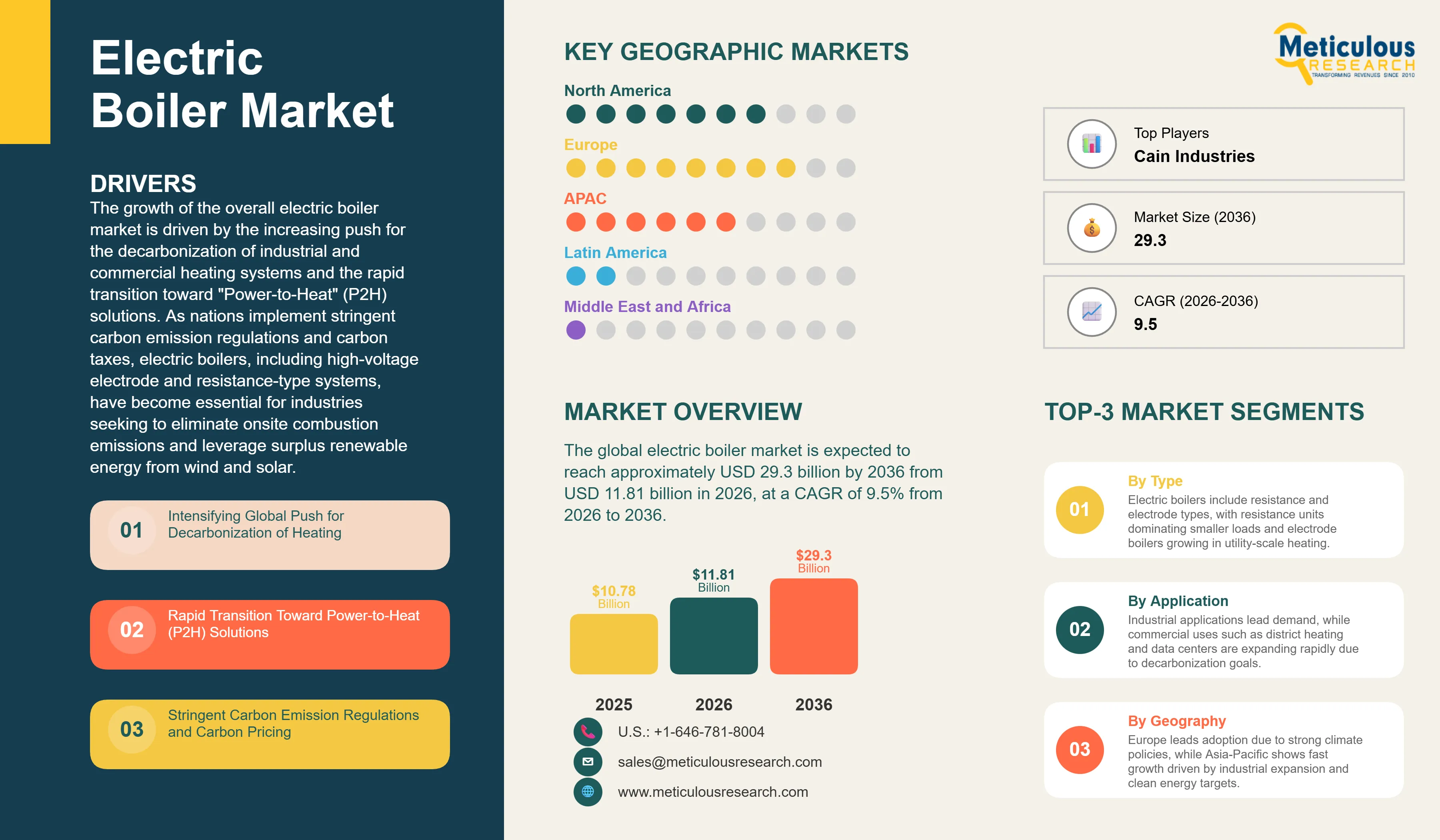
Market dynamics
2 factors across 2 forcesDecarbonization Mandates and Carbon Pricing
Global regulations requiring the reduction of greenhouse gas emissions have created significant incentives for the adoption of electric heating. The EU Green Deal, the U.S. Clean Air Act, and various national carbon tax schemes drive manufacturers toward zero-emission solutions that conventional boilers cannot match. It is estimated that as carbon prices rise through 2036, the total cost of ownership (TCO) for electric boilers becomes increasingly attractive; therefore, electric boilers, with their ability to eliminate onsite combustion, are considered a crucial enabler of modern industrial strategies.
Table of contents
12 chapters · 117 sections · 235 pages · click to expandSegmental analysis
| Segment | Largest share (2026) | Fastest growth (2026–2036) |
|---|---|---|
| By Product Type | Resistance Boilers | Electrode boilers |
By Product Type
- The resistance boilers segment accounts for around 60-65% of the overall electric boiler market in 2026.
- These systems, typically ranging from 10 kW to 5,000 kW, offer a cost-effective and reliable way to provide hot water and steam.
- The commercial sector alone consumes the vast majority of resistance boiler production, with major projects in North America and Europe demonstrating the technology's capability to provide safe, emission-free heating.
- However, the electrode boilers segment is expected to grow at the fastest CAGR during the forecast period, driven by the requirement for high-capacity bulk heat generation in district heating and large-scale industrial processes.
- The ease of integration into high-voltage grids and the high power density of new electrode designs make them highly attractive for utility-scale users.
- Application Insights
- The industrial segment holds the largest share of the overall electric boiler market in 2026, accounting for around 55-60% of the overall electric boiler market.
- From food processing and chemical manufacturing to pharmaceutical production and paper mills, the use of electric boilers in the industrial sector is central to modernizing manufacturing infrastructure.
- Current industrial projects are increasingly specifying electric units for their precision control and ability to meet corporate sustainability targets.
- The commercial segment is expected to witness the fastest CAGR during the forecast period, owing to the growing focus on green building certifications (LEED, BREEAM) and the need for resilient onsite heating in data centers and healthcare facilities.
- Electric boilers are finding critical applications in providing sustainable hot water and steam for large urban complexes.
Geographic analysis
Europe
Largest shareEurope holds the largest share of the global electric boiler market in 2026. The largest share of this region is primarily attributed to the massive government-led investments in energy transition infrastructure, particularly in Germany, Norway, and the UK. Europe alone accounts for a significant portion of global electrode boiler innovation, with its position as a leading hub for Power-to-Heat technology driving sustained growth. The presence of leading manufacturers, including Bosch Thermotechnology, Cochran, and specialized electrode boiler producers like PARAT Halvorsen AS, provides a well-developed supply chain serving regional and global customers.
North America
North America accounts for around 20 to 25% of the global electric boiler market. The growth of this market is mainly driven by the need to replace aging boiler assets and the implementation of stringent local emission mandates in cities like New York and Vancouver. The demand for electric units in North America is mainly due to its large-scale commercial modernization projects and the presence of innovators like Cleaver-Brooks and Fulton Group.
Asia-Pacific
In Asia Pacific, the rapid industrialization and the push for air quality improvement are driving the adoption of electric boilers. China leads the market with a strong focus on "Coal-to-Electricity" conversions and the presence of leading technology providers. India represents a rapidly emerging market, driven by its ambitious renewable energy targets and the need for efficient industrial heating in its expanding manufacturing corridors.
Competitive landscape
Alfa Laval & Babcock & Wilcox: These industry giants provide comprehensive thermal technology solutions, offering complete heat recovery systems. Their established reliability and extensive experience in major industrial projects provide them with operational references across all continents.
Cain Industries: A specialist in the field, Cain Industries is a leader in custom-engineered economizer solutions, particularly for challenging industrial applications where standard systems may not suffice.
Alfa Laval & Babcock & Wilcox: These industry giants provide comprehensive thermal technology solutions, offering complete heat recovery systems. Their established reliability and extensive experience in major industrial projects provide them with operational references across all continents.
Cain Industries: A specialist in the field, Cain Industries is a leader in custom-engineered economizer solutions, particularly for challenging industrial applications where standard systems may not suffice.
- —
Alfa Laval launched a compact once-through steam generator that integrates an economizer, evaporator, and superheater into a single unit. This design is specifically intended for modular thermal energy storage systems, facilitating the use of renewable energy (solar/wind) for industrial heating by storing heat in molten salt.
- —
Cleaver-Brooks introduced myBoilerRoom, an advanced digital platform powered by Prometha®. This IoT-driven system uses real-time data analytics to optimize boiler efficiency and reliability. Early deployments, such as in food processing and manufacturing plants, have demonstrated significant fuel cost savings (e.g., over $10,000 annually in one instance) through optimized settings and predictive maintenance.
Frequently asked questions
The electric boiler market is expected to grow from USD 11.81 billion in 2026 to USD 29.3 billion by 2036.
Cite this report
Meticulous Research. (2026). Electric Boiler Market - Global Opportunity Analysis and Industry Forecast (2026-2036) (Report No. MR-1666). Meticulous Market Research Pvt. Ltd. https://www.meticulousresearch.com/product/electric-boiler-market-6349