Resources
About Us
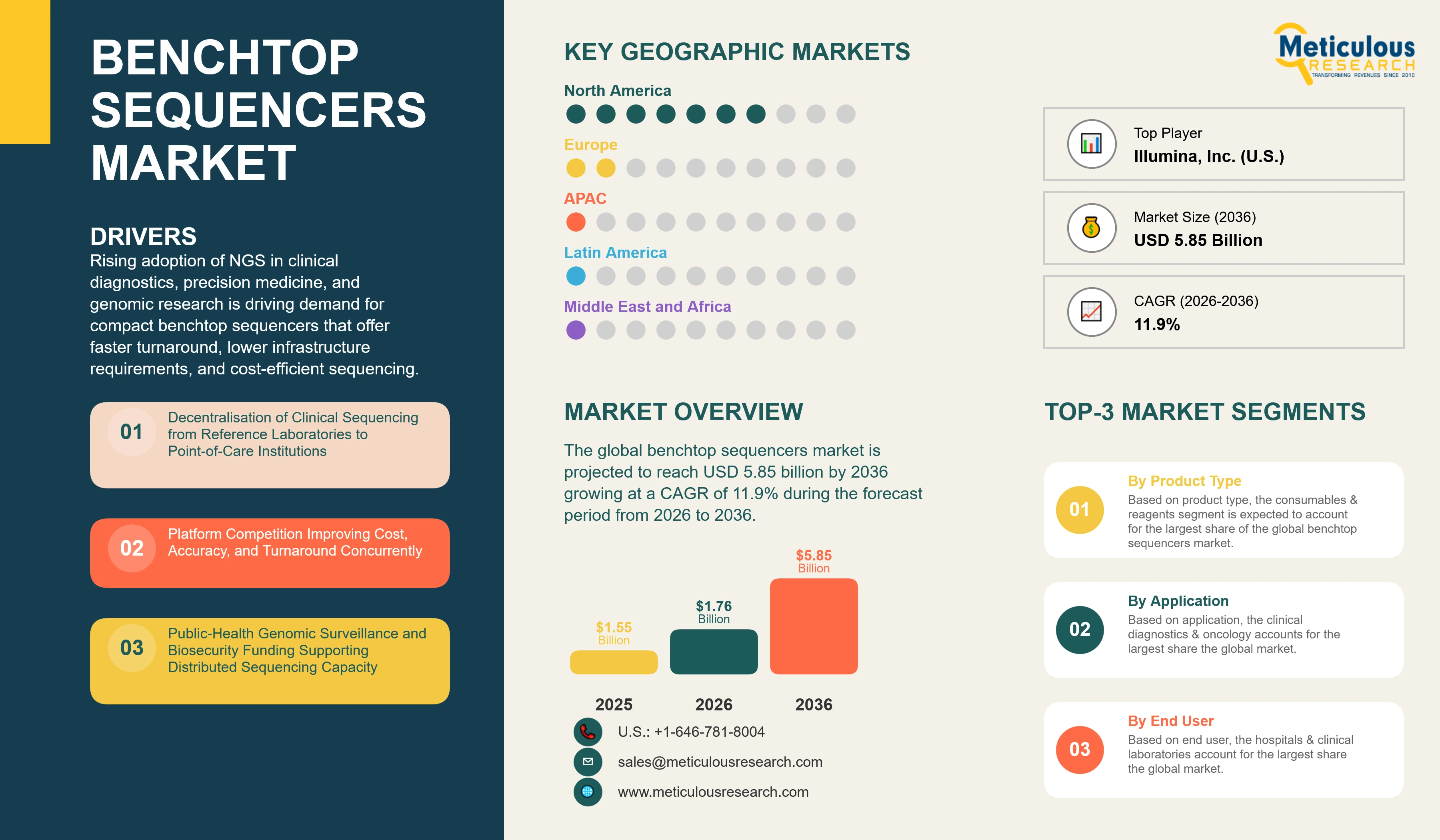
The global benchtop sequencers market is projected to reach USD 5.85 billion by 2036 from an estimated USD 1.76 billion in 2026, at a CAGR of 11.9% during the forecast period from 2026 to 2036. Consumables and reagents account for most of the market value across the period, as each installed instrument generates recurring flow-cell, reagent, and library-preparation demand over a service life of five to eight years.
Click here to: Get Free Sample Pages
A benchtop sequencer is a compact, self-contained next-generation sequencing instrument that operates on a standard laboratory bench without dedicated infrastructure or a full-time production team. The class includes short-read sequencing-by-synthesis systems, ion semiconductor platforms, nanopore devices in portable and compact benchtop configurations, avidity- and expansion-based chemistries, and single-molecule real-time instruments. The market comprises three connected layers: instruments, the consumables and reagents used on every run, and the software, informatics, and service contracts that convert raw signal into reportable results. Instruments are the smallest layer by revenue, but each placement commits a laboratory to a proprietary consumable stream for the working life of the system.
The category reflects a change in where sequencing is performed. Through most of the 2010s, high-throughput sequencing was concentrated in genome centres and commercial reference laboratories able to amortise multimillion-dollar production instruments across continuous sample flow. As cost per genome fell, the National Human Genome Research Institute's cost series records a decline of roughly five orders of magnitude since the Human Genome Project era, the constraint moved from the price of data to the latency, logistics, and process control associated with sending samples elsewhere. Benchtop instruments address that constraint, and buying criteria have shifted accordingly turnaround time, run-size flexibility for small batches, hands-on time, and validated clinical workflows now weigh more heavily than cost per gigabase in most decentralised purchases.
Several platforms have been introduced or updated in a short period. Illumina introduced the MiSeq i100 Series in November 2024, with configurations delivering up to 25 million and 100 million single-end reads per run, urgent-sample runs completing in as little as four hours, and room-temperature-stable reagents that remove cold-chain requirements. Element Biosciences completed the rollout of AVITI24 in 2025, combining Q40+ base-call accuracy with simultaneous multiomic readouts on a benchtop footprint. Oxford Nanopore has extended compact high-output access through PromethION 2 Solo, and Thermo Fisher Scientific's Ion Torrent line retains established positions in targeted oncology panels and regulated workflows. Roche announced Sequencing by Expansion in early 2025 and is commercialising it on the Axelios platform during 2026; the chemistry expands each template into a surrogate Xpandomer read by CMOS-based detection.
Demand comes largely from clinical and public-health workflows rather than discretionary research budgets. Comprehensive genomic profiling in oncology, rare-disease diagnosis, transplant and reproductive testing, antimicrobial resistance characterisation, and outbreak investigation each require sequencing with defined turnaround and chain-of-custody. Public funding supports this: the FY 2026 U.S. Budget proposes USD 52 million for a CDC Biothreat Radar pathogen detection system, and published analysis of the U.S. GenomeTrakr foodborne surveillance network reports approximately USD 31 in avoided health-related costs for every USD 1 invested in whole-genome sequencing. On this basis, the benchtop sequencers market is expected to record low-double-digit growth through 2036.
Decentralisation of Clinical Sequencing from Reference Laboratories to Point-of-Care Institutions
Sequencing is becoming increasingly accessible to hospital molecular pathology departments, regional public-health laboratories, and biotechnology companies that previously relied on centralized facilities. Benchtop platforms reduce logistical constraints associated with outsourcing and provide greater control over turnaround time, sample processing, and workflow customization.
Platforms such as Illumina's MiSeq i100 Series offer run times of approximately four to 24 hours, room-temperature reagent storage, and flexible throughput, making them suitable for laboratories with variable sample volumes and limited genomics infrastructure. This expansion of decentralized sequencing capacity supports demand for instruments, consumables, software, and service contracts.
Platform Competition Improving Cost, Accuracy, and Turnaround Concurrently
Competition among sequencing-platform manufacturers is driving simultaneous improvements in speed, accuracy, throughput flexibility, and ease of use. Roche's AXELIOS 1, launched in 2026, uses Sequencing by Expansion technology for rapid sequencing workflows, while Element Biosciences' AVITI24 offers high-accuracy short-read sequencing with integrated multiomic capabilities.
Oxford Nanopore and PacBio further strengthen competition through real-time and long-read sequencing capabilities. These innovations are increasing differentiation based on accuracy, turnaround time, input requirements, throughput flexibility, reagent stability, and workflow automation, supporting replacement demand and first-time adoption of benchtop systems.
Public-Health Genomic Surveillance and Biosecurity Funding Supporting Distributed Capacity
Growing investment in genomic surveillance is supporting sequencing adoption across state, regional, and sentinel laboratories. The CDC's FY2026 budget proposal includes the Biothreat Radar initiative to strengthen pathogen detection and genomic surveillance capabilities.
Applications including antimicrobial-resistance surveillance, respiratory-virus monitoring, wastewater surveillance, food-safety testing, and outbreak investigation require geographically distributed sequencing capacity. Benchtop systems are well suited to these applications because of their smaller footprint, flexible throughput, and relatively rapid turnaround, creating opportunities for recurring instrument, consumables, software, and service revenues.
Total Cost of Ownership and Bioinformatics Talent Scarcity Limiting Adoption
The cost of clinical deployment extends well beyond the instrument price. A clinically deployed benchtop sequencer requires validated library-preparation workflows, positive and negative controls, proficiency testing, LIMS integration, secure genomic data storage, and bioinformatics and variant-interpretation expertise that mid-size hospitals and regional laboratories often find difficult to recruit and retain. Building and validating a CAP/CLIA-compliant pipeline takes several months and involves analytical validation, version control, and documented change management, and compliance expectations for CLIA- and CAP-accredited laboratories were tightened further in 2026. Reagents are also platform-locked: once an assay is validated, third-party consumables cannot be substituted without revalidation, which limits price competition after placement and raises lifetime cost. For laboratories with low sample volumes, per-sample economics often remain unfavourable relative to outsourcing, which limits penetration in smaller institutions regardless of instrument-price reductions.
Emerging-Market National Genome Programmes and Decentralised Public-Health Networks
National genome initiatives, precision-oncology programmes, and pathogen surveillance networks across Asia-Pacific, the Middle East, and Latin America represent a substantial source of new placements. These programmes generally require distributed capacity at provincial and hospital level rather than a single national centre, and are frequently procured through multi-year public tenders that include training, service, and local-language informatics obligations. Vendors offering low-infrastructure instruments, room-temperature or cold-chain-light reagents, and locally supported informatics are better positioned in these tenders, and regional manufacturing partnerships or technology transfer arrangements are increasingly a condition of award.
Integrated Sample-to-Report Automation, AI Variant Interpretation, and Attached Software Revenue
Automated library preparation, closed-cartridge workflows, cloud-native secondary analysis, and AI-assisted variant classification address the bioinformatics bottleneck that limits adoption, and are sold as recurring revenue alongside the instrument. Pipeline modernisation is an explicit priority for clinical laboratories responding to tightened 2026 compliance expectations. Vendors that supply validated, auditable analysis alongside the chemistry convert a capital sale into a multi-year software and service contract and increase switching costs.
Regulatory Validation Burden, Reimbursement Uncertainty, and Genomic Data Governance
Bringing a sequencing workflow into regulated clinical use is time-consuming and costly. Industry guidance places a 510(k) clearance at roughly USD 500,000–1.5 million over 12–18 months, and a De Novo pathway at USD 1–2.5 million over 18–24 months, before laboratory-level CAP/CLIA validation begins. Requirements differ across jurisdictions — FDA device pathways in the United States, the EU In Vitro Diagnostic Regulation in Europe, NMPA registration in China, and national laboratory accreditation regimes elsewhere — so vendors maintain market-specific evidence packages. Reimbursement remains uneven for comprehensive genomic profiling and whole-genome testing outside a limited set of indications, which affects laboratory willingness to add capacity. Genomic data governance is a further consideration: sequence data is identifiable and permanent, and is subject to HIPAA, GDPR, and national genomic-sovereignty rules that restrict cross-border transfer and complicate cloud-analysis architectures.
Convergence of Long-Read, Short-Read, and Multiomic Capability on a Single Bench Footprint
The separation between accurate short reads and structurally informative long reads is narrowing as vendors combine capability on one instrument. Element Biosciences' AVITI24 provides simultaneous multiomic readouts alongside Q40+ sequencing; nanopore platforms combine long reads with native modification detection; and Roche's SBX targets speed without reducing accuracy. For laboratories, this lowers the need to operate multiple platforms and shifts selection criteria from chemistry specifications toward assay breadth per placement.
Rapid Turnaround, Room-Temperature Reagents, and Infrastructure-Light Deployment as Buying Criteria
Operational attributes now carry more weight than throughput specifications in benchtop purchases. Four-hour urgent runs and room-temperature-stable reagents, as introduced with the MiSeq i100 Series, remove freezer infrastructure and cold-chain logistics, making sequencing feasible in hospital laboratories, field-adjacent public-health sites, and resource-limited settings that could not previously host an NGS programme. This increases the number of addressable sites rather than only upgrading existing ones.
By Product: The Consumables & Reagents Segment is Expected to Dominate the Market in 2026
Based on product, the benchtop sequencers market is segmented into instruments, consumables & reagents, and software & services. In 2026, the consumables & reagents segment is expected to account for the largest share of the global benchtop sequencers market. The large share of this segment is attributed to per-run consumption of flow cells, sequencing reagents, and library-preparation kits, platform lock-in once a clinical assay is validated, and a five- to eight-year instrument life over which cumulative consumable spend typically exceeds the original capital purchase.
Reagent development supports the segment. Room-temperature-stable chemistries introduced with the MiSeq i100 Series remove cold-chain requirements and widen the set of sites able to run consumables. However, the software & services segment is projected to record the highest CAGR during the forecast period, driven by CAP/CLIA pipeline validation requirements, tightened 2026 compliance expectations, AI-assisted variant interpretation, and cloud-based secondary and tertiary analysis sold on subscription rather than perpetual licence.
By Technology: Sequencing by Synthesis Dominates in 2026 While Newer Chemistries Grow Fastest
Based on technology, the market is segmented into sequencing by synthesis (SBS), ion semiconductor sequencing, nanopore sequencing, avidity and expansion-based chemistries including SBX, and single-molecule real-time (SMRT) sequencing. In 2026, SBS accounts for the largest share of the global market, supported by the largest validated assay ecosystem, an extensive published-evidence base, established regulatory precedent, and an installed base whose CAP/CLIA-validated workflows are costly to replace.
However, nanopore and newer chemistries — including Roche's Sequencing by Expansion, launching on Axelios in 2026, and avidity-based approaches such as Element's AVITI platform — are projected to grow fastest. SBX's Xpandomer and CMOS architecture is the first new commercial detection modality in more than a decade, and nanopore's real-time, long-read, native-modification capability addresses structural variation, repeat expansions, and epigenetic marks that short reads resolve poorly.
By Application: Clinical Diagnostics & Oncology Holds the Largest Share in 2026
Based on application, the market is segmented into clinical diagnostics & oncology, infectious disease & genomic surveillance, reproductive and genetic health, drug discovery & translational research, and agrigenomics & applied testing. In 2026, clinical diagnostics & oncology accounts for the largest share the global market, driven by comprehensive genomic profiling for therapy selection, minimal residual disease monitoring, hereditary cancer risk assessment, and rare-disease diagnosis, where established reimbursement and clinical-guideline support convert testing volume into recurring consumable demand.
However, infectious disease & genomic surveillance is projected to grow fastest, supported by public-health funding such as the proposed USD 52 million FY 2026 CDC Biothreat Radar allocation and by reported returns of approximately USD 31 per USD 1 invested in the GenomeTrakr foodborne surveillance network. Surveillance is distributed by design, which makes it a benchtop rather than a production-sequencer application.
By End User: Hospitals & Clinical Laboratories Dominate the Market in 2026
Based on end user, the market is segmented into hospitals & clinical laboratories, academic & research institutions, pharmaceutical & biotechnology companies, public health & government laboratories, and contract research and testing organisations. In 2026, hospitals & clinical laboratories account for the largest share the global market, reflecting in-house molecular pathology capability, the clinical value of shorter turnaround, and existing CAP/CLIA accreditation that reduces the incremental compliance burden of adding a sequencing service.
However, public health & government laboratories are projected to register the fastest growth, driven by biosurveillance mandates, antimicrobial-resistance monitoring, food-safety enforcement, and multi-year framework procurement that produces steadier placement volumes than grant-cycle research demand.
Based on geography, the global benchtop sequencers market is segmented into North America, Europe, Asia-Pacific, Latin America, and the Middle East & Africa. In 2026, North America accounts for the largest share of the global benchtop sequencers market.
North America's share reflects the density of CAP/CLIA-accredited laboratories, established reimbursement for comprehensive genomic profiling in oncology, federal biosurveillance funding including the proposed USD 52 million FY 2026 CDC Biothreat Radar allocation, reported public-health returns such as the approximately 31-to-1 benefit ratio for GenomeTrakr whole-genome sequencing, and the presence of the principal platform developers and their early-access customers. The United States is the largest national market and is typically the first geography in which new benchtop platforms are placed and validated.
Asia-Pacific is expected to register the fastest CAGR during the forecast period, driven by national genome and precision-medicine programmes in China, Japan, South Korea, India, and Singapore, expanding hospital molecular pathology capacity, domestic platform manufacturing that lowers landed instrument cost, and public tenders that distribute capacity to provincial level. Europe remains a substantial and standards-driven market, where the EU In Vitro Diagnostic Regulation raises the evidence requirements for clinical workflows while national genomic-medicine programmes in the United Kingdom, Germany, France, and the Nordics support placement volume. Latin America and the Middle East & Africa are earlier-stage markets where growth is concentrated in public-health surveillance networks, national reference laboratories, and infrastructure-light instrument configurations.
Major companies in the global benchtop sequencers market have pursued new platform launches, chemistry development, regulatory clearances, informatics and AI partnerships, and installed-base expansion to strengthen their market positions. Platform launches and chemistry differentiation account for most of the strategic activity, as newer entrants compete on accuracy, speed, and run flexibility while the incumbent defends a validated-assay ecosystem and an installed base protected by revalidation cost.
Some of the prominent players operating in the global benchtop sequencers market include Illumina, Inc. (U.S.), Thermo Fisher Scientific Inc. (U.S.), Oxford Nanopore Technologies plc (U.K.), Pacific Biosciences of California, Inc. (U.S.), Element Biosciences, Inc. (U.S.), MGI Tech Co., Ltd. (China), Singular Genomics Systems, Inc. (U.S.), and Complete Genomics, Inc. (U.S.).
Benchtop Sequencers Market: Latest Developments from Key Industry Players
|
Particulars |
Details |
|
Forecast Period |
2026–2036 |
|
Base Year |
2025 |
|
Estimated Year |
2026 |
|
CAGR (Value) |
11.9% |
|
Market Size (Value) in 2026 |
USD 1.76 Billion |
|
Market Size (Value) in 2036 |
USD 5.85 Billion |
|
Segments Covered |
By Product - Instruments - Consumables & Reagents - Software & Services By Technology - Sequencing by Synthesis (SBS) - Ion Semiconductor Sequencing - Nanopore Sequencing - Avidity & Expansion-based Chemistries (incl. SBX) - Single-Molecule Real-Time (SMRT) Sequencing By Read Type - Short-read Sequencing - Long-read Sequencing By Throughput - Low Throughput (<10 Gb per run) - Mid Throughput (10–100 Gb per run) - High Throughput (>100 Gb per run) By Application - Clinical Diagnostics & Oncology - Infectious Disease & Genomic Surveillance - Reproductive & Genetic Health - Drug Discovery & Translational Research - Agrigenomics & Applied Testing By End User - Hospitals & Clinical Laboratories - Academic & Research Institutions - Pharmaceutical & Biotechnology Companies - Public Health & Government Laboratories - CROs & Contract Testing Organizations |
|
Countries Covered |
North America (U.S., Canada), Europe (Germany, U.K., France, Italy, Spain, Switzerland, Netherlands, Nordics, and Rest of Europe), Asia-Pacific (China, Japan, India, South Korea, Singapore, Australia & New Zealand, and Rest of Asia-Pacific), Latin America (Brazil, Mexico, and Rest of Latin America), and the Middle East & Africa (Saudi Arabia, UAE, Israel, South Africa, and Rest of Middle East & Africa) |
|
Key Companies |
Illumina, Inc. (U.S.), Thermo Fisher Scientific Inc. (U.S.), F. Hoffmann-La Roche Ltd (Switzerland), Oxford Nanopore Technologies plc (U.K.), Pacific Biosciences of California, Inc. (U.S.), Element Biosciences, Inc. (U.S.), MGI Tech Co., Ltd. (China), QIAGEN N.V. (Netherlands), Agilent Technologies, Inc. (U.S.), BGI Genomics Co., Ltd. (China), Singular Genomics Systems, Inc. (U.S.), Ultima Genomics, Inc. (U.S.), Twist Bioscience Corporation (U.S.), 10x Genomics, Inc. (U.S.), and Bio-Rad Laboratories, Inc. (U.S.) |
|
Primary Reference Sources |
U.S. National Human Genome Research Institute (cost per genome / cost per megabase series); U.S. FDA device pathways and guidance; U.S. CDC and FY 2026 Federal Budget documentation (Biothreat Radar); published cost-benefit analysis of the FDA GenomeTrakr network; CAP and CLIA laboratory accreditation requirements; EU In Vitro Diagnostic Regulation; company press releases, product documentation and investor disclosures from Illumina, Roche, Element Biosciences, Oxford Nanopore, Thermo Fisher Scientific and PacBio; and specialist trade press including CAP TODAY, Clinical Lab Products, Front Line Genomics and Food Safety Magazine |
The global benchtop sequencers market size is estimated at USD 1.76 billion in 2026.
The market is projected to grow from USD 1.76 billion in 2026 to USD 5.85 billion by 2036, at a CAGR of 11.9%.
The benchtop sequencers market is projected to reach USD 5.85 billion by 2036, at a compound annual growth rate (CAGR) of 11.9% from 2026 to 2036.
Key companies include Illumina, Inc. (U.S.), Thermo Fisher Scientific Inc. (U.S.), Oxford Nanopore Technologies plc (U.K.), Pacific Biosciences of California, Inc. (U.S.), Element Biosciences, Inc. (U.S.), MGI Tech Co., Ltd. (China), Singular Genomics Systems, Inc. (U.S.), and Complete Genomics, Inc. (U.S.), among others.
The commercialisation of Roche's Sequencing by Expansion on the Axelios platform in 2026, convergence of long-read, short-read and multiomic capability on a single bench footprint, room-temperature reagents and four-hour urgent runs supporting infrastructure-light deployment, and AI-assisted variant interpretation sold on subscription are prominent trends in the market.
By product, consumables & reagents hold the largest share in 2026 while software & services grow fastest; by technology, sequencing by synthesis leads while nanopore and newer chemistries including SBX grow fastest; by application, clinical diagnostics & oncology leads while infectious disease & genomic surveillance grows fastest; by end user, hospitals & clinical laboratories lead while public health & government laboratories grow fastest; and by geography, North America commands the largest share in 2026.
North America holds the largest share in 2026, supported by CAP/CLIA laboratory density, comprehensive genomic profiling reimbursement, and federal biosurveillance funding including the proposed USD 52 million FY 2026 CDC Biothreat Radar allocation. Asia-Pacific is expected to register the highest growth rate, driven by national genome programmes, provincial-level capacity building, and domestic platform manufacturing.
Key drivers include the decentralisation of clinical sequencing from reference laboratories into hospitals and regional laboratories, platform competition improving cost, accuracy and turnaround concurrently, and publicly funded genomic surveillance capacity.
1 Introduction
1.1. Market Definition
1.2. Currency & Limitations
2 Research Methodology
2.1. Research Approach
2.2. Data Collection & Validation
2.2.1. Secondary Research
2.2.2. Primary Research
2.3. Market Assessment
2.3.1. Market Size Estimation
2.3.2. Bottom-Up Approach
2.3.3. Top-Down Approach
2.3.4. Growth Forecast
2.4. Assumptions for the Study
3 Executive Summary
4 Market Insights
4.1. Overview
4.2. Factors Affecting Market Growth
4.2.1. Drivers
4.2.1.1. Decentralisation of Clinical Sequencing from Reference Laboratories to Point-of-Care Institutions
4.2.1.2. Platform Competition Improving Cost, Accuracy, and Turnaround Concurrently
4.2.1.3. Public-Health Genomic Surveillance and Biosecurity Funding Supporting Distributed Sequencing Capacity
4.2.2. Restraints
4.2.2.1. Total Cost of Ownership and Bioinformatics Talent Scarcity Limiting Adoption
4.2.3. Opportunities
4.2.3.1. Emerging-Market National Genome Programmes and Decentralised Public-Health Networks Generating Growth Opportunities
4.2.3.2. Integrated Sample-to-Report Automation and AI Variant Interpretation Accelerating Market Expansion
4.2.4. Challenges
4.2.4.1. Regulatory Validation Burden, Reimbursement Uncertainty, and Genomic Data Governance Expected to Remain a Major Challenge
4.3. Key Trends
4.3.1. Convergence of Long-Read, Short-Read, and Multiomic Capability on a Single Bench Footprint
4.3.2. Rapid Turnaround, Room-Temperature Reagents, and Infrastructure-Light Deployment as Buying Criteria
4.4. Vendor Selection Criteria/Factors Influencing Purchase Decisions
4.5. Use Cases
4.6. Porter's Five Forces Analysis
4.6.1. Bargaining Power of Buyers: Moderate
4.6.2. Bargaining Power of Suppliers: High
4.6.3. Threat of Substitutes: Moderate
4.6.4. Threat of New Entrants: Moderate to High
4.6.5. Degree of Competition: High
4.7. Value Chain Analysis
4.8. Pricing Analysis (Instrument Capital Cost, Cost per Gigabase, Cost per Sample)
4.9. Technology Analysis
4.10. Installed Base & Placement Analysis
4.11. Regulatory Landscape (U.S. FDA, CLIA/CAP, EU IVDR, China NMPA, Japan PMDA)
4.12. Reimbursement Landscape for Sequencing-based Testing
4.13. Genomic Data Governance, Privacy & Sovereignty Analysis
4.14. Pestel Analysis
5 Benchtop Sequencers Market Assessment—By Product
5.1. Overview
5.2. Instruments
5.3. Consumables & Reagents
5.3.1. Flow Cells & Chips
5.3.2. Sequencing Reagents
5.3.3. Library Preparation Kits
5.4. Software & Services
5.4.1. Bioinformatics & Analysis Software
5.4.2. Instrument Service & Support
6 Benchtop Sequencers Market Assessment—By Technology
6.1. Overview
6.2. Sequencing by Synthesis (SBS)
6.3. Ion Semiconductor Sequencing
6.4. Nanopore Sequencing
6.5. Avidity & Expansion-based Chemistries (including Sequencing by Expansion)
6.6. Single-Molecule Real-Time (SMRT) Sequencing
7 Benchtop Sequencers Market Assessment—By Read Type and Throughput
7.1. Overview
7.2. Short-read Sequencing
7.3. Long-read Sequencing
7.4. Low Throughput (<10 Gb per Run)
7.5. Mid Throughput (10–100 Gb per Run)
7.6. High Throughput (>100 Gb per Run)
8 Benchtop Sequencers Market Assessment—By Application
8.1. Overview
8.2. Clinical Diagnostics & Oncology
8.2.1. Comprehensive Genomic Profiling
8.2.2. Minimal Residual Disease & Liquid Biopsy
8.2.3. Hereditary & Rare Disease Testing
8.3. Infectious Disease & Genomic Surveillance
8.4. Reproductive & Genetic Health
8.5. Drug Discovery & Translational Research
8.6. Agrigenomics & Applied Testing
9 Benchtop Sequencers Market Assessment—By End User
9.1. Overview
9.2. Hospitals & Clinical Laboratories
9.3. Academic & Research Institutions
9.4. Pharmaceutical & Biotechnology Companies
9.5. Public Health & Government Laboratories
9.6. CROs & Contract Testing Organizations
10 Benchtop Sequencers Market Assessment, By Geography
10.1. Overview
10.2. North America
10.2.1. United States
10.2.2. Canada
10.3. Europe
10.3.1. Germany
10.3.2. United Kingdom
10.3.3. France
10.3.4. Italy
10.3.5. Spain
10.3.6. Switzerland
10.3.7. Netherlands
10.3.8. Nordic Countries
10.3.9. Rest of Europe
10.4. Asia Pacific
10.4.1. China
10.4.2. Japan
10.4.3. India
10.4.4. South Korea
10.4.5. Singapore
10.4.6. Australia & New Zealand
10.4.7. Rest of Asia Pacific
10.5. Latin America
10.5.1. Brazil
10.5.2. Mexico
10.5.3. Rest of Latin America
10.6. Middle East & Africa
10.6.1. Saudi Arabia
10.6.2. United Arab Emirates
10.6.3. Israel
10.6.4. South Africa
10.6.5. Rest of Middle East & Africa
11 Competitive Landscape
11.1. Introduction
11.2. Key Growth Strategies
11.3. Competitive Benchmarking (Throughput, Read Length, Accuracy, Run Time, Cost per Gb)
11.4. Competitive Dashboard
11.4.1. Industry Leaders
11.4.2. Market Differentiators
11.4.3. Vanguards
11.4.4. Emerging Companies
11.5. Market Share/Position Analysis
12 Company Profiles
12.1. Illumina, Inc. (U.S.)
12.2. Thermo Fisher Scientific Inc. (U.S.)
12.3. Oxford Nanopore Technologies plc (U.K.)
12.4. Pacific Biosciences of California, Inc. (U.S.)
12.5. Element Biosciences, Inc. (U.S.)
12.6. MGI Tech Co., Ltd. (China)
12.7. Singular Genomics Systems, Inc. (U.S.)
12.8. Complete Genomics, Inc. (U.S.)
12.9. Other Key Companies
13 Appendix
13.1. Available Customization
13.2. Related Reports
























Published Date: Mar-2024
Published Date: Jan-2024
Published Date: Jan-2025
Published Date: Jan-2025
Subscribe to get the latest industry updates