Resources
About Us
Peripheral Vascular Devices Market by Type [Angioplasty Balloon, Stents, Catheters (Guiding, IVUS), IVC Filter, Atherectomy, Thrombectomy, Hemodynamic Flow Alteration (Embolic Protection, Occlusion)] and Geography - Global Forecast to 2036
Report ID: MRHC - 104486 Pages: 220 Feb-2026 Formats*: PDF Category: Healthcare Delivery: 24 to 48 Hours Download Free Sample Report
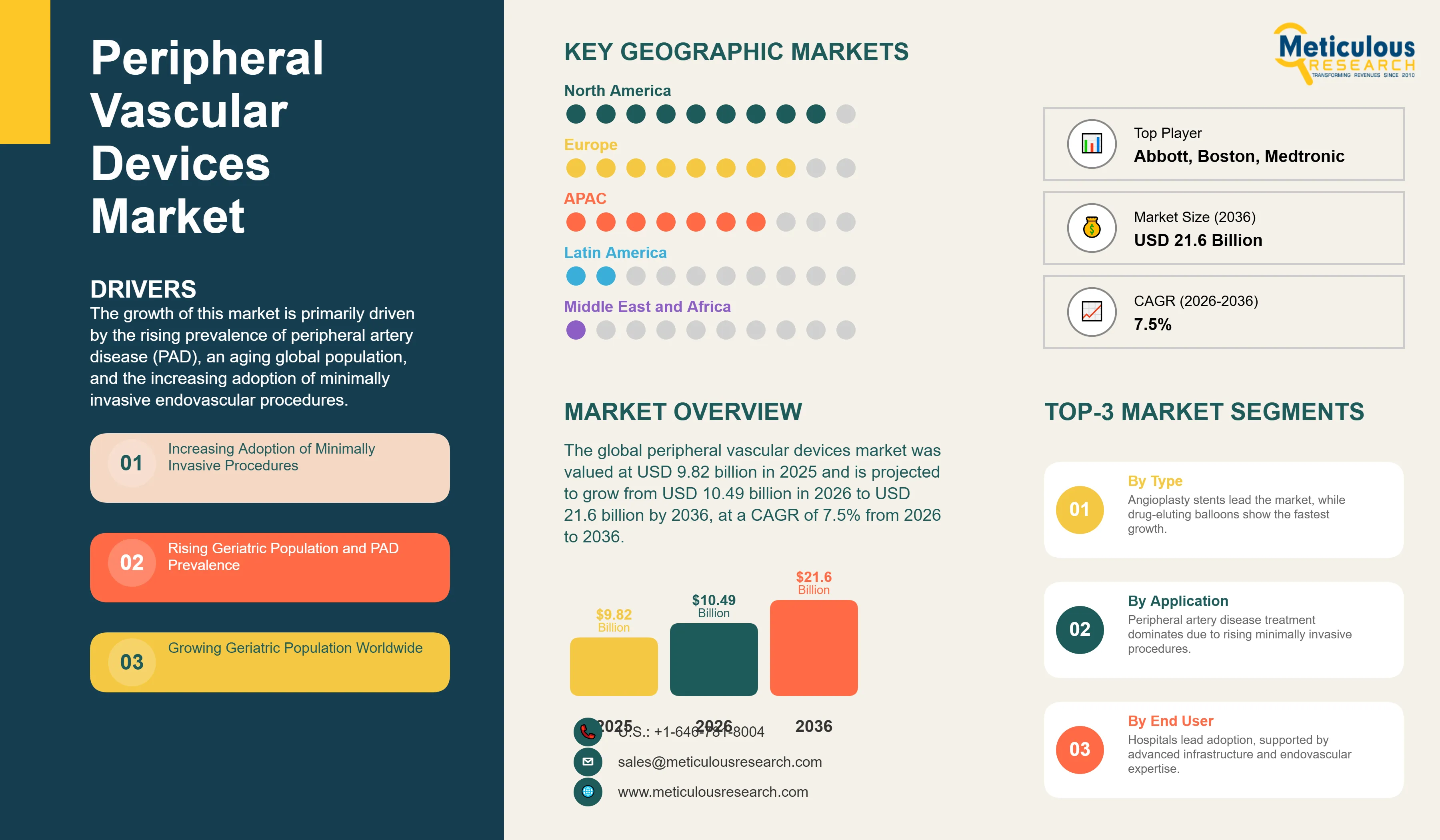
The global peripheral vascular devices market was valued at approximately USD 9.82 billion in 2025. This market is expected to reach approximately USD 21.6 billion by 2036 from USD 10.49 billion in 2026, growing at a CAGR of 7.5% from 2026 to 2036. The growth of this market is primarily driven by the rising prevalence of peripheral artery disease (PAD), an aging global population, and the increasing adoption of minimally invasive endovascular procedures. Technological advancements leading to the development of more effective and safer devices, such as drug-eluting stents and balloons, are also significant contributors to market expansion. The growing awareness among patients and healthcare providers about the benefits of early diagnosis and treatment of peripheral vascular diseases further supports market growth.
 Click here to: Get Free Sample Pages of this Report
The peripheral vascular devices market encompasses a wide range of medical devices used in the diagnosis and treatment of diseases affecting the circulatory system outside of the heart and brain, primarily peripheral artery disease (PAD). These devices are critical for restoring blood flow in narrowed or blocked arteries and veins in the limbs, neck, and abdomen. The market includes products such as angioplasty balloons, stents, catheters, endovascular aneurysm repair (EVAR) stent grafts, inferior vena cava (IVC) filters, and plaque modification devices like atherectomy and thrombectomy systems.
The market is characterized by continuous innovation, with a strong focus on developing devices that improve procedural outcomes, reduce recovery times, and minimize complications. The shift from open surgical procedures to minimally invasive endovascular techniques has been a major catalyst for market growth. These less invasive procedures offer significant benefits, including smaller incisions, reduced pain, shorter hospital stays, and faster recovery for patients.
The competitive landscape is dominated by large, diversified medical technology companies that have extensive product portfolios and a strong global presence. Key players include Medtronic, Boston Scientific, Abbott, and Terumo Corporation. These companies compete based on product innovation, clinical evidence, physician relationships, and distribution networks. The market also features smaller, specialized companies that focus on niche technologies or specific product categories, contributing to the overall dynamism and technological advancement within the industry.
What are the Key Trends in the Peripheral Vascular Devices Market?
Development of Bioresorbable Scaffolds and Drug-coated Balloons
A key trend in the market is the development and increasing adoption of advanced technologies like bioresorbable vascular scaffolds (BVS) and next-generation drug-coated balloons (DCBs). BVS are stents that provide temporary support to a vessel and are gradually absorbed by the body over time, leaving no permanent implant behind. This eliminates the long-term risks associated with permanent metallic stents, such as in-stent restenosis and late stent thrombosis. Similarly, DCBs are designed to deliver an anti-proliferative drug directly to the vessel wall to prevent restenosis, without the need for a permanent stent implant. These innovations represent a significant shift towards more restorative and less invasive treatment options.
Focus on Treating Complex Lesions and Below-the-Knee (BTK) Disease
There is a growing focus on developing devices specifically designed to treat complex and challenging lesions, including heavily calcified lesions, chronic total occlusions (CTOs), and disease in the small vessels below the knee. Treating BTK disease is particularly challenging due to the small vessel diameter and high rates of restenosis. Companies are investing in R&D to create specialized stents, balloons, and atherectomy devices that are more flexible, deliverable, and effective in these difficult-to-treat anatomical locations. This trend is driven by the need to improve outcomes for patients with critical limb ischemia (CLI), a severe form of PAD that can lead to amputation if not treated effectively.
|
Parameters |
Details |
|
Market Size by 2036 |
USD 21.6 Billion |
|
Market Size in 2026 |
USD 10.49 Billion |
|
Market Size in 2025 |
USD 9.82 Billion |
|
Market Growth Rate (2026-2036) |
CAGR of 7.5% |
|
Dominating Region |
North America |
|
Fastest Growing Region |
Asia-Pacific |
|
Base Year |
2025 |
|
Forecast Period |
2026 to 2036 |
|
Segments Covered |
Type and Geography |
|
Regions Covered |
North America, Europe, Asia-Pacific, Latin America, and Middle East & Africa |
Drivers: Rising Geriatric Population and Associated Increase in PAD Prevalence
The global increase in the geriatric population is a primary driver for the peripheral vascular devices market. The elderly are at a significantly higher risk of developing peripheral artery disease and other vascular conditions due to age-related changes in the circulatory system and the accumulation of risk factors over a lifetime. As the number of people aged 65 and older continues to grow worldwide, the prevalence of PAD is expected to rise, leading to a greater demand for diagnostic and therapeutic interventions. This demographic trend ensures a sustained and growing patient base for peripheral vascular devices.
Opportunity: Emerging Markets and Untapped Patient Populations
Emerging markets in Asia-Pacific, Latin America, and the Middle East & Africa represent a significant growth opportunity for the peripheral vascular devices market. These regions have large and often underserved patient populations. As healthcare infrastructure improves, healthcare spending increases, and awareness of vascular diseases grows in these regions, the demand for advanced medical devices is expected to surge. Market players who can successfully navigate the regulatory and economic landscapes of these emerging economies and offer cost-effective solutions will be well-positioned to capitalize on this opportunity.
Why Do Angioplasty Stents Dominate the Market?
Based on type, the angioplasty stents segment is expected to account for the largest share of the peripheral vascular devices market in 2026. Stents are the most widely used devices for treating arterial blockages, providing a mechanical scaffold to keep the vessel open and restore blood flow. The development of drug-eluting stents (DES), which release medication to prevent the recurrence of blockages, has further solidified their position as the standard of care. The high volume of stenting procedures performed globally, coupled with the premium pricing of advanced stent technologies, contributes to the segment's large market share.
How is North America Maintaining Its Leadership in the Market?
North America is expected to hold the largest share of the global peripheral vascular devices market in 2026. The region's dominance is attributed to several factors, including a high prevalence of peripheral vascular diseases, a well-established healthcare system with high rates of diagnosis and treatment, and favorable reimbursement policies for endovascular procedures. The presence of major market players, a strong focus on research and development, and the rapid adoption of new technologies also contribute to North America's market leadership.
Which Regions Are Experiencing Rapid Growth?
Asia-Pacific is projected to be the fastest-growing regional market. The region's growth is driven by a large and aging population, a rising prevalence of risk factors like diabetes and hypertension, and increasing healthcare investments. Governments in countries like China and India are actively working to improve healthcare access and quality, which is leading to greater adoption of advanced medical technologies. The growing medical tourism industry in several Asia-Pacific countries also contributes to the demand for high-quality peripheral vascular devices.
The global peripheral vascular devices market is consolidated, with a few large players dominating the market. The key players profiled in the global peripheral vascular devices market are Medtronic plc (Ireland), Boston Scientific Corporation (U.S.), Abbott Laboratories (U.S.), Terumo Corporation (Japan), B. Braun Melsungen AG (Germany), Becton, Dickinson and Company (BD) (U.S.), Cardinal Health, Inc. (U.S.), Cook Group (U.S.), and Koninklijke Philips N.V. (Netherlands). These companies have strong brand recognition, extensive product portfolios, and robust global distribution networks.
The peripheral vascular devices market is expected to grow from USD 10.49 billion in 2026 to USD 21.6 billion by 2036.
The peripheral vascular devices market is expected to grow at a CAGR of 7.5% from 2026 to 2036.
The key players operating in the global peripheral vascular devices market include Medtronic plc, Boston Scientific Corporation, Abbott Laboratories, Terumo Corporation, B. Braun Melsungen AG, Becton Dickinson and Company, Cardinal Health, Inc., Cook Group, and Koninklijke Philips N.V.
The main factors include the rising prevalence of peripheral artery disease, an aging global population, increasing adoption of minimally invasive procedures, technological advancements in device design, and growing awareness about early diagnosis and treatment of vascular diseases.
North America will lead the global peripheral vascular devices market during the forecast period 2026 to 2036, while Asia-Pacific is expected to witness the fastest growth.






















Published Date: Aug-2026
Published Date: Jun-2026
Published Date: Jan-2025
Published Date: Jan-2025
Published Date: Dec-2017
Please enter your corporate email id here to view sample report.
Subscribe to get the latest industry updates


