Green Logistics Market (2026-2036)
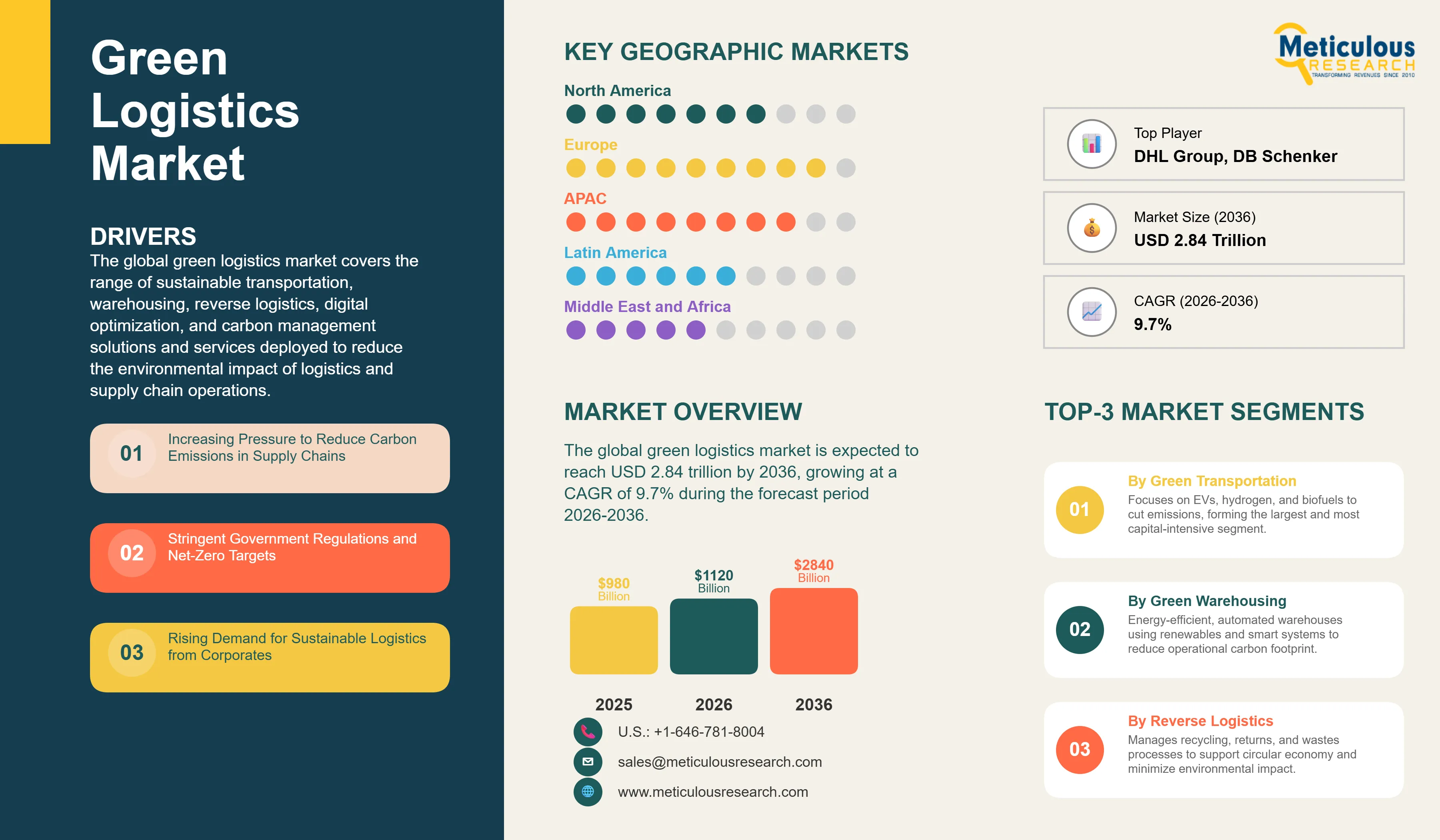
The global green logistics market was valued at USD 0.98 trillion in 2025. This market is expected to reach USD 2.84 trillion by 2036 from an estimated USD 1.12 trillion in 2026, growing at a CAGR of 9.7% during the forecast period 2026-2036.
- Published
- Apr 2026
- Pages
- 315
- Format
- PDF + Excel
- Report ID
- MR-1893
- Base year
- 2025
- 2025 · BASELINE
- $980.0B
- 2036
- $2.84T
- CAGR 2026–2036
- 9.7%
2025 baseline · 2026–2036 forecast at 9.7% CAGR · hover a bar for the value
Key highlights
The global green logistics market is projected to reach USD 2.84 trillion by 2036.
The market is expected to grow at a CAGR of 9.7% during the forecast period 2026-2036.
The global green logistics market was valued at USD 0.98 trillion in 2025 and is estimated to reach USD 1.12 trillion in 2026.
Europe is expected to dominate the global green logistics market with the largest market share in 2026, driven by the EU's Fit for 55 legislative package and European Green Deal mandating progressive decarbonization of the transport and logistics sector, the advanced state of electric truck adoption and alternative fuel infrastructure in Germany, the Netherlands, Sweden, and Norway, and the strong regulatory and corporate sustainability frameworks compelling European logistics operators including DHL, DB Schenker, Kuehne+Nagel, and DSV to invest aggressively in green fleet and warehousing transitions.
Asia-Pacific is projected to witness the fastest growth during the forecast period, driven by China's national carbon neutrality commitments accelerating electric commercial vehicle adoption and green logistics infrastructure investment at enormous scale, India's rapidly growing logistics sector adopting green practices supported by National Logistics Policy sustainability mandates, and the strong corporate sustainability commitments of Japanese and South Korean logistics operators and manufacturing exporters that are integrating green logistics requirements throughout their supply chain programs.
By solution type, the green transportation segment is expected to hold the largest share of the global green logistics market in 2026, as transportation accounts for approximately 60 to 70% of total logistics-related carbon emissions and represents the highest-priority decarbonization target for logistics companies, shippers, and regulators, generating the largest capital investment flows within the green logistics landscape across electric freight vehicles, hydrogen trucks, and alternative fuel transition programs.
By solution type, the digital and optimization solutions segment is projected to register the highest CAGR during the forecast period, driven by the rapid adoption of AI-powered route optimization, fleet management, and carbon tracking software platforms that enable logistics operators to reduce fuel consumption and emissions without requiring fleet replacement capital expenditure, delivering immediate sustainability ROI and generating strong demand across both large logistics providers and SME freight operators.
By mode of transport, the road transport segment is expected to hold the largest share in 2026, reflecting road freight's dominant share of logistics volume in all regional markets and the corresponding concentration of green logistics investment and regulation in road fleet decarbonization. The maritime shipping segment is projected to register the highest CAGR, driven by the International Maritime Organization's 2050 net-zero target, the accelerating adoption of LNG, methanol, and ammonia-fueled vessels, and the significant carbon intensity of global ocean shipping that makes maritime decarbonization a high-priority target for both regulatory compliance and corporate Scope 3 emission reduction programs.
By fuel type, the electric segment is expected to hold the largest share in 2026, reflecting the current commercial leadership of battery electric vehicles in last-mile and urban delivery fleet electrification across major markets. The hydrogen segment is projected to register the highest CAGR, driven by the advancing commercialization of hydrogen fuel cell heavy trucks from Hyundai, Daimler Truck, and Nikola for long-haul freight applications where battery electric vehicles face range and payload limitations.
By application, the retail and e-commerce segment is expected to hold the largest share in 2026, while pharmaceuticals is projected to register the highest CAGR, driven by the pharmaceutical industry's stringent ESG compliance requirements, cold chain decarbonization investment programs, and the concentration of high-value pharmaceutical shipments in premium green logistics service tiers.
By end user, the third-party logistics providers segment is expected to hold the largest share in 2026, while e-commerce companies are projected to register the highest CAGR, driven by the intense consumer and regulatory pressure on e-commerce platforms including Amazon, Alibaba, and Flipkart to decarbonize their last-mile delivery networks and the large capital investment programs these companies are deploying in proprietary electric delivery fleets and sustainable packaging logistics.
Report summary
| Particulars | Details |
|---|---|
| Market Size by 2036 | USD 2.84 Trillion |
| Market Size in 2026 | USD 1.12 Trillion |
| Market Size in 2025 | USD 0.98 Trillion |
| Revenue Growth Rate (2026-2036) | CAGR of 9.7% |
| Format | PDF, Excel & Cloud Portal · 315 pages |
| Dominating Solution Type | Green Transportation |
| Fastest Growing Solution Type | Digital and Optimization Solutions |
| Dominating Mode of Transport | Road Transport |
| Fastest Growing Mode of Transport | Maritime Shipping |
| Dominating Fuel Type | Electric |
| Fastest Growing Fuel Type | Hydrogen |
| Dominating Application | Retail & E-commerce |
| Fastest Growing Application | Pharmaceuticals |
| Dominating End User | Third-Party Logistics Providers (3PLs) |
| Fastest Growing End User | E-commerce Companies |
| Dominating Deployment Model | Outsourced Logistics |
| Fastest Growing Deployment Model | In-House Logistics |
| Dominating Geography | Europe |
| Fastest Growing Geography | Asia-Pacific |
| Base Year | 2025 |
| Forecast Period | 2026 to 2036 |
Report overview
Segments covered: solution type, mode of transport, fuel type, application, end user.
The global green logistics market covers the range of sustainable transportation, warehousing, reverse logistics, digital optimization, and carbon management solutions and services deployed to reduce the environmental impact of logistics and supply chain operations. This encompasses electric, hydrogen, and biofuel-powered freight transport across road, rail, air, and maritime modes, energy-efficient and renewable energy-powered warehousing facilities, AI and IoT-enabled route optimization and fleet management platforms that reduce fuel consumption and emissions, reverse logistics and circular economy programs, and carbon tracking and offsetting services that enable shippers and logistics operators to measure, manage, and reduce their supply chain emissions footprint.
The growth of the global green logistics market is primarily driven by the intensifying corporate and regulatory pressure to decarbonize supply chains as climate commitments translate into binding emission targets and mandatory sustainability reporting obligations. The EU's Corporate Sustainability Reporting Directive requires large European companies and their supply chain partners to disclose detailed Scope 1, 2, and 3 greenhouse gas emissions from 2025 onward, directly compelling shippers and their logistics providers to implement green logistics solutions capable of generating the emission measurement and reduction data required for compliance. The rapid improvement in the commercial competitiveness of electric commercial vehicles, with total cost of ownership parity with diesel counterparts approaching in urban delivery applications as battery costs decline and charging infrastructure expands, is accelerating fleet electrification investment beyond regulatory motivation into financially compelling territory for logistics operators managing large urban delivery fleets.
Two significant opportunities are shaping the market's long-term trajectory. The electrification of logistics fleets at scale, enabled by the rapid expansion of charging infrastructure networks, the improving range and payload capacity of battery electric trucks, and the growing availability of green electricity contracts that allow fleet operators to achieve near-zero operational emissions, represents the largest near-term capital deployment opportunity within the green logistics market. The adoption of AI-based route optimization and fleet management platforms represents a highly accessible and immediately return-generating opportunity that enables logistics operators to reduce fuel consumption by 10 to 20% without fleet replacement investment, generating rapid payback periods that are driving fast adoption across logistics operators of all sizes globally.
Report infographic
Market dynamics
7 factors across 3 forcesIncreasing Pressure to Reduce Carbon Emissions in Supply Chains
The intensifying pressure on corporations to reduce Scope 3 supply chain emissions in response to investor ESG expectations, customer sustainability requirements, and the emerging mandatory climate disclosure regulations being implemented across major economies represents the primary structural demand driver of the green logistics market. Supply chain and logistics activities typically constitute 40 to 70% of corporate Scope 3 emissions for manufacturing and retail companies, making logistics decarbonization a critical component of corporate net-zero transition programs. The Science Based Targets initiative requires companies with validated net-zero commitments to address supply chain emissions in their decarbonization roadmaps, and the growing number of global corporations with validated SBTi net-zero targets is translating directly into procurement pressure on logistics service providers to demonstrate measurable emission reduction performance. This creates a cascading demand effect through the logistics value chain as major shippers including Apple, Amazon, Walmart, and Unilever impose green logistics requirements on their carrier and 3PL relationships.
Stringent Government Regulations and Net-Zero Targets
The legislative framework being built across the European Union, United States, United Kingdom, Japan, South Korea, and China to mandate transport sector decarbonization is creating binding compliance drivers for green logistics adoption that operate independently of voluntary corporate sustainability motivations. The EU's revised CO2 standards for heavy-duty vehicles mandate 45% emission reduction for new trucks sold from 2030 and 90% reduction from 2040 relative to 2019 baselines, effectively phasing out diesel heavy trucks from new registrations on a defined regulatory timeline. The EU Emissions Trading System extension to road transport from 2027 will put a carbon price on transport fuel consumption that increases the operating cost of conventional diesel logistics relative to electric and alternative fuel alternatives. The IMO's 2050 net-zero target for international shipping and the Carbon Intensity Indicator regulations are driving compliance investment across the global shipping industry. These regulatory frameworks create mandatory transition timelines that translate directly into green logistics technology and service procurement demand regardless of upfront cost premiums.
Table of contents
15 chapters · 186 sections · 315 pages · click to expandSegmental analysis
| Segment | Largest share (2026) | Fastest growth (2026–2036) |
|---|---|---|
| By Solution Type | Green Transportation | Digital and optimization solutions |
| By Mode of Transport | Road Transport | Maritime shipping |
| By Fuel Type | Electric | Hydrogen |
| By Application | Retail & E-commerce | Pharmaceuticals |
| By End User | Third-Party Logistics Providers | E-commerce companies |
| By Deployment Model | Outsourced Logistics | In-house logistics |
By Solution Type
- Green Transportation to Dominate
- The green transportation segment is expected to account for the largest share of the global green logistics market.
- The large share of this segment is attributed to transportation's dominant position as the largest source of logistics-related greenhouse gas emissions and therefore the primary focus of regulatory mandates, corporate sustainability investment, and capital deployment across the green logistics landscape.
- Electric vehicle procurement programs, hydrogen truck pilots, biofuel transition investments, and sustainable aviation and maritime fuel adoption collectively represent the largest component of green logistics capital expenditure, with fleet electrification programs at DHL, UPS, Amazon, Maersk, and major freight carriers generating very large annual investment flows that dominate total green logistics market value.
- However, the digital and optimization solutions segment is poised to register the highest CAGR during the forecast period.
- The high growth of this segment is attributed to the accelerating enterprise adoption of AI route optimization, fleet management, and carbon tracking platforms that deliver immediate and measurable emission and cost reductions at low implementation barriers, the mandatory carbon reporting requirements under EU CSRD and equivalent frameworks creating non-discretionary demand for carbon tracking software across logistics operators and their shipper customers, and the expanding SaaS delivery model of green logistics software that enables rapid scaling across logistics operator customer bases of all sizes.
By Mode of Transport
- Road Transport to Hold the Largest Share
- The road transport segment is expected to account for the largest share of the global green logistics market.
- This dominance reflects road transport's position as the single largest freight mode by volume and value in virtually all regional logistics markets, the concentration of fleet electrification and alternative fuel investment in road transport where the technology maturity of electric vehicles is most advanced, and the direct regulatory pressure on road freight emissions from truck CO2 standards and urban low-emission zone policies that is driving the largest concentration of green logistics regulatory compliance investment.
- However, the maritime shipping segment is projected to register the highest CAGR during the forecast period.
- This growth is driven by the IMO's 2050 net-zero shipping target and the Carbon Intensity Indicator regulations creating binding compliance investment requirements across the global shipping fleet, the very high absolute carbon intensity of ocean shipping that makes maritime decarbonization programs high-priority Scope 3 emission reduction opportunities for global shippers with significant ocean freight volumes, and the large capital investment programs underway at Maersk, CMA CGM, Hapag-Lloyd, and MSC in alternative-fuel vessel newbuilds and fuel transition programs that represent major green logistics market value creation.
By Fuel Type
- Electric to Hold the Largest Share
- The electric segment is expected to account for the largest share of the global green logistics market, driven by the commercial maturity and rapid adoption of battery electric vehicles in last-mile and urban delivery logistics, the availability of a broad range of commercially deployed electric van and light commercial vehicle models from multiple manufacturers, and the strongest government incentive support and charging infrastructure investment concentration in battery electric vehicle technology among all green fuel alternatives.
- The active electric fleet programs of DHL, UPS, FedEx, Amazon, and major urban delivery logistics operators across Europe, North America, and China are generating the largest fuel type segment revenue within the green logistics market.
- However, the hydrogen segment is projected to register the highest CAGR during the forecast period.
- This growth is driven by the advancing commercialization of hydrogen fuel cell heavy trucks for long-haul freight applications, national hydrogen strategy investments in refueling infrastructure in Europe, Japan, South Korea, and the United States, and the maritime sector's growing adoption of hydrogen as a pathway fuel for deep-sea shipping decarbonization where battery electric propulsion is not technically feasible at commercial scale.
By Application
- Retail & E-commerce to Hold the Largest Share
- The retail and e-commerce segment is expected to account for the largest share of the global green logistics market.
- This dominance reflects the e-commerce sector's generation of the highest volumes of urban last-mile delivery operations that are most immediately amenable to electric vehicle fleet electrification, the intense consumer-facing sustainability pressure on e-commerce platforms that is driving the largest green logistics capital investment programs among any shipper category, and the strategic green fleet investments of Amazon, Zalando, ASOS, and major retail logistics networks targeting net-zero delivery operations.
- However, the pharmaceuticals segment is projected to register the highest CAGR during the forecast period.
- This growth is driven by the pharmaceutical industry's stringent ESG reporting requirements and investor sustainability expectations that are compelling pharma logistics operators to invest in cold chain decarbonization, the premium logistics service tier in which pharmaceutical shipments operate that supports the pricing of green logistics service premiums, and the growing complexity of pharmaceutical supply chains encompassing temperature-controlled biologics and personalized medicine logistics that are requiring purpose-built green cold chain solutions.
By End User
- Third-Party Logistics Providers to Hold the Largest Share
- The third-party logistics providers segment is expected to account for the largest share of the global green logistics market.
- Third-party logistics providers represent the primary commercial deployers of green logistics solutions, as their business model of operating transportation and warehousing assets on behalf of multiple shipper clients creates both the largest aggregate fleet and facility emission footprints requiring decarbonization and the most direct exposure to shipper sustainability procurement requirements that mandate green logistics performance.
- DHL Group's GoGreen Plus program, UPS Carbon Neutral shipping service, FedEx's fleet electrification program, Kuehne+Nagel's NetZero carbon neutral logistics offering, and DB Schenker's electrification and alternative fuel programs collectively represent the largest green logistics investment programs in the industry.
- However, the e-commerce companies segment is projected to register the highest CAGR during the forecast period.
- This growth is driven by the extraordinary capital investment programs of Amazon, JD.com, Flipkart, and Coupang in proprietary electric delivery fleet deployment and sustainable logistics infrastructure, the intense consumer and regulatory scrutiny of e-commerce delivery sustainability that is compelling platforms to invest in green logistics at a pace exceeding the 3PL sector, and the direct control that e-commerce companies' proprietary last-mile logistics operations provide over fleet electrification programs that enables faster transition timelines than coordinating green logistics transitions across third-party carrier networks.
By Deployment Model
- Outsourced Logistics to Hold the Largest Share
- The outsourced logistics segment is expected to account for the largest share of the global green logistics market.
- The dominant share of outsourced logistics reflects the broad industry practice of manufacturing, retail, and consumer goods companies contracting their transportation and warehousing operations to specialist logistics service providers, concentrating the majority of logistics asset ownership and operation and therefore the primary green logistics investment decision-making within the 3PL and freight carrier sector.
- The outsourced logistics model allows shippers to access green logistics services and carbon footprint reporting without direct capital investment in green fleet assets, purchasing sustainable logistics capacity as a service from providers who manage the green technology transition investment.
- However, the in-house logistics segment is projected to register the highest CAGR during the forecast period.
- This growth is driven by the strategic insourcing of last-mile delivery operations by major e-commerce platforms seeking direct control over delivery sustainability performance and customer experience, the proprietary electric fleet programs of Amazon Logistics, JD Logistics, and Flipkart that are building large in-house green delivery operations, and the growing preference of sustainability-focused corporations for direct ownership of green logistics assets that enables more verifiable and credible sustainability reporting than purchased third-party green logistics services.
Geographic analysis
Europe
Largest shareIn 2026, Europe is expected to account for the largest share of the global green logistics market. The largest share of this region is mainly due to the EU's comprehensive and binding regulatory framework for logistics decarbonization, encompassing the revised CO2 standards for heavy-duty vehicles, the EU Emissions Trading System extension to road transport, the IMO carbon intensity regulations affecting European-registered shipping, and the Corporate Sustainability Reporting Directive creating mandatory supply chain emission reporting requirements that collectively constitute the world's most comprehensive and commercially consequential green logistics regulatory environment. Germany, the Netherlands, Sweden, Norway, and Belgium represent the most advanced European national green logistics markets, with the Netherlands' role as Europe's primary logistics gateway generating very high green freight investment concentration, Sweden and Norway's leading electric truck adoption rates supported by mature charging infrastructure and high carbon taxation, and Germany's large industrial freight market undergoing significant green fleet transition investment driven by strong corporate sustainability programs at BMW, Mercedes-Benz, Volkswagen, and major German logistics operators. DHL Group, DB Schenker, Kuehne+Nagel, and DSV, all with European headquarters and primary operations, are the most active investors in green logistics technology among global logistics companies, reinforcing Europe's market leadership position. Green Logistics Market by Region: Europe Leading by Share, Asia-Pacific by Growth
Asia-Pacific
Fastest growthHowever, the Asia-Pacific green logistics market is expected to grow at the fastest CAGR during the forecast period. The region's rapid growth is driven by China's dominant and accelerating position in electric commercial vehicle production and deployment, with Chinese EV manufacturers including BYD, SAIC, and JAC producing the large majority of global electric trucks and vans and deploying them at scale in Chinese urban logistics operations, China's national carbon neutrality goals driving large-scale green logistics infrastructure investment, and the regulatory and market pressure compelling major Chinese e-commerce operators including JD.com, Cainiao, and SF Express to transition to electric last-mile delivery fleets. India's rapidly growing logistics sector is adopting electric three-wheelers and light commercial vehicles for last-mile delivery at scale, with Mahindra Electric, Tata Motors EV, and international EV brands deploying large urban electric delivery fleets. Japan and South Korea's advanced corporate sustainability programs and hydrogen infrastructure investment are creating important green logistics adoption centers, while Singapore and Australia are establishing themselves as Asia-Pacific green logistics innovation hubs with advanced sustainable port and aviation fuel programs.
North America
North America represents the second-largest regional green logistics market, anchored by large fleet electrification programs at Amazon, UPS, FedEx, and the major U.S. trucking carriers, the EPA's Clean Trucks Plan emission standards driving commercial heavy truck decarbonization, and state-level zero-emission vehicle mandates in California, New York, and other leading states that are establishing binding electric truck adoption timelines. The U.S. Inflation Reduction Act's commercial vehicle tax credits and charging infrastructure grants are accelerating the economic case for electric fleet adoption across U.S. logistics operators of all sizes.
Competitive landscape
- DHL Group · Germany
- FedEx Corporation (U.S.)
- United Parcel Service Inc. (U.S.)
- A.P. Moller-Maersk A/S · Denmark
- DB Schenker · Germany
- Kuehne+Nagel International AG · Switzerland
- DSV A/S · Denmark
- XPO Logistics Inc. (U.S.)
- CEVA Logistics · France
- CMA CGM Group · France
- Nippon Express Co. Ltd. · Japan
- Schneider National Inc. (U.S.)
- J.B. Hunt Transport Services Inc. (U.S.)
- Lineage Logistics (U.S.)
- GEODIS · France
Frequently asked questions
The global green logistics market is expected to reach USD 2.84 trillion by 2036 from an estimated USD 1.12 trillion in 2026, at a CAGR of 9.7% during the forecast period 2026-2036.
Cite this report
Meticulous Research. (2026). Green Logistics Market - Global Opportunity Analysis and Industry Forecast (2026-2036) (Report No. MR-1893). Meticulous Market Research Pvt. Ltd. https://www.meticulousresearch.com/product/green-logistics-market-6576