Resources
About Us

Digital Signage Market by Product (Videowall, Kiosk, Menu boards and Billboards), Component (Hardware (LCD, LED and OLED), Services), Application, Industry Vertical (Retail, Hospitality, Entertainment, Transportation, Healthcare) - Global Forecast to 2036
Report ID: MRICT - 104391 Pages: 215 Feb-2026 Formats*: PDF Category: Information and Communications Technology Delivery: 24 to 48 Hours Download Free Sample Report
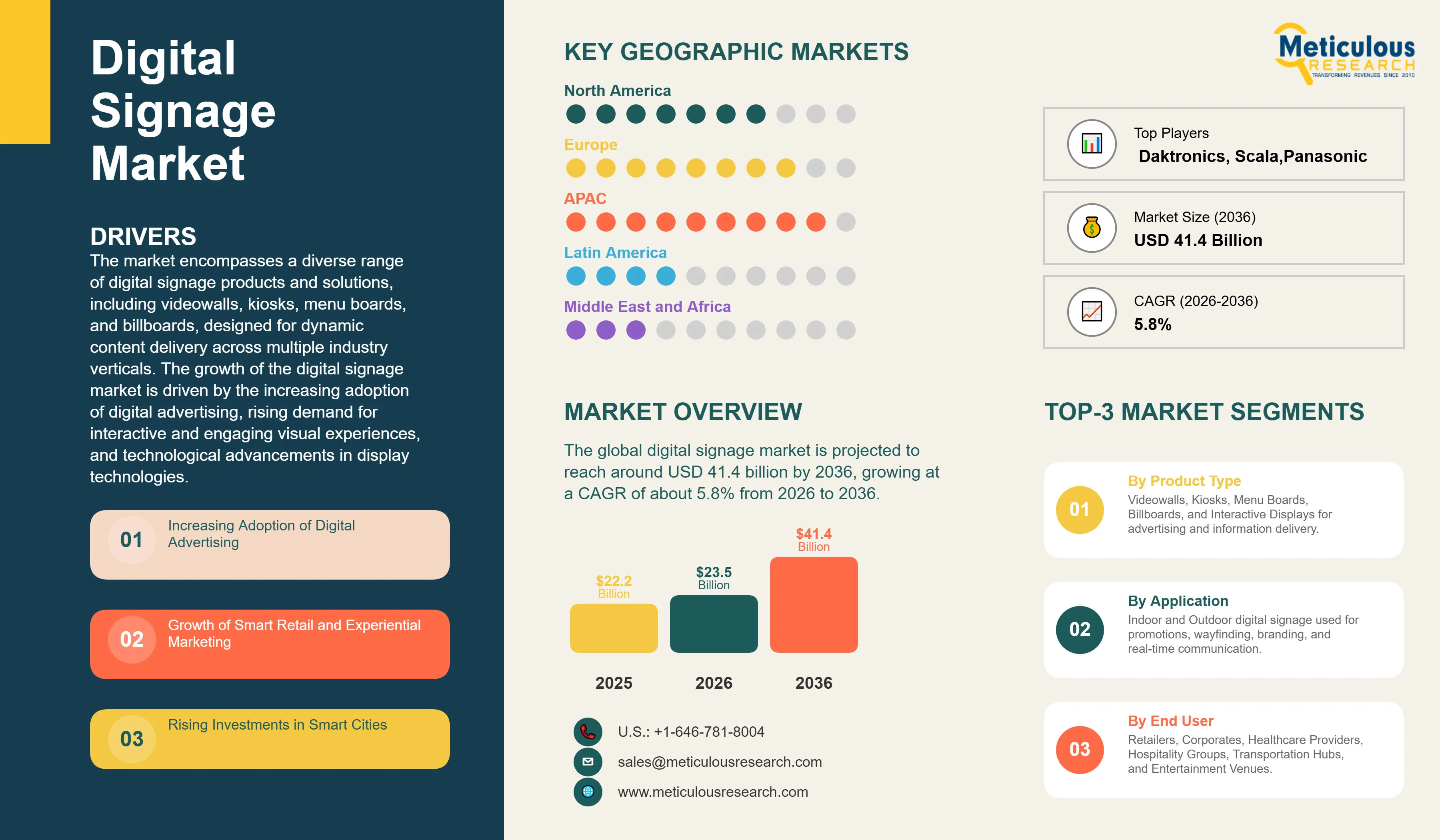
The global digital signage market was valued at USD 23.5 billion in 2026 and is projected to reach around USD 41.4 billion by 2036, growing at a CAGR of about 5.8% from 2026 to 2036. The market encompasses a diverse range of digital signage products and solutions, including videowalls, kiosks, menu boards, and billboards, designed for dynamic content delivery across multiple industry verticals. The growth of the digital signage market is driven by the increasing adoption of digital advertising, rising demand for interactive and engaging visual experiences, and technological advancements in display technologies. Additionally, the growing emphasis on real-time information dissemination and the expansion of smart city initiatives are expected to support market expansion throughout the forecast period.
Click here to: Get Free Sample Pages of this Report
The global digital signage market is primarily driven by technological advancements, changing consumer expectations, and the emergence of new applications across diverse industries. Digital signage solutions are fundamental components in modern communication strategies, enabling applications ranging from simple information displays to sophisticated interactive advertising and immersive brand experiences. The market includes established manufacturers such as Samsung Electronics Co., Ltd., LG Electronics, Inc., and NEC Corporation, alongside emerging specialized manufacturers focusing on specific display technologies and software solutions.
The transition from static, traditional signage to dynamic, digital displays has been one of the most significant market drivers. Digital signage offers superior advantages including real-time content updates, targeted messaging, and enhanced audience engagement compared to conventional signage methods. This shift has created substantial demand for digital signage solutions across retail, hospitality, transportation, and corporate environments. For instance, according to a study by Nielsen, digital billboards have a significant impact on brand recall and purchase intent. Furthermore, the integration of advanced display technologies such as 4K, 8K, and OLED into digital signage solutions has expanded the addressable market for high-impact visual communication. The development of interactive features, including touchscreens and gesture control, has revolutionized customer engagement and enabled personalized brand interactions.
Integration of Artificial Intelligence and Data Analytics
The digital signage market is witnessing rapid advancement in the integration of AI and data analytics, characterized by improvements in content personalization and audience measurement. Advanced digital signage solutions are increasingly incorporating AI-powered features that enable real-time content optimization based on audience demographics, behavior, and environmental factors. For example, Samsung's MagicINFO platform leverages AI to analyze data and deliver targeted advertising. This development is enabling new applications in personalized marketing, dynamic pricing, and audience engagement tracking. Manufacturers including Intel Corporation and Cisco Systems, Inc. are investing heavily in AI-enabled digital signage solutions to maintain competitive advantage. The trend toward data-driven content strategies and enhanced audience intelligence is expected to continue, creating opportunities for manufacturers capable of developing next-generation digital signage solutions with integrated AI and analytics capabilities.
Adoption of Interactive and Immersive Display Technologies
The digital signage market is experiencing significant growth driven by the increasing adoption of interactive and immersive display technologies. Interactive features such as touchscreens, gesture control, and augmented reality are transforming passive viewing experiences into engaging brand interactions. For instance, LG's Transparent OLED displays create captivating visual effects in retail and public spaces. The adoption of large-format videowalls and fine-pitch LED displays is enabling the creation of immersive visual environments in corporate lobbies, transportation hubs, and entertainment venues. Companies such as Planar Systems and Leyard Optoelectronics are developing innovative display solutions that push the boundaries of visual communication. The convergence of interactive technologies with high-resolution displays is expected to drive further innovation and market expansion in the digital signage sector.
|
Parameters |
Details |
|
Market Size by 2036 |
USD 41.4 Billion |
|
Market Size in 2026 |
USD 23.5 Billion |
|
Revenue Growth Rate (2026-2036) |
CAGR of 5.8% |
|
Dominating Product Type |
Videowalls |
|
Fastest Growing Component |
Hardware (Displays) |
|
Largest Industry Vertical |
Retail |
|
Dominant Application |
Indoor |
|
Leading Geographic Region |
Asia-Pacific |
Drivers: Increasing Demand for Digital Advertising and Enhanced Customer Experience
The primary drivers of the digital signage market include the increasing demand for digital advertising and the growing emphasis on enhancing customer experience. The superior ability of digital signage to deliver dynamic, targeted content is driving widespread adoption in retail, hospitality, and transportation sectors. According to the Digital Signage Federation, digital signage can increase brand awareness by over 40%. Government initiatives promoting smart city development, combined with declining display prices, are accelerating market penetration. The increasing demand for real-time information dissemination in public spaces and corporate environments is fueling growth in the digital signage market. The proliferation of interactive and immersive technologies is creating sustained demand for advanced digital signage solutions. Additionally, the expansion of 5G communication infrastructure is enabling the delivery of high-bandwidth content to digital displays.
Opportunity: Emerging Applications and Technological Innovation
The digital signage market presents substantial opportunities through emerging applications and continuous technological innovation. The development of advanced display technologies such as transparent OLED and micro-LED is creating new market segments with significant growth potential. The expansion of digital signage applications in healthcare for patient communication and wayfinding is opening new revenue streams. The integration of AI and data analytics is driving demand for personalized and context-aware digital signage solutions. The growing adoption of digital signage in smart city initiatives for public information and advertising is creating opportunities for advanced solutions. Additionally, the development of cloud-based content management systems is simplifying the deployment and management of digital signage networks. Manufacturers investing in research and development to address these emerging applications are well-positioned to capture market share.
Why Do Videowalls Dominate the Market?
Based on product, Videowalls hold the largest share of the overall digital signage market, driven by their widespread adoption in large-scale visualization applications. The superior ability of videowalls to create immersive and high-impact visual experiences has made them the preferred choice for control rooms, broadcast studios, and corporate lobbies. The declining cost of videowall technology, combined with improving display quality and bezel-less designs, has accelerated market adoption. Videowalls are utilized in diverse applications, including advertising, entertainment, and information dissemination. Major manufacturers including Samsung, LG, and NEC offer a wide range of videowall solutions, such as the Samsung's 'The Wall' which is a microLED display that can be configured to any size.
Why Does Hardware Lead Components?
Hardware represents the largest component segment in the digital signage market, driven by the continuous demand for displays, media players, and other physical components. The declining cost of display technology, combined with improving performance and features, has accelerated market adoption. Hardware components are utilized in diverse applications, including retail, hospitality, and transportation. Major manufacturers including Samsung, LG, and Intel offer a wide range of hardware solutions for the digital signage market.
Why Does Indoor Application Lead?
Based on application, the indoor applications command the largest share of the digital signage market, driven by the widespread adoption of digital displays in retail stores, corporate offices, and public venues. The superior ability of indoor digital signage to engage customers, inform employees, and enhance brand image has made it an essential communication tool. The declining cost of indoor displays, combined with the availability of a wide range of content management software, has accelerated market adoption. Indoor digital signage is utilized in diverse applications, including advertising, wayfinding, and corporate communication. Major manufacturers including Samsung, LG, and NEC offer a wide range of indoor digital signage solutions.
Why Does Retail Dominate Industry Verticals?
The retail industry represents the largest vertical segment in the digital signage market, driven by the increasing adoption of digital displays for in-store advertising, promotions, and customer engagement. The superior ability of digital signage to influence purchasing decisions and enhance the shopping experience has made it a critical tool for retailers. According to a report by POPAI (Point of Purchase Advertising International), digital signage can increase sales by over 30%. The declining cost of retail digital signage solutions, combined with the availability of advanced analytics and content management platforms, has accelerated market adoption. Retail digital signage is utilized in diverse applications, including product information displays, interactive kiosks, and promotional screens. Major retailers such as Walmart and Target have deployed extensive digital signage networks in their stores.
How Does Asia-Pacific Maintain Its Leadership in the Global Digital Signage Market?
Asia-Pacific is expected to hold the largest share of the global digital signage market in 2026, driven by the rapid economic growth, increasing urbanization, and expanding retail sector. China has emerged as a major manufacturing hub for digital signage displays, with numerous companies producing advanced solutions at scale. Japan remains a leader in advanced display technology development, with companies such as Sony and Panasonic driving innovation. South Korea is a significant player in the digital signage market, with Samsung and LG Electronics producing high-performance displays. India is experiencing rapid growth in digital signage adoption, driven by government smart city initiatives and increasing demand for digital advertising. The key companies operating in the Asia-Pacific digital signage market are Samsung Electronics, LG Electronics, NEC Corporation, and various Chinese manufacturers.
The key players profiled in the global digital signage market report include Samsung Electronics Co., Ltd. (South Korea), LG Electronics, Inc. (South Korea), NEC Corporation (Japan), Sharp Corporation (Japan), Sony Corporation (Japan), Panasonic Corporation (Japan), Barco NV (Belgium), Leyard Optoelectronic Co., Ltd. (China), Planar Systems, Inc. (U.S.), and Intel Corporation (U.S.), among others.
The global digital signage market is valued at USD 23.5 billion in 2026 and is expected to reach USD 41.4 billion by 2036, growing at a CAGR of 5.8%.
The digital signage market is expected to grow at a CAGR of 5.8% from 2026 to 2036.
The key players include Samsung Electronics Co., Ltd., LG Electronics, Inc., NEC Corporation, Sharp Corporation, Sony Corporation, Panasonic Corporation, Barco NV, Leyard Optoelectronic Co., Ltd., Planar Systems, Inc., and Intel Corporation.
The main factors include the increasing demand for digital advertising, the growing emphasis on enhancing customer experience, and technological advancements in display technologies.
Asia-Pacific is expected to lead the global digital signage market during the forecast period 2026 to 2036.






















Published Date: Sep-2025
Published Date: Jan-2025
Published Date: Aug-2024
Published Date: Jul-2024
Published Date: Apr-2023
Please enter your corporate email id here to view sample report.
Subscribe to get the latest industry updates


