Cloud-native Application Protection Platform Market (2025-2035)
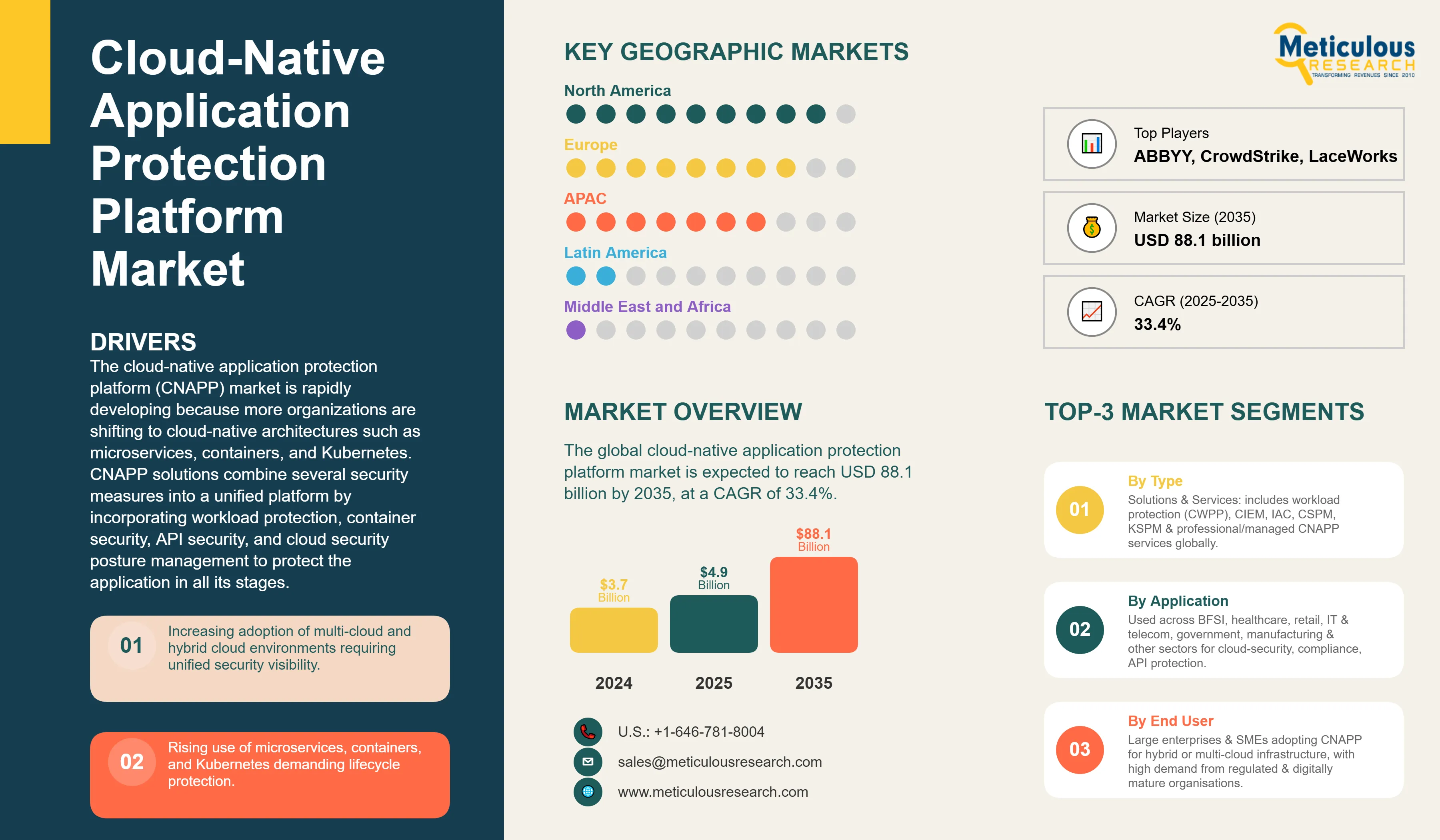
The global cloud-native application protection platform market was valued at USD 3.7 billion in 2024. The market is expected to reach USD 88.1 billion by 2035 from USD 4.9 billion in 2025, at a CAGR of 33.4%.
- Published
- Sep 2025
- Pages
- 210
- Format
- PDF + Excel
- Report ID
- MRICT - 1041594
- Base year
- 2024
- 2024 · BASELINE
- $3.70B
- 2035
- $88.10B
- CAGR 2025–2035
- 33.4%
2024 baseline · 2025–2035 forecast at 33.4% CAGR · hover a bar for the value
Key highlights
Solution Segment Dominated the Market Through Comprehensive Security Integration
By Cloud, Hybrid Segment held the Majority of Market Share
North America Leads the CNAPP Market with Highest Revenue Share
Europe Emerging as a Rapidly Growing CNAPP Market
Government Digital Strategy and Cloud Infrastructure Investment Drive Rapid Market Growth in China
Report summary
| Particulars | Details |
|---|---|
| Market size (2025) | USD 4.9 billion |
| Revenue forecast in 2035 | USD 88.1 billion |
| CAGR (2025-2035) | 33.4% |
| Format | PDF, Excel & Cloud Portal · 210 pages |
| Base Year | 2024 |
| Forecast period | 2025 – 2035 |
| Report coverage | Market size and forecast, competitive landscape and benchmarking, country/regional level analysis, key trends, growth drivers and restraints |
| Segments covered | Component (Solution and Services), Cloud (Hybrid cloud and Multi-cloud), Organization Size, Application, Geography |
| Regional scope | North America, Europe, Asia-Pacific, Latin America, and Middle East & Africa |
| Key companies profiled | Checkpoint Security, ABBYY, CrowdStrike, LaceWorks, Fortinet, Zscaler, Palo Alto Networks, Tenable, Qualys, Trend Micro, and Other Key Players. |
| Customization | Comprehensive report customization with purchase. Addition or modification to country, regional & segment scope available |
| Pricing Details | Access customized purchase options to meet your specific research requirements. Explore flexible pricing models |
Report overview
Segments covered: application.
The cloud-native application protection platform (CNAPP) market is rapidly developing because more organizations are shifting to cloud-native architectures such as microservices, containers, and Kubernetes. CNAPP solutions combine several security measures into a unified platform by incorporating workload protection, container security, API security, and cloud security posture management to protect the application in all its stages. This integrated strategy helps simplify it and enhance identification of threats on the dynamic cloud landscape. As an example, Prisma Cloud, provided by Palo Alto Networks, supports CNAPP functionality and allows the Siemens Company to meet compliance requirements and protect its worldwide multi-cloud infrastructure against the modern threat environment of the cyber world.
Report infographic
Base CAGR: 33.4%
|
Category |
Key Factor |
Short-Term Impact (2025–2028) |
Long-Term Impact (2029–2035) |
Estimated CAGR Impact |
|
Drivers |
Rising Multi-Cloud & Hybrid Cloud Adoption |
Increased demand for unified security platforms |
Standardization of cross-cloud security frameworks |
▲ +3.5% |
|
Shift-Left Security Practices |
Greater integration of security scanning |
Full automation of DevSecOps workflows |
▲ +3.2% |
|
|
AI & ML-Powered Threat Detection |
Enhanced real-time anomaly detection and automated incident response |
Predictive threat intelligence preventing zero-day vulnerabilities |
▲ +3.0% |
|
|
Restraints |
High Implementation & Integration Costs |
Slower adoption by SMBs due to budget constraints |
Gradual cost reduction with SaaS-based CNAPP offerings |
▼ −1.5% |
|
Integration Challenges with Legacy Systems |
Delays in deployment due to incompatibility with existing security tools |
Broader API and connector support reducing integration friction |
▼ −1.3% |
|
|
Opportunities |
Expansion of Agentless Security Models |
Rapid adoption due to ease of deployment |
Agentless CNAPP becoming default model |
▲ +3.1% |
|
CNAPP Integration with AI-Driven Cloud Governance |
Early adoption in regulated industries |
AI-powered policy enforcement |
▲ +2.8% |
|
|
Trends |
Convergence with DevSecOps Platforms |
Security fully embedded into developer workflows |
Unified security & development dashboards |
▲ +2.5% |
|
Challenges |
Managing Dynamic & Large-Scale Cloud Environments |
Difficulty in maintaining consistent security posture |
Advanced orchestration & automated policy enforcement |
▼ −1.0% |
Market dynamics
4 factors across 2 forcesIncreasing Multi-Cloud Adoption
The use of multi-cloud approaches has become more common to maximize the organizational performance and prevent vendor lock-in, which makes CNAPP solutions which enable the unified view of the multiple environments and their security prospects in high demand. For instance, Johnson & Johnson adopted a CNAPP to ensure that security across AWS, Azure, and Google Cloud would be observed in an efficient manner. Moreover, widespread adoption of containerization, microservices, and serverless architectures creates unprecedented security complexity requiring comprehensive platforms that provide visibility and control over dynamic, distributed environments. Multi-cloud adoption rates exceed 70% among large enterprises, intensifying demand for unified security platforms capable of consistent policy enforcement across diverse cloud infrastructures.
Rising Cloud-Based Application Development
The proliferation of microservices, containers and Kubernetes usage is creating the fact that integrated security solutions must be in place to protect workloads throughout the application lifecycle. For instance, Shopify uses CNAPP features to secure the large-scale Kubernetes environment without sacrificing the speed of deployment. This approach requires platforms capable of seamlessly integrating with development tools, automated testing frameworks, and deployment pipelines while providing real-time security feedback and automated remediation capabilities, thereby driving the market demand.
Higher Compliance and Protection of Data laws
Stricter international policies (e.g. GDPR, HIPPA, PCI-DSS, etc.) are forcing companies to consider CNAPPs that have an improved compliance auto-remediation functionality. Stringent data protection regulations including GDPR in Europe, CCPA in California, and sector-specific compliance requirements drive demand for CNAPP solutions offering automated compliance monitoring, audit trail generation, and continuous risk assessment capabilities. Regulatory frameworks emphasize data sovereignty, privacy protection, and security accountability that require comprehensive documentation and real-time compliance validation across complex cloud infrastructures. Indicatively, one of the European healthcare providers implemented CNAPP tools so as to maintain constant compliance monitoring and automated remediation of sensitive patient data.
Table of contents
13 chapters · 142 sections · 210 pages · click to expandSegmental analysis
| Segment | Largest share (2025) | Fastest growth (2025–2035) |
|---|---|---|
| Other segments | Solution | — |
| By Cloud | Hybrid | — |
Other segments
- Solution Segment Dominated the Market Through Comprehensive Security Integration
- The cloud native application protection platform market is expected to be dominated by the solution segment, accounting for more than 60% market share in 20245.
- This market dominance is majorly pertaining to the continued to rise due to the increased demand of one-stop comprehensive and integrated security platforms that deliver workload protection, container security, API monitoring and compliance management combined.
- Organizations are choosing end-to-end CNAPP solutions on a subscription basis rather than standalone tools to minimize complexity, better understand, and automate cloud-native environments.
- As an example, Prisma Cloud by Palo Alto Networks gained popularity among the international organizations as the system with the potential to provide unified security across multi-cloud and hybrid environments, assuring quicker discovery and mitigation of the threats.
- The solution-centric methodology focuses on seamless integration with current cloud infrastructure, providing unified visibility and control.
- The segment further benefits from AI and machine learning integration that enables sophisticated pattern recognition, automated threat hunting, and intelligent risk scoring for proactive security measures.
By Cloud
- Hybrid Segment held the Majority of Market Share
- Hybrid cloud segment is the largest in the CNAPP market as businesses gradually move to on-premises and multi-cloud environments to achieve balance between scalability, control and compliance.
- CNAPP in Hybrid environments provide visibility, detection of threats, and policy enforcement of all varieties of infrastructures across organizations, which decreases security silos.
- For instance, Microsoft Defender for Cloud offers end to end security management among the Azure, AWS, and on-premises workloads, a feature that makes it ideal in a hybrid cloud application.
- The segment's dominance reflects organizational confidence in hybrid cloud security when protected by comprehensive CNAPP solutions that provide real-time threat detection, automated response capabilities, and continuous compliance monitoring.
- The hybrid cloud segment further projects significant expansion potential, driven by organizations requiring consistent security governance across on-premises and multiple cloud infrastructures.
- These environments demand integrated security management platforms offering centralized visibility, policy enforcement, and compliance monitoring across diverse infrastructure types.
Geographic analysis
North America
Largest shareThe North American region is expected to command the highest market share in the cloud-native application protection platform market, accounting for 40–45% market share globally in 2025. This high market share is majorly owing to the early adoption of modern cloud-native security services, and a strong presence of most key players. The area has a high penetration level of clouds wherein more than 85% of organizations are utilizing at least one cloud services as well as approximately 70% pursuing multi-cloud tactics. Strict regulatory compliance requirement as well as huge investments in the integration of DevSecOps further enhance market growth. As an example, large US based enterprises (Capital One, etc.) deploy kubernetes, securing it with tools such as Prisma Cloud developed by Palo Alto Networks to be compliant in large scale Kubernetes-based deployments and be compliant with much of the environments in which they exist (AWS, Azure, and Google Cloud, etc.). The U.S. market boasts of a commanding influence on the cloud-native application protection platform business, owing to high concentration of cloud-native companies, quick pace of digitalization, and high profile of international Cybersecurity giants. Federal agencies implement extensive cybersecurity frameworks including NIST guidelines, FedRAMP certification requirements, and zero-trust architecture mandates that establish security standards influencing global adoption. Major enterprises across finance, healthcare, and technology sectors deploy comprehensive CNAPP solutions to address regulatory compliance, protect intellectual property, and maintain competitive advantages in digital markets. The market maturity is fostered by the country focus on the implementation of DevSecOps and AI to detect threats. For instance, Netflix, CNAPP is used to protect its large Kubernetes and microservices stack, but with important scalability and security. Additionally, industry organizations and associations promote cybersecurity best practices and provide training resources for security professionals implementing CNAPP solutions across diverse enterprise environments, thereby driving the country market. North America Leads the CNAPP Market with Highest Revenue Share Government Digital Strategy and Cloud Infrastructure Investment Drive Rapid Market Growth in China
Europe
The Europe cloud-native application protection platform (CNAPP) market is experiencing a robust growth in the region, pertaining to rising cloud adoption, growth in containerized applications, and strict data protection policies. The implementation of GDPR has been a significant catalyst, compelling organizations to adopt comprehensive security measures for cloud applications. Other key variables include a mature cloud adoption landscape, high regulatory compliance standards, and a proactive approach towards cybersecurity. Several companies in various industries are now spending on CNAPP solutions to be able to meet the multi-cloud operations with a guaranteed security at the same time observing the regulations. For instance, the Deutsche Telekom has implemented and integrated CNAPP tools to improve visibility, threat detection and compliance monitoring within its hybrid cloud environment that serves its operational efficiency and compliance. Additionally, the surging use of cloud services in essential industries such as the banking, healthcare, and government, along with the rise of remote working and digital transformation initiatives, are propelling the industry growth. Federal Security Requirements and Enterprise Innovation Drive Technology Leadership in the U.S. Europe Emerging as a Rapidly Growing CNAPP Market Country-level Analysis
Asia-Pacific
China demonstrates significant growth potential in the CNAPP market, and is expanding at 35.8% CAGR, owing to comprehensive government digital transformation strategies and massive investments in cloud infrastructure that require sophisticated security protection. The government's emphasis on technological self-reliance and data sovereignty drives development of indigenous CNAPP solutions that comply with national cybersecurity regulations and data localization requirements. Major technology companies including Alibaba, Tencent, and Baidu develop comprehensive cloud security platforms serving both domestic and international markets, while state-owned enterprises implement advanced security measures for critical infrastructure protection. Moreover, the integration of CNAPP solutions with national monitoring systems and compliance frameworks enables comprehensive security management across multiple administrative levels. Thus, the surging emphasis on international cybersecurity cooperation and standards harmonization facilitates technology transfer and global market expansion opportunities for Chinese CNAPP vendors throughout the forecast period.
Competitive landscape
CNAPP market is increasingly competitive as vendors are attempting to distinguish themselves with full-featured offerings, integration features, and scale. Cogent security-based businesses like Palo Alto Networks, Check Point Software technologies, and Trend Micro have well established, end-to-end platforms that combine workload, container, and API security. In the meantime, new industry players such as Orca Security, Wiz and Lacework are gaining popularity, implementing an agentless scanning capability, quicker deployment and an in-depth perspective on a multi-cloud environment.
- July 2025
Trend Micro has extended its partnership with Google Cloud, to advance AI-driven cybersecurity in complex cloud environments. This extended collaboration brings together Trend Micro Vision One Sovereign and Private Cloud (SPC) solution with Google Cloud Assured Workloads that strengthen the protection of data in the public, hybrid and air-gapped environments.
- February 2025
Palo Alto Networks launched Cortex Cloud, an integration of its next-generation CNAPP solutions with the world-leading SecOps platform to provide real-time cloud security. The launch combines the capabilities of Prisma Cloud and the runtime detection and response (CDR) used by Cortex, so there is one backend and simplified tools.
- Checkpoint Security
- ABBYY
- CrowdStrike
- LaceWorks
- Fortinet
- Zscaler
- Palo Alto Networks
- Tenable
- Qualys
- Trend Micro
- Other Key Players
Frequently asked questions
The Cloud-native Application Protection Platform Market size is estimated to be USD 4.9 billion in 2025 and grow at a CAGR of 33.4% to reach USD 88.1 billion by 2035.
Cite this report
Meticulous Research. (2025). Cloud-native Application Protection Platform Market - Global Opportunity Analysis And Industry Forecast (2025-2035) (Report No. MRICT - 1041594). Meticulous Market Research Pvt. Ltd. https://www.meticulousresearch.com/product/cloud-native-application-protection-platform-market-6277