
Butterfly Valves Market (2026-2036)
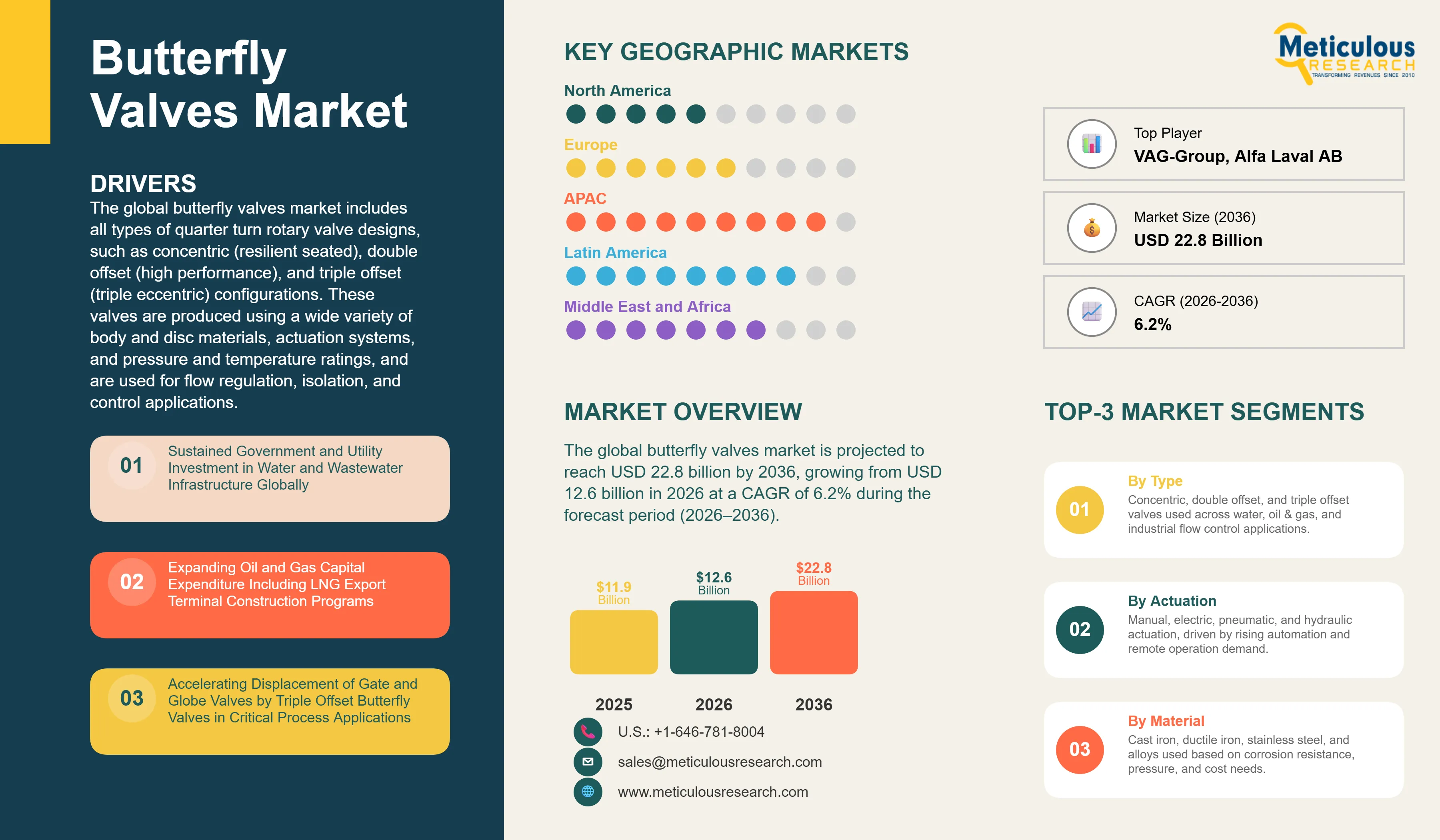
The global butterfly valves market was valued at USD 11.9 billion in 2025. The market is projected to reach USD 22.8 billion by 2036, growing from USD 12.6 billion in 2026 at a CAGR of 6.2% during the forecast period (2026–2036).
- Published
- Apr 2026
- Pages
- 274
- Format
- PDF + Excel
- Report ID
- MR-1923
- Base year
- 2025
- 2025 · BASELINE
- $11.90B
- 2036
- $22.80B
- CAGR 2026–2036
- 6.2%
2025 baseline · 2026–2036 forecast at 6.2% CAGR · hover a bar for the value
Key highlights
The global butterfly valves market is projected to reach USD 22.8 billion by 2036.
The market is expected to grow at a CAGR of 6.2% during the forecast period 2026–2036.
The global butterfly valves market was valued at USD 11.9 billion in 2025 and is estimated to reach USD 12.6 billion in 2026.
Asia Pacific is expected to dominate the global butterfly valves market with the largest market share in 2026, driven by large scale water infrastructure development, rapid industrialization, and active energy sector investments across China, India, Japan, and Southeast Asia, supported by the presence of a well established regional manufacturing base and growing domestic demand from process industries.
The Middle East & Africa is projected to witness the fastest growth during the forecast period, driven by expanding oil and gas capital expenditure programs, accelerating water desalination and distribution infrastructure investments, and growing petrochemical and industrial project activity, particularly across the Gulf Cooperation Council countries.
By type, the concentric (resilient seated) butterfly valves segment is expected to hold the largest market share in 2026.
By type, the triple offset butterfly valves segment is projected to register the highest CAGR during the forecast period, driven by growing adoption in high temperature and high pressure applications across oil and gas, liquefied natural gas, refining, and power generation facilities where conventional gate and globe valves are being displaced.
By actuation, the manual actuation segment is expected to account for the largest share of the global butterfly valves market in 2026.
By actuation, the electric actuated segment is projected to register the highest CAGR during the forecast period, driven by growing industrial automation, remote operation requirements, and the integration of valve control systems with plant wide digital infrastructure.
By material, the cast iron and ductile iron segment is expected to account for the largest share in 2026, while the stainless steel segment is projected to register the highest CAGR during the forecast period.
By end use, the water and wastewater treatment segment is expected to account for the largest share in 2026, while the oil and gas segment is projected to register the highest CAGR during the forecast period.
By geography, Asia Pacific is expected to dominate the market in 2026, while the Middle East & Africa is expected to witness the fastest growth during the forecast period.
Report summary
| Particulars | Details |
|---|---|
| Market Size by 2036 | USD 22.8 Billion |
| Market Size in 2026 | USD 12.6 Billion |
| Market Size in 2025s | USD 11.9 Billion |
| Revenue Growth Rate (2026–2036) | CAGR of 6.2% |
| Format | PDF, Excel & Cloud Portal · 274 pages |
| Dominating Type | Concentric (Resilient Seated) Butterfly Valves |
| Fastest Growing Type | Triple Offset Butterfly Valves |
| Dominating Actuation | Manual Actuation |
| Fastest Growing Actuation | Electric Actuated |
| Dominating Material | Cast Iron & Ductile Iron |
| Fastest Growing Material | Stainless Steel |
| Dominating End Use | Water & Wastewater Treatment |
| Fastest Growing End Use | Oil & Gas |
| Dominating Geography | Asia Pacific |
| Fastest Growing Geography | Middle East & Africa |
| Base Year | 2025 |
| Forecast Period | 2026 to 2036 |
Report overview
Segments covered: type, actuation, material, end use.
The global butterfly valves market includes all types of quarter turn rotary valve designs, such as concentric (resilient seated), double offset (high performance), and triple offset (triple eccentric) configurations. These valves are produced using a wide variety of body and disc materials, actuation systems, and pressure and temperature ratings, and are used for flow regulation, isolation, and control applications. These valves are installed across water and wastewater treatment, oil and gas, chemical and petrochemical, power generation, HVAC and building services, food and beverage, pharmaceutical, and marine applications where reliable, compact, and cost effective flow control solutions are required across a wide range of operating conditions.
The growth of the butterfly valves market is primarily driven by continued investment in water and wastewater infrastructure worldwide, particularly in developing economies where aging distribution networks are being upgraded, and new treatment capacity is being added to serve growing urban populations. Simultaneously, the global expansion of oil and gas production, transmission, and processing infrastructure, including a new generation of liquefied natural gas export terminals in North America, the Middle East, and Africa, is driving demand for high performance and triple offset butterfly valves capable of handling demanding service conditions. The ongoing energy transition is also creating new demand vectors, as butterfly valves are increasingly specified in hydrogen production facilities, carbon capture systems, and thermal power plant cycling applications.
Despite a positive growth outlook, the market faces challenges by intense price competition among manufacturers, specifically in the concentric butterfly valve segment, where commoditization has led to shrinking profit margins. The increasing complexity of procurement and compliance requirements in end use industries, including material traceability documentation and third party testing certifications such as API 609, ISO 5752, and EN 593, adds cost and lead time for smaller manufacturers without established quality management infrastructure.
A meaningful opportunity is emerging as industries started replacing traditional gate and globe valves with triple offset butterfly valves in critical applications. These advanced designs deliver similar sealing performance but with much lower weight and a smaller installation footprint, making them easier and more efficient to install. Additionally, the growing integration of smart positioners, wireless communication protocols, and condition monitoring sensors into valve actuator packages is giving rise to a premium category of products. These higher value solutions not only increase the overall market but also allow leading manufacturers to generate more revenue per unit and achieve better margins.
Report infographic
Market dynamics
3 factors across 1 forceTriple Offset Butterfly Valves Displacing Gate and Globe Valves in Critical Process Service
One of the most commercially important shifts in the butterfly valve market is the replacement of traditional gate, globe, and ball valves with triple offset butterfly valves in critical isolation and control applications. These valves use a geometric cam action to create a metal to metal seal, eliminating the friction between the disc and seat seen in concentric and double offset designs. As a result, they can deliver zero leakage performance under high temperature, high pressure, and even cryogenic conditions applications that previously demanded larger, heavier, and more expensive valve types.
Leading engineering, procurement, and construction contractors for LNG terminals, refinery units, and offshore platforms are increasingly specifying triple offset butterfly valves in line classes historically reserved for gate valves, citing their lower installed weight, reduced face to face length, and lower total cost of ownership over the service life of the installation. Manufacturers such as Emerson (Keystone), Flowserve, and IMI Critical Engineering have developed dedicated triple offset product ranges, including Emerson's Keystone Figure 36/37, Flowserve's Durco Mark III, and IMI's BJ Series, specifically engineered to meet API 609 Category B requirements and qualify for these demanding applications. The growing pipeline of LNG projects globally, particularly in the United States Gulf Coast, Qatar, and East Africa, is expected to maintain demand for triple offset butterfly valves well into the next decade.
Smart Valve Packages and Digital Integration Transforming the Actuated Butterfly Valve Segment
The integration of intelligent electronic positioners, partial stroke testing capabilities, wireless HART and Foundation Fieldbus communication, and real time valve health diagnostics into actuated butterfly valve packages is fundamentally changing how plant operators procure, commission, and maintain flow control assets. This shift from standalone mechanical valve and actuator combinations toward fully integrated smart valve packages is providing predictive maintenance strategies, reducing unplanned shutdowns, and supporting digital twin implementations across process plants and water utilities.
Industrial automation companies such as Emerson, ABB, and Rotork have built complete smart valve ecosystems that pair butterfly valve bodies with intelligent actuators and asset management software, helping plant operators to monitor valve performance parameters including torque signature, seat leakage trends, and actuator health continuously through distributed control systems. The increasing adoption of IEC 62443 compliant cybersecurity frameworks for industrial control systems is also influencing smart valve procurement, with end users requiring manufacturers to demonstrate secure communication protocols as part of valve package qualification. As digital transformation programs at process industry operators accelerate through the forecast period, the share of actuated butterfly valves shipped with integrated smart positioners and diagnostic capabilities is expected to increase materially.
Water Infrastructure Investment Programs Sustaining Demand Across Developed and Developing Markets
Government led water and wastewater infrastructure investment programs represent a consistent and structurally important demand driver for the butterfly valves market, particularly for concentric and double offset designs in water distribution, pumping station, and treatment plant applications. In the United States, the Infrastructure Investment and Jobs Act, signed in 2021, allocated over USD 50-55 billion for water infrastructure, funding a broad pipeline of water main replacement, treatment facility upgrades, and lead service line replacement projects that require large quantities of isolation and control valves across a wide range of pipe sizes.
In parallel, the European Union's water resilience agenda, including directives on urban wastewater treatment and drinking water quality, is compelling member states to invest in modernizing aging treatment infrastructure, creating sustained demand across key European butterfly valve markets including Germany, France, Italy, and the Netherlands. In developing economies across South and Southeast Asia and Sub Saharan Africa, multilateral development bank financing and domestic government programs are driving new water supply and sanitation infrastructure construction, creating growing procurement volumes for cost effective resilient seated butterfly valves in standard pressure classes. Manufacturers with established distribution networks and competitive offerings in the DN50 to DN600 size range are well positioned to capture this demand across both replacement and greenfield infrastructure investment cycles.
Table of contents
12 chapters · 145 sections · 274 pages · click to expandSegmental analysis
| Segment | Largest share (2026) | Fastest growth (2026–2036) |
|---|---|---|
| By Type | Concentric (Resilient Seated) Butterfly Valves | Triple offset butterfly valves |
| By Actuation | Manual Actuation | Electric actuated |
| By Material | Cast Iron & Ductile Iron | Stainless steel |
| By End Use | Water & Wastewater Treatment | Oil and gas |
By Type
- The Concentric (Resilient Seated) Butterfly Valves Segment to Dominate the Global Butterfly Valves Market
- The concentric butterfly valves segment is expected to account for the largest share of the global butterfly valves market.
- The dominant market position of this segment is attributed to its broad applicability across water and wastewater treatment, HVAC, and general industrial service conditions, its competitive cost position relative to alternative valve types in standard pressure and temperature ratings, and the high replacement and maintenance procurement volumes generated by the large installed base of concentric butterfly valves in municipal water infrastructure worldwide.
- The resilient elastomeric seat design of concentric butterfly valves enables cost-effective manufacturing at scale, and the segment benefits from well established supply chains and standardized product ranges offered by manufacturers including AVK Group, NIBCO, Bray International, and KITZ Corporation.
- However, the triple offset butterfly valves segment is projected to register the highest growth rate during the forecast period.
- The high growth of this segment is driven by the accelerating specification of triple offset designs in LNG, refinery, chemical, and power generation projects globally, the ongoing substitution of gate and globe valves in critical service applications, and the superior lifecycle economics of triple offset butterfly valves in high cycle and demanding service environments compared to the valve types they are replacing.
By Actuation
- The Manual Actuation Segment to Hold the Largest Share
- The manual actuation segment is expected to account for the largest share of the global butterfly valves market.
- The large share of the segment is driven by the very large volume of butterfly valves installed in water distribution networks, building services, and general industrial piping systems where manual quarter turn or gear operated actuation is sufficient for infrequent isolation duties and the cost and complexity of motorized actuation are not justified by operational requirements.
- The low purchase price and near zero maintenance requirements of manual operators support their continued dominance across standard duty applications worldwide.
- However, the electric actuated segment is projected to grow at the fastest growth rate during the forecast period.
- The high growth of this segment is driven by the broad adoption of plant wide automation and remote operation strategies across process industries, the increasing specification of electrically actuated butterfly valves in water utility SCADA systems, and the growing preference for electric actuators over pneumatic alternatives in facilities without compressed air infrastructure or where fail safe electric designs can eliminate the need for instrument air supply.
- Key suppliers in the electric actuated butterfly valve segment include Rotork, AUMA Riester, Biffi (Emerson), and Belimo Automation.
By Material
- The Cast Iron & Ductile Iron Segment to Account for the Largest Share
- The cast iron and ductile iron segment is expected to account for the largest share of the global butterfly valves market, reflecting the dominant use of these materials across water and wastewater treatment, HVAC, and general service applications where cost efficiency, adequate pressure ratings, and acceptable corrosion resistance meet the service requirements at the lowest installed cost.
- Ductile iron, in particular, has largely replaced grey cast iron across most butterfly valve body applications due to its superior impact resistance and pressure ratings for the same wall thickness.
- However, the stainless steel segment is projected to register the highest growth during the forecast period.
- The growth of this segment is driven by the expanding demand for corrosion resistant valve materials in chemical processing, food and beverage, pharmaceutical, marine, and desalination applications, where hygiene requirements, aggressive media compatibility, or seawater exposure preclude the use of ferrous materials.
- Leading manufacturers including Flowserve, Emerson, and Georg Fischer offer comprehensive stainless steel butterfly valve ranges in both 316L and duplex grades to serve these growing application areas.
By End Use
- The Water & Wastewater Treatment Segment to Hold the Largest Share
- The water and wastewater treatment segment and is expected to account for the largest share of the global butterfly valves market, driven by the very large volume of butterfly valves installed and maintained across municipal water distribution, pumping stations, and treatment plants worldwide.
- The high replacement cycle of rubber seated butterfly valves in continuous water service, combined with the steady expansion of water infrastructure capacity in developing economies, sustains robust procurement volumes across this segment.
- Major municipal water infrastructure suppliers including AVK Group, VAG Group, and Watts Water Technologies are heavily oriented toward this end use.
- However, the oil and gas segment is projected to register the highest growth during the forecast period.
- The high growth of this segment is driven by the large number of LNG export terminal projects under construction and in front end engineering and design globally, the growing use of high performance and triple offset butterfly valves as gate valve alternatives in upstream, midstream, and downstream applications, and the resumption of capital investment in offshore and deepwater production facilities across the Americas, Africa, and the Middle East.
- The segment is also benefiting from the increasing specification of butterfly valves in hydrogen and carbon capture infrastructure being developed in support of industrial decarbonization programs.
Geographic analysis
Asia-Pacific
Largest shareIn 2026, Asia Pacific is expected to account for the largest share of the global butterfly valves market. The region large share is mainly driven by the scale and pace of water and wastewater infrastructure construction across China, India, and Southeast Asia, the large and growing industrial base requiring process control and isolation valves across chemical, power, and oil and gas facilities, and the presence of a well developed regional manufacturing industry that includes globally competitive producers such as KITZ Corporation in Japan, L&T Valves in India, and numerous established Chinese manufacturers serving both domestic and export markets. China's ongoing urbanization program and India's national water mission and industrial corridor initiatives are contributing substantial and sustained procurement volumes across valve types and sizes.
Middle East & Africa
Fastest growthHowever, the Middle East and Africa butterfly valves market is expected to grow at the fastest rate during the forecast period. The rapid growth of this market is driven by the continued execution of large scale oil and gas infrastructure projects across the Gulf Cooperation Council, including upstream expansion programs in Saudi Arabia and the UAE, a new generation of LNG and petrochemical projects in Qatar and Oman, and significant investments in water desalination and distribution infrastructure to address water security challenges across the region. Sub Saharan Africa is also contributing to regional growth through a growing pipeline of water supply, mining, and power generation projects supported by development finance institution funding, where butterfly valves represent a cost effective and practical flow control solution.
Competitive landscape
- Emerson Electric Co.
- Flowserve Corporation
- Crane Co.
- IMI plc
- Pentair plc
Frequently asked questions
The global butterfly valves market is expected to reach USD 22.8 billion by 2036 from an estimated USD 12.6 billion in 2026, at a CAGR of 6.2% during the forecast period 2026–2036.
Cite this report
Meticulous Research. (2026). Butterfly Valves Market - Global Opportunity Analysis And Industry Forecasts (2026-2036) (Report No. MR-1923). Meticulous Market Research Pvt. Ltd. https://www.meticulousresearch.com/product/butterfly-valves-market-6606