
Advanced Avionics Systems Market (2026-2036)
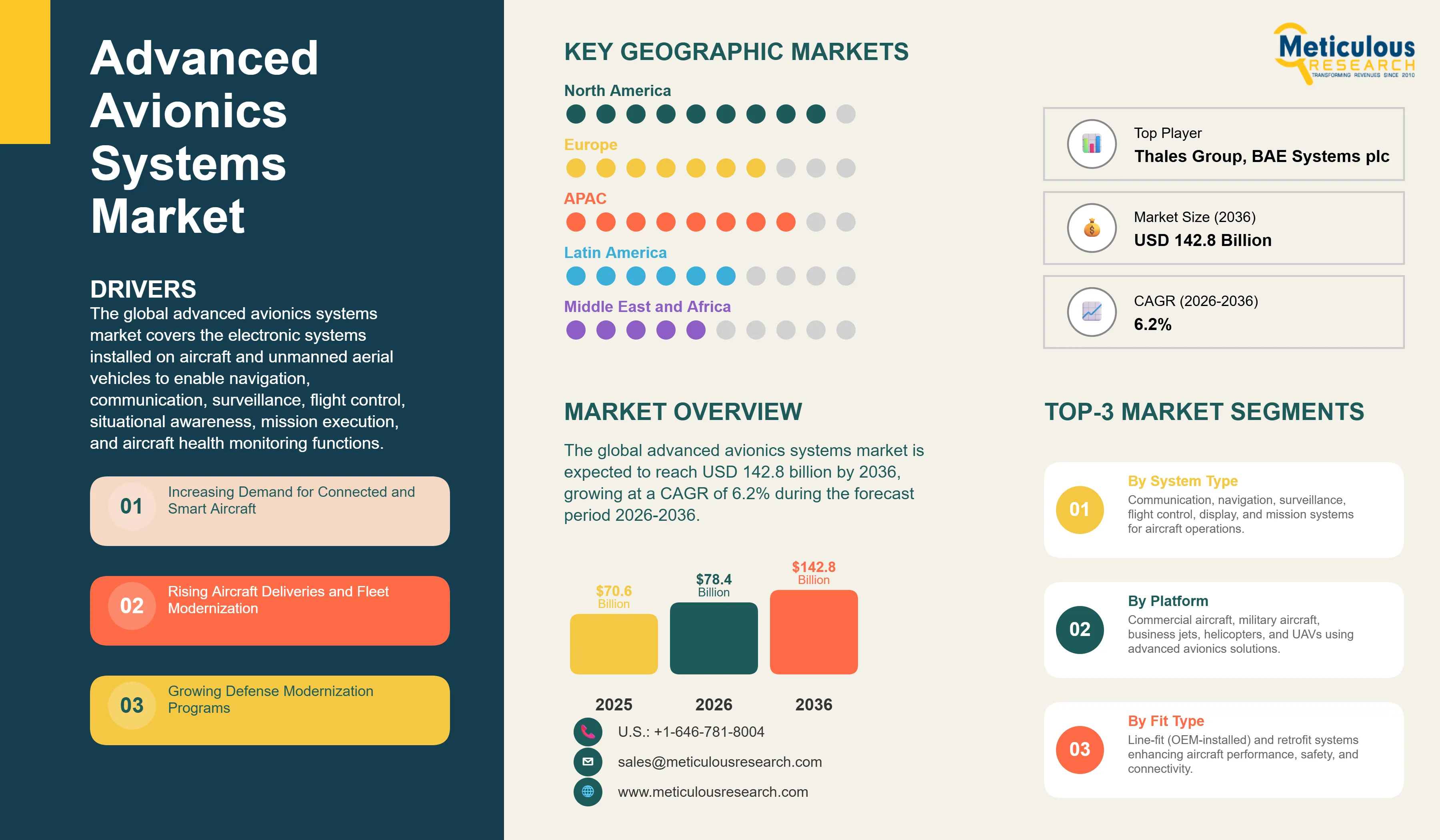
The global advanced avionics systems market was valued at USD 70.6 billion in 2025. This market is expected to reach USD 142.8 billion by 2036 from an estimated USD 78.4 billion in 2026, growing at a CAGR of 6.2% during the forecast period 2026-2036.
- Published
- Apr 2026
- Pages
- 295
- Format
- PDF + Excel
- Report ID
- MR-1912
- Base year
- 2025
- 2025 · BASELINE
- $70.60B
- 2036
- $142.8B
- CAGR 2026–2036
- 6.2%
2025 baseline · 2026–2036 forecast at 6.2% CAGR · hover a bar for the value
Key highlights
The global advanced avionics systems market is projected to reach USD 142.8 billion by 2036.
The market is expected to grow at a CAGR of 6.2% during the forecast period 2026-2036.
The global advanced avionics systems market was valued at USD 70.6 billion in 2025 and is estimated to reach USD 78.4 billion in 2026.
North America is expected to dominate the global advanced avionics systems market with the largest market share in 2026, while Asia-Pacific is projected to register the highest CAGR during the forecast period.
By system type, the communication systems segment is expected to hold the largest share of the market in 2026, while the health monitoring systems segment is projected to register the highest CAGR during the forecast period.
By platform, the commercial aircraft segment is expected to hold the largest share in 2026, while the UAVs segment is projected to register the highest CAGR during the forecast period.
By fit type, the line-fit segment is expected to hold the largest share in 2026, while the retrofit/aftermarket segment is projected to register the highest CAGR during the forecast period.
By architecture type, the integrated modular avionics segment is expected to hold the largest share in 2026, while the software-defined avionics segment is projected to register the highest CAGR during the forecast period.
By application, the flight operations and navigation segment is expected to hold the largest share in 2026, while the aircraft health monitoring segment is projected to register the highest CAGR during the forecast period.
By end user, the commercial aviation operators segment is expected to hold the largest share in 2026, while the UAV operators segment is projected to register the highest CAGR during the forecast period.
Report summary
| Particulars | Details |
|---|---|
| Market Size by 2036 | USD 142.8 Billion |
| Market Size in 2026 | USD 78.4 Billion |
| Market Size in 2025 | USD 70.6 Billion |
| Revenue Growth Rate (2026-2036) | CAGR of 6.2% |
| Format | PDF, Excel & Cloud Portal · 295 pages |
| Dominating System Type | Communication Systems |
| Fastest Growing System Type | Health Monitoring Systems |
| Dominating Platform | Commercial Aircraft |
| Fastest Growing Platform | Unmanned Aerial Vehicles (UAVs) |
| Dominating Fit Type | Line-Fit (OEM Installation) |
| Fastest Growing Fit Type | Retrofit/Aftermarket |
| Dominating Architecture Type | Integrated Modular Avionics (IMA) |
| Fastest Growing Architecture Type | Software-Defined Avionics |
| Dominating Application | Flight Operations and Navigation |
| Fastest Growing Application | Aircraft Health Monitoring |
| Dominating End User | Commercial Aviation Operators |
| Fastest Growing End User | UAV Operators |
| Dominating Geography | North America |
| Fastest Growing Geography | Asia-Pacific |
| Base Year | 2025 |
| Forecast Period | 2026 to 2036 |
Report overview
Segments covered: system type, platform, fit type, architecture type, application, end user, technology.
The global advanced avionics systems market covers the electronic systems installed on aircraft and unmanned aerial vehicles to enable navigation, communication, surveillance, flight control, situational awareness, mission execution, and aircraft health monitoring functions. This encompasses communication systems including SATCOM, VHF and HF radio, and digital data link platforms; navigation systems including GPS and GNSS receivers, inertial navigation systems, and flight management computers; surveillance systems including weather radar, ADS-B transponders, and TCAS collision avoidance; flight control systems including fly-by-wire and autopilot platforms; cockpit display systems including primary flight displays, multi-function displays, and head-up displays; and the mission and tactical systems, health monitoring platforms, and integrated modular avionics architectures that form the digital backbone of modern aircraft across commercial, military, business aviation, and unmanned system applications.
The growth of the global advanced avionics systems market is primarily driven by the strong recovery and expansion of commercial aircraft deliveries following the COVID-19 pandemic disruption, with Boeing and Airbus collectively delivering over 1,200 commercial aircraft annually at peak rates and carrying large order backlogs that translate into sustained avionics line-fit procurement demand extending well through the forecast period. The aviation industry's progressive digital transformation toward connected aircraft architectures that enable real-time data exchange between the aircraft and ground operations, maintenance, and air traffic management systems is driving avionics investment in SATCOM broadband connectivity, electronic flight bag integration, ADS-B systems, and the data link infrastructure that enables performance-based navigation and digital air traffic management operations.
Two significant opportunities are shaping the market's long-term trajectory. The rapid growth of the unmanned aerial vehicle market across both commercial and military applications is creating a large and fast-growing new avionics procurement channel that requires purpose-designed avionics platforms optimized for the size, weight, power, and cost constraints of unmanned systems while providing the navigation, communication, and sense-and-avoid capabilities required for safe urban and beyond-visual-line-of-sight operations. The very large global installed base of aging aircraft requiring avionics retrofits to comply with ADS-B mandate implementation programs, Performance-Based Navigation requirements, and the NextGen and SESAR air traffic management modernization programs represents a large and addressable near-term aftermarket revenue opportunity for avionics suppliers with FAA and EASA-certified retrofit product lines.
Report infographic
Market dynamics
7 factors across 3 forcesIncreasing Demand for Connected and Smart Aircraft
The aviation industry's broad adoption of connected aircraft architectures that leverage satellite and terrestrial broadband communications to integrate aircraft with ground-based airline operations centers, maintenance facilities, and air traffic management systems in real time is the primary demand driver generating avionics system investment growth across both commercial line-fit and retrofit market segments. Airlines are increasingly requiring SATCOM broadband data connectivity on their aircraft fleets to enable predictive maintenance programs that use real-time aircraft sensor data streamed during flight to detect engine, system, and structural anomalies before they cause in-service failures, reducing unplanned maintenance events and improving aircraft dispatch reliability. The FAA and EASA mandates for ADS-B Out equipage that were fully implemented by 2020 in the U.S. and 2023 in Europe required avionics upgrades on thousands of commercial and general aviation aircraft, and the follow-on SESAR and NextGen programs are generating further avionics investment requirements for Performance-Based Navigation, datalink weather and routing services, and digital ATIS subscription terminals that collectively represent a sustained avionics modernization investment cycle.
Rising Aircraft Deliveries and Fleet Modernization
The strong recovery and expansion of commercial aircraft production following the COVID-19 pandemic's severe disruption to the aviation industry is generating sustained and growing line-fit avionics procurement demand as Airbus and Boeing execute their large order backlogs extending into the early 2030s at production rates that are approaching and targeting historic peaks. Airbus's A320neo Family and A350 program deliveries, Boeing's 737 MAX return to service and delivery acceleration, and the emerging widebody deliveries of Airbus A330neo and Boeing 787 and 777X programs collectively generate very large annual avionics system procurement from Honeywell, Collins Aerospace, Thales, Garmin, and Safran as launch suppliers for these platforms. The simultaneous retirement of older Boeing 747, 737 Classic, and Airbus A320ceo and A330ceo aircraft creates both demand for new aircraft avionics through replacement aircraft orders and retrofit avionics demand as operators invest in extending the service life of retained older aircraft through avionics modernization programs that improve operational capability and compliance with mandate requirements.
Table of contents
15 chapters · 185 sections · 295 pages · click to expandSegmental analysis
| Segment | Largest share (2026) | Fastest growth (2026–2036) |
|---|---|---|
| By System Type | Communication Systems | Health monitoring systems |
| By Platform | Commercial Aircraft | UAV |
| By Fit Type | Line-Fit | — |
| By Architecture Type | IMA | Software-defined avionics |
| By Application | Flight Operations and Navigation | Aircraft health monitoring |
| By End User | Commercial Aviation Operators | UAV operators |
By System Type
- Communication Systems to Dominate
- The communication systems segment is expected to account for the largest share of the global advanced avionics systems market.
- The large share of this segment is attributed to communication systems representing the broadest-installed and highest-procurement-volume avionics category across commercial, military, and business aviation platforms, encompassing SATCOM terminals, VHF and HF radio transceivers, and digital datalink systems that are installed on virtually every commercial and military aircraft and that are generating significant upgrade procurement driven by SATCOM broadband adoption for passenger connectivity and operational data applications, datalink communication mandates, and the progressive transition from analog to digital radio communication across global airspace.
- However, the health monitoring systems segment is poised to register the highest CAGR during the forecast period.
- The high growth of this segment is attributed to airlines' accelerating adoption of aircraft health management and predictive maintenance programs that use real-time sensor data streaming from structural, engine, and systems health monitoring avionics to detect anomalies and predict maintenance requirements before failure, reducing unplanned maintenance events and improving aircraft operational availability.
- The expanding regulatory and OEM emphasis on aircraft health monitoring data as a tool for improving aviation safety and reducing maintenance costs is driving both new aircraft installation and retrofit investment in health monitoring avionics across the global commercial fleet.
By Platform
- Commercial Aircraft to Hold the Largest Share
- The commercial aircraft segment is expected to account for the largest share of the global advanced avionics systems market.
- Commercial aircraft represent the highest aggregate avionics procurement volume category globally, driven by the large annual production rates at Airbus and Boeing generating substantial line-fit avionics orders, the mandatory retrofit requirements of regulatory mandates affecting the large global commercial fleet of over 25,000 active aircraft, and the high per-aircraft avionics content of modern narrowbody and widebody aircraft platforms that each carry multiple avionics system categories representing millions of dollars in avionics equipment value per aircraft.
- However, the UAV segment is projected to register the highest CAGR during the forecast period.
- This growth is driven by the extraordinary expansion of military unmanned system procurement across all major defense establishments for intelligence, surveillance, and reconnaissance and strike missions, the rapid development of commercial UAV applications in logistics, inspection, agriculture, and mapping that require FAA and EASA-certified avionics for beyond-visual-line-of-sight operations, and the emerging urban air mobility market creating demand for eVTOL avionics platforms as these systems advance toward commercial certification.
By Fit Type
- Line-Fit to Hold the Largest Share
- The line-fit segment is expected to account for the largest share of the global advanced avionics systems market.
- Line-fit avionics installed at aircraft manufacturing facilities through long-term launch supplier agreements between Boeing, Airbus, and military aircraft OEMs and avionics suppliers represent the highest aggregate revenue category, as new aircraft deliveries generate multi-year contracted avionics procurement programs at defined rates and prices that provide revenue visibility and high per-aircraft avionics content.
- The large Boeing and Airbus commercial delivery backlogs extending into the early 2030s ensure sustained line-fit avionics demand across the forecast period.
- However, the retrofit/aftermarket segment is projected to register the highest CAGR during the forecast period.
- This growth is driven by the large global installed aircraft fleet requiring avionics upgrades to comply with regulatory mandates for ADS-B, Performance-Based Navigation, and communications system modernization, the business aviation fleet's strong avionics upgrade demand for glass cockpit retrofits and SATCOM installations, and the military aircraft avionics modernization programs that are upgrading existing airframes rather than procuring new aircraft in many national air force programs.
By Architecture Type
- IMA to Hold the Largest Share
- The integrated modular avionics segment is expected to account for the largest share of the global advanced avionics systems market.
- IMA architecture, which consolidates multiple avionics functions on shared processing hardware modules with time-space partitioned operating environments, has become the standard architecture for modern commercial and military aircraft platforms including the Airbus A380 and A350, Boeing 787, F-35 Lightning II, and Eurofighter Typhoon.
- IMA's advantages in reducing hardware weight and volume, simplifying maintenance through line-replaceable module standardization, and enabling software-based avionics function upgrades without hardware replacement have established it as the dominant architecture for all new-design aircraft programs.
- However, the software-defined avionics segment is projected to register the highest CAGR during the forecast period.
- Software-defined avionics extend IMA principles toward greater flexibility by enabling avionics functions to be reconfigured, updated, and expanded through software changes to standardized hardware platforms, reducing the time and cost of avionics capability upgrades and enabling in-service performance improvements without physical hardware modification.
- The growing demand for rapid avionics capability updates in response to evolving air traffic management requirements, threat environment changes in military applications, and the introduction of new communication standards is driving the adoption of software-defined architectures across both new aircraft programs and retrofit applications.
By Application
- Flight Operations and Navigation to Hold the Largest Share
- The flight operations and navigation segment is expected to account for the largest share of the global advanced avionics systems market.
- Flight operations and navigation systems encompassing flight management computers, GPS and GNSS receivers, inertial navigation systems, and autopilot platforms are installed on every commercial, military, and business aviation aircraft and represent the core functional avionics category whose procurement volume across new aircraft and retrofit installations generates the highest aggregate segment revenue.
- Regulatory mandates for advanced navigation capability including RNAV and RNP approach procedures are driving sustained retrofit investment that reinforces the segment's dominant position.
- However, the aircraft health monitoring segment is projected to register the highest CAGR during the forecast period.
- This growth is driven by airlines' strong financial motivation to adopt predictive maintenance programs that reduce unplanned aircraft on-ground events by detecting developing maintenance issues through real-time sensor data analysis, the OEM-driven expansion of aircraft condition monitoring system capabilities on new-generation aircraft that generate larger data volumes and more sophisticated health monitoring insights, and the growing regulatory emphasis on continuous airworthiness monitoring that is creating compliance-driven aircraft health monitoring investment across the global commercial fleet.
By End User
- Commercial Aviation Operators to Hold the Largest Share
- The commercial aviation operators segment is expected to account for the largest share of the global advanced avionics systems market.
- Commercial airlines represent the largest avionics procurement channel through their influence on OEM line-fit selection decisions and their direct retrofit investment programs, driven by the large global commercial fleet scale, the multiple regulatory avionics mandates affecting commercial operators, the airline industry's adoption of advanced connectivity and health management avionics for operational efficiency, and the high per-aircraft avionics content of narrowbody and widebody aircraft representing the majority of global commercial traffic capacity.
- However, the UAV operators segment is projected to register the highest CAGR during the forecast period.
- This growth is driven by the explosive expansion of military unmanned system procurement across U.S. and allied defense forces for persistent surveillance, strike, and logistics missions requiring advanced avionics certification, the growing commercial UAV market adoption of FAA-certified avionics enabling beyond-visual-line-of-sight operations in controlled airspace, and the emerging eVTOL urban air mobility operator market requiring purpose-designed avionics suites for type certificate achievement and commercial operations launch.
Geographic analysis
North America
Largest shareIn 2026, North America is expected to account for the largest share of the global advanced avionics systems market. The largest share of this region is mainly due to the United States' position as the home of the world's two largest commercial aircraft manufacturers in Boeing and the major U.S. partner in Airbus programs, the dominant U.S. avionics supplier ecosystem anchored by Honeywell Aerospace, Collins Aerospace, Garmin Aviation, and L3Harris that collectively supply the majority of avionics content on both U.S.-manufactured and foreign aircraft, and the very large U.S. military aviation avionics market driven by the world's largest defense aviation fleet modernization programs. The U.S. commercial aviation fleet, comprising over 7,000 commercial jet aircraft operated by major U.S. airlines, generates the world's largest single-country commercial avionics retrofit and service market driven by the ongoing NextGen ATC modernization requirements and the large airline fleet investment programs in SATCOM connectivity and health management avionics. Canada's Bombardier business aviation and regional aircraft programs contribute additional North American avionics procurement demand, and Mexico's growing MRO and avionics installation services sector supports the regional market's aftermarket activities.
Asia-Pacific
Fastest growthHowever, the Asia-Pacific advanced avionics systems market is expected to grow at the fastest CAGR during the forecast period. The region's rapid growth is driven by Asia-Pacific's position as the world's fastest-growing commercial aviation market, with Chinese, Indian, Southeast Asian, and Oceanian airline fleets expanding rapidly to serve the region's growing middle-class air travel demand, generating very large new aircraft delivery-driven line-fit avionics procurement programs at CAAC-regulated Chinese airlines and India's IndiGo, Air India, and Akasa Air expansion programs. China's Commercial Aircraft Corporation of China's C919 and C929 commercial aircraft development programs, though initially relying on international avionics suppliers including Honeywell, Collins, and Thales, are establishing Chinese domestic aviation industry capabilities and generating domestic avionics component demand. India's Tejas fighter jet program and the advancing AMCA fifth-generation fighter development are generating military avionics procurement demand for domestically developed and internationally sourced systems. Japan's F-35 program, South Korea's KF-21 Boramae indigenous fighter, and Australia's very large F-35 acquisition collectively contribute substantial Asia-Pacific military avionics procurement
Europe
Europe represents a large and technologically advanced avionics market anchored by Airbus's dominant commercial aircraft manufacturing programs generating very large line-fit avionics procurement for European suppliers including Thales, Safran, and Liebherr Aerospace, the large European commercial airline fleet's retrofit avionics investment driven by SESAR ATM modernization requirements and the EU's Single European Sky performance-based navigation mandates, and the substantial European military avionics procurement across Eurofighter, Rafale, Gripen, and NH90 helicopter programs.
Middle East & Africa
The Middle East's rapidly growing commercial aviation market, dominated by Emirates, Qatar Airways, and Etihad expanding their widebody fleets with high avionics content aircraft, combined with the Gulf states' substantial military aviation investment programs, positions the Middle East and Africa region as an important and growing avionics procurement market.
Competitive landscape
- Honeywell International Inc. (U.S.)
- Collins Aerospace/RTX Corporation (U.S.)
- Thales Group · France
- Garmin Ltd. (Switzerland/U.S.)
- Safran S.A. · France
- Northrop Grumman Corporation (U.S.)
- BAE Systems plc (UK)
- L3Harris Technologies Inc. (U.S.)
- General Dynamics Corporation (U.S.)
- Leonardo S.p.A · Italy
- Elbit Systems Ltd. · Israel
- Boeing Company (U.S.)
- Airbus SE · Netherlands
- Mitsubishi Electric Corporation · Japan
- Panasonic Avionics Corporation (U.S.)
Frequently asked questions
The global advanced avionics systems market is expected to reach USD 142.8 billion by 2036 from an estimated USD 78.4 billion in 2026, at a CAGR of 6.2% during the forecast period 2026-2036.
Cite this report
Meticulous Research. (2026). Advanced Avionics Systems Market - Global Opportunity Analysis and Industry Forecast (2026-2036) (Report No. MR-1912). Meticulous Market Research Pvt. Ltd. https://www.meticulousresearch.com/product/advanced-avionics-systems-market-6595