AI Data Center Power Demand: Why Grid Delays Are Pushing Operators Toward Microgrids, Batteries and Fuel Cells
A data center can be built in about two years. Getting a grid connection for it can take longer than that, sometimes much longer. That gap between how fast AI campuses are being planned and how slowly utilities can serve them is now shaping where money goes in the power equipment chain.
This blog looks at what is driving AI data center power demand, why the grid has become the bottleneck, and how operators are responding with on-site power. It then walks through the equipment inside the fence, from substations to switchgear, because that is where most of the spend lands. Seven Meticulous Research reports sit behind the numbers.
Key takeaways
- Data centers used about 415 TWh of electricity in 2024, roughly 1.5% of global demand, and the International Energy Agency (IEA) expects about 945 TWh by 2030.
- Waiting for a utility connection is the main constraint. Lawrence Berkeley National Laboratory found that interconnection waits for new generation rose from under two years to more than four.
- Operators are adding their own power. In Bloom Energy's 2026 survey, 33% of data centers expect to run fully on on-site power by 2030, up from 1% in April 2024.
- Microgrids, battery storage and fuel cells are the three on-site options growing fastest. The data center microgrid and battery storage markets are each forecast to grow at 14.2% a year from 2026 to 2036.
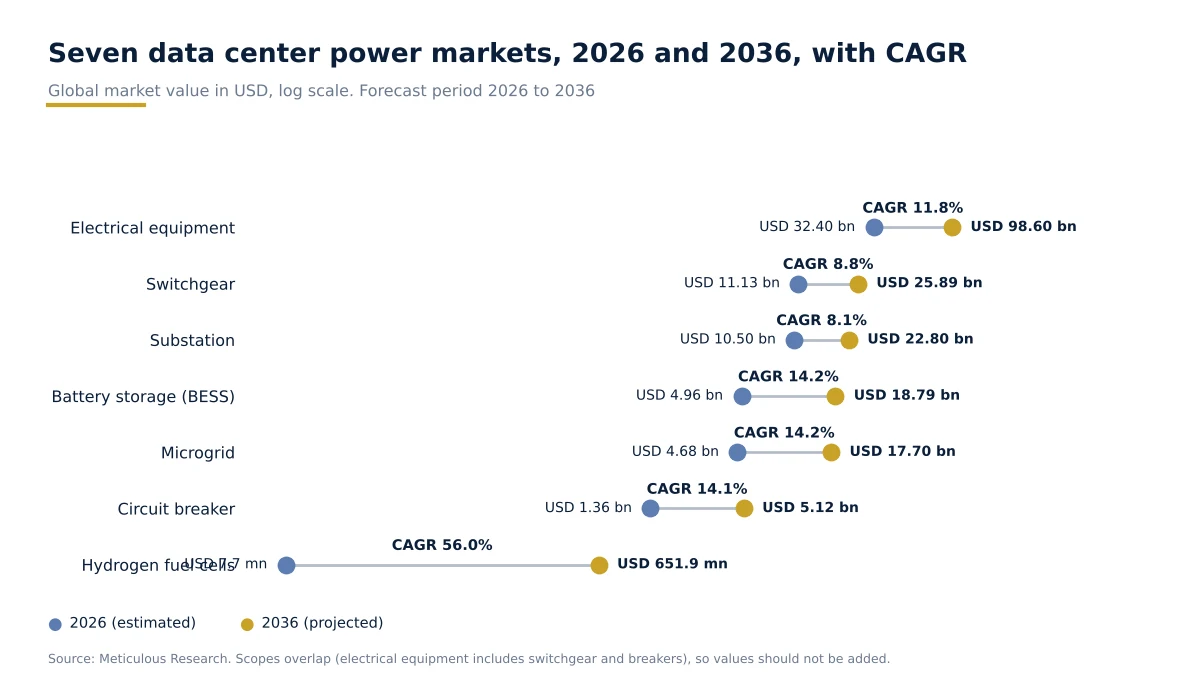
- Inside the fence, electrical equipment is the larger pool: USD 32.4 billion in 2026, rising to USD 98.6 billion by 2036.
Why AI Data Center Power Demand Is Rising So Fast
For most of the last decade, data center electricity use grew slowly because chips and cooling kept getting more efficient. AI changed that. A rack of modern accelerators draws many times the power of a conventional server rack, and operators are building campuses sized in hundreds of megawatts, not tens.
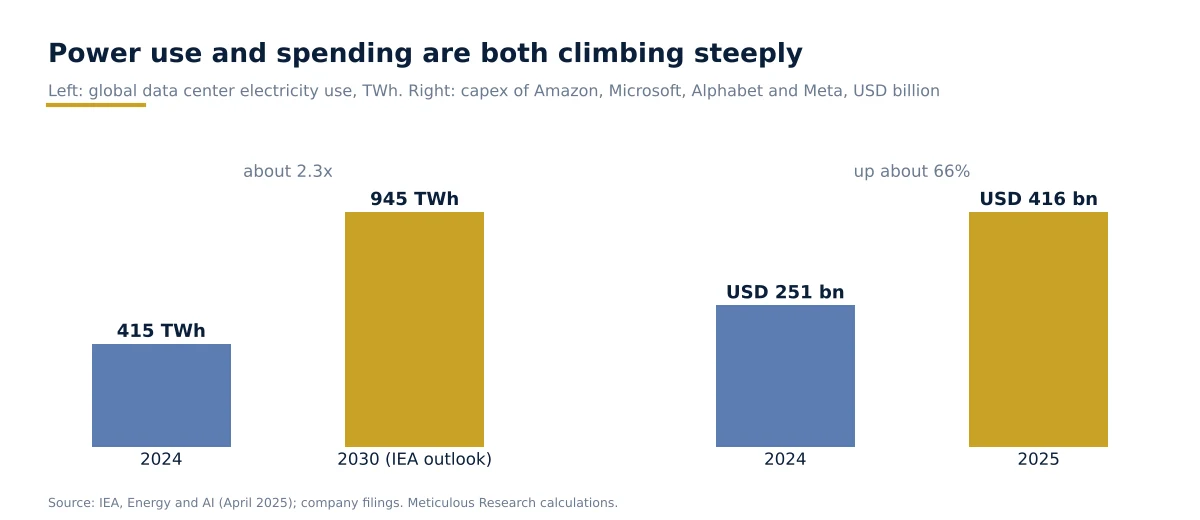
The numbers show the shift. The IEA's Energy and AI analysis from April 2025 puts global data center consumption at about 415 TWh in 2024, around 1.5% of world electricity, and expects it to reach about 945 TWh by 2030. In the United States, the U.S. Department of Energy and Lawrence Berkeley National Laboratory estimate that data centers used about 176 TWh in 2023, or 4.4% of national electricity, and could account for 6.7% to 12% by 2028.
Money is following the load. Company filings show that Amazon, Microsoft, Alphabet and Meta spent about USD 416 billion on capital projects in 2025, up from about USD 251 billion in 2024. Much of that goes into land, chips and buildings, but a growing share must go into the electrical systems that keep them running.
This is the demand side of the story. The harder question is whether the grid can deliver the power in time.
The Grid Bottleneck: Why Data Centers Cannot Wait for a Connection
Building a data center is no longer the slow part. Connecting it is.
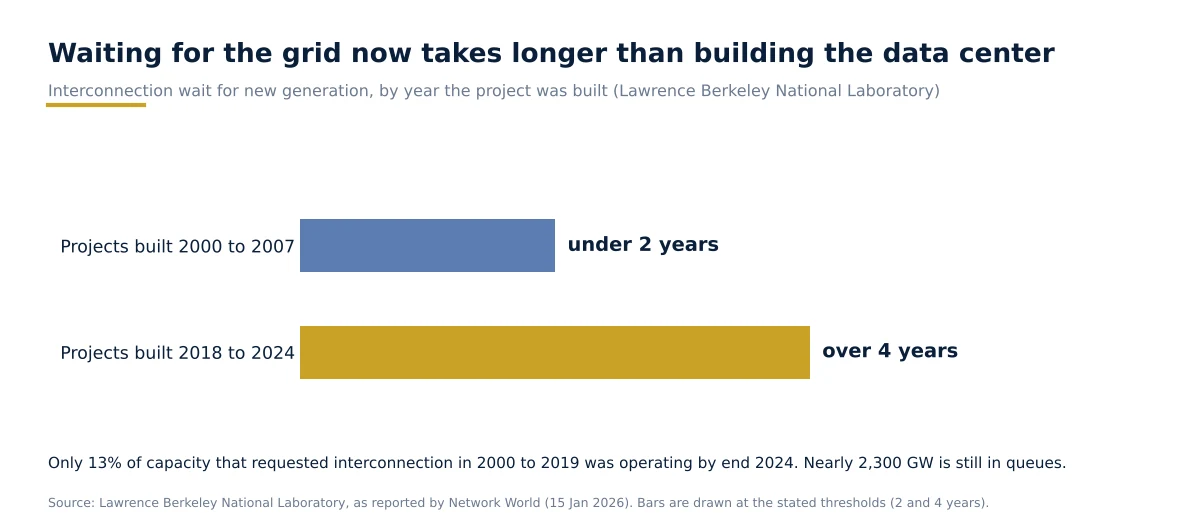
A January 2026 report in Network World on Google's warnings to regulators quotes utilities telling the company that interconnection can take "four or five, sometimes ten years", and one utility said it needed 12 years just to study a request. Research from Lawrence Berkeley National Laboratory shows why. Generation projects built between 2000 and 2007 waited under two years to connect; those built between 2018 and 2024 waited more than four. Of the capacity that asked to connect between 2000 and 2019, only 13% was operating by the end of 2024, and nearly 2,300 GW is still sitting in queues.
Transformers and switchgear add to the delay. Lead times for large power equipment have stretched, and the IEA has warned that about 20% of planned data center projects could be at risk of delay because of grid constraints.
Regulators are starting to respond. On 12 December 2025, Ireland's Commission for Regulation of Utilities decided that new data centers must bring on-site or nearby dispatchable generation or storage matching their maximum import capacity. Ireland is a small market, but the rule shows where policy can go when a grid is stretched: the data center is asked to carry part of its own reliability.
For operators, the practical result is simple. A campus that can generate or store some of its own power can start earning revenue years before the grid catches up. That is why on-site power has moved from a back-up idea to a design question at the start of a project.
On-Site Power: Microgrids, Batteries and Fuel Cells
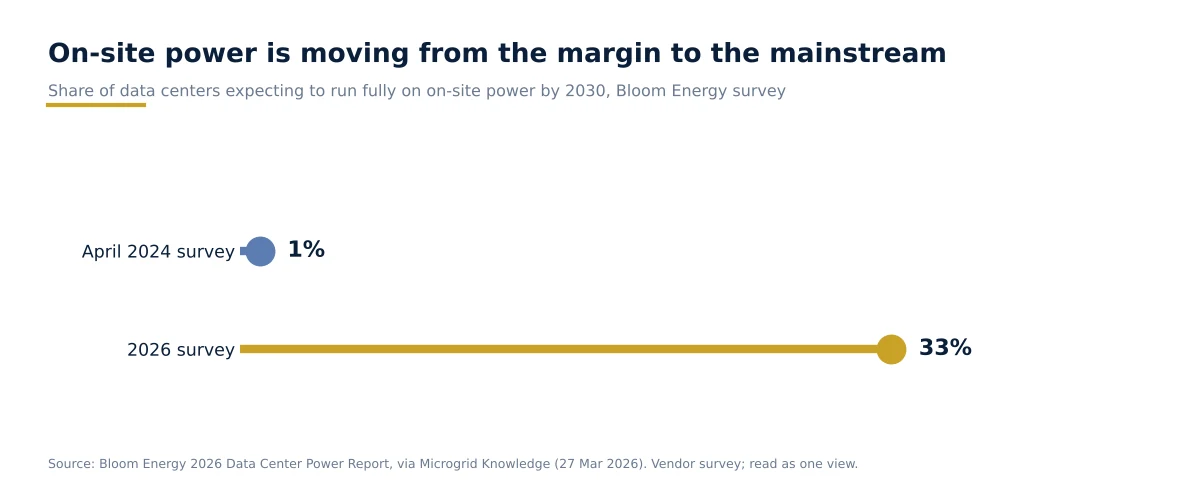
Operators are not giving up on the grid. They are building a second source of power beside it. Bloom Energy's 2026 Data Center Power Report, a survey of industry insiders, found that 33% of data centers expect to be fully powered by on-site resources by 2030, compared with 1% in April 2024, and that 75% of developers are actively evaluating on-site power. Bloom sells fuel cells, so treat the survey as one vendor's view, but the direction matches what the rest of the market is doing.
Three technologies carry most of the activity.
Microgrids: the foundation
A microgrid ties on-site generation, storage and controls into one system that can run with or without the utility. Meticulous Research's Data Center Microgrid Market report values the segment at USD 4.68 billion in 2026 and USD 17.7 billion by 2036, a 14.2% CAGR. Hybrid systems built on natural gas and diesel generators lead today, while renewables paired with batteries are the fastest growing power source. North America is the largest region and Asia-Pacific the fastest.
The scale of recent projects is telling. In April 2026, Oracle and Bloom Energy announced a microgrid of up to 2.45 GW for a New Mexico data center campus, as reported by Hydrogen Fuel News. In Dublin, Pure Data Centres Group unveiled a 10 MW on-site microgrid.
Battery storage: the shock absorber
AI training jobs can swing a campus's load sharply within seconds. Batteries smooth those swings, ride through outages, and let operators avoid oversizing the grid connection. The Battery Energy Storage Market for Data Centers report puts the segment at USD 4.96 billion in 2026, growing to USD 18.79 billion by 2036 at 14.2% a year. Lithium-ion leads today, with flow batteries the fastest growing technology, and the fastest growing application is AI load management. Uninterruptible power and backup remain the largest use.
Fuel cells: the cleaner prime power option
Fuel cells can supply continuous power without waiting for a grid connection and with far lower local emissions than diesel. They are also the smallest and fastest growing of the three. The Hydrogen Fuel Cells for Data Centers Market report estimates USD 7.66 million in 2026 and USD 651.88 million by 2036, a 56.0% CAGR from a very small base. Prime and continuous power is the largest application, and the 2 to 10 MW range holds the biggest share.
Projects are scaling up. FuelCell Energy and SDCL signed a letter of intent in January 2026 for up to 450 MW of behind-the-meter fuel cell power, using 2.5 MW and 1.25 MW systems that can run on blends of up to 50% hydrogen. Replacing diesel is part of the draw: Northern Virginia alone hosts more than 4,000 diesel generators at data centers, with a combined capacity above 11 GW, according to Virginia Mercury in January 2026. Microsoft committed in 2020 to end its dependence on diesel backup by 2030 and, in July 2022, tested a 3 MW hydrogen fuel cell backup system with Plug Power.
A fair caution applies. Fuel cell volumes today are tiny, and most projects run on natural gas, not green hydrogen, until supply and prices improve. The 56.0% growth rate reflects how small the base is as much as how fast demand is rising.
Inside the Fence: Substations, Switchgear, Breakers and Electrical Equipment
Generating or storing power is half the job. Every megawatt still has to be stepped down, switched, protected and distributed inside the campus, and this is where the largest budgets sit.
The Data Center Electrical Equipment Market report is the widest view. It values the segment at USD 32.4 billion in 2026 and USD 98.6 billion by 2036, an 11.8% CAGR. Uninterruptible power supply (UPS) systems are the largest product today, while switchgear and power distribution units grow fastest. Hyperscale facilities are the largest application.
Three narrower reports show where the pressure points are:
- Substations. The Data Center Substation Market is estimated at USD 10.5 billion in 2026, reaching USD 22.8 billion by 2036 at 8.1% a year. Prefabricated and modular substations and power automation and control systems are the fastest growing segments, because buyers want shorter build times.
- Switchgear. The Data Center Switchgear Market grows from USD 11.13 billion in 2026 to USD 25.89 billion in 2036, an 8.8% CAGR. Low-voltage gear leads, high-voltage gear grows fastest, and SF6-free designs are rising as regulation tightens. Under EU F-gas Regulation (EU) 2024/573, SF6 has been banned in new medium-voltage switchgear up to 24 kV since 1 January 2026.
- Circuit breakers. The Data Center Circuit Breaker Market grows from USD 1.36 billion to USD 5.12 billion over the same period, a 14.1% CAGR. Air circuit breakers are the largest type and molded case breakers grow fastest.
The infographic below puts all seven markets side by side. These scopes overlap, because electrical equipment includes switchgear and breakers, so the figures should be compared and not added together.
Demand signals from the suppliers themselves are strong. Eaton reported data center orders up about 200% in the fourth quarter of 2025, and Siemens Smart Infrastructure booked record data center orders of EUR 1.9 billion in the second quarter of its 2026 fiscal year.
Reliability is the reason buyers pay for this equipment. The Uptime Institute's 2025 Annual Outage Analysis found power to be the leading cause of impactful outages, at 54% of cases.
What Operators and Suppliers Should Do Next
The pattern across all seven markets is the same: demand is set by how fast campuses can be energised, not only by how many are planned. That points to a few clear moves.
For data center operators
- Treat power as a site-selection filter. Ask early how long the utility will take, and price a bridging plan with on-site generation and storage alongside it.
- Design for both modes. Microgrid controls, batteries and switchgear sized for island operation cost less to include at the start than to retrofit.
- Plan for the rules to move. Ireland's requirement for on-site dispatchable capacity may spread to other constrained grids.
For equipment and technology suppliers
- Shorten delivery. Prefabricated substations and modular switchgear are among the fastest growing segments because they cut on-site build time.
- Prepare for SF6-free switchgear. The EU ban on SF6 in new medium-voltage gear from 1 January 2026 is likely to push buyers elsewhere to ask for the same.
- Pair products into systems. Microgrid controls, storage and generation increasingly sell as one package, so partnerships matter.
For investors and planners
Look at the whole chain. Generation and storage get the attention, but electrical equipment is the larger and steadier pool, and it benefits whichever on-site technology wins.
Frequently Asked Questions
How much electricity do data centers use? The IEA estimates about 415 TWh in 2024, around 1.5% of global electricity, rising to about 945 TWh by 2030. In the United States, DOE and Berkeley Lab put use at about 176 TWh in 2023, or 4.4% of national electricity.
Why are AI data centers struggling to get grid power? Interconnection queues are long, equipment is slow to arrive, and AI campuses ask for hundreds of megawatts at once. Berkeley Lab data shows waits for new generation have grown from under two years to over four.
What is behind-the-meter power for data centers? It is power generated or stored on the data center's own site, ahead of the utility meter. Common forms are gas generators, fuel cells and battery storage, often tied together by a microgrid.
Which on-site power technology is growing fastest? In Meticulous Research's forecasts, hydrogen fuel cells for data centers show the highest growth rate (56.0% a year to 2036) from a very small base. Microgrids and battery storage are far larger, each growing 14.2% a year.
Which electrical equipment segments are largest? Data center electrical equipment is the broadest pool at USD 32.4 billion in 2026, followed by switchgear at USD 11.13 billion, substations at USD 10.5 billion and circuit breakers at USD 1.36 billion. These scopes overlap, so they are not additive.
Explore the Reports
- Data Center Microgrid Market (2026-2036)
- Battery Energy Storage Market for Data Centers (2026-2036)
- Hydrogen Fuel Cells for Data Centers Market (2026-2036)
- Data Center Substation Market (2026-2036)
- Data Center Switchgear Market (2026-2036)
- Data Center Electrical Equipment Market (2026-2036)
- Data Center Circuit Breaker Market (2026-2036)
To see segment forecasts, company profiles and regional detail, request a sample from any report page or contact Meticulous Research.
Sources
- International Energy Agency, Energy and AI (April 2025)
- U.S. Department of Energy and Lawrence Berkeley National Laboratory, data center energy report (December 2024)
- Network World, Google warns transmission delays are now the biggest threat to data center expansion (15 January 2026)
- Microgrid Knowledge, For data centers, on-site power increasingly ticks the right boxes (27 March 2026), on Bloom Energy's 2026 Data Center Power Report
- Hydrogen Fuel News, Hydrogen fuel cells power Oracle's New Mexico AI data center microgrid (28 April 2026)
- Data Center Knowledge, FuelCell Energy, SDCL connect for 450 MW fuel cell power plan (21 January 2026)
- Commission for Regulation of Utilities, Ireland (12 December 2025); Uptime Institute, Annual Outage Analysis 2025; EU F-gas Regulation (EU) 2024/573; company filings and results statements from Amazon, Microsoft, Alphabet, Meta, Eaton and Siemens
Looking for full market sizing & granular dataset?
Access our comprehensive market forecast report SKU: MRSE - 1042002.
Related Market Intelligence Briefings
Recommended reading from the same research domain

METICULOUS INSIGHT
The Compliance Imperative: How the EU Cyber Resilience Act and NIS-2 Directive Are Reshaping Europe's OT/ICS Cybersecurity Market
For much of the past decade, cybersecurity in European industrial environments operated in a largely voluntary framework. Organizations adop...
METICULOUS INSIGHT
Rising Need for Home Safety & Security
The rising need for home safety and security is driven by a combination of evolving consumer concerns, technological advancements, and incre...

METICULOUS INSIGHT
Navigating the Future: Trends & Innovations in the English Language Learning Market
The English language learning market is rapidly evolving, driven by technological advancements, diverse learning preferences, and the rising...