Hydrogen Fuel Cells for Data Centers Market (2026-2036)
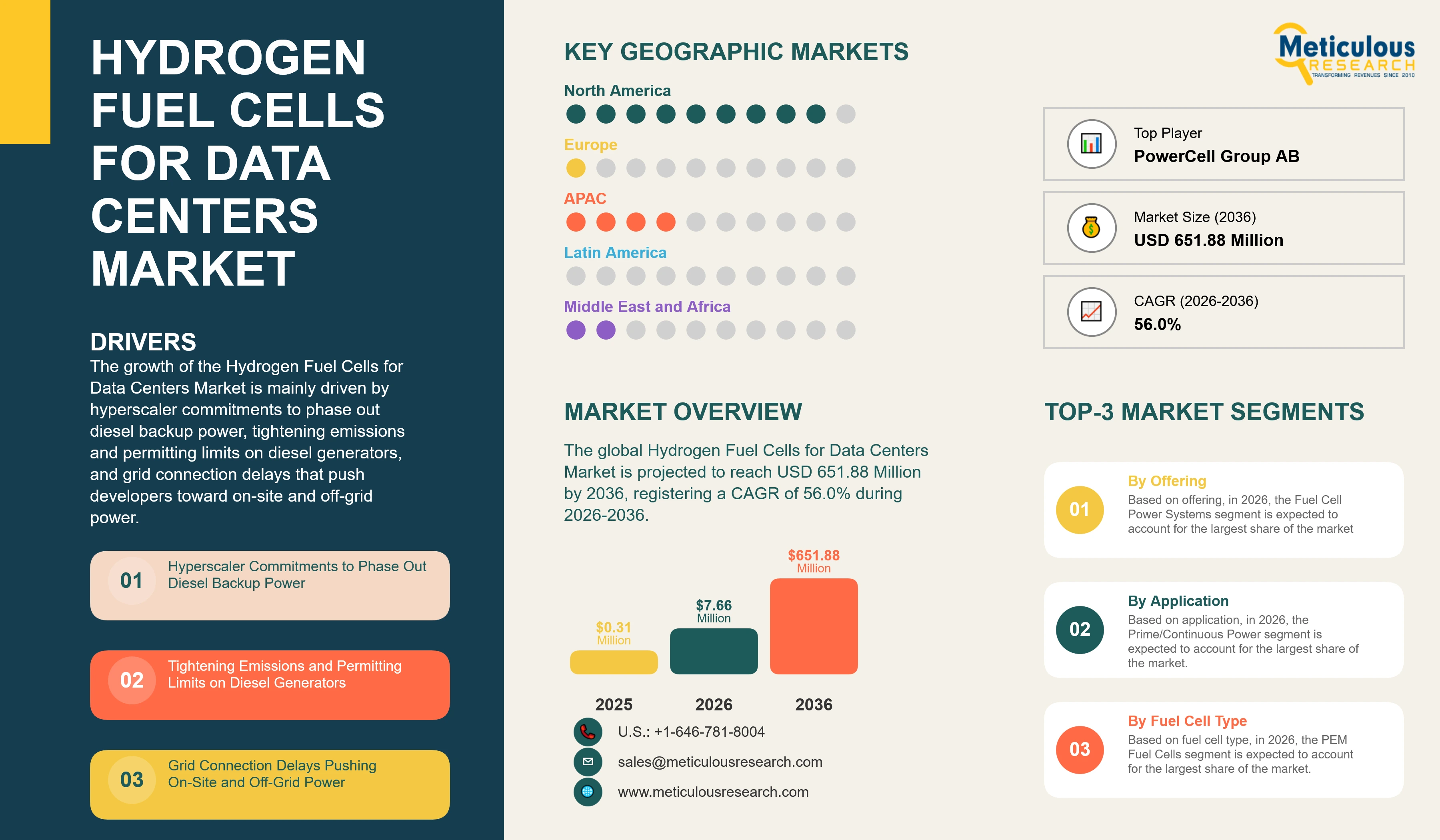
The global Hydrogen Fuel Cells for Data Centers Market was valued at USD 0.31 million in 2025. This market is expected to reach USD 651.88 million by 2036 from an estimated USD 7.66 million in 2026, registering a CAGR of 56.0% during the forecast period (2026-2036).
- Published
- May 2026
- Pages
- 320
- Format
- PDF + Excel
- Report ID
- MR-1998
- Base year
- 2025
- 2025 · BASELINE
- $0.3M
- 2036
- $651.9M
- CAGR 2026–2036
- 56.0%
2025 baseline · 2026–2036 forecast at 56.0% CAGR · hover a bar for the value
Key highlights
The global Hydrogen Fuel Cells for Data Centers Market is projected to reach USD 651.88 million by 2036 from an estimated USD 7.66 million in 2026, at a CAGR of 56.0%. The high growth rate reflects a very small starting base, and growth is projected to moderate to a CAGR of 39.2% from 2030 to 2036.
Firm hydrogen fuel cell capacity at data centers worldwide remained in the single-digit megawatt range in 2024–2026, while non-binding plans exceeded 1 GW. The order that ECL placed with PowerCell in July 2026 for a 5 MW class system at its Santa Clara campus is the first multi-MW commercial order of its kind.
By offering, the fuel cell power systems segment is expected to account for the largest share of 52.7% of the market in 2026, while the hydrogen storage & supply systems segment is projected to register the highest CAGR of 56.9%.
By application, the prime/continuous power segment is expected to account for the largest share of 76.9% in 2026, while backup & emergency power is projected to become the largest application from 2030 and to reach a share of 78.1% by 2036.
By data center type, the colocation segment is expected to account for the largest share of 84.3% in 2026, while the hyperscale segment is projected to register the highest CAGR of 93.4% and to account for 64.0% of the market by 2036.
North America is expected to account for the largest share of 81.7% of the market in 2026, while Europe is projected to register the highest CAGR of 100.0% from a small base.
Report summary
| Particulars | Details |
|---|---|
| Forecast Period | 2026-2036 |
| Base Year | 2025 |
| Estimated Year | 2026 |
| CAGR (Value) | 56.0% |
| Format | PDF, Excel & Cloud Portal · 320 pages |
| Market Size (Value) in 2026 | USD 7.66 Million |
| Market Size (Value) in 2036 | USD 651.88 Million |
| Segments Covered | By Offering: Fuel Cell Power Systems, Hydrogen Storage & Supply Systems, Integration, Installation & Services. By Fuel Cell Type: PEM Fuel Cells, Solid Oxide Fuel Cells, Other Fuel Cells. By Power Capacity: Up to 500 kW, 500 kW–2 MW, 2–10 MW, Above 10 MW. By Application: Backup & Emergency Power, Prime/Continuous Power, Bridge & Grid-Support Power. By Data Center Type: Hyperscale, Colocation, Enterprise, Edge. |
| Countries Covered | North America: U.S., Canada. Europe: Germany, U.K., Ireland, Netherlands, France, Nordics, Rest of Europe. Asia-Pacific: Japan, South Korea, China, Singapore, India, Australia, Rest of Asia-Pacific. Latin America: Brazil, Rest of Latin America. Middle East & Africa: UAE, Saudi Arabia, Rest of Middle East & Africa. |
| Key Companies | Ballard Power Systems, Plug Power, PowerCell Group, Bosch, Bloom Energy, Doosan Fuel Cell, Horizon Fuel Cell Technologies, Nedstack, Toyota, Honda, Rehlko, Caterpillar, Vertiv, SFC Energy, and Shanghai Hydrogen Propulsion Technology. |
Report overview
Segments covered: offering, fuel cell type, power capacity, application, data center type.
The growth of this market is mainly driven by hyperscaler commitments to phase out diesel backup power, tightening emissions and permitting limits on diesel generators, and grid connection delays that push developers toward on-site and off-grid power. However, the high cost and limited supply of delivered hydrogen and the high upfront cost of hydrogen systems compared with diesel generators and batteries restrain the growth of this market.
Furthermore, off-grid hydrogen-powered AI campuses, hydrogen hubs, liquid hydrogen logistics, and on-site electrolysis, and rental and hydrogen-as-a-service models are expected to offer growth opportunities for the stakeholders in this market. However, safety codes, permitting, setbacks, and site footprint, together with policy uncertainty for hydrogen supply, remain major challenges impacting the growth of this market. Additionally, containerized multi-MW fuel cell power blocks, hybrid microgrids that combine fuel cells, batteries, and grid power, and partnerships and consolidation across the value chain are prominent trends in this market.
The Hydrogen Fuel Cells for Data Centers Market covers fuel cell power systems, hydrogen storage and supply systems, and integration, installation, and services used to provide backup and emergency, prime or continuous, and bridge and grid-support power at data centers. It covers PEM, solid oxide, and other fuel cells across power classes from systems of up to 500 kW to blocks above 10 MW, in hyperscale, colocation, enterprise, and edge data centers.
Hydrogen fuel cells give data centers a way to produce power on site without combustion emissions at the point of use. Data centers used about 415 TWh of electricity in 2024, and the International Energy Agency (Energy and AI, April 2025) expects this to reach about 945 TWh by 2030. Each new campus needs backup generation of roughly the same capacity as its critical load, and most of that capacity is still diesel.
The market is at an early commercial stage. The ECL MV-1 data center in Mountain View, California, has run on trucked hydrogen since May 2024, Microsoft has tested hydrogen backup at megawatt scale with Plug Power and with Caterpillar and Ballard, and rental units from GeoPura have supported trials at Microsoft and Equinix sites in Dublin. In July 2026, ECL ordered a 5 MW class system from PowerCell for its Santa Clara campus and signed a non-binding memorandum of understanding for about 300 MW of additional capacity.
Cost remains the main barrier. A PEM system at about 55% efficiency uses about 55 kg of hydrogen per MWh, so a delivered price of USD 8 to USD 15 per kg means fuel costs of about USD 0.44 to USD 0.83 per kWh. Growth therefore depends on lower hydrogen prices from hubs and liquid hydrogen logistics, lower system costs from containerized power blocks, and the conversion of announced plans into firm orders.
Report infographic
Market dynamics
11 factors across 4 forcesHyperscaler Commitments to Phase Out Diesel Backup Power
Microsoft committed in 2020 to eliminate its dependence on diesel fuel for backup power in its data centers by 2030, a goal that applies to a global fleet in which almost every site relies on diesel generators. It has tested hydrogen fuel cells in four programs since 2020, including a 3 MW backup system with Plug Power in July 2022 and a 1.5 MW demonstration with Caterpillar and Ballard at Cheyenne, Wyoming, announced in January 2024. These tests shape how other operators assess the technology for standby power.
Tightening Emissions and Permitting Limits on Diesel Generators
Northern Virginia hosts more than 4,000 diesel generators at data centers with a combined capacity of over 11 GW, according to the Virginia Mercury (January 2026). The Virginia General Assembly passed HB 507 in March 2026, and legislators introduced further bills in the 2026 session to limit how much data centers can run diesel backup generators and to encourage energy storage as backup power. Every new campus adds another generator yard that needs an air permit, which puts diesel at the center of local opposition to data center growth.
Grid Connection Delays Pushing On-Site and Off-Grid Power
The International Energy Agency estimates that about 20% of planned data center projects could be at risk of delay because of grid constraints, and connection queues run up to about 10 years in the Netherlands and up to seven years in Northern Virginia. In Ireland, the Commission for Regulation of Utilities decided on 12 December 2025 that new data centers must provide on-site or nearby dispatchable generation or storage matching their maximum import capacity. Developers are therefore adding on-site generation, and ECL has built its model around behind-the-meter hydrogen power blocks.
Table of contents
13 chapters · 162 sections · 320 pages · click to expandSegmental analysis
| Segment | Largest share (2026) | Fastest growth (2026–2036) |
|---|---|---|
| By Offering | Fuel Cell Power Systems | Hydrogen Storage & Supply Systems |
| By Fuel Cell Type | PEM Fuel Cells | — |
| By Power Capacity | 2–10 MW | 500 kW–2 MW |
| By Application | Prime/Continuous Power | Bridge & Grid-Support Power |
| By Data Center Type | Colocation | Hyperscale |
By Offering
- The Fuel Cell Power Systems segment is expected to account for the largest share of 52.7% of the market.
- The large share of this segment is mainly due to the high value of stacks, modules, power conditioning, and controls in each installation.
- However, the Hydrogen Storage & Supply Systems segment is projected to register the highest CAGR of 56.9% during the forecast period.
- The rapid growth of this segment is driven by the need for several hours of on-site hydrogen in backup systems, because the Uptime Institute Tier standards require at least 12 hours of on-site fuel at N load, and by the high cost of on-site storage per kilogram.
By Fuel Cell Type
- The PEM Fuel Cells segment is expected to account for the largest share of 99.5% of the market.
- The large share of this segment is mainly due to the fast start-up, high power density, and pure-hydrogen operation of PEM systems, which were used in every verified hydrogen fuel cell deployment with a disclosed fuel cell type at a data center between 2024 and 2026.
- However, the Other Fuel Cells segment, which includes phosphoric acid and alkaline fuel cells, is projected to register the highest CAGR of 91.2% during the forecast period, from a very small base.
- Solid oxide fuel cells have no verified hydrogen-fueled data center installation as of October 2026 but are projected to reach USD 21.72 million by 2036 in prime power applications.
By Power Capacity
- The 2–10 MW segment is expected to account for the largest share of 74.5% of the market.
- The large share of this segment is mainly due to the 5 MW class PowerCell system ordered for the ECL CSC-1 campus in Santa Clara, scheduled for delivery by the end of 2026.
- However, the 500 kW–2 MW segment is projected to register the highest CAGR of 114.3% during the forecast period, from a small base.
- The rapid growth of this segment is driven by containerized backup systems of 1 MW to 2 MW, such as the Plug Power GenSure HP line and the 1 MW Rehlko generator, as they reach colocation and hyperscale sites.
By Application
- The Prime/Continuous Power segment is expected to account for the largest share of 76.9% of the market.
- The large share of this segment is mainly due to ECL, which runs its MV-1 site fully off-grid on hydrogen and ordered hydrogen power blocks for its CSC-1 campus in 2026.
- However, the Bridge & Grid-Support Power segment is projected to register the highest CAGR of 95.9% during the forecast period, driven by grid connection delays and rental fleets.
- The Backup & Emergency Power segment becomes the largest application from 2030 and is projected to reach a share of 78.1% by 2036, as hydrogen systems gain a small but growing share of the large volume of standby generation procured each year.
By Data Center Type
- The Colocation segment is expected to account for the largest share of 84.3% of the market.
- The large share of this segment is mainly due to colocation developers and operators such as ECL, Equinix, and NorthC, which hosted most hydrogen fuel cell installations and trials at data centers.
- However, the Hyperscale segment is projected to register the highest CAGR of 93.4% during the forecast period and to account for 64.0% of the market by 2036.
- Hyperscale operators procure the largest volume of standby generation, and Microsoft has tested hydrogen backup at megawatt scale with Plug Power and with Caterpillar and Ballard.
Geographic analysis
North America
Largest shareIn 2026, North America is expected to account for the largest share of 81.7% of the global Hydrogen Fuel Cells for Data Centers Market. The large share of North America is attributed to ECL projects in California, the hydrogen backup tests of Microsoft, and the largest volume of data center capacity additions in the world. The U.S. accounts for the entire regional market in 2026 and is projected to reach USD 358.15 million by 2036, while Canada had no verified installation as of October 2026. North America
Europe
Fastest growthHowever, Europe is projected to register the highest CAGR of 100.0% during the forecast period, from a small base, after accounting for 1.3% of the market in 2026. Growth in the region is driven by grid congestion in Ireland and the Netherlands, energy efficiency rules for data centers in Germany, and rental-based hydrogen trials in Dublin. Germany is projected to reach USD 21.31 million by 2036, followed by the Nordics and the U.K. Europe
Asia-Pacific
Asia-Pacific is expected to account for a share of 11.6% of the market in 2026. Japan and China are the largest markets in the region in 2036, at USD 28.72 million and USD 28.20 million, respectively, and India is projected to grow fastest in the region from 2030 to 2036. Honda has demonstrated stationary fuel cell power at a data center in Shunan, Japan. Asia-Pacific
Latin America
Latin America had no verified hydrogen fuel cell data center installation as of October 2026. The region is projected to reach USD 11.77 million by 2036, with Brazil at USD 4.74 million, and to post one of the highest regional growth rates from 2030 to 2036, from a small base. Latin America
Middle East & Africa
The Middle East & Africa is expected to account for a share of 5.4% of the market in 2026, which comes from a hydrogen backup system supplied by SHPT for an Egyptian mobile operator data center. The UAE and Saudi Arabia are projected to reach USD 14.49 million and USD 14.18 million, respectively, by 2036, as large AI campuses develop alongside national hydrogen programs. Middle East & Africa
Competitive landscape
The global Hydrogen Fuel Cells for Data Centers Market is at an early commercial stage and is highly concentrated, because a few projects account for most of its value. The leading players are ranked on the number and capacity of verified hydrogen fuel cell projects at data centers from January 2024 to October 2026. On this basis, PowerCell Group ranks first with about 6.4 MW across three projects, followed by Ballard Power Systems through the GeoPura rentals in Dublin, Shanghai Hydrogen Propulsion Technology through its system for an Egyptian data center, and Honda through its Shunan demonstration.
Between January 2024 and October 2026, the 15 companies profiled in the report announced 25 verified developments related to hydrogen fuel cells for data centers, led by agreements and contracts (10) and partnerships (7), followed by product launches (4), acquisitions (2), and expansions (2). Major examples include the Vertiv and Ballard partnership of June 2024, the PowerCell order and memorandum of understanding with ECL in July 2026, and the acquisition of GeoPura by Ballard in August 2026.
The report provides a comprehensive competitive assessment of the leading companies operating in the global Hydrogen Fuel Cells for Data Centers Market. The key players profiled in the report include Ballard Power Systems Inc. (Canada), Plug Power Inc. (U.S.), PowerCell Group AB (Sweden), Robert Bosch GmbH (Germany), Bloom Energy Corporation (U.S.), Doosan Fuel Cell Co., Ltd. (South Korea), Horizon Fuel Cell Technologies Pte. Ltd. (Singapore), Nedstack Fuel Cell Technology B.V. (Netherlands), Toyota Motor Corporation (Japan), Honda Motor Co., Ltd. (Japan), Rehlko (U.S.), Caterpillar Inc. (U.S.), Vertiv Holdings Co (U.S.), SFC Energy AG (Germany), and Shanghai Hydrogen Propulsion Technology Co., Ltd. (China).
- Ballard Power Systems
- Plug Power
- PowerCell Group
- Bosch
- Bloom Energy
- Doosan Fuel Cell
- Horizon Fuel Cell Technologies
- Nedstack
- Toyota
- Honda
- Rehlko
- Caterpillar
- Vertiv
- SFC Energy
- Shanghai Hydrogen Propulsion Technology
Expert perspectives
Hydrogen fuel cells at data centers are still at the demonstration and first-order stage. The market value in 2024–2026 rests on a handful of projects, led by ECL, so annual values move sharply with individual deliveries. The key test for the next few years is whether announced plans, such as the ECL memorandum of understanding with PowerCell, convert into firm orders.
Three developments are expected to shape the market through 2036. First, backup and emergency power overtakes prime power from 2030, as hyperscale operators begin fleet orders to replace part of their diesel backup. Second, containerized power blocks and hybrid microgrids with batteries bring hydrogen systems closer to diesel in form and integration. Third, hydrogen hubs and liquid hydrogen logistics determine where delivered hydrogen becomes affordable.
For suppliers, the most attractive positions are likely to be in containerized PEM systems of 1 MW and above, on-site hydrogen storage, rental and hydrogen-as-a-service offers, and integration with UPS and battery systems. The principal risks are the cost and supply of low-emission hydrogen, permitting and setback requirements, and changes in hydrogen policy, which the report addresses through conservative, base, and accelerated scenarios.
Customer perspectives
Insights gathered during primary interviews with critical power leads at data center operators and developers, executives at fuel cell and hydrogen suppliers, and system integrators highlight where priorities are shifting. The following perspectives reflect recurring themes raised across these discussions.
“This reflects why rental and hydrogen-as-a-service models lead early adoption.”
“This indicates how grid delays support prime and bridge power applications.”
“This highlights the role of containerized systems, hybrid integration, and supply partnerships.”
Frequently asked questions
The global Hydrogen Fuel Cells for Data Centers Market is estimated at USD 7.66 million in 2026.
Cite this report
Meticulous Research. (2026). Hydrogen Fuel Cells for Data Centers Market - Global Opportunity Analysis and Industry Forecast (2026-2036) (Report No. MR-1998). Meticulous Market Research Pvt. Ltd. https://www.meticulousresearch.com/product/hydrogen-fuel-cells-for-data-centers-market-6681