Heat Pump Market Outlook 2026 to 2036: Growth Drivers, Technologies and Where Demand Is Heading

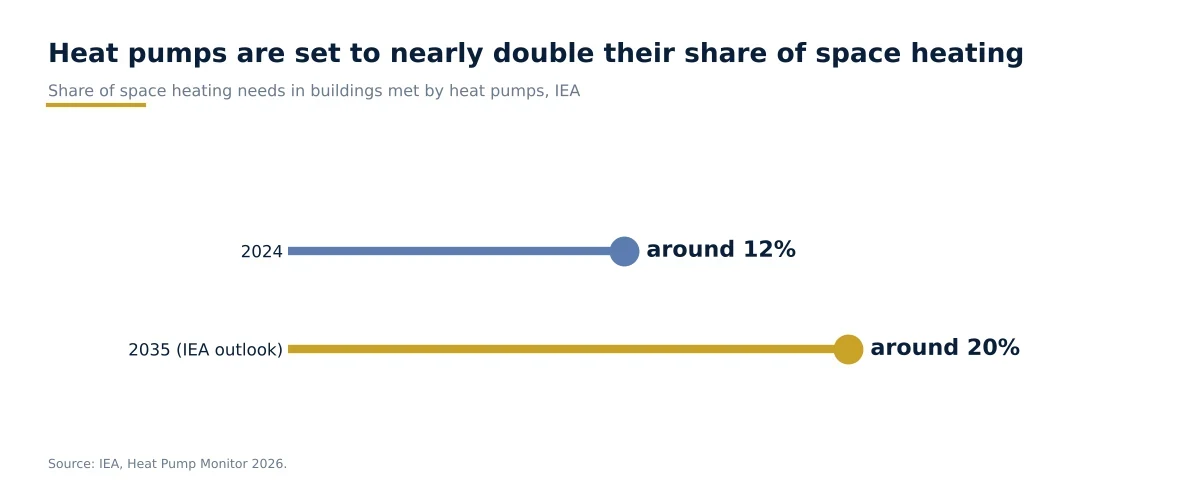
Heat pumps are no longer a niche product. They already supply around 12% of the space heating needs of buildings worldwide, and the International Energy Agency (IEA) expects that to reach around 20% by 2035 under current policies. Yet the last two years have not been smooth. Global sales slipped about 2% in 2025, Europe rebounded, the United States cooled, and Germany rewrote its heating law in the middle of a sales recovery.
This blog explains where the heat pump market stands in late 2026, what is driving demand in each region, and how the market breaks down across residential systems, industrial units and the compressors and coils inside them. Five Meticulous Research reports sit behind the figures.
Key takeaways
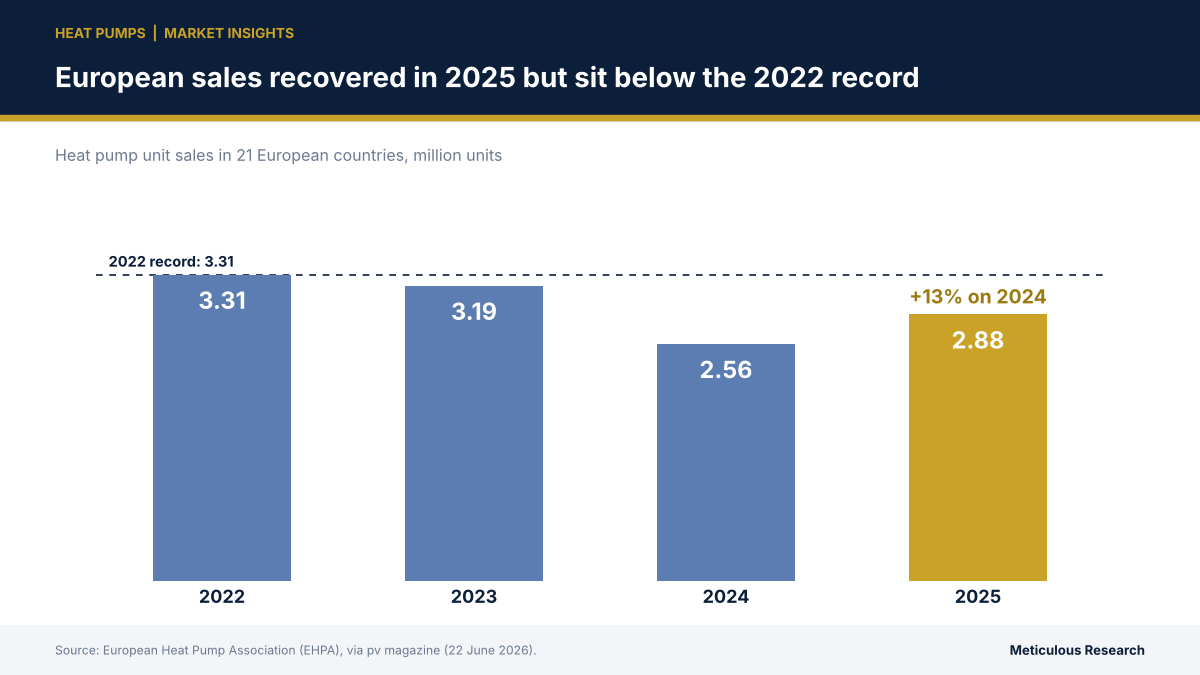
- Global heat pump sales fell about 2% in 2025, according to the IEA, but Europe grew 11% and sales in 21 European countries reached 2.88 million units, up 13%, according to the European Heat Pump Association (EHPA).
- In the United States, air source heat pump shipments are 3.8% higher in the first half of 2026 while gas furnace shipments are 6.2% lower, according to AHRI.
- Industrial heat pumps are the fastest growing slice. The industrial heat pump systems market is valued at USD 1.85 billion in 2026 and is projected to reach USD 6.85 billion by 2036.
- Residential systems remain the largest pool. The ductless heat pumps market is valued at USD 12.6 billion in 2025 and is projected to reach USD 30.3 billion by 2035, at a CAGR of 9.2%.
- Component suppliers benefit from every unit sold. Compressors are forecast to grow at 12.5% a year and coils at 9.2% a year over 2025 to 2035.
Heat Pump Sales by Region: Europe Recovers, the U.S. Wobbles, China Pauses
The global picture hides very different regional stories, and each one tells a supplier where to look.
Europe. EHPA reported that heat pump sales across 21 European countries rose 13% in 2025 to 2.88 million units, after 2.56 million in 2024. That is still below the 3.31 million record of 2022, so the market is recovering, not setting new highs. Of the 18 countries that reported 2025 sales, 14 grew, while France, Poland, Austria and Norway fell. Germany led the rebound. According to Euronews, heat pumps made up 48% of new heating systems there in 2025, about 299,000 units, and sales in the first quarter of 2026 were up 34% on a year earlier.
Policy is moving in two directions. In July 2026 the European Commission published an Electrification Action Plan that, as reported by Refindustry, calls for annual heat pump installations to rise from 2.4 million in 2025 to 4 million by 2030. In May 2026 the German cabinet decided to drop the 65% renewable requirement from the national heating law, allowing gas and oil systems to continue with rising shares of climate neutral fuel. The change is expected to pass through parliament, but the final outcome should be checked before it is quoted as law. The lesson for suppliers is that demand in Germany now has to be won on running cost, not on a mandate.
 United States. The IEA notes that over 20% of U.S. households use a heat pump for space heating and that heat pumps outsold gas boilers for the fourth year in a row in 2025, even though total sales fell, by about 13% according to the IEA. The federal tax credit for heat pumps under Section 25C does not apply to equipment placed in service after 31 December 2025, which removes a consumer incentive that supported the earlier gains. Even so, AHRI data for the first half of 2026 show air source heat pump shipments of 2,156,549 units, up 3.8%, while gas warm air furnace shipments fell 6.2% to 1,552,934. Heat pumps are now shipping roughly 600,000 units ahead of gas furnaces.

China and Japan. China accounts for about 35% of global heat pump manufacturing capacity, according to the IEA, with costs 35% to 50% lower than in other regions. Domestic building deployment dipped slightly in 2025 and stagnated in the first quarter of 2026. In April 2025 six ministries issued an action plan to raise heat pump efficiency by at least 20% and extend use into industry, agriculture and transport. In Japan, sales were mostly stable, and Eco-cute water heaters supply close to 15% of residential water heating.
Taken together, the regions point to a market that is shifting from policy led growth to economics led growth. That favours efficient, lower cost products and makes the supply chain, from compressors to coils, more important.
Ductless and Polyvalent Heat Pumps: Where Buildings Are Buying
Most heat pump volume still goes into buildings, and two product families show how the demand is splitting.
Ductless systems for homes
Ductless units suit homes without ductwork, retrofits and room by room comfort. The Ductless Heat Pumps Market report values the segment at USD 12.6 billion in 2025 and projects USD 30.3 billion by 2035, at a CAGR of 9.2%. Split systems are the largest type, residential is the largest application, and Asia-Pacific is both the largest and the fastest growing region.
Refrigerant change is shaping product launches. In April 2025 Trane Technologies introduced equipment using R-454B, a lower global warming potential refrigerant than R-410A. Suppliers that move early on newer refrigerants will find it easier to meet coming rules, a point that matters equally to buyers and installers.
Polyvalent systems for larger buildings
Polyvalent heat pumps heat and cool at the same time, which suits hotels, offices and hospitals with year round demand. The Polyvalent Heat Pumps Market report values the segment at USD 8.9 billion in 2025 and projects USD 18.3 billion by 2035, at a CAGR of 7.5%. Air to water systems hold roughly 60% to 65% of the market, commercial buildings account for 65% to 70%, and Europe is the largest region with a 35% to 40% share. Water to water units, systems above 30 kW and data center uses are growing faster than the average.
Large buyers are already signing multi year deals. In July 2025 Daikin and Greater Manchester agreed a five year programme covering 64,000 heat pump installations from 2025 to 2030. Contracts of that size show that heat pumps are moving from one house at a time sales to programme level procurement.
Cold climates
Performance in cold weather is the question buyers ask first. A Natural Resources Canada field study of a ductless unit found a coefficient of performance (COP) of about 2.3 at minus 15 degrees Celsius and close to 2.0 at minus 25 degrees, with backup heat needed at the lowest temperatures. That study dates from 2014 and covered one house, so newer products are likely to do better, but it shows why cold climate ratings and backup heat design remain central to sales in northern markets.
Industrial Heat Pumps: The Fastest Growing Opportunity
Factories use a great deal of heat, and much of it is below 160 degrees Celsius, which is within reach of modern heat pumps. The European Commission Electrification Action Plan, as reported by Refindustry, says about 60% of fuel based industrial energy demand could be electrified using heat pumps. That is the size of the prize.
The Industrial Heat Pump Systems Market report values the market at USD 1.85 billion in 2026 and projects USD 6.85 billion by 2036. Waste heat source systems, medium temperature units in the 100 to 160 degree range, closed cycle designs and drying and dehydration uses lead today. Europe is the largest region and Asia-Pacific the fastest growing.
Technology is moving up the temperature scale. On 15 September 2026 Johnson Controls announced the Sabroe HitemHP, built in Denmark, which delivers output up to 122 degrees Celsius and can run down to 18% of capacity. In January 2026 Trane introduced the RTWF HT, a water to water unit reaching up to 105 degrees Celsius at up to 1.5 MW, as reported by Refindustry. In Japan, industrial heat pump capacity reached nearly 650 MW in 2024, according to the IEA.
Three points explain why this segment attracts so much attention. First, heat pumps recover waste heat, so one unit of electricity can deliver several units of heat. Second, food and beverage, chemicals and pharmaceutical plants need steady heat that suits this technology. Third, carbon rules in Europe raise the cost of burning gas, which improves the payback for electric options. The main barrier is the upfront cost and engineering work, which means suppliers with strong application teams and financing options should win share.
Inside the Unit: Compressors and Coils
Every heat pump sold needs a compressor and at least one coil, so these components rise and fall with unit volumes and also with the shift toward higher efficiency designs.
The Rotary Heat Pump Compressor Market report values the segment at USD 1.73 billion in 2025 and projects USD 5.61 billion by 2035, at a CAGR of 12.5%. Asia-Pacific holds over 45% of the market and is also the fastest growing region at 14.2% a year. That fits the IEA data on manufacturing, where China holds about 35% of global heat pump capacity.
The Heat Pump Coil Market report values the segment at USD 4.14 billion in 2025 and projects USD 9.97 billion by 2035, at a CAGR of 9.2%. Evaporator coils hold 40% to 50% of the market, copper and aluminum designs are the leading material, and residential systems account for 50% to 55% of demand. Europe is the largest region and Asia-Pacific the fastest, at 11.1% a year.
The chart below sets the five heat pump markets side by side. The four component and equipment reports are 2025 to 2035 editions, and the industrial report is a 2026 to 2036 edition, so each market is shown from its own base year to its own end year. The scopes also differ, so the values should be compared and not added together.
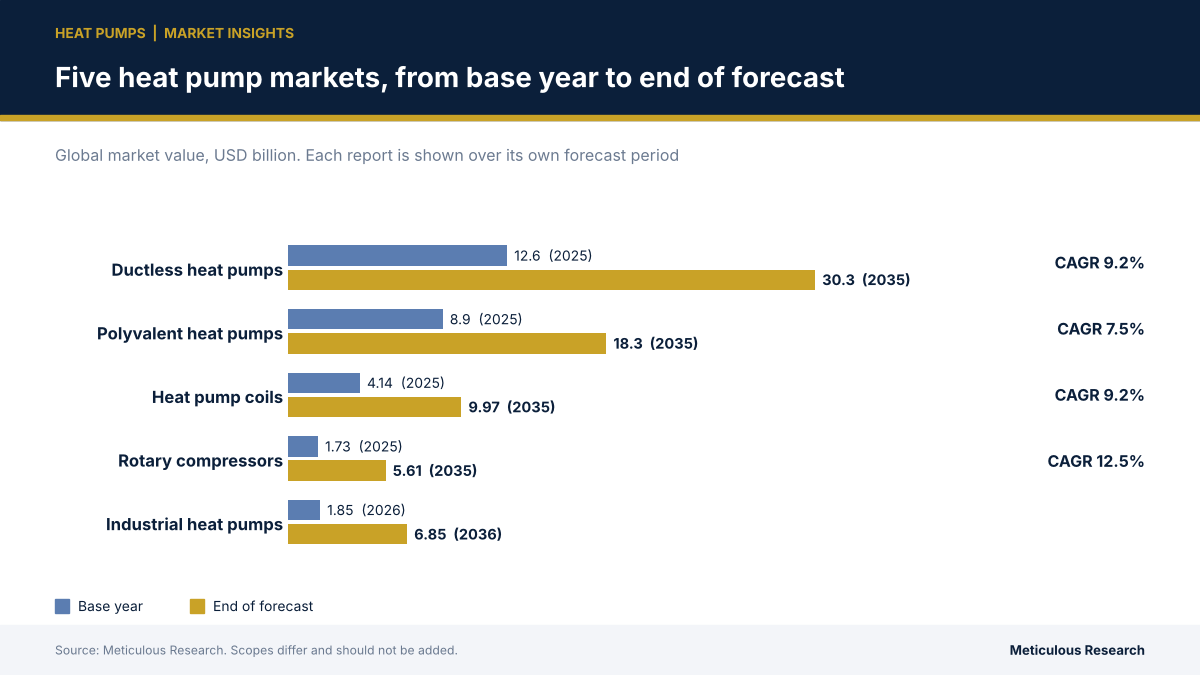
For component makers, the practical message is that growth is concentrated in Asia-Pacific manufacturing while higher temperature and cold climate duty push technical requirements up. Suppliers that can serve both volume and performance tiers hold the best position.
What Manufacturers, Installers and Investors Should Do Next
The evidence from 2025 and 2026 is that heat pump demand follows running cost and incentives closely, so the response needs to be regional.
For equipment manufacturers
- Compete on total cost. With the U.S. federal credit gone and the German mandate removed, price and efficiency decide purchases.
- Build for cold weather and higher temperatures. Cold climate ratings matter in northern homes, and units above 100 degrees Celsius open the industrial market.
- Plan refrigerant transitions early. Lower global warming potential refrigerants such as R-454B are already appearing in launches.
For installers and distributors
- Follow the programme buyers. Municipal and utility contracts, such as the Greater Manchester agreement, offer volume that single home sales cannot.
- Train for retrofits. Ductless and polyvalent systems fit existing buildings, which is where most of the installed base sits.
For component suppliers and investors
The strongest growth is in compressors and in Asia-Pacific manufacturing. Industrial heat pumps are small today but are the fastest growing system segment, so they deserve a place in any portfolio view alongside the larger residential market.
Frequently Asked Questions
How big is the heat pump market? By Meticulous Research estimates, ductless heat pumps are valued at USD 12.6 billion in 2025 and polyvalent heat pumps at USD 8.9 billion. Industrial heat pump systems are valued at USD 1.85 billion in 2026. These are separate scopes and should not be added.
How many heat pumps were sold in Europe in 2025? EHPA reported 2.88 million units across 21 European countries, up 13% on 2024 but below the 3.31 million record of 2022.
Are heat pumps outselling gas furnaces in the United States? According to AHRI, air source heat pump shipments of 2,156,549 units in the first half of 2026 exceeded gas warm air furnace shipments of 1,552,934 units.
What is an industrial heat pump? It is a large heat pump that raises waste heat or ambient heat to the temperatures needed in processes such as drying, evaporation and distillation. Recent products reach 105 to 122 degrees Celsius.
Which region will lead heat pump growth? Asia-Pacific is the largest and fastest growing region for ductless systems and compressors, while Europe leads in industrial and polyvalent systems and in coils.
Explore the Reports
- Ductless Heat Pumps Market (2025-2035)
- Industrial Heat Pump Systems Market (2026-2036)
- Polyvalent Heat Pumps Market (2025-2035)
- Heat Pump Coil Market (2025-2035)
- Rotary Heat Pump Compressor Market (2025-2035)
To see segment forecasts, company profiles and regional detail, request a sample from any report page or contact Meticulous Research.
Sources
- IEA, Heat Pump Monitor 2026
- IEA, Global Energy Review 2026, heat pumps
- pv magazine, European heat pump sales increased 13% last year (22 June 2026), reporting EHPA data; EHPA market data
- Euronews, Germany scraps renewable heating law just as heat pumps gain momentum (14 May 2026)
- AHRI, June 2026 Statistical Release (14 August 2026)
- U.S. Internal Revenue Service, FAQs on the modification of Sections 25C and related credits under Public Law 119-21
- European Commission Electrification Action Plan (17 July 2026), as reported by Refindustry (22 July 2026)
- Johnson Controls, Sabroe HitemHP announcement (15 September 2026); Trane RTWF HT, as reported by Refindustry (January 2026)
- Natural Resources Canada, CanmetENERGY mini split heat pump field study (2014)
- Company announcements from Daikin, Greater Manchester and Trane Technologies, as cited in the Meticulous Research reports
Looking for full market sizing & granular dataset?
Access our comprehensive market forecast report SKU: MREP - 1041585.
Related Market Intelligence Briefings
Recommended reading from the same research domain

METICULOUS INSIGHT
The AI Infrastructure Imperative: How Generative AI and Hyperscaler CapEx Are Reshaping Hyperscale Data Centers
There comes a point in the evolution of any infrastructure sector when the pace of investment stops resembling a cycle and begins to signal...

METICULOUS INSIGHT
Growing Demand For Automated Inspection Processes Supporting Market Growth
Several industries, including manufacturing, logistics, healthcare, and food processing, are harnessing the power of automation to streamlin...

METICULOUS INSIGHT
Government Initiatives to Promote Industrial Automation Expected To Drive Growth Of Pharmaceutical Automation Market
Major economies across the globe are implementing Industry 4.0 technologies, including IoT, artificial intelligence, robotics, cloud, and an...