ReFuelEU Aviation SAF Mandate: 2025 Results, 2030 Targets and What Fuel Suppliers Must Do Next
The first year of the ReFuelEU Aviation SAF mandate is complete, and Europe cleared the bar. According to the European Union Aviation Safety Agency (EASA), fuel suppliers delivered 1.1 million tonnes of sustainable aviation fuel (SAF) at EU airports in 2025. That equals 2.8% of all aviation fuel supplied, against a legal minimum of 2%.
The harder part comes next. The required share triples to 6% in 2030 and reaches 20% in 2035, while the supply of waste based feedstock stays limited and SAF still costs several times more than fossil jet fuel.
This article explains what the regulation requires, how the 2025 numbers should be read, what the 2030 step demands in tonnes and what fuel suppliers must do now to stay compliant. The figures come from the latest Meticulous Research analysis of the Bio-SAF market and the sustainable aviation fuel market.
Key takeaways
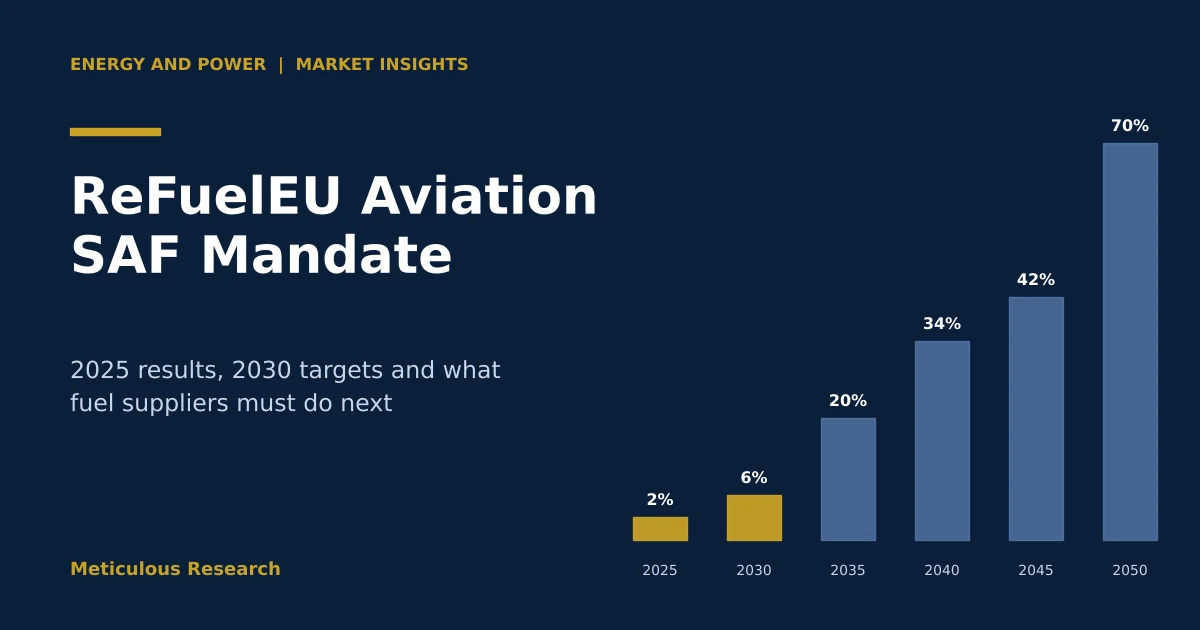
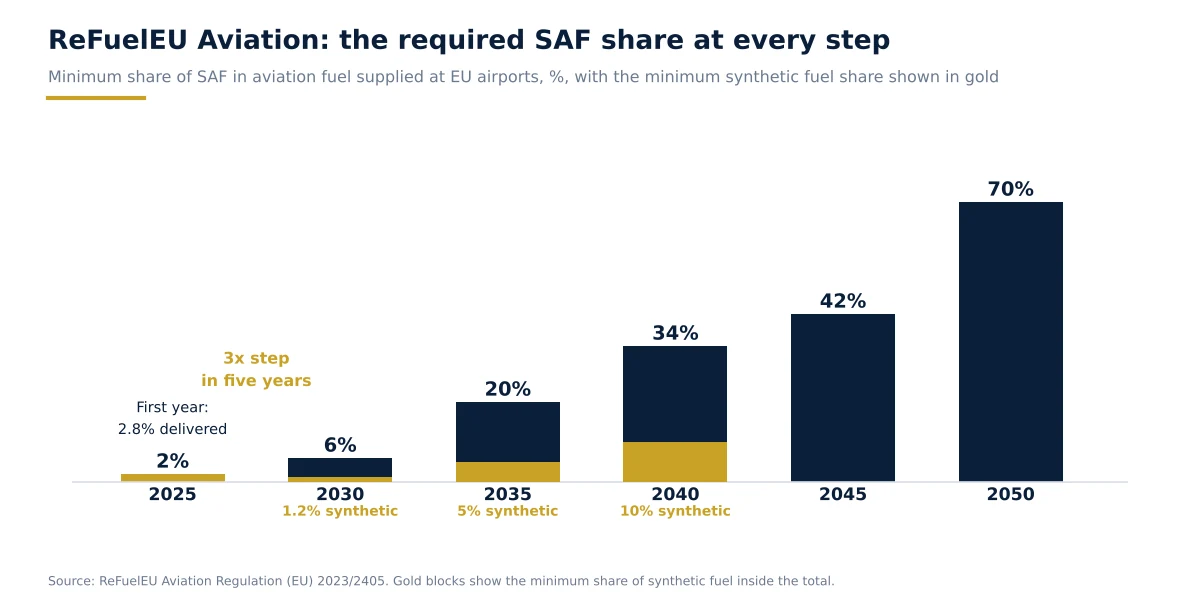
- The ReFuelEU Aviation mandate requires a SAF share of 2% in 2025, 6% in 2030, 20% in 2035, 34% in 2040, 42% in 2045 and 70% in 2050.
- EU airports received 1.1 million tonnes of SAF in 2025, up from 193,000 tonnes in 2024.
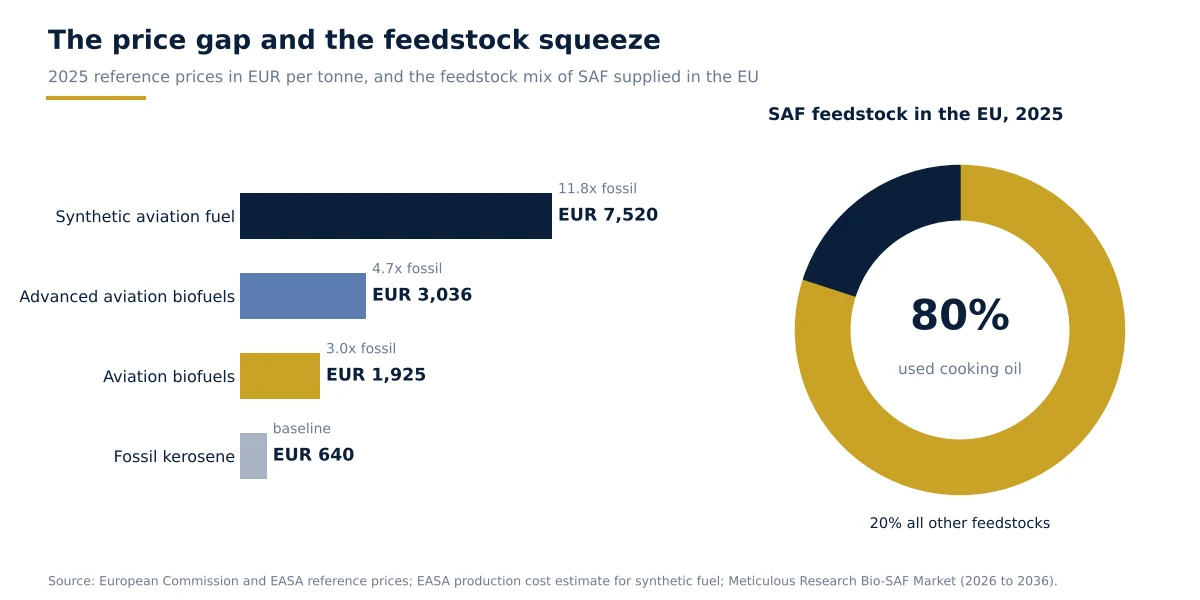
- Used cooking oil made up 80% of the feedstock, so supply depends on a narrow waste stream.
- Non compliance carries a penalty of at least twice the price gap between SAF and conventional jet fuel.
- The Bio-SAF market is valued at USD 4.99 billion in 2026 and is projected to reach USD 42.0 billion by 2036, at a CAGR of 23.7%.
What the ReFuelEU Aviation SAF mandate requires
ReFuelEU Aviation is Regulation (EU) 2023/2405. It places the obligation on fuel suppliers at EU airports, not on airlines. Suppliers must deliver a rising minimum share of SAF in the jet fuel they sell, and the share steps up every five years.
The minimum share is 2% in 2025, 6% in 2030, 20% in 2035, 34% in 2040, 42% in 2045 and 70% in 2050. Thus, the obligation grows more than thirty times over the life of the regulation, and most of the increase falls after 2030.
The regulation also sets a separate floor for synthetic aviation fuel, known as e-SAF, which is made from renewable hydrogen and captured carbon dioxide. The minimum share of synthetic fuel is 1.2% in 2030, 5% in 2035 and 10% in 2040. Thus, suppliers cannot meet the mandate with bio based fuel alone after 2030.
Penalties give the rule its force. A supplier that misses the target faces a fine of at least twice the price difference between SAF and conventional jet fuel on the volume it failed to deliver. Thus, non compliance costs more than buying the fuel, which makes delivery the cheaper choice.
The 2025 results: Europe beat the 2% target
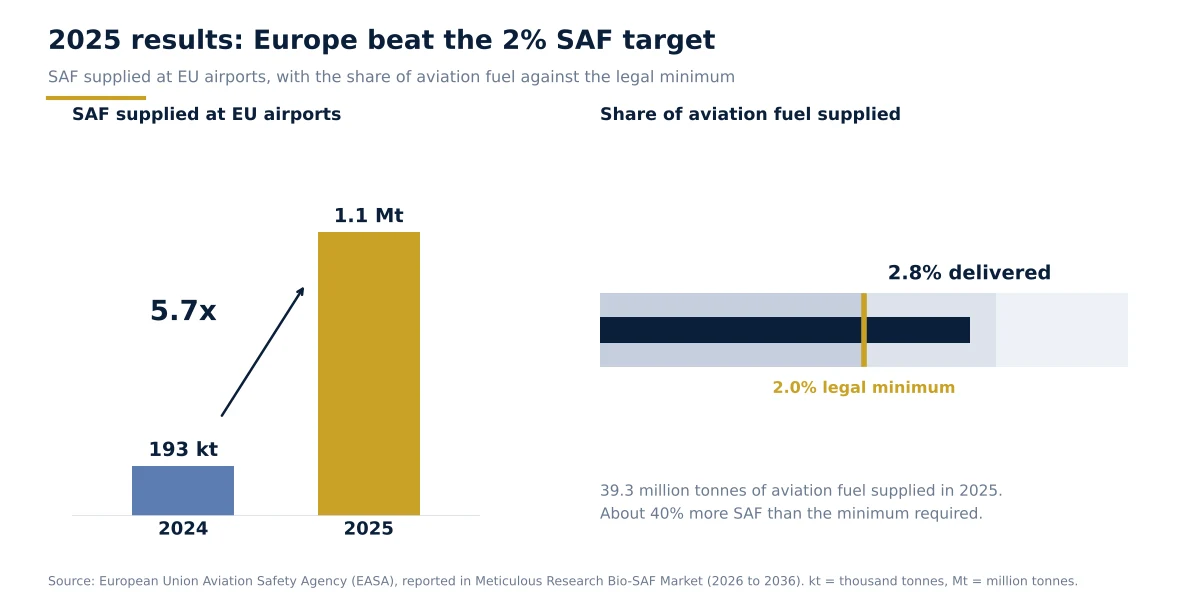
According to EASA, SAF supplied at EU airports rose from 193,000 tonnes in 2024 to 1.1 million tonnes in 2025. Total aviation fuel supplied was 39.3 million tonnes, so SAF reached 2.8% of the total and cleared the 2% minimum in the first year of the mandate.
Thus, the first target was met with room to spare, and early fears that suppliers would struggle to comply have not materialised.
The gap between volume and share needs careful reading. The 2% minimum equals about 0.8 million tonnes on a base of 39.3 million tonnes, so Europe delivered roughly 40% more than the rule required. However, the 2025 target was set low on purpose. Thus, the result shows that the first step was easy, and it says little about how the steeper steps will go.
Global context sharpens the point. According to the International Air Transport Association (IATA), global SAF production reached an estimated 1.9 million tonnes in 2025, up from 1.0 million tonnes in 2024, yet SAF still made up only 0.6% of total jet fuel consumption. Thus, Europe leads the world in SAF use, and the mandate is the main reason.
Supply is also concentrated. Neste sold 867 thousand tonnes of SAF in 2025, more than double its 2024 volume of 412 thousand tonnes and about 46% of global volume. Thus, a small group of producers with converted refineries decides how much SAF reaches European airports.
What the 2030 step demands from suppliers
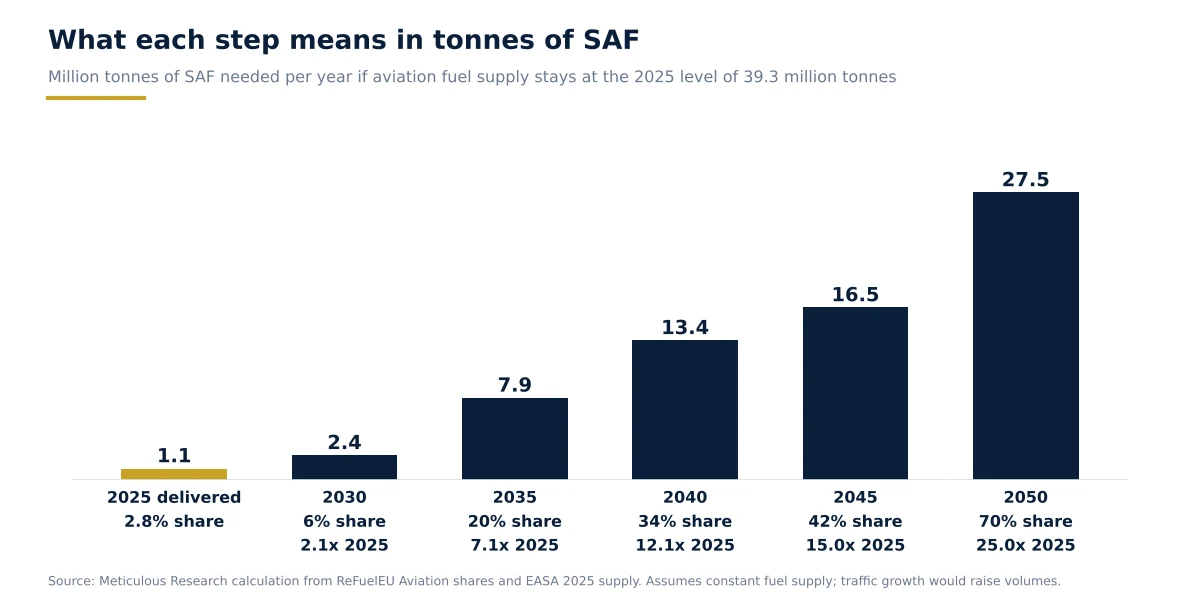
The jump from 2% to 6% is the real test. If total aviation fuel supply stays at the 2025 level of 39.3 million tonnes, a 6% share needs about 2.4 million tonnes of SAF in 2030. That is more than double the 1.1 million tonnes delivered in 2025.
Thus, suppliers must add more than 1.2 million tonnes of new SAF within five years, even before any growth in air traffic is counted.
The 2035 step is steeper still. A 20% share needs about 7.9 million tonnes, roughly seven times the 2025 volume. According to the Meticulous Research Bio-SAF analysis, European demand for biogenic SAF is expected to rise from about 1.3 million tonnes in 2025 to more than 9 million tonnes by 2036. Thus, supply must grow by a factor of seven within a decade to keep pace with the law.
The synthetic fuel floor adds a second problem. A 1.2% share in 2030 equals about 0.5 million tonnes of e-SAF, a fuel that was below 0.1% of volume in 2025. According to the ReFuelEU Aviation Annual Technical Report 2026, around 50 e-SAF projects were awaiting a final investment decision, and only about 0.6 million tonnes of synthetic fuel could be produced by 2030 under the high credibility project scenario. Thus, the 2030 synthetic target leaves almost no margin, and any project delay creates a shortfall.
Feedstock and price: the two limits on supply
Used cooking oil made up 80% of the feedstock used for SAF supplied in the EU in 2025. It is a waste feedstock, so it qualifies for stronger policy support, and it fits the hydroprocessed esters and fatty acids (HEFA) process that most converted refineries already use. However, the global pool of waste oils and fats is limited. Thus, a single feedstock now carries most of the mandate, and its availability sets the pace of the market.
Vegetable oils face caps in the EU because of land use concerns, and animal fats are used mainly in the U.S. Thus, new supply must come from other routes. Alcohol-to-jet fuel moved closer in November 2025, when LanzaJet announced full operation of its Freedom Pines Fuels facility in the U.S., the first commercial scale plant to make jet fuel from ethanol. Agricultural and forestry residues are projected to be the fastest growing feedstock in the Bio-SAF market for the same reason.
Price is the second limit. The European Commission set the 2025 reference price of aviation biofuels at EUR 1,925 per tonne and that of advanced aviation biofuels at EUR 3,036 per tonne, compared with EUR 640 per tonne for fossil kerosene. EASA estimates the production cost of synthetic aviation fuel at EUR 7,520 per tonne. Thus, bio based SAF costs about three times as much as fossil jet fuel, advanced fuel about five times and synthetic fuel more than eleven times.
According to IATA, SAF prices exceed fossil jet fuel by a factor of two, and by up to a factor of five in mandated markets. The cost pressure is already visible, as World Energy ceased operations at its Paramount, California SAF facility in April 2025. Thus, the mandate guarantees demand, but producers still carry real financial risk.
How the U.K. SAF Mandate compares
The U.K. runs its own mandate, separate from ReFuelEU Aviation, and suppliers serving both markets must plan for two rule books. The U.K. SAF Mandate requires 2% in 2025, 10% in 2030, 15% in 2035 and 22% in 2040. Thus, the U.K. starts at the same level as the EU but climbs more slowly after 2030.
The design differs in one important way. The U.K. caps the share of fuel that can come from HEFA at 71% in 2030 and 35% in 2040, and it adds a separate power-to-liquid obligation from 2028. It also introduces tradeable certificates, with extra certificates for fuel that delivers higher emission savings. Thus, the U.K. pushes investment toward non lipid pathways earlier than the EU does.
Support for domestic plants is still being built. On 13 July 2026, the U.K. Government confirmed that the first SAF allocation round under its revenue certainty mechanism will open for applications in Q1 2027, with contracts expected from Q4 2028, according to law firm Orrick. Thus, producers weighing new U.K. capacity must wait for the first contracts before revenue is secured.
What fuel suppliers must do next
The 2025 result shows that compliance is achievable, and the 2030 step shows that it will not stay easy. The Meticulous Research analysis points to five actions that separate prepared suppliers from exposed ones.
- Secure feedstock early. With used cooking oil at 80% of supply, access to waste lipids decides who can deliver. Long term supply agreements with collectors and processors protect volume and cost.
- Plan for more than one pathway. Alcohol-to-jet, co-processing and gasification based routes widen the feedstock base and reduce dependence on HEFA, which the U.K. already caps.
- Build a route to e-SAF. The synthetic floor starts in 2030, and projects need a final investment decision well before then. Partnerships with e-SAF developers, or offtake agreements for their output, reduce the risk of a shortfall.
- Lock in offtake with airlines. Long term agreements give producers the revenue certainty needed to finance new capacity, and they give suppliers a defined route to pass on compliance costs.
- Track certification and reporting. Both the EU and the U.K. require proof of emission savings and sustainability, so clean documentation protects every delivered tonne.
Thus, the suppliers best placed for 2030 are those that treat the first years as preparation, and not as proof that the mandate is easy. For established producers, the main risk is not a lack of demand but rising feedstock costs and policy changes outside Europe.
What to watch next
- Official 2025 compliance reports. EU and U.K. reports are expected by the end of 2026 and will confirm which suppliers met their share.
- U.K. revenue certainty mechanism. The first allocation round opens in Q1 2027, with contracts from Q4 2028.
- e-SAF investment decisions. The number of projects reaching financial close will show whether the 2030 synthetic floor is realistic.
- Feedstock prices. Used cooking oil costs will shape production margins and the cost of compliance.
- Policy outside Europe. Singapore applies a SAF levy from April 2026, Japan targets 10% SAF use by 2030, and India and South Korea plan targets from 2027.
Frequently asked questions
What is the ReFuelEU Aviation SAF mandate? ReFuelEU Aviation is an EU regulation that requires fuel suppliers at EU airports to deliver a minimum share of sustainable aviation fuel, rising from 2% in 2025 to 70% in 2050.
What are the ReFuelEU Aviation SAF targets? The minimum SAF share is 2% in 2025, 6% in 2030, 20% in 2035, 34% in 2040, 42% in 2045 and 70% in 2050. Synthetic fuel must account for at least 1.2% in 2030, 5% in 2035 and 10% in 2040.
Did Europe meet the 2025 SAF target? Yes. According to EASA, 1.1 million tonnes of SAF were supplied at EU airports in 2025, equal to 2.8% of aviation fuel and above the 2% minimum.
What happens if a supplier misses the target? The penalty is at least twice the price difference between SAF and conventional jet fuel on the volume not delivered.
How much more expensive is SAF than jet fuel? The 2025 reference price of aviation biofuels was EUR 1,925 per tonne against EUR 640 per tonne for fossil kerosene, so SAF costs about three times as much. Advanced and synthetic fuels cost more.
How big is the SAF market? The Bio-SAF market is valued at USD 4.99 billion in 2026 and is projected to reach USD 42.0 billion by 2036, at a CAGR of 23.7%. The wider sustainable aviation fuel market, including e-SAF, is valued at USD 5.01 billion in 2026 and is projected to reach USD 52.8 billion by 2036, at a CAGR of 26.5%.
Explore the full research
Meticulous Research covers each of these markets with segment level forecasts, country analysis and company profiles.
- Bio-SAF Market (2026 to 2036): production pathway, feedstock and application for biogenic SAF.
- Sustainable Aviation Fuel Market (2026 to 2036): feedstock type, production technology, blend ratio, application and end user, including e-SAF.
To see how these markets could shape your plans, download a free sample or talk to an analyst about a custom study.
Sources referenced: European Union Aviation Safety Agency (EASA); International Air Transport Association (IATA); European Commission reference prices for aviation fuels; ReFuelEU Aviation Regulation (EU) 2023/2405; ReFuelEU Aviation Annual Technical Report 2026; U.K. SAF Mandate; Orrick, Sustainable Aviation Fuel briefing (August 2026).
Looking for full market sizing & granular dataset?
Access our comprehensive market forecast report SKU: MREP - 1042319.
Related Market Intelligence Briefings
Recommended reading from the same research domain
METICULOUS INSIGHT
Sustainable Fuels for Aviation and Shipping: How SAF, Bio-Methanol and Waste-to-Hydrogen Compare
Aircraft and large ships cannot run on batteries over long distances. A long haul flight or an ocean crossing needs a dense liquid fuel, and...