What Are Prefabricated Power Pods, and Why Are Data Centers Adopting Them?
A prefabricated power pod is a factory-built power unit, a generator or battery with switchgear, cooling and controls in one enclosure, that is tested before shipment and arrives ready to connect. Conventional power infrastructure takes about 18 to 24 months to build, while pods are commissioned in hours to days after delivery. According to the Meticulous Research report, Modular Power Pods Market, the market is valued at USD 8.94 billion in 2026 and is projected to reach USD 34.72 billion by 2036, at a CAGR of 14.5%.
Data centers and colocation are the largest application, at about 28% to 32% of 2026 revenue. The Hyperscale Data Centers Market report values the facilities behind that demand at USD 301.6 billion in 2026, rising to USD 1,801.8 billion by 2036 at a CAGR of 19.6%.
What is inside a prefabricated power pod?
A power pod is a self-contained power generation or energy storage system built into a standard containerised or skid-mounted enclosure. It holds a generator or battery, switchgear, monitoring electronics, cooling, safety systems and connectivity, and it is assembled, tested and commissioned as a single unit at the factory. The site work is reduced to placing the unit, connecting fuel or grid cables and switching it on.
Diesel and hydrotreated vegetable oil (HVO) generator pods hold the largest share of the market, at about 42% to 46% of 2026 revenue, and they can run for 8 to 72 hours on their own fuel. Battery energy storage pods are the fastest growing, at about 20% to 22% a year. Natural gas, hydrogen fuel cell and solar hybrid pods complete the range. Diesel remains the volume leader, and batteries are taking the growth.
Pods are sold by power rating. The 100 to 500 kVA range is the largest at about 34% to 38% of the market, while the 500 kVA to 2 MVA range is the fastest growing at about 17% to 19% a year. Data center operators buy at the upper end of that range and beyond. Schneider Electric launched prefabricated power modules of 2 MW, 2.25 MW and 2.5 MW on 16 September 2026, each combining a UPS, switchgear, cooling, batteries and busway in a factory-tested enclosure. Vertiv OneCore, launched in August 2025, starts at 5 MW per module. Modules of this size are several times larger than the 100 to 500 kVA pods that lead the market, and the same factory method applies at both scales.
Why are data centers adopting them?
Electricity demand from data centers rose 17% in 2025 while global electricity demand rose 3%, and the International Energy Agency (IEA) expects data center consumption to double by 2030, with AI-focused facilities roughly tripling. Supply has not kept pace. The IEA points to slow grid connections and tight supplies of gas turbines and transformers as the main bottlenecks, and it notes that developers are turning to on-site gas generation and on-site battery storage. A data center that waits for the grid waits for a queue, and a pod is a way to start earlier.
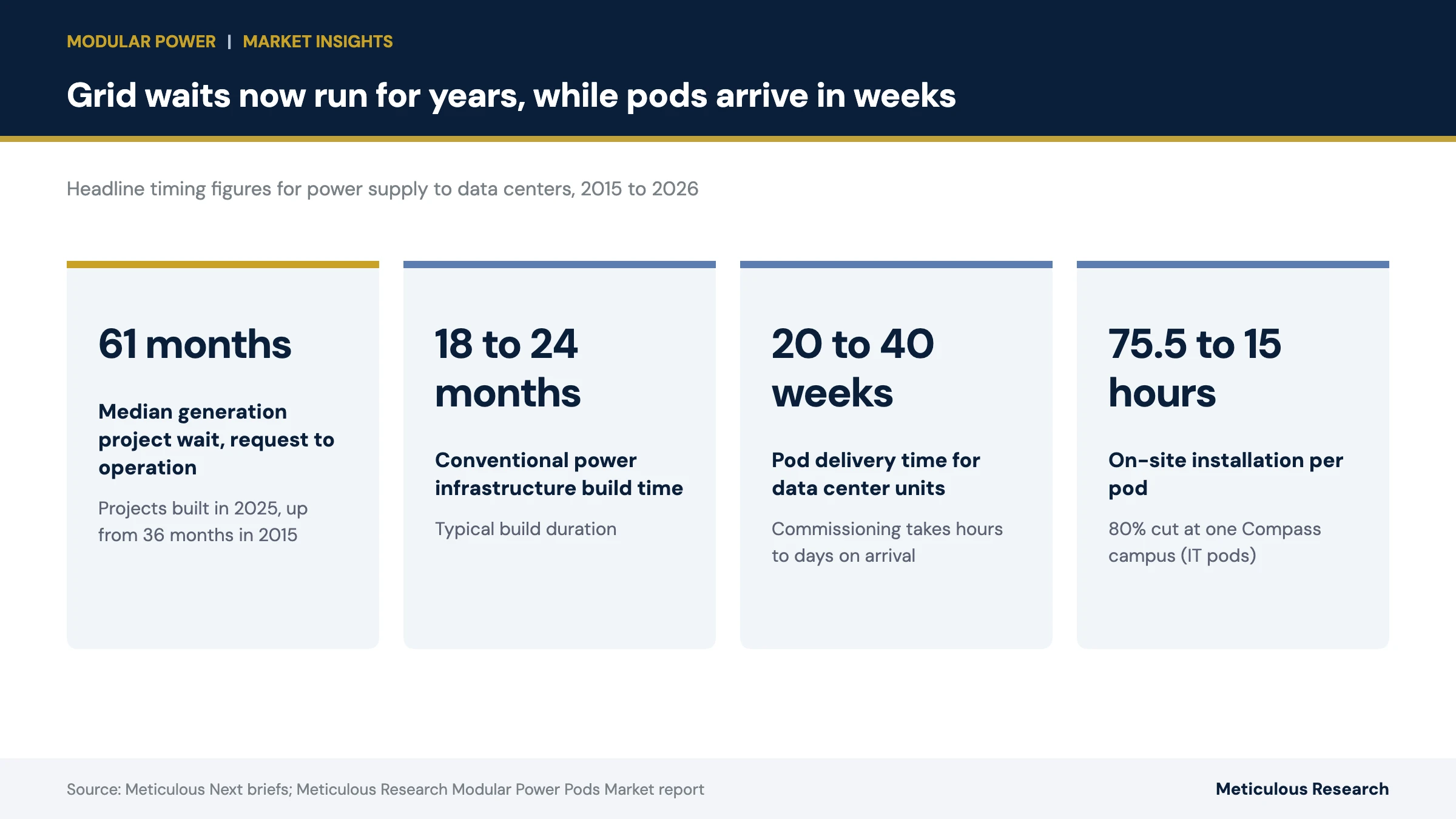
The queue is long. In the Meticulous Next brief Grid Interconnection Queues and the Future of Capacity Addition, generation projects built in 2025 took a median of 61 months from request to commercial operation, against 36 months in 2015. The brief On-Site Power for AI Data Centers and the Future of Behind-the-Meter Generation reports that GE Vernova was booking gas turbine delivery slots for 2031 in the second quarter of 2026. Against those waits, the Modular Power Pods Market report puts pod delivery at 20 to 40 weeks for data center units, with commissioning in hours to days on arrival.
A study by Compass Datacenters and Schneider Electric found that prefabricated pods cut on-site installation from 75.5 hours to 15 hours per pod, a reduction of 80% at one Compass campus. That study covered prefabricated IT pods rather than power pods, and it shows the same logic: work moved into the factory is work that does not have to be done in the field.
Because each unit is tested at the factory, a 2.5 MW module can be repeated across a campus and added in blocks as load grows, so a 100 MW site can be built up in stages instead of in one long programme. Schneider Electric said its modules are available in Europe now and will reach North America later in 2026.
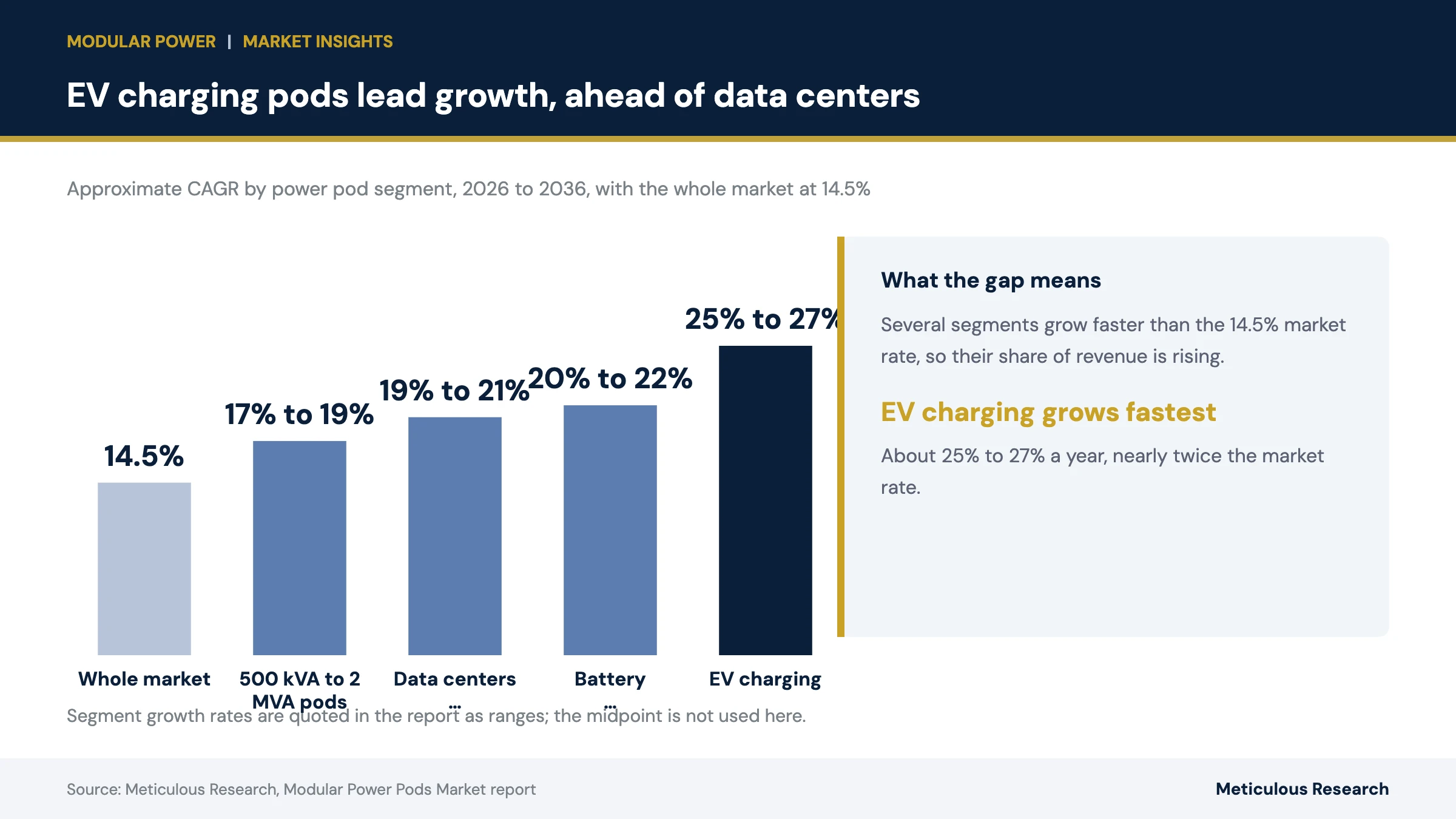
The market numbers match the pattern. Data centers and colocation are the fastest-growing core application for pods, at about 19% to 21% a year against 14.5% for the whole market. North America is the largest region at about 36% to 40% of 2026 revenue, and Asia-Pacific is the fastest growing at about 17% to 19% a year. The three largest cloud providers hold about 58% of global hyperscale capacity, so a few purchasing decisions set the pace of demand.
How big is the power pod market, and where is it growing fastest?
The Modular Power Pods Market report sizes the market at USD 7.16 billion in 2025 and USD 8.94 billion in 2026, and projects USD 34.72 billion by 2036 at a CAGR of 14.5% from 2026 to 2036. The growth of this market is mainly driven by electrification of remote and off-grid industrial operations such as mining, oil and gas and construction, AI-driven data center growth, EV charging deployment, and demand for modular power in military expeditionary operations.
EV charging is the fastest-emerging application at about 25% to 27% a year, and data centers and colocation are the largest end-user industry at about 26% to 30% of demand, with oil and gas second. Battery energy storage pods, the 500 kVA to 2 MVA range and Asia-Pacific all grow faster than the market as a whole. Aggreko plc, Caterpillar Inc. and Cummins Inc. are the profiled players.
The demand behind data center pods is described in the Hyperscale Data Centers Market report. Facilities of 20 MW to 50 MW are the largest capacity segment and facilities of 150 MW and above are the fastest growing, cloud providers are the largest end users and colocation providers are the fastest growing, and Asia-Pacific is the fastest-growing region. Eaton, ABB, Schneider Electric and Vertiv are among the 21 profiled players. Larger campuses need larger blocks of power, and that favours factory-built modules of 2 MW and above.
Related Meticulous Next briefs
- Modular Data Center Construction and the Speed-to-Power Race sizes the market at USD 10 to 15 billion in 2026 and USD 32.78 to 49.18 billion by 2034, a CAGR of 16%. It covers the prefabricated power modules from Schneider Electric and Vertiv and the 2.5 MW module launched on 16 September 2026.
- On-Site Power for AI Data Centers and the Future of Behind-the-Meter Generation sizes the market at USD 14 to 20 billion in 2026 and USD 39.94 to 57.05 billion by 2034, a CAGR of 14%. Nearly 100 GW of United States behind-the-meter gas power for data centers was in the development pipeline at the start of 2026, up from 4 GW at the start of 2024.
- Grid Interconnection Queues and the Future of Capacity Addition sizes the market at USD 1.2 to 1.8 billion in 2026 and USD 2.77 to 4.15 billion by 2034, a CAGR of 11%. Active queues held 2,061 GW across 8,244 requests at the end of 2025.
For the full segmentation, company profiles and regional forecasts, see the Modular Power Pods Market report.
Frequently Asked Questions
What is a prefabricated power pod?
A factory-built, self-contained power unit, a generator or battery with switchgear, cooling and controls in a containerised or skid-mounted enclosure, tested as one unit and delivered ready to connect.
How fast can a power pod be installed?
Pods are commissioned in hours to days after delivery, against about 18 to 24 months for conventional power infrastructure. Delivery of data center units takes 20 to 40 weeks.
Why do data centers use prefabricated power?
Grid connections and equipment supply are slow, and a factory-built unit can be ordered, delivered and commissioned in a fraction of the time. Data centers and colocation are the largest and fastest-growing core application for pods.
What sizes do power pods come in?
The market leads in the 100 to 500 kVA range. Data center modules are larger, such as the 2 MW, 2.25 MW and 2.5 MW modules from Schneider Electric and the 5 MW and larger OneCore modules from Vertiv.
How big is the power pod market?
The Meticulous Research Modular Power Pods Market report values the market at USD 8.94 billion in 2026 and projects USD 34.72 billion by 2036 at a CAGR of 14.5%.
Sources
- IEA, Data centre electricity use surged in 2025
- Meticulous Research: Modular Power Pods Market, Hyperscale Data Centers Market
- Meticulous Next: Modular Data Center Construction and the Speed-to-Power Race, On-Site Power for AI Data Centers and the Future of Behind-the-Meter Generation, Grid Interconnection Queues and the Future of Capacity Addition
Looking for full market sizing & granular datasets?
Access our comprehensive market forecast reports:
Related Market Intelligence Briefings
Recommended reading from the same research domain
METICULOUS INSIGHT
Battery Pack Market by Segment and Region: Where the Opportunity Sits
Every electric vehicle, grid battery and data center backup system ships with a battery pack, and the pack is where cells, electronics, cool...
METICULOUS INSIGHT
Transformer Components Market Outlook: Growth Drivers, Segments and Key Players
A transformer is only as dependable as the parts inside it, and those parts are now where the supply chain is tightest. Winding conductors,...
METICULOUS INSIGHT
CO2 Utilization and the Future of Chemicals and Fuels: Foresight, Key Signals and Strategic Implications
Carbon dioxide is turning from a waste stream into a raw material, and the next twelve years will decide which routes reach scale. Meticulou...